
Private AI Workflow Automation for Regulated Firms

Oct 13, 202614 min read
Sensitive data remains behind the corporate perimeter when business logic and model inference are orchestrated within a self-hosted environment. This is the essence of private AI workflow automation.
By deploying the entire stack on managed local infrastructure, organizations eliminate the egress of proprietary information to third-party providers.
Keep private AI data behind firewalls
The difference between public and private AI layers
Every prompt and document fragment is transmitted over the open internet to a vendor’s server when using public AI, which relies on external API calls to models like GPT-6 Astra.
In contrast, a private setup utilizes local resources such as Activepieces to coordinate tasks between internal databases and a self-hosted instance of Mistral Large 4.
The Private AI Perimeter shows this structural isolation. A Corporate Firewall contains the User, the orchestrator, and the local model, while the public internet remains entirely disconnected from the data flow.
This boundary ensures that even if a model requires high-reasoning capabilities, the computation occurs on hardware the company owns and audits.
Why data residency is the primary driver for private automation
Regulated industries prioritize data residency because legal frameworks often prohibit the processing of personally identifiable information outside specific geographic or organizational boundaries.
Using a cloud-based agent for high-volume classification via Claude Haiku 5.5 introduces a compliance risk if the vendor’s processing region shifts or lacks an adequate data processing agreement.
Nobody notices for three days, but financial records are processed without passing through public load balancers. Health information remains in encrypted local volumes during model inference. Intellectual property in codebases is analyzed by local instances of Codestral without training external models.
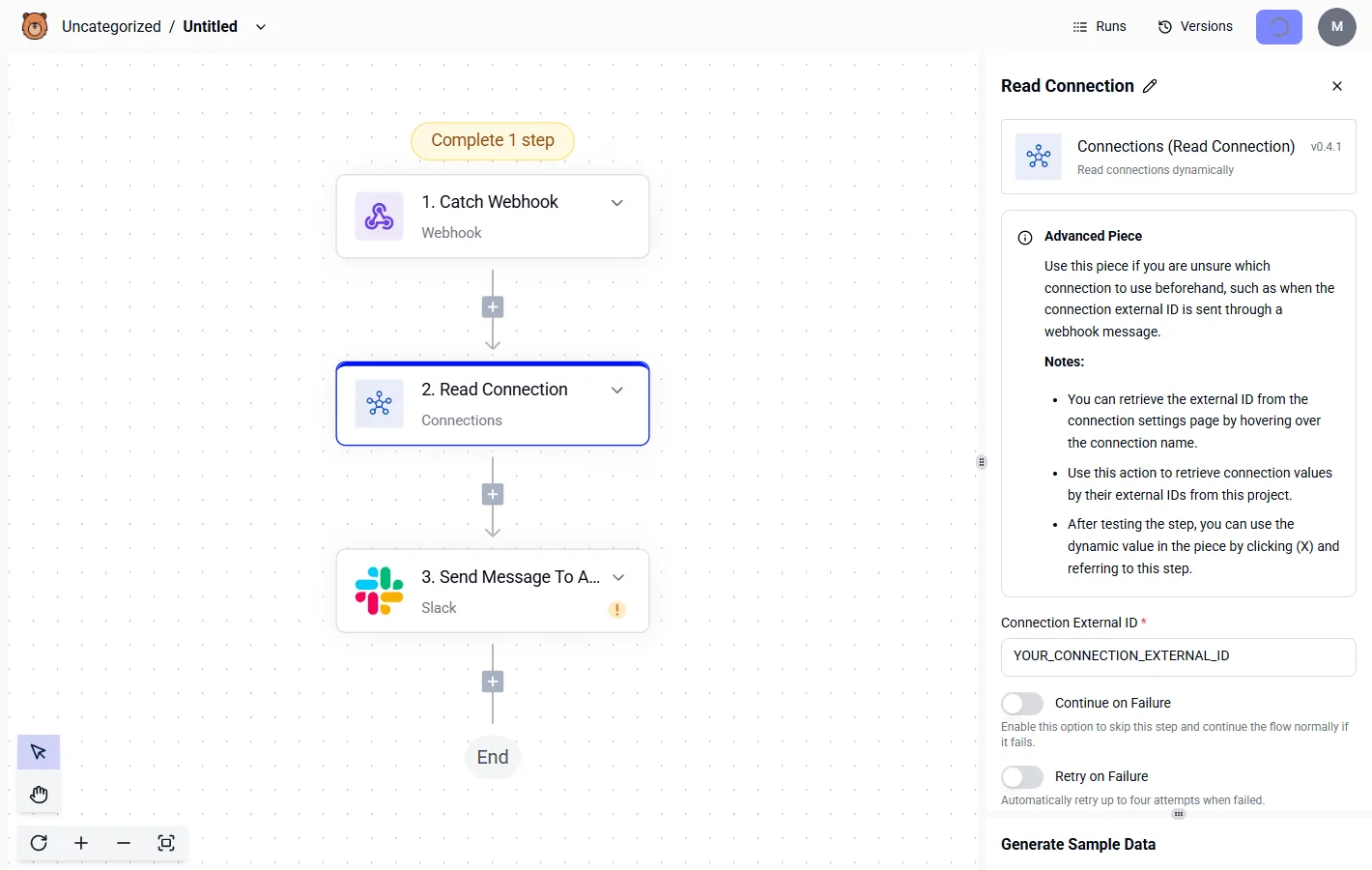
This architectural sovereignty moves the focus from chasing the largest possible model scale to ensuring the intelligence used is physically tethered to the data it serves.
This takes minutes, not a project: automate it in Activepieces free.
How private AI architectures function locally
By replacing public API endpoints with a three-tier stack hosted entirely within the user’s firewall, private AI automation functions without external exposure. This structural shift ensures that every prompt and retrieved record remains on local hardware.
What an inference server does in AI workflows
An inference server acts as the bridge between raw model weights and the orchestration layer by providing a local API endpoint. While the orchestrator manages the logic, the inference server manages the GPU resources and executes the actual mathematical operations of the LLM.

Tools like Ollama provide a streamlined interface for running models on macOS or Linux, while vLLM offers high-throughput serving for enterprise-grade production environments. LocalAI serves as a drop-in replacement for OpenAI-style APIs, allowing the orchestrator to communicate with local models using familiar protocols.
Self-hosted LLMs: The engine of private intelligence
Local models are the reasoning core, executing logic on internal servers rather than sending data to external endpoints. By deploying weights like Mistral Large 4 or Llama 3.1 on private infrastructure, organizations retain full control over the model's lifecycle and data residency.
Within the same security perimeter, this setup is the only way to ensure that sensitive inputs never leave the local network. The inference process occurs within the same security perimeter as the data it processes.
The orchestration layer: Connecting models to internal data
Acting as the nervous system, the orchestration layer translates business logic into specific calls for the local model to execute.
This tier manages the flow of information between the LLM and the environment, ensuring that a model only receives the specific context required for a task. The following table illustrates how these tiers interact to maintain operational integrity.
| Tier | Component | Function |
|---|---|---|
| Tier 1 | Local Model (Llama 3.1/Mistral) | Handles inference and reasoning within the private network. |
| Tier 2 | Orchestration Engine | Manages workflow logic, triggers, and data routing. |
| Tier 3 | Secure Connector Layer | Interfaces with local databases and legacy software via internal protocols. |
This modularity allows teams to swap models without rebuilding the entire automation logic.
Secure integration: Reaching local databases and legacy apps
The connector layer bridges the gap between the AI’s reasoning and the static data stored in proprietary systems. For organizations using PostgreSQL (an open-source relational database) or SAP (an enterprise resource planning suite), these connectors must operate over local networks or encrypted tunnels.
You will not find these credentials on the public internet because the architecture keeps these integrations behind the firewall.
VRAM and hardware requirements for local AI
Video Random Access Memory (VRAM) capacity, rather than raw CPU clock speed, defines the hardware profile for local AI execution.

While cloud providers charge hourly premiums for access to the NVIDIA H100 (a high-end data center GPU), on-premise infrastructure requires an upfront capital expenditure that eliminates recurring data egress fees.
GPU memory: The bottleneck for high-performance automation
VRAM determines the maximum complexity of the model an automated workflow can trigger without crashing the host system.
According to data from GigaGPU, a base Llama 3.1 8B requires 5.4 GB of VRAM.
A standard consumer GPU with 8 GB of memory can handle simple routing tasks but lacks the headroom for long-context processing, forcing developers to truncate inputs or risk frequent out-of-memory errors, which means applications will inevitably suffer from reduced accuracy and incomplete data analysis.
Higher-density models demand enterprise-grade hardware. For example, Llama 3.3 70B requires 45.7 GB of VRAM, which forces organizations to utilize dual-GPU setups or specialized cards like the NVIDIA A100 to avoid out-of-memory errors during large-scale data extraction.
The following chart illustrates the VRAM requirements for 7B-8B models, showing the jump from minimum boot requirements to the maximum memory needed for full-context reasoning.
| Model | VRAM Requirement |
|---|---|
| Mistral 7B v0.3 | 4.9 GB |
| Qwen 2.5 7B | 5.1 GB |
| Llama 3.1 8B | 5.4 GB |
| Gemma 2 9B | 6.1 GB |
Mistral 7B v0.3 at 4.9 GB enables higher concurrency on the same hardware compared to Gemma 2 9B. The latter consumes 6.1 GB and reduces the available buffer for parallel API requests, so the system will likely encounter bottlenecks during peak traffic periods.
Quantization tradeoffs for AI model accuracy
Quantization reduces the precision of model weights to shrink the memory footprint, allowing larger models to run on cheaper hardware. By compressing a model from 16-bit to 4-bit precision, an engineer can fit a high-reasoning model into a smaller VRAM envelope.
This trade-off is the primary lever for controlling infrastructure costs: it determines whether a firm can use existing workstations or must invest in dedicated server racks to maintain the fidelity required for regulated reporting.
Sizing GPU memory for local LLM workloads
VRAM capacity dictates the complexity of the workflows a private environment can support. Local execution requires the entire model weights to reside in active GPU memory to avoid debilitating processing delays.
VRAM capacity dictates the complexity of the workflows a private environment can support.
Why 8B models are the sweet spot for automation
Small-parameter models, such as Ministral 3 8B, provide the most efficient balance for high-volume routing because they fit within the memory limits of standard professional workstations. This allows a firm to repurpose existing office hardware for classification tasks.
When an automation requires high-speed extraction, these models offer lower latency than larger architectures. Because these models occupy a smaller memory footprint, an organization can run multiple concurrent instances on a single card.
Scaling to large language models with multi-GPU clusters
Scaling to frontier-class open weights, like Mistral Large 4, necessitates a transition to multi-GPU clusters. The model size exceeds the addressable memory of a single consumer or mid-range professional card.
Dedicated rack-mount servers provide the thermal overhead for continuous inference. NVLink (a high-bandwidth bridge) allows GPUs to share memory pools for larger context windows. ECC memory modules reduce the risk of bit-flips during long-running agentic coding sessions.

You can follow the rest of this with the builder open. Start free, no card.
Governance needs for regulated AI automation environments
Governance in private AI automation requires strict technical boundaries to ensure that decentralized model execution does not bypass corporate oversight.
Moving high-reasoning models like GPT-6 Astra or Claude Fable 5.1 into local infrastructure creates a visibility gap unless the automation layer enforces the same rigorous controls as the underlying database.
Audit logging for AI compliance and regulation
Comprehensive audit logging captures the full execution history of every automated step to provide a forensic trail for regulatory bodies.
When a workflow routes a sensitive document through Mistral Large 4 for summarization, the log must record the exact prompt sent and the raw JSON response received.
This ensures that if a model hallucinations, the compliance team can pinpoint the specific version of the flow responsible.
Role-Based Access Control (RBAC) in automated workflows
Granular permissions restrict who can modify the logic of an AI agent to prevent unauthorized changes to data routing.
In a regulated environment, a developer might have permission to trigger a workflow using Gemini 3.8 Flash for data extraction but lack the authority to change the destination of that data to an external endpoint.
SSO and SCIM: Managing identity in air-gapped systems
Integrating with SAML or OIDC protocols ensures that AI access is tied to the central corporate directory for immediate revocation of privileges. Using SCIM (System for Cross-domain Identity Management) allows the automation platform to mirror the user’s status in the primary identity provider.

SSO (SAML/OIDC) handles identity. RBAC manages workflow editing permissions. Audit Logging tracks every execution step. Secret Management protects internal API keys.
These controls demonstrate that the system is under active management rather than running as a black box. This structural integrity makes it possible to deploy frontier models within the most sensitive network segments.
Self-hosting private workflows with Activepieces Enterprise
Activepieces supports central credential management and integration with secret managers, ensuring that sensitive access is governed according to enterprise security standards. This infrastructure shift ensures that agentic workflows using Claude Fable 5.1 or Gemini 3.8 Flash never leak execution metadata to third-party cloud orchestrators.
How to run containers for automation
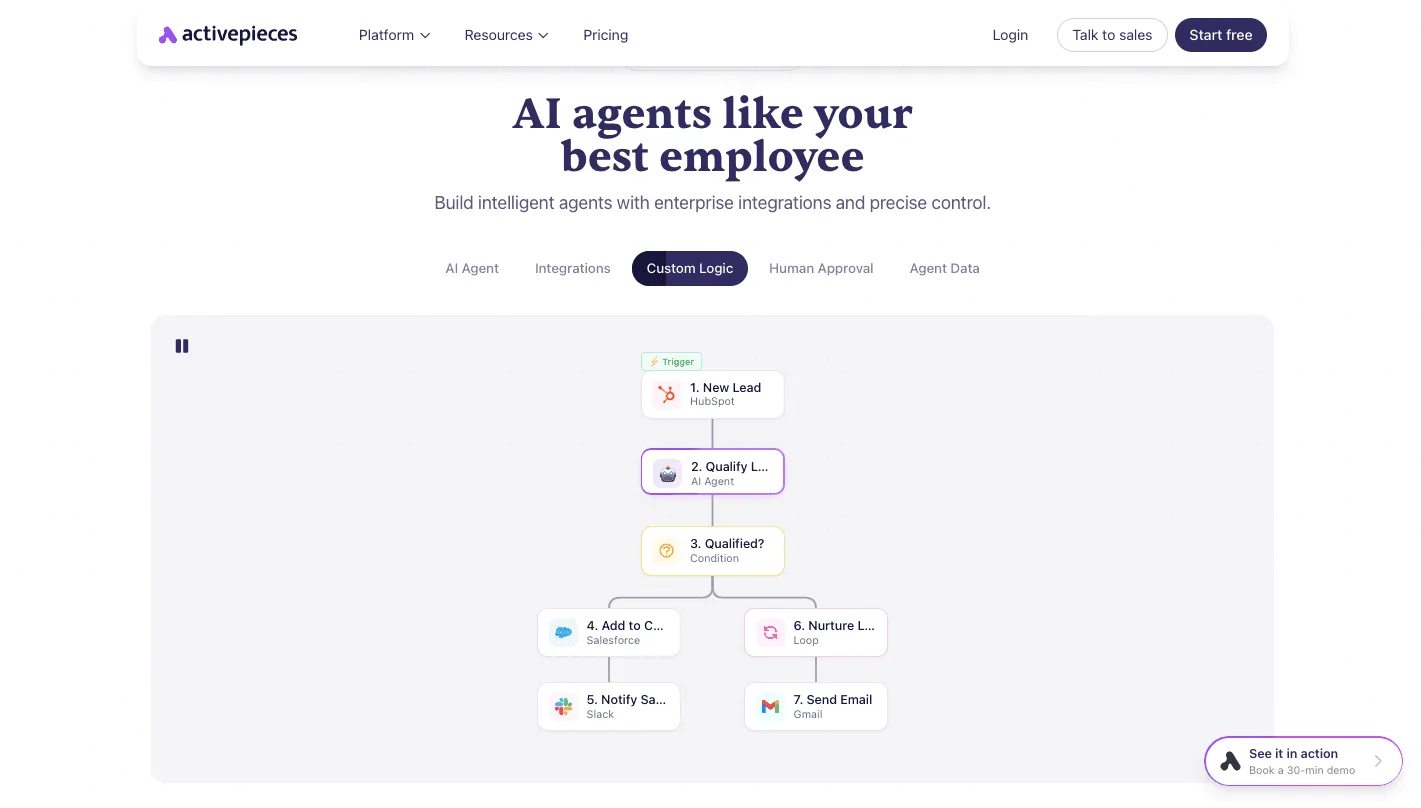
Activepieces provides an MIT-licensed core that runs on standard container infrastructure to ensure data sovereignty while reaching 739+ integrations. The platform is distributed via Docker and Kubernetes, allowing engineers to map local volumes for persistent storage and connect to internal databases without opening inbound ports.
Because the Community edition supports unlimited execution runs, teams can scale high-volume tasks like document routing with Claude Haiku 5.5 without incurring the per-step tax typical of SaaS providers.
Air-gapped installations for high-security sectors
Air-gapped means full control, not a fraction, and Activepieces does not restrict its governance suite for buyers who require the most isolation.
The same SSO, SCIM, custom RBAC, and secret manager integrations found in the managed cloud are available in the air-gapped build, a parity that allows MoneyGram and FundingSocieties to run production automation in highly regulated environments.
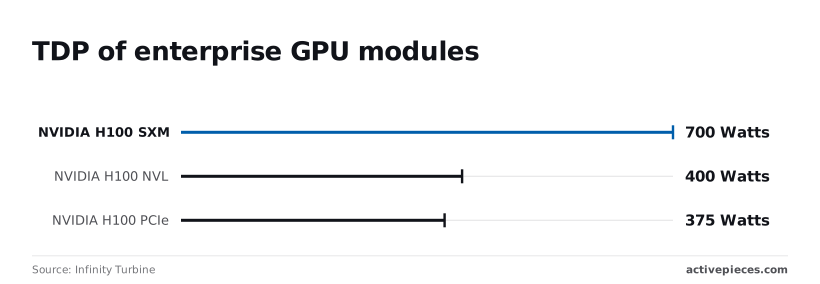
When the NVIDIA H100 SXM draws 700 Watts, a single high-density rack requires specialized liquid cooling to prevent thermal throttling.
The NVIDIA H100 NVL pulls 400 Watts, so dual-card configurations for large models like Mistral Large 4 demand robust power delivery at the server level. The NVIDIA H100 PCIe consumes 375 Watts, allowing for traditional air-cooled integration in standard enterprise workstations.
Enterprise governance features
While the core engine is open, the Activepieces Sales team provides the proprietary layers required for institutional compliance.
SSO and SCIM integration provides centralized identity management. Role-Based Access Control (RBAC) restricts model access by department. Comprehensive audit logs allow forensic tracking of every internal API call. Dedicated support assists with complex, air-gapped environment migrations.
The implementation roadmap for a private automation pilot
Choosing a small AI model for pilot testing
A pilot begins by matching a local model’s parameter count to the available VRAM on your dedicated hardware. For text-heavy workflows like document summarization, Mistral Small 4 is a balanced architecture for reasoning and instruction following.
Selecting an open-weight model allows for local execution, which ensures that no prompt data ever leaves the physical premises of the organization.
Network isolation for private AI deployments
True data sovereignty requires a network configuration where the automation orchestrator and the model inference engine communicate over a local loopback or a restricted virtual switch.
- Provision hardware with sufficient GPU memory to host the model weights entirely.
- Deploy the automation engine via a container orchestrator like Kubernetes to manage resource scaling.
- Pull model weights using a local serving tool to ensure the binary is verified before execution.
- Configure the internal firewall to block all outbound traffic to the public internet.
This sequence guarantees that the environment is air-gapped before any sensitive credentials are loaded.
Phase 3: Connecting the first internal data source
The final step is mapping a local database or file share to the automation engine. This allows the model to perform Retrieval-Augmented Generation (RAG) without external API calls.
By using a local instance of a vector database, the organization maintains a private index of its intellectual property. Once this link is established, the team can verify that the model respects the existing access controls of the source system.
Frequently asked questions about private AI automation
Is private AI slower than using OpenAI or Anthropic?
Latency in private AI depends entirely on the proximity of your compute resources to your data, rather than the public internet congestion affecting third-party APIs.
While flagship cloud models like GPT-6 Astra or Claude Opus 5.5 benefit from massive distributed clusters, a local deployment of Mistral Large 4 on dedicated hardware eliminates the round-trip time to external servers.
Can private AI workflows run without any internet connection?
Local automation platforms allow workflows to execute in total isolation by routing all model calls to internal inference servers.
When you host a reasoning model like Gemini 3.5 Flash-Lite within a secure perimeter, the system never attempts to reach an external gateway to validate a token or fetch a weight.
How do you update models in a self-hosted environment?
Updating models in a managed infrastructure involves swapping the container image or weight files on your internal registry.
Because these environments do not auto-update from the vendor, a team can verify the performance of a new release like Grok 4.7 against a staging dataset before deployment.
Common failure modes in private AI automation projects
Operationalizing private AI fails when teams treat local infrastructure as a static resource rather than a dynamic, high-maintenance utility.
The VRAM trap: Why consumer hardware often fails at scale
Scaling local inference requires strict memory management because running out of Video Random Access Memory (VRAM) causes immediate process crashes rather than simple queuing.
VRAM OOM (Out of Memory) errors from concurrent runs halt all active automation pipelines until the service restarts. Vector DB index fragmentation degrades retrieval accuracy and increases latency as the knowledge base grows.
These bottlenecks force a transition to dedicated, managed GPU clusters for models like GPT-6 Astra.
Orchestration leaks: When the automation tool becomes the risk
The orchestration layer frequently introduces the very vulnerabilities that private infrastructure was intended to prevent. If the tool managing the workflow does not support rigorous network isolation, it may inadvertently broadcast sensitive operational data through unmonitored channels.
Unencrypted orchestration logs store plain-text records of every variable and secret passed between the model and internal databases. Securing this layer is the final step in achieving true data sovereignty.
Related reading
References
Build it
Set this up in minutes.
No code required. Connect your accounts, and Activepieces runs it from there.
Start free Talk to sales