
ClickFunnels Pricing 2026: Every Plan Compared

Oct 22, 202614 min read
$97 a month is what ClickFunnels' entry plan, Launch, costs.
Calculate your realistic ClickFunnels pricing
That figure is where your bill starts, not where it usually ends, so judge each tier by its limits before its price, much as you would when comparing a funnel builder against an automation tool like Activepieces.
What ClickFunnels is and how it bills
ClickFunnels is a hosted builder for funnels, the chain of pages that moves a visitor from an ad to a purchase. You rent it by subscription, so you pay every month for as long as your pages are live.

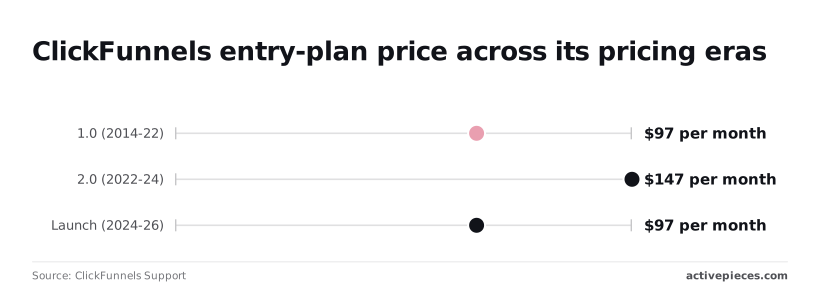
Follow the entry price and it moves in a circle. Version 1.0 (2014-22) started at $97 a month. Version 2.0 (2022-24) raised it to $147, which cost a new customer $600 more per year for the same starting position.
According to Support, the current Launch plan (2024-26) is back at $97. Those years matter because old reviews and forum posts quote the $147 figure, and a budget built on them is $50 a month off.
Criteria for comparing ClickFunnels pricing and plans
Each plan, ClickFunnels or otherwise, gets measured the same way:
- Entry price, which tells you the cheapest way in, not the cost of staying.
- Contact limits, meaning how many people you can store before you're pushed up a tier.
- Funnel and domain limits, meaning how many funnels and custom web addresses are included.
- Payment handling, meaning what it takes to collect money and whether fees come on top of the subscription.
- Cost at realistic usage, which is the monthly total once your list, funnels and add-ons look like they will in twelve months.

If you are running this arithmetic for your own team, see what the same workload costs on Activepieces.
Compare all ClickFunnels plans and pricing
Four plans are on offer:
- Launch
- Scale
- Optimize
- Dominate
In the table below, you get every price and limit the company publishes for them, with the gaps marked as unpublished.
Plan table with the October 2026 check date
On 2026-10-22 these figures were checked against the ClickFunnels pricing page and the ClickFunnels Support pricing article. Read the "Not published" cells as questions to put to sales before you commit.
| Plan | Monthly price | Annual price | Contacts | Emails/month | Workspaces | Courses | Funnels | Domains | Seats |
|---|---|---|---|---|---|---|---|---|---|
| Launch | $97/mo | $81/mo | 10K | 50K | 1 | 3 | Unlimited | 5 | 2 |
| Scale | $197/mo | $164/mo | 75K | 300K | 5 | 6 | Unlimited | Unlimited | 5 |
| Optimize | $297/mo | $248/mo | 150K | 750K | 10 | 10 | Unlimited | Unlimited | 10 |
| Dominate | Annual only | $5,997/yr | 400K | 1.2M | 20 | 20 | Unlimited | Unlimited | 20 |
The pricing page lists a monthly and annual price for Scale, and gives contact, email, workspace, course and seat caps for every tier.
The Scale prices are derived: Support's comparison gives $2,364 for twelve months monthly and $1,970 annually, the totals quoted in the usage section below, and dividing by twelve gives the figures above. Dominate is sold annually only, at $5,997 a year, so treat it as a sales conversation.
That lets you see where Launch ends and Scale begins from public sources alone. Before step 4 of the checklist, ask sales for the contact, funnel and domain caps of each tier in writing.
If you need a second business or client, you are on a higher tier, because Launch gives you one workspace, a separate sub-account with its own settings.
On Launch, funnel count isn't your constraint, so the limits that decide your plan are the published contact, email and team-member caps.
Monthly versus annual billing
Hold either published plan and annual billing is the cheaper way to do it. Per ClickFunnels Support, Launch drops from $97 to $81 a month, which ClickFunnels puts at $194 saved per year, close to two free months.

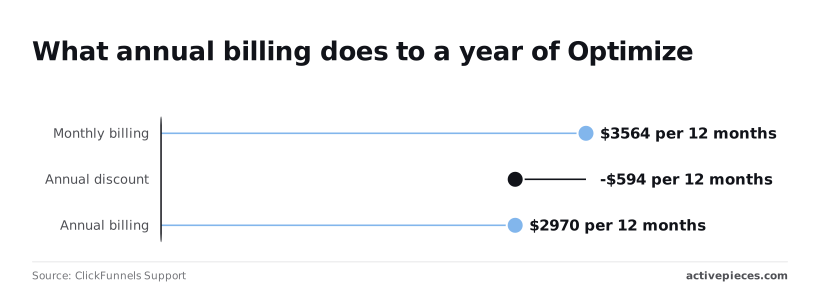
On Optimize the gap is larger. Paying monthly costs $3,564 over twelve months, while annual billing costs $2,970, according to ClickFunnels Support.
That's $594 back in your pocket, but only if you stay the full year. If you're unsure you will, the monthly premium is what you pay for the option to leave.
What each ClickFunnels plan costs at realistic usage
Run the same twelve months through three common businesses and they land on Launch, Scale and Optimize in turn. The contact or funnel limit decides when each one has to move up.
ClickFunnels Support's analysis puts annual as cheaper on all three, by $194 on Launch, $394 on Scale and $594 on Optimize.
For one person selling one offer, Launch fits, and on annual billing it costs $970 for the year. It stays the right plan only while your list and funnel count stay inside its caps.
If a good launch pushes your contacts past the limit, you move to Scale at $1,970 annually, which is $1,000 more than you budgeted.
Growing store or course business
With several products and a steadily growing customer list, a business usually sits on Scale, at $1,970 on annual billing or $2,364 month to month.
Because every buyer, lead and abandoned cart counts, the list grows faster than revenue feels like it does. If you outgrow Scale mid-year, the next step is Optimize at $2,970 annually, another $1,000.
Best ClickFunnels plan for agencies and multi-brand operators
When you run several brands or client accounts, you need more funnels and more domains, and those are the limits that decide your plan, not your contact count. Optimize at $2,970 on annual billing is the realistic starting point.
Hidden ClickFunnels costs and limits buyers hit
Outside the plan price sit the costs that catch buyers.
Each one has a place you can check before you buy:
- Contact cap overage that forces an upgrade, listed on ClickFunnels' pricing page under each plan's limits
- Extra domains beyond what your plan includes, listed on the same page
- Card fees on every sale, published on Stripe's and PayPal's own pricing pages
- Email and SMS volume, set by ClickFunnels' plan terms and its messaging charges
- Third-party tools for anything the platform doesn't do natively, priced by each vendor
ClickFunnels contact and funnel limits
When your list grows past the plan's contact limit, you don't get a polite warning and a grace period you can count on. You move up a tier, and the next tier's price becomes your real price.
When your list grows past the plan's contact limit, you don't get a polite warning and a grace period you can count on.
Funnel and domain limits work the same way, and run several client brands and you hit them sooner than a solo seller. Count the contacts you expect in twelve months, not today.
To collect money you connect a processor, because ClickFunnels doesn't process payments itself, and the processor takes its cut.
Stripe's standard US card rate is 2.9% plus $0.30 per transaction, which means a low-priced offer loses a bigger share to the flat part of the fee. PayPal sets its own rates, so check its page for your country and payment type.
ClickFunnels email, SMS and integration costs
Once you send to a large list, it costs money, and texting usually costs more than email. If you plan to message customers often, price that volume before you pick a tier.
Then add the tools around the funnel: a CRM (the system that holds your customer records), a calendar, an analytics service. Each carries its own monthly bill.
If ClickFunnels' native integrations don't reach one of them, budget for a connector or a person's time to move the data.
Activepieces can move ClickFunnels leads and orders into a CRM, email tool or spreadsheet, and it meters by the run: its pricing page lists 1 credit per flow run, where Zapier bills per task and Make per module.
The free plan includes 1,000 credits a month with unlimited flows.
Worth checking against a plan that does not meter every step: one credit covers a whole run on Activepieces.
ClickFunnels versus its closest alternatives on price
The moment you hit a cap on contacts, pages or domains, the cheapest sticker can stop being the cheapest, because each of the four alternatives prices the same limits differently.
Side-by-side comparison table
The table gives rough entry prices alongside which of the five tools publishes a flat figure for each limit and which ones bundle email.
The dollar amounts are ballparks I did not verify on the check date above, because vendors revise them often, so confirm the live pricing page before you commit.
| Tool | Entry price | Contacts | Funnels/pages | Custom domains | Email included | Free tier |
|---|---|---|---|---|---|---|
| ClickFunnels | $97/mo | Capped by plan | Capped by plan | Capped by plan | Yes | No, trial only |
| Kartra | About $100/mo | Capped by plan | Capped by plan | Capped by plan | Yes | No, trial only |
| Systeme.io | Free, paid from roughly $20/mo | Capped by plan | Capped by plan | Capped by plan | Yes | Yes |
| GoHighLevel | About $100/mo | Unpublished as a flat limit | Unpublished as a flat limit | Unpublished as a flat limit | Yes, billed by usage | No, trial only |
| Leadpages | About $40-50/mo | Unpublished as a flat limit | Capped by plan | Capped by plan | No, connects to an email tool | No, trial only |
Where ClickFunnels alternatives cost less or fall short
For a free plan among these five, Systeme.io is the only choice, so you can test a funnel before paying anything. The cost of that is a smaller toolset than a funnel-first builder.
Pay less at the Leadpages entry price and you lose a tool you'll probably need, since it doesn't include email marketing. You then pay for a separate email service on top.
On GoHighLevel a quiet month is cheap, and a big send isn't, because it bills email by usage rather than folding it into the plan.
Kartra bundles email and funnels like ClickFunnels does, so the gap between them comes down to which plan limits you hit first.
Which ClickFunnels plan should you buy
ClickFunnels pricing verdict and when it applies
Pick the cheapest ClickFunnels tier whose contact, funnel and domain limits still fit twelve months from now. Look elsewhere only if you need unlimited contacts or a lower entry price.
One condition applies: your business is built around sales funnels, meaning a chain of pages that moves a visitor from first click to purchase.
If you mostly need a general website, an email tool, or automations that don't start with a funnel, you're paying for a specialty you won't use, and a tool built for that job will likely cost less.
Work through these in order.
- Export your current list and tally every funnel you run or have planned.
- Take your honest growth rate, apply it to both counts, and write down where you land. Plan for the number you'd be glad to hit, not the one you fear.
- Build one real funnel during the free trial, using your actual pages and domain. A trial you only browse tells you nothing about limits.
- Compare your projected contacts, funnels and domains against what each tier allows. Any tier you'd exceed within the year is out.
- Add the extras you'll need, such as payment features or additional capacity, to each remaining tier's monthly cost.
- Choose the lowest total that clears every limit, and set a calendar reminder to recheck it in six months.
What Activepieces does about this
Activepieces can't change a ClickFunnels contact cap, and it isn't a funnel builder, so it won't get you out of the tier math above.
What it can shrink is the add-on line: the connector, the per-task bill, or the hours spent moving data between ClickFunnels and the CRM, email tool or spreadsheet around it.
The pricing is the part to check against your own volume. Activepieces' pricing page lists 1 credit per flow run, and the free plan includes 1,000 credits a month with unlimited flows.
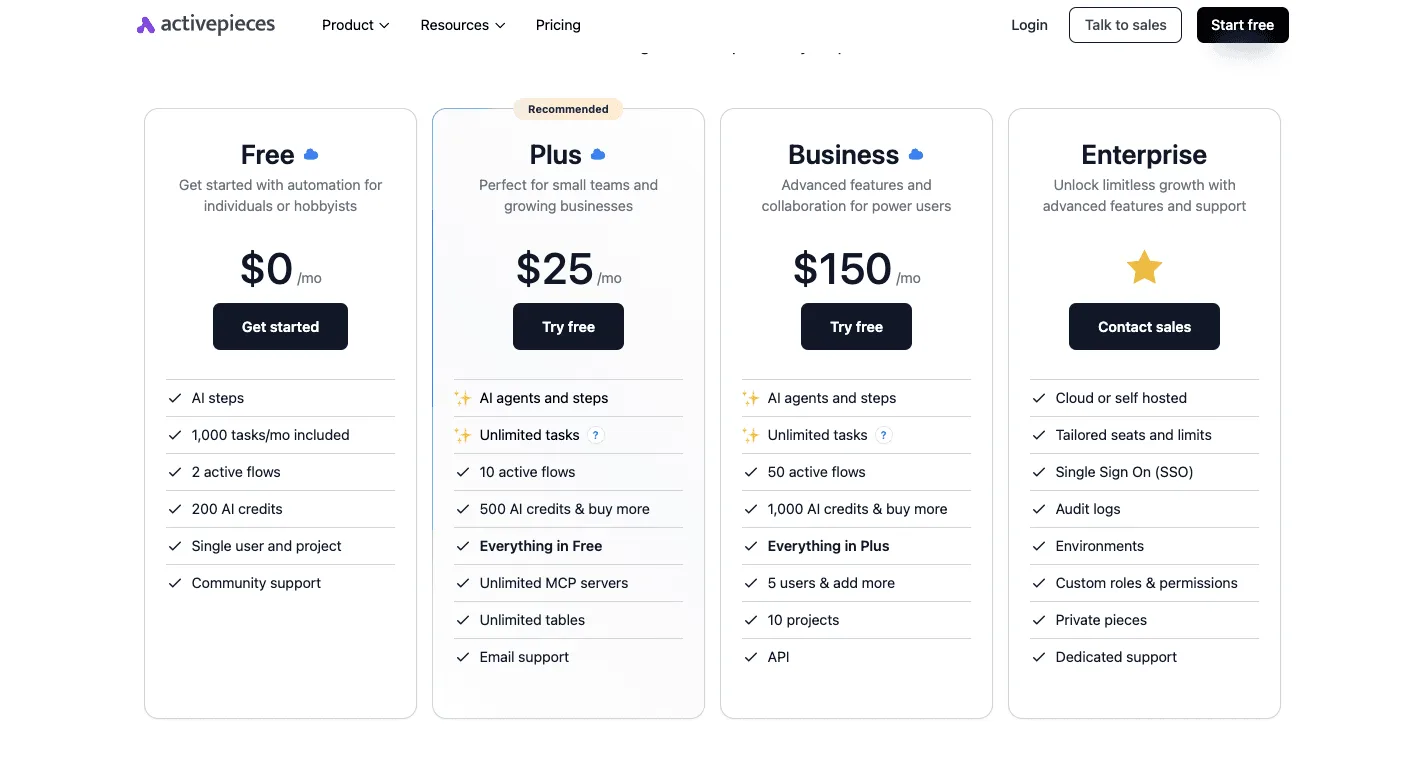
A flow that tags a buyer, writes the CRM row and logs the order is one run however many steps it has, so a busy launch month doesn't multiply your automation bill by the number of steps.
That makes the cost easy to forecast, which is what the twelve-month projection needs.
You can also use a flow as a check on the projection.
Have each new lead or order append a row to a sheet, and you get a running count to set against the contact and funnel limits you wrote down in step 2 of the checklist.
You'll see a cap coming weeks before the upgrade prompt does.
The core of Activepieces is open source under the MIT licence, so if per-run metering still doesn't suit you, you can self-host it and pay for your own server instead. The trade is that you then maintain it.
Everything else here stays the same: pick the cheapest ClickFunnels tier that survives the year, and keep the glue between your tools cheap and predictable.
For someone running a ClickFunnels setup who needs the glue between funnel, CRM, email tool and spreadsheet to stay cheap and forecastable, Activepieces is the better choice on billing model: its pricing page meters one credit per flow run however many steps the flow contains, whereas Zapier bills per task and Make per module, so a longer workflow costs more on those platforms and the same on Activepieces.
That doesn't touch ClickFunnels' own contact and funnel caps, and a short, single-step automation may price similarly everywhere, but for multi-step flows during a busy launch month, metering the run rather than the steps makes the add-on bill easier to project.
Frequently asked questions
Does ClickFunnels have a free plan or free trial?
There is no permanent free tier. ClickFunnels has offered a free trial of its paid plans, and trial length and whether it asks for a card up front have changed over time, so read the terms on the pricing page before you sign up.
Use the trial to build your real funnel with your real domain and contact list, not to click around.
Can I change or cancel my ClickFunnels plan at any time?
You can manage your plan from your account's billing settings, and the practical catch is on the way down.
A lower tier has lower limits, so if your funnels, contacts or domains already exceed them, you'll have to trim before the downgrade works. Check your usage against the smaller plan first.
Cancelling mid-term is a separate question: look up how refunds and the end of the billing period are handled before you commit, especially on an annual plan.
Are ClickFunnels transaction fees charged on top of the subscription?
Treat the subscription and payment processing as two separate bills. When a customer buys through your funnel, the payment processor, such as Stripe or PayPal, takes its own fee on each sale.
That cost exists whichever ClickFunnels tier you choose, so build it into your margins and don't count it as part of the plan price.
Confirm on the current plan page whether the platform itself adds any charge.
Is the annual ClickFunnels plan worth it?
Paying annually costs less than paying monthly, but only if you're certain the tier will hold for the full year. If you're still guessing at your contact or funnel counts, start monthly.
Move to annual once a few months of real numbers show the tier fits. Otherwise you may be locked into a plan you've outgrown, or paying for one you've stopped using.
Related reading
References
Running the numbers
See what the same workload costs here.
Free forever plan, and every paid plan self-hosts at no extra cost.
See pricing Talk to sales