Competitor Price Monitoring Automation: A 2026 Guide

Nov 14, 202612 min read
A three-part system defines competitor price monitoring automation. It consists of a data source, a logic engine to compare prices, and a destination to update your own store or alert your team.
Competitor price monitoring automation is the practice of using integrated software workflows to systematically track, analyze, and respond to rival pricing changes without manual intervention.
This structure replaces the manual "refresh-and-type" cycle with a resilient flow where a headless browser constantly audits rival URLs.
By routing this raw data through a logic-gated automation platform, businesses ensure that price changes only trigger updates when they meet specific margin-protection rules. The following architecture illustrates how data transforms from a raw web signal into a strategic business action.

The diagram shows a linear flow: a Data Source feeds into a Logic Engine, which outputs to Destinations. This visualization demonstrates that automation is a relay where the logic engine acts as the central validator before the system modifies any live store data. Following this validation, the system executes the final update to the sales channel.
Automating competitor price monitoring in three steps
The three functional layers of competitor price monitoring
For the procurement team's supervisory setup, connecting three distinct functional layers is the only way to build this flow. This setup moves the procurement team from data entry into a supervisory role where they only intervene when the logic engine flags a pricing anomaly that falls outside of pre-set safety bounds.

- The Data Source: is a web scraping tool or headless browser that monitors specific product pages.
- The Logic Engine: is Activepieces, which receives the price data and applies conditional filters to ensure only valid market signals proceed. This step is critical because raw scraping often captures "out of stock" notices or temporary shipping surcharges as the base price.
- The Destination: is the final API call that pushes the validated price to a commerce platform like Shopify or a communication tool like Slack.
Linking these layers allows the system to operate as a continuous loop. This setup defends your market position without requiring a team member to manually audit a spreadsheet.
The fastest way to settle a shortlist is to try one. Activepieces is free to try, no credit card.
Choosing a reliable price data source for 2026
Reliable price monitoring depends on a data source that can bypass sophisticated anti-bot shields while delivering structured product information into your automation flow.
A ten-step validation process for a single SKU costs the same to run as the two-step workaround it replaced.
Activepieces bills 1 credit per flow run regardless of the number of steps, which removes the cost penalty for adding extra logic gates or data cleaning modules.
A ten-step validation process for a single SKU costs the same to run as the two-step workaround it replaced.
The published pricing page shows 1 credit per flow run for any number of steps, a direct contrast to the per-task billing found on Zapier or the per-module billing on Make.
Using residential proxies to avoid anti-bot blocking
To mimic human behavior and avoid the IP-based blacklisting that triggers on data center traffic, automated pricing flows require residential proxies.
| Provider | Entry Price | Success Rate (%) | Primary Strength |
|---|---|---|---|
| Bright Data | $500/mo | 99.9% | Largest residential proxy network |
| ScrapingBee | $49/mo | 98.5% | Headless browser management |
| Apify | $49/mo | 97.0% | Pre-configured specialized scrapers |
| ZenRows | $49/mo | 99.2% | Anti-bot bypass API |
Smaller teams can achieve high success rates with API-first tools like ZenRows or ScrapingBee, even though Bright Data offers the highest reliability for enterprise-scale operations.
Pre-built scraper actors vs custom CSS selectors
The decision between using pre-built "Actors" or custom selectors determines how much maintenance the engineering team must perform when a target site changes its layout.
Because providers maintain pre-built scrapers, such as those found in the Apify Store, your automation flow continues to work even if a retailer renames their "Price" tag.
Most resilient flows utilize Claude Haiku 5.5 to dynamically map incoming HTML to standard data schemas, reducing the fragility of hard-coded selectors.
Cost structures for high-frequency monitoring
Scaling a price monitoring strategy requires shifting from "pay-per-month" tiers to "pay-per-successful-request" models.
By utilizing Gemini Decision 1 to filter which URLs require a refresh, teams can reduce their API spend. The system only calls the scraper when market volatility signals are detected.
Building the logic for automated price adjustments
Before pushing updates to the storefront, automated price adjustments depend on a logic-gated sequence that validates competitor data against internal financial guardrails.
This process ensures that every price move is mathematically sound and margin-protected, preventing the "race to the bottom."
The following sequence defines the standard workflow for a resilient pricing engine:
- Normalize currency to USD.
- Compare Competitor Price to My Price.
- Check Price Floor (If < $X, Stop).
- Calculate New Price (Comp - $0.01).
- Update Storefront.
Normalizing disparate currency and unit data
Mismatched units or exchange rates can fire automated triggers incorrectly. To provide a clean JSON object for the next step, Claude Haiku 5.5 extracts the numerical value and the ISO currency code from the raw text.

Once extracted, the system calls a currency conversion API to convert all foreign denominations into a single base currency, such as USD.
Setting price floors to protect profit margins
To prevent the system from matching a competitor price that would result in a net loss, safety floors act as a hard stop.
This logic gate compares the proposed new price against a "Minimum Advertised Price" (MAP) or a cost-plus-margin threshold stored in a database like Airtable or Google Sheets.
If the competitor's price is lower than this floor, the automation terminates the update and instead routes a notification to Slack for a category manager to review.
Handling 'Out of Stock' signals from competitors
Because a competitor with no inventory isn't a threat to your conversion rate anymore, the automation must detect and interpret "Out of Stock" status.
If a scraper identifies that an "Add to Cart" button is disabled or a "Notify Me" label is present, the logic flow bypasses the price-cut calculation.
The system may instead trigger a price increase to capture higher margins while supply is limited. Gemini 3.8 Flash is particularly effective here for visual reasoning.
Reading a table only gets you so far. Build the same workflow in Activepieces and compare it yourself.
How Activepieces connects price scrapers to business apps
Activepieces automates the pricing lifecycle by routing raw competitive data from scrapers into commerce platforms through a visual, logic-based canvas.
The AI's judgment and the pricing rules run in the same flow, on the same engine, in the same run trace. Activepieces places an Agent step alongside deterministic automation steps inside one flow definition, which avoids the latency of bridging two products with a webhook.

Opening a run trace shows the entire execution logged from start to finish, confirming that the AI reasoning and the API calls to Shopify occurred within a single engine.
Triggering the workflow on a daily or hourly schedule
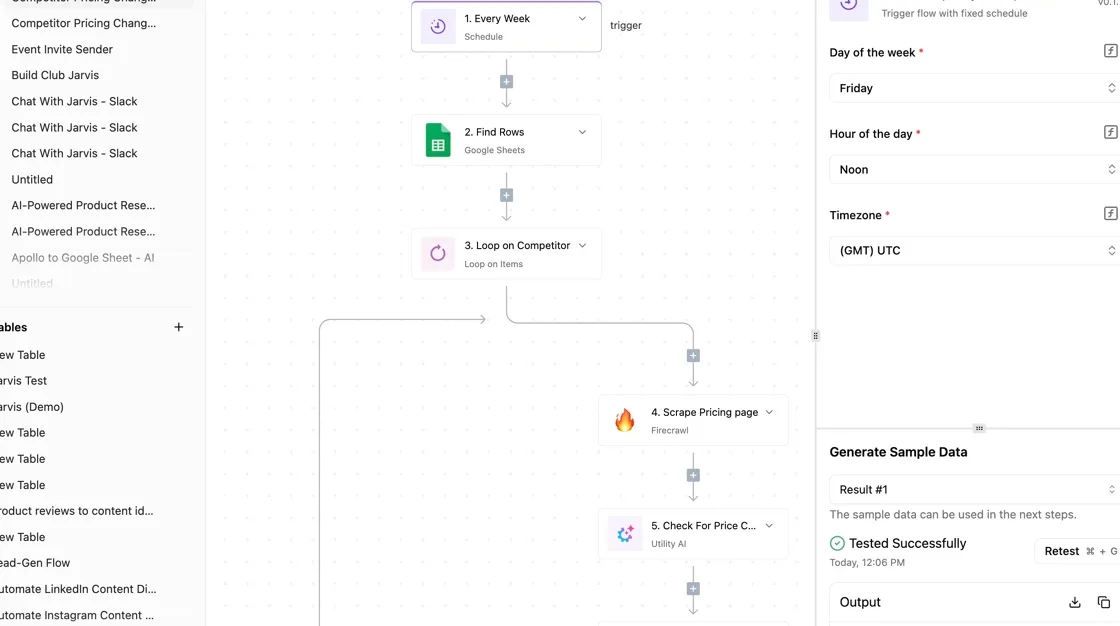
To ensure market data never grows stale, the workflow begins with the Schedule trigger, which initiates the sequence at a fixed frequency.
Within the Activepieces builder, selecting the "Every Hour" frequency ensures that rapid price fluctuations are captured.
The Activepieces flow builder demonstrates this starting point. It shows a Schedule trigger configured to run at hourly intervals with the "Run on weekends" toggle enabled to capture Sunday peak traffic.

Below the trigger, the integration selector modal highlights the deep integration with data destinations like Google Sheets and Microsoft Excel 365.
This specific action calls the Bright Data integration. This specific action calls the scraping browser to fetch the competitor’s current price, stock level, and shipping cost, passing those variables downstream for processing.
Syncing scraped prices to Shopify and WooCommerce
Once the scraper returns data, Activepieces uses its internal mapping engine to align raw web elements with structured commerce fields.
The flow utilizes the Shopify integration or WooCommerce integration to search for matching SKUs and update the "Price" or "Compare at price" fields.
Shopify is best for enterprise-scale stores requiring the "Update Product" action to sync prices across multiple regional storefronts instantly.
WooCommerce is ideal for WordPress-based retailers using the "Update a Product" action to modify product listings through the platform's API.
Google Sheets serves as a supporting spreadsheet within the Activepieces-based Logic Engine, where prices are calculated using formulas before being pushed to the store, ensuring a human-readable audit trail exists for every change.
Sending margin-alert notifications to Slack or Microsoft Teams
To prevent the automation from "racing to the bottom" and eroding profits, the flow includes a Branch integration.
This step checks if the proposed new price falls below a predefined margin threshold. If the logic gate detects a sub-margin price, it halts the Shopify update and routes the data to a Slack or Microsoft Teams notification action instead.

In the event of a scraper failure or a 403 forbidden error, the "Stop Flow" action prevents the system from clearing out existing price data.
Build your first resilient pricing flow by exploring the Activepieces pieces library and start for free.
Solving common price monitoring errors and limits
Resilient price monitoring requires transitioning from static scripts to logic-gated flows that autonomously detect and repair environmental failures.
Using AI to fix scrapers when layouts change
Traditional scrapers break because they rely on fixed HTML path selectors. To resolve this, modern flows route the raw HTML through Claude Haiku 5.5.
The model semantically identifies price data regardless of the underlying code structure. When the AI confidence score drops below a set threshold, the flow triggers a notification to Slack.
Identifying and ignoring false-positive price drops
When a competitor shows a high "list price" on the search results page but applies bulk discounts only after an item is added to the cart, phantom discounts occur.
| Error Type | Detection Method | Resolution |
|---|---|---|
| Shadow-banning | Persistent 403 errors or empty data returns even when the URL is valid. | Rotate through Residential Proxies, which use real home IP addresses to bypass data center blocks. |
| Phantom Discounts | Price on the product page is significantly lower than the final transaction value. | Use a headless browser to simulate the checkout flow and scrap the "Grand Total" line item. |
| Stale Cache | Receiving the same price for 24+ hours on a high-volatility SKU. | Force a hard refresh by appending unique query strings to the target URL. |
Managing API rate limits across your tech stack
To maintain throughput without getting blocked, you must implement jittered scheduling. This adds randomized delays between requests to mimic human browsing patterns.
- Set the primary trigger in your automation builder to a recurring schedule.
- Insert a "Delay" step using a math function to generate a random wait time.
- Route the request through a proxy manager to distribute the load across multiple geographic exit nodes.
- Configure an "Error Branch" that catches 429 status codes and automatically pauses the flow.
- Log the failure in Airtable, the cloud database tool, to track which competitors are tightening their security perimeters over time.
Frequently asked questions about price automation
Is it legal to automate competitor price scraping?
Provided the process doesn't bypass authentication barriers or violate specific terms of service regarding data redistribution, automating the collection of publicly available pricing data is generally legal.
The legal landscape is governed by the precedent set in cases involving LinkedIn. This established that scraping data not protected by a digital gate (like a password) doesn't violate the Computer Fraud and Abuse Act (CFAA).
To maintain compliance and avoid IP blacklisting, teams must respect the Robots.txt file. This is a text file websites use to communicate scraping permissions to bots. It dictates which directories are off-limits for automated agents.
How often should I refresh competitor price data?
Refresh cycles must align with the specific volatility of the marketplace.
| Platform | Avg. Price Changes per SKU/Week | Typical Price Ending |
|---|---|---|
| Amazon | 9.4 | .99 |
| Walmart | 5.9 | .97 |
| Target | 2.1 | .99 |
As shown, Amazon’s high change frequency necessitates a near-continuous monitoring loop to remain competitive, whereas Target’s stability allows for a daily sync without risking significant market lag.
Can I automate pricing without a dedicated scraper tool?
By using no-code integration platforms and Large Language Models (LLMs) to extract data directly from site HTML, you can build a functional pricing engine.
- Use a tool like Make to schedule a recurring trigger that opens a target URL.
- Send the raw HTML to Claude Haiku 5.5 (an Anthropic model optimized for high-volume extraction) to identify the price and stock status tags.
- Pass the extracted values to a Google Sheets spreadsheet to log the historical trend.
- Set a conditional filter that sends a Slack notification to the Category Manager if the price drops below a specific threshold.
Still comparing
The fastest way to settle it is to build something.
Open source under MIT, so you can self-host the same thing later.
Start free Talk to sales