
D-ID Pricing 2026: Every Plan, Cost and Limit

Nov 11, 202617 min read
D-ID pricing today: every plan, price and limit
D-ID pricing summary and last checked date
The monthly price is only the entry fee.
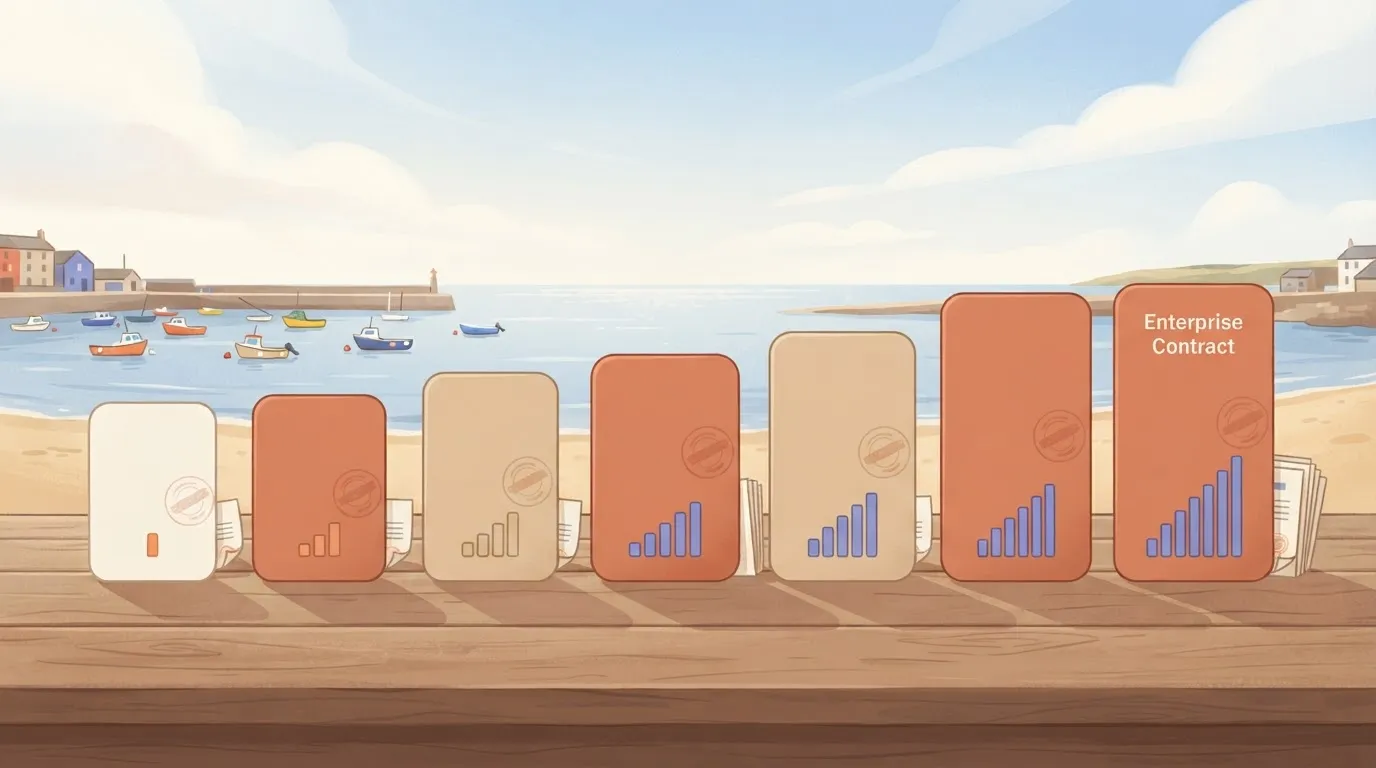
D-ID sells seven tiers, from a free trial to enterprise contracts, and what you can actually publish depends on credits, watermarks and licence terms, as the table below shows, which means the tier you choose determines both your total spend and your output ceiling.
Checked against d-id.com/pricing on 11 November 2026.
You type or upload a script, pick a digital presenter, and get a talking-head video back. That is D-ID, an AI avatar video platform.
It comes in two forms: Studio, a browser editor for people making videos by hand, and an API, which lets your own software request videos automatically.
If you trigger videos from Activepieces, which runs unlimited flows on every plan including the free one, the API rows matter more than the Studio rows.
Because pricing pages change without notice, treat the date above as a shelf life. Where I couldn't confirm a figure, the table says so rather than guessing, because a guessed price in a budget's worse than a blank one.
Plan table: price, credits, minutes, watermark
Read across a row rather than down a column. The table lists every plan against the five things that decide the real bill, and a cheap plan with a watermark or no commercial licence may be unusable for what you're building.
| Plan | Monthly price | Annual-billed price | Minutes or credits | Watermark | Commercial use |
|---|---|---|---|---|---|
| Free trial | Free | Not applicable | Not verified | Not verified | Not verified |
| Lite | Not verified | Not verified | Not verified | Not verified | Not verified |
| Pro | Not verified | Not verified | Not verified | Not verified | Not verified |
| Advanced | Not verified | Not verified | Not verified | Not verified | Not verified |
| API Build | Not verified | Not verified | Not verified | Not verified | Not verified |
| API Launch | Not verified | Not verified | Not verified | Not verified | Not verified |
| Enterprise | Custom quote | Custom quote | Not verified | Not verified | Not verified |
Before choosing, fill the gaps yourself from the live page. Then divide each plan's price by the minutes or credits it includes, which gives the cost of one finished minute.
What the free trial allows
Think of the free trial as a way to test output quality, not a tier to build on. I couldn't confirm its credit allowance, watermark or licence terms, so check all three on the pricing page before you show a trial clip to a customer.

If it carries a watermark or bars commercial use, any video you publish from it's a liability.
Treat the trial as a way to learn how many credits one real script burns, which is the number every later plan decision depends on.
If you are running this arithmetic for your own team, see what the same workload costs on Activepieces.
D-ID costs across volume tiers
Once you know how many credits one real script burns, the bill at any volume's that number multiplied out. It's then matched to the cheapest plan that holds it, plus overage on whatever spills over.
The table shows how each volume resolves, and what to take from it is that the arithmetic stays the same while the plan changes.
| Volume | Plan it lands on | Units needed | Monthly bill | Overage | Cost per finished minute | Arithmetic |
|---|---|---|---|---|---|---|
| 1,000 minutes | Smallest paid plan that holds the credits | Minutes × credits per minute | Plan fee | Only if credits run out | Bill ÷ minutes kept | Fee ÷ 1,000 |
| 10,000 minutes | Mid-tier plan or entry API tier | Same formula, ten times larger | Plan fee plus any top-up | Likely, if the plan is undersized | Bill ÷ minutes kept | (Fee + overage) ÷ 10,000 |
| 100,000 minutes | Top API tier or an enterprise quote | Same formula, a hundred times larger | Quoted, not listed | Negotiated | Bill ÷ minutes kept | Quote ÷ 100,000 |
Divide by minutes you keep, not minutes you generate. Every discarded take's paid for and raises the real figure.
At 1,000 minutes a month a small plan usually covers you, and the risk's waste. Retakes and test renders burn credits just as final videos do, so you pay for more minutes than you publish.
At 10,000 minutes a month an undersized plan costs you most. Overage's charged on the shortfall, so running past your allowance can cost more than stepping up a tier. Price the next plan up before you commit to the current one.
At 100,000 minutes a month list price stops being the number to plan around. Expect an enterprise quote, so use the lower tiers' per-minute rate only as a ceiling to negotiate against.
Studio versus API: which meter applies
Pay attention to the route you take, because the two are metered differently. Studio is the point-and-click editor, and the API is the route your code calls.
Commercial video through the API tiers works out cheaper per minute than the same video made in Studio, with the top API tier cheapest and the priciest Studio plan dearest.
If your workflow can call the API, building against it's the cheaper habit. A person clicking through Studio's paying for convenience.
D-ID watermarks, render credits and usage limits
Pay for convenience and you also pay for what the convenience hides:
- a mark on the video
- credits spent on renders you can't use
- ceilings on length and speed
Read Lite's low figure as the price of a video that still carries a watermark, not of a clean one.
Watermark rules by plan
Nothing from the trial can go in front of a customer, because it puts a full-screen watermark on the video. Lite swaps that for the D-ID mark, which's fine for internal drafts and wrong for anything you sell.
Pro shrinks it to a small "AI" mark. So the cheapest plan that gives you a presentable video's Pro, and Pro's per-minute cost is the one to budget against.
D-ID credits, expiry and failed renders
When a script is bad or an input is broken, you still pay, because credits are charged on failed renders. Plan for retries as a normal line in the budget, the way a contractor adds a margin for waste.
When a script is bad or an input is broken, you still pay, because credits are charged on failed renders.
Send a 16-second clip and it's paid for as 30, because rendering's billed in 15-second steps. Short clips lose the most to this rounding, and a workflow that produces many of them pays it every time.
Check each plan's credit expiry before buying ahead, because unused credits that lapse raise your real cost per finished minute.
D-ID API concurrency, length and latency limits
Because each clip's capped at 5 minutes, longer material has to be cut into integrations. Every integration rounds up separately, which adds to the rounding cost above.
Concurrency limits decide how many renders run at once. If your app has several users waiting, a low cap turns into a queue, and the fix is a higher API tier, not a faster script.

Whether you may use the output commercially, and whether you can build a custom avatar of your own presenter, depends on the plan. Confirm both on the plan page before you build. Finding out afterward means re-rendering finished work on a higher tier.
D-ID against HeyGen, Synthesia and Tavus on price
A builder who picks it for its headline price pays more per video than the same money buys elsewhere.
Comparison table on five dimensions
Read the table as a floor: it tells you who starts cheapest, not who stays cheapest once your volume grows. It shows what each entry plan costs per finished minute, using the vendors' own pricing as collected by Humva, Soku.ai and Tavus.
| Vendor and plan | Entry-plan cost per finished minute |
|---|---|
| HeyGen Avatar III | $0.19 |
| Tavus Starter | $0.37 |
| D-ID Lite | $0.59 |
| HeyGen Avatar IV | $1.50 |

Where D-ID costs less than rivals
Stop paying for studio features you don't use and D-ID gets cheaper. VideoMake puts a commercial minute at:
- $0.69 on the API Scale route
- $0.78 on API Launch
- against $1.06 on Studio Pro

So the API routes cost less. If your app generates video through code rather than a web editor, you pay roughly a third less per minute for the same output.
At $1.50 a minute, HeyGen's higher-quality Avatar IV also costs less than D-ID's upper plans, covered next, which means you're getting premium quality without premium pricing.
Where D-ID alternatives win on price
At the entry plan, and again as you move up, an alternative wins. HeyGen Avatar III at $0.19 and Tavus Starter at $0.37 both undercut D-ID Lite's $0.59, so a small project loses money by choosing D-ID on price alone.
The steeper problem is D-ID's own ladder.
Quickveed calculates cost per included minute at $0.59 on Lite, then $1.93 on Pro and $1.96 on Advanced. Moving up one tier more than triples your unit price, so a team that outgrows Lite pays dearly for the step.
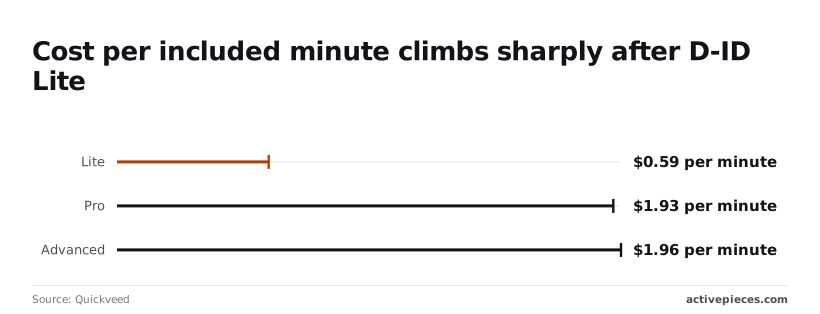
Compare that with HeyGen Avatar IV at $1.50, which's cheaper than either D-ID upgrade, making HeyGen the more economical choice between the two vendors the higher your production volume climbs, by the time you're at scale, the cost gap widens substantially in HeyGen's favor.
Price your expected monthly minutes against each vendor's tiers before you commit. Treat the Lite-to-Pro jump as the point where a switch deserves a serious look.
Worth checking against a plan that does not meter every step: one credit covers a whole run on Activepieces.
D-ID entry plan advantage
Start on the entry plan and you've made a sound choice. For a small, steady workload it can be a sound place to stay, but only until watermarks, credits and concurrency limits begin deciding what you can ship.
Having just read the vendor comparison, you could fairly ask: if the pain begins at the jump between tiers, why not stay below it? The case for that has four parts, and each one has a limit that answers it.
- The entry tier is cheap, so you commit very little. But that price buys a fixed pool of credits, and the first month you run short you're either buying more or upgrading.
- The free trial lets you prototype at no cost. But trial output is watermarked, so it proves your workflow works and can't be shown to a paying customer.
- Few avatar tools offer real-time streaming agents, and D-ID does. But a live agent holds a session open for as long as the conversation lasts, and concurrency limits cap how many people can talk to it at once.
- Per-minute billing looks predictable. But it's predictable only if every minute you generate's a minute you keep, and retakes and failed renders spend credits too.
D-ID cost per finished minute explained
Skip the per-finished-minute figure and you find out from the invoice, after the product is already built around the plan.
A plan price tells you what you pay to open the account, not what one usable minute costs, and that's the number your budget depends on.
Fixing it takes a short test, not a spreadsheet exercise. Run your real script through the trial, with your real retakes, and note how many credits it takes to get one minute you would publish. Multiply that by the minutes you expect each month.
Then check whether the result fits inside the entry plan, or whether concurrency and watermark limits push you to the next tier anyway. If it fits, the cheap plan was the right call. If it doesn't, you have learned that before the bill taught you.
Call the D-ID API from a workflow with Activepieces
You call D-ID from an Activepieces flow, even on the $0 free plan, by sending one create-talk request, waiting for the finished video, and handing its link to the next step.
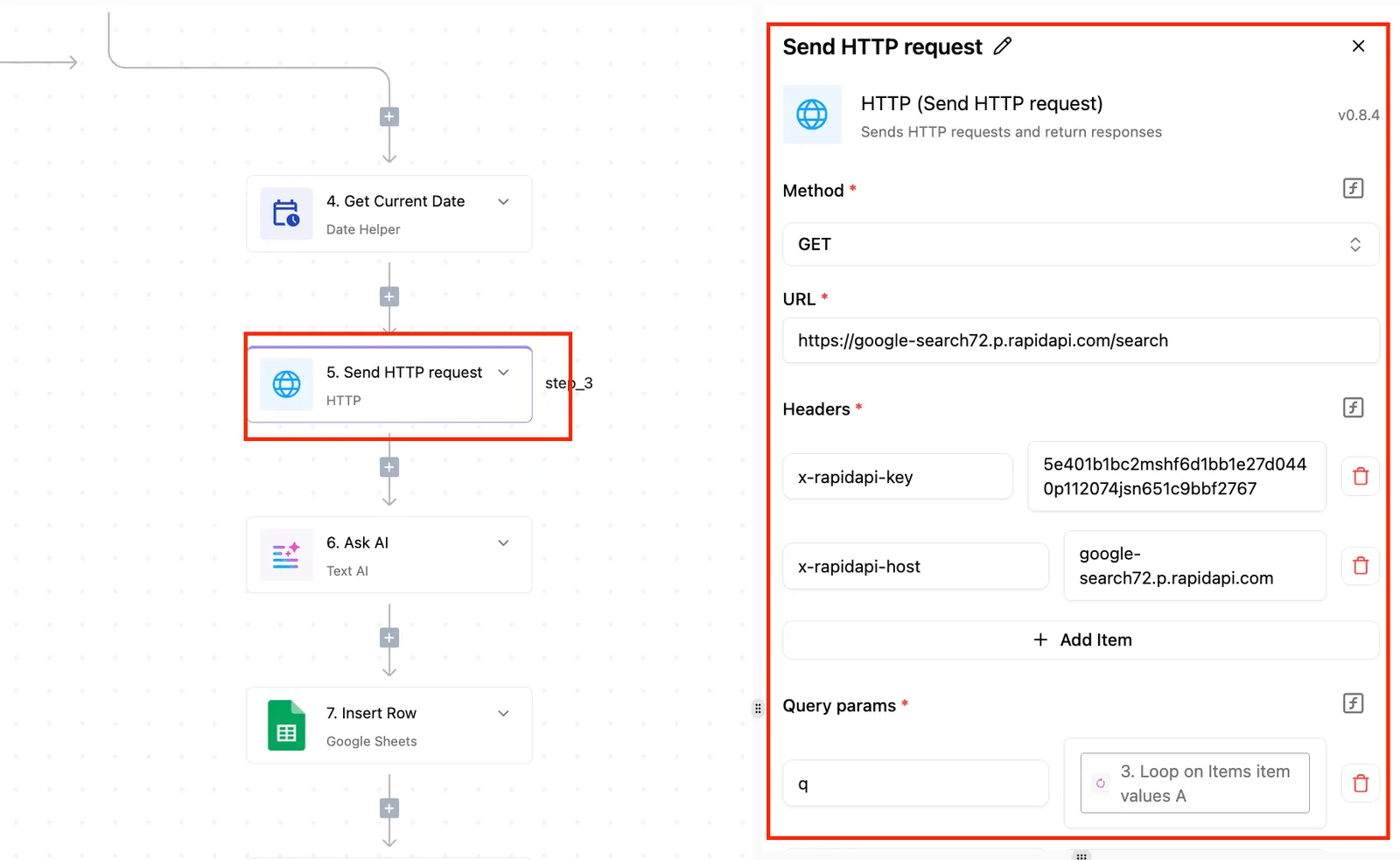
Activepieces only runs those steps in order; it doesn't change what D-ID charges, so every request it sends still spends your D-ID credits, separate from the Activepieces credits counted below.
The flow itself adds almost nothing to the bill.
Activepieces' free plan is $0 with no card needed and includes 1,000 credits a month and unlimited flows, and a run is 1 credit however many steps it has, so the five-step flow below costs one Activepieces credit per video while D-ID's meter runs separately.

The $20-a-month Plus plan carries 10,000 credits, which covers 10,000 videos a month of one-credit runs, which means you're paying $0.002 per video at that volume.
A flow that holds a D-ID key and spends credits on every run is worth controlling once more than one person can edit it.
Activepieces' Ultimate plan lists custom RBAC, SCIM, audit logs, event streaming, releases with Git Sync and secret manager integration, and SSO is already in Team at $200 a month, so enterprise-grade authentication doesn't require trading up to a higher plan.
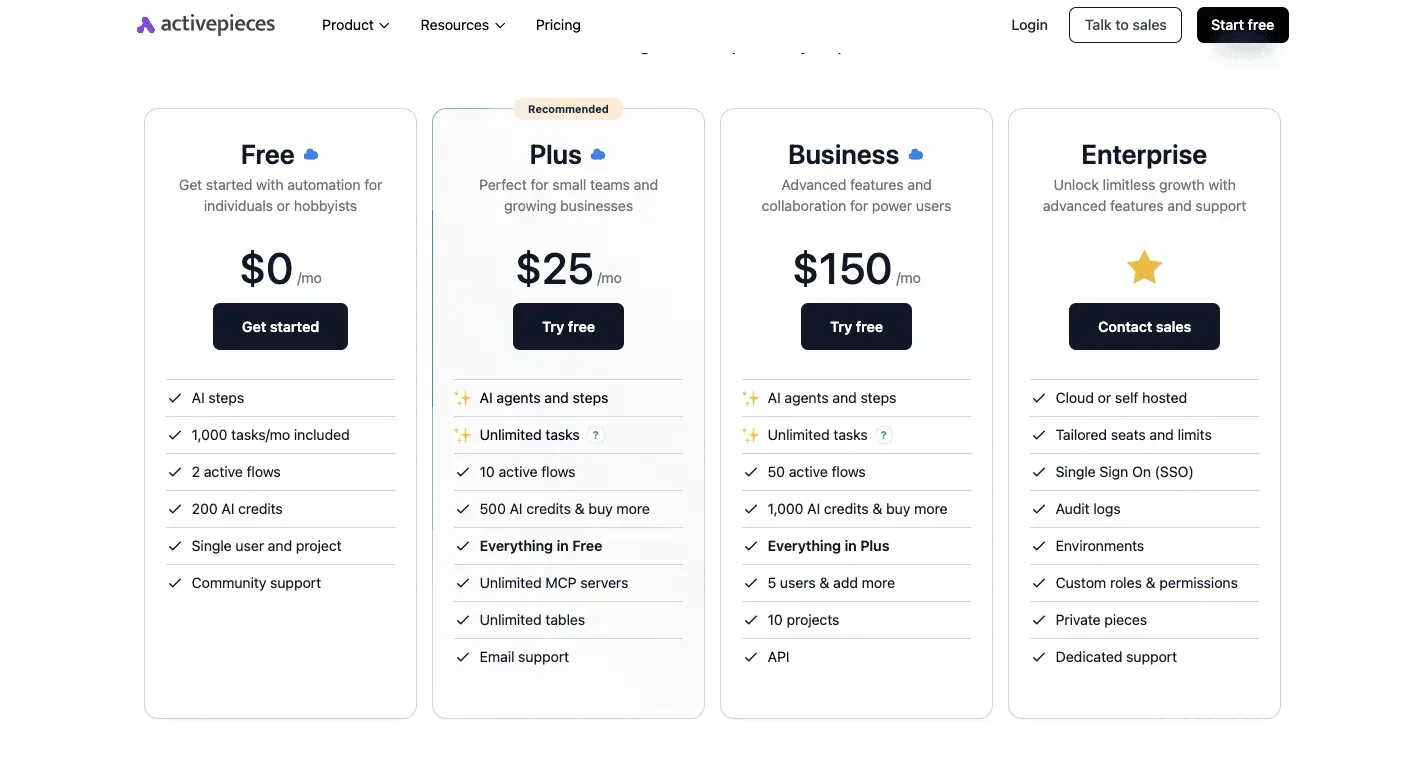
Those controls apply whether you self-host or use the cloud, and MoneyGram, Moneypenny, Alan and FundingSocieties run it in production.
Request, poll and webhook steps
You chain steps, and each step passes its output to the next, with a run staying at 1 Activepieces credit however many steps it has. The flow can send a web request, wait, and branch on the answer, which's all a D-ID call needs.
Only step two spends credits; everything else's bookkeeping around it. The sequence below's what the flow looks like.
- Store the D-ID API key in the flow's connection or secret settings, never typed into a step, so it stays out of exports and shared copies.
- Add an HTTP step that sends the create-talk request with your script text, your chosen presenter image and the key in the authorization header. D-ID replies with an ID for the video, not the video itself.
- Either poll or receive a webhook. Polling means a loop that asks D-ID for that ID at a spaced interval. A webhook means you give D-ID an address in the request and it calls you when the video is done. The webhook costs you fewer requests and fewer moving parts.
- Check the status in the reply. If it says done, continue. If it says error, stop the flow right there and don't resend the request.
- Pass the result URL downstream to whatever uses the video: an email step, a storage step, a post to your app.
Save the file somewhere you control at step five. A result link that you never copied may not last, and regenerating the video means paying for it twice.
Guarding credits with retry limits
When a create-talk request errors because of a bad image or a script D-ID rejects, sending it again just fails again, and any attempt that gets as far as rendering can still use credits.
Automation tools are built to retry failures, and that's the habit that quietly inflates a bill.
So switch off automatic retries on the create step, and cap the polling loop at a fixed number of checks. A stalled job then ends in an alert to you instead of an open-ended loop.
Run the flow on a few real scripts before you turn it on for a queue. What you learn from those runs is your actual cost per finished video, and that figure's the one to price your plan against.
Frequently asked questions
Is D-ID free to use?
Yes, D-ID has a free trial, but it's built for testing, not for running a product on. Expect a small allowance of credits and limits that push you to a paid plan quickly.
Use it to make a few test videos and work out your cost per finished video, then price a paid plan from that. Check D-ID's pricing page for the current allowance before you rely on it, since trial terms change.
Does D-ID put a watermark on paid videos?
Paying alone doesn't remove it. Watermarks are tied to the plan, not to the act of paying. The free trial marks its output, and paid plans are where that mark comes off.
Which paid plan removes it's a detail to confirm on the plan you're considering, because a watermarked video isn't something you can hand to a customer. Run one test export on the exact plan before you commit to a month.
Do unused D-ID credits roll over?
Treat them as not rolling over until the plan's terms tell you otherwise. Credits on subscription plans are typically tied to the billing period, so a quiet month means you paid for video you never made. That's the cost of doing nothing with them.
If your volume swings from month to month, read the expiry terms before you pick the plan, and size it to your slow months, not your busy ones.
Can I use D-ID videos commercially?
Don't assume the free trial covers it; commercial use depends on the plan.
Paid plans are where commercial rights are generally granted, but the exact terms, including what you may do with a cloned or custom avatar, sit in D-ID's terms of service. Read those before you put a video in front of paying customers.
Fixing a rights problem after publishing costs far more than a few minutes of reading first.
Is D-ID API pricing separate from Studio pricing?
Yes. The API's priced and metered apart from the Studio, D-ID's browser-based video editor, so a Studio subscription doesn't cover videos you generate from code.
The API has its own tiers, and those carry their own concurrency limits, meaning how many videos can render at the same moment.
If your workflow fires off many requests at once, a lower tier will queue them. Price the API on its own page, against your own volume.
Prices on both pages were not rechecked for this section, so confirm the current figures on D-ID's site before you buy.
Related reading
References
Running the numbers
See what the same workload costs here.
Free forever plan, and every paid plan self-hosts at no extra cost.
See pricing Talk to sales