Gemini 4 Carbon: Benchmarks, Pricing and Review (2026)

Oct 28, 202611 min read
On October 28, 2026, Google DeepMind announced Gemini 4 Carbon in a post on blog.google by Koray Kavukcuoglu, and calls it its "strongest model." Everything below was checked against Google's pages on 2026-10-28, so treat later changes as unverified, whether you read them directly or through a workflow tool such as Activepieces that relays them.
Google releases Gemini 4 Carbon
What Google released and when
Quote these lines, not a third party's summary, when you write the model into a ticket or spec. The box below pins down the record: who made it, when, who announced it and how Google describes it.
- Maker: Google DeepMind
- Announced: October 28, 2026
- Announcement post: by Koray Kavukcuoglu
- Google's description: its "strongest model"
- Facts checked: 2026-10-28
Take "strongest" as Google's own wording, since the numbers behind it come from Google DeepMind. In every pair below, the first figure is Carbon and the second is Gemini 4 Argon, the comparison model Google sets beside it.
For shell and computer-use steps in a workflow, the nearest scores are Terminal-Bench 4 and OSWorld-2.1.
Rerun your own tasks before relying on any of these, because they are Google's figures.
Once the introductory period ends, the prices double.
The blog post sets introductory API prices of $2 per million input tokens and $10 per million output tokens, rising to $4 and $20, which means customers will pay twice as much for continued use.

Those rates are the launch post's, so confirm them on Google's pricing page before you commit a budget.
Budget at the doubled rate, or your cost estimate breaks the day the intro pricing ends.
Sources used for Gemini 4 Carbon facts
Nothing here comes from leaks or third-party benchmarks. Every claim traces to Google's announcement or the DeepMind model page, both read on 2026-10-28. Anything those pages don't state is left out, not inferred.
That matters for tooling.
Activepieces lists a Google Gemini integration with 11 actions and 0 triggers, and once it is connected an agent can call all 11: each action is a step in a flow and, through the project's MCP server, a tool that Claude, ChatGPT, Cursor or an agent you built yourself can invoke.
It is the same integration action either way, so there is no second catalog to publish to and no re-integration for your agents. The code lives in packages/integrations in the open source repo. Whether it exposes Carbon isn't something that listing states.
If you are running this arithmetic for your own team, see what the same workload costs on Activepieces.
What Gemini 4 Carbon changes for automation teams
Of all the blocks in a workflow, the AI step is the swappable one. Every release is therefore a choice about quality, speed and cost on work you already run. That choice doesn't require rebuilding anything, and it doesn't require trusting a launch post.
Where a model sits inside a workflow
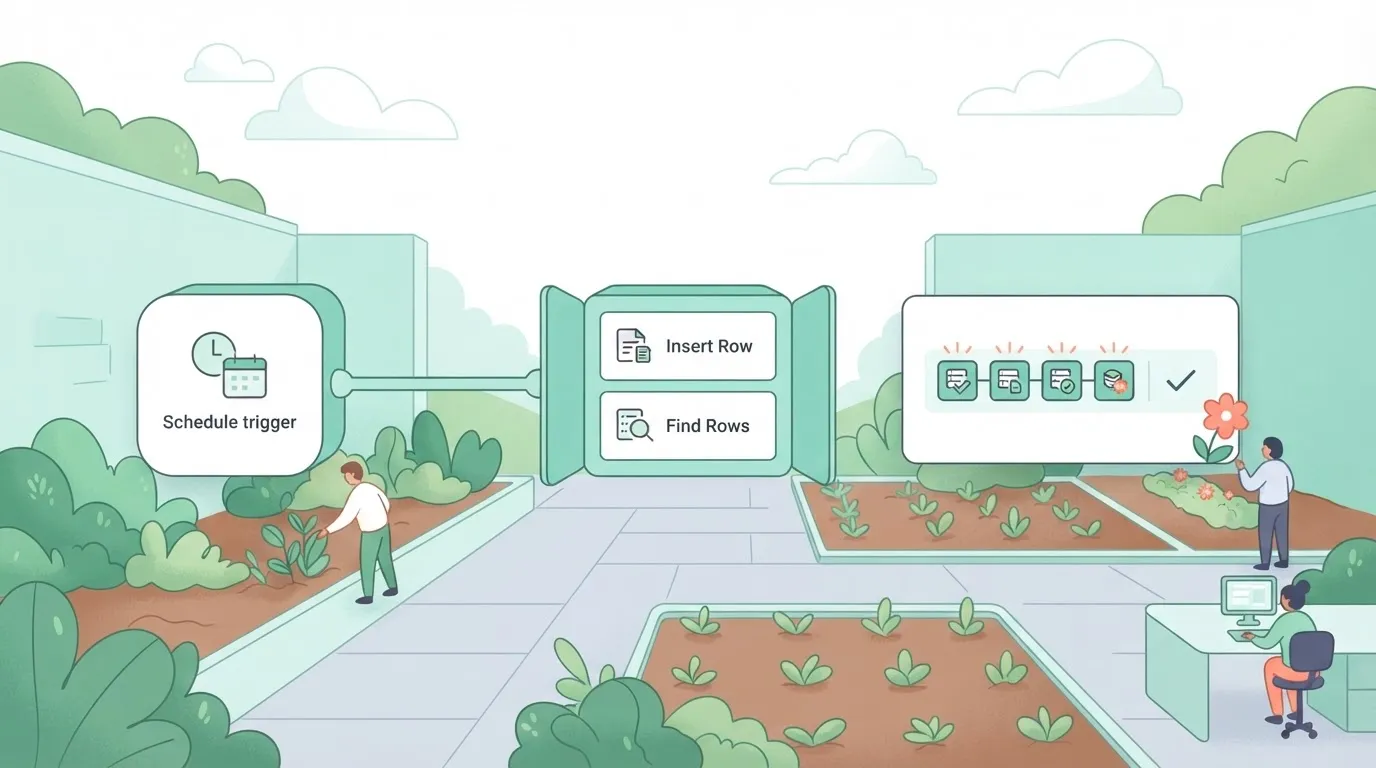
In the illustration, a workflow is a row of connected blocks: a trigger, an AI step, and an app action. The AI step lifts out, and three alternative model blocks sit beside it, one of them labelled Gemini 4 Carbon.
What to take from it is that the trigger and the action stay put. The model's the one block you replace, so trying Carbon costs a swap, not a rebuild.
What the swap leaves untouched matters just as much. The trigger still fires on the same event. The action still writes to the same field in the same app.
When you move the prompt you wrote for one model onto another, the output may come back in a slightly different shape, and a downstream field mapping that expects a clean value will reject or mangle it.

That is the part that can break: the middle. Test the output format before you test the quality.
Settle three things, in this order, and settle them on your own tasks rather than on the vendor's description.
- Quality: run a sample of real inputs from the existing workflow through both the current model and the new one, and compare what lands in the app action.
- Speed: check whether the step sits in a path where someone is waiting on it, such as a reply to a customer, or in a batch job where nobody is.
- Cost: price the step at your actual volume, using the rates Google publishes for the model you are testing, not an assumed tier.
Until your own run answers it, anything Google hasn't stated about Carbon stays an open question.
What's new in Gemini 4 Carbon
Three claims, plus the launch post's prices and benchmark figures: that is what Google's pages give for Carbon, and all of it is Google's own, not independently checked.
Capabilities Google states
Treat the first three as marketing claims until a test of your own supports them, and treat the last as Google's figures to confirm. The list below separates what the page says from what still needs checking.
- Google calls Carbon its strongest model.
- Google describes its cybersecurity capability as state-of-the-art.
- Google cites long-horizon capabilities.
- The launch post gives pricing and benchmark figures against Gemini 4 Argon, but Google has not published speed.
Nothing in "strongest" tells you about your trigger, your field mapping or your failure rate, because on its own it has no yardstick attached.
Long-horizon's the claim that matters most to automation teams, because multi-step runs are where a model drifts. Whether Carbon holds a plan across a long run's something only your workflow can show.
How to get access to Gemini 4 Carbon
Because no confirmed detail was available to cite, this section can't name an access route or a plan tier. Check Google's Carbon page for the current routes before building anything around it.
Once you have access, call the model by its exact name in a single non-critical step and see whether the name resolves. Keep the step swappable, so a wrong assumption costs you one node and not the flow.
What Google lists for pricing
Google's launch post lists $2 per million input tokens and $10 per million output tokens during the introductory period, then $4 and $20.
That is enough for a first cost-per-run estimate, but only if you log real token counts and price them at the later rate.
Run a small batch of real inputs, log the token counts, and price them at both rates. Until you have confirmed the figures on Google's pricing page, a comparison against Gemini 4 Argon's output rate of $10 is a comparison on paper only.
Worth checking against a plan that does not meter every step: one credit covers a whole run on Activepieces.
What Activepieces has already shipped for Gemini 4 Carbon
There's no shipped support to cite, because we found no Activepieces announcement naming Gemini 4 Carbon, and we haven't run the model ourselves. Anything below about Carbon in a flow's a method, not a result.
The shipped support, with date and link
There's no date and no link, because we've found nothing that names the model. Activepieces lists a Google Gemini integration, but that says little about whether a specific model has a dedicated action with the right fields.
Until Activepieces or Google publishes one, assume Carbon has no built-in step. The Google Gemini integration lists 11 actions and 0 triggers, and none of that listing names Carbon, so it isn't proof that the model is covered.
Trying Gemini 4 Carbon in a workflow
Test it as a plain API call you control, so a failure points at the model rather than at the connector.
Take the model identifier and request format from Google's own model page, not from a blog post or from us, because we can't confirm either.
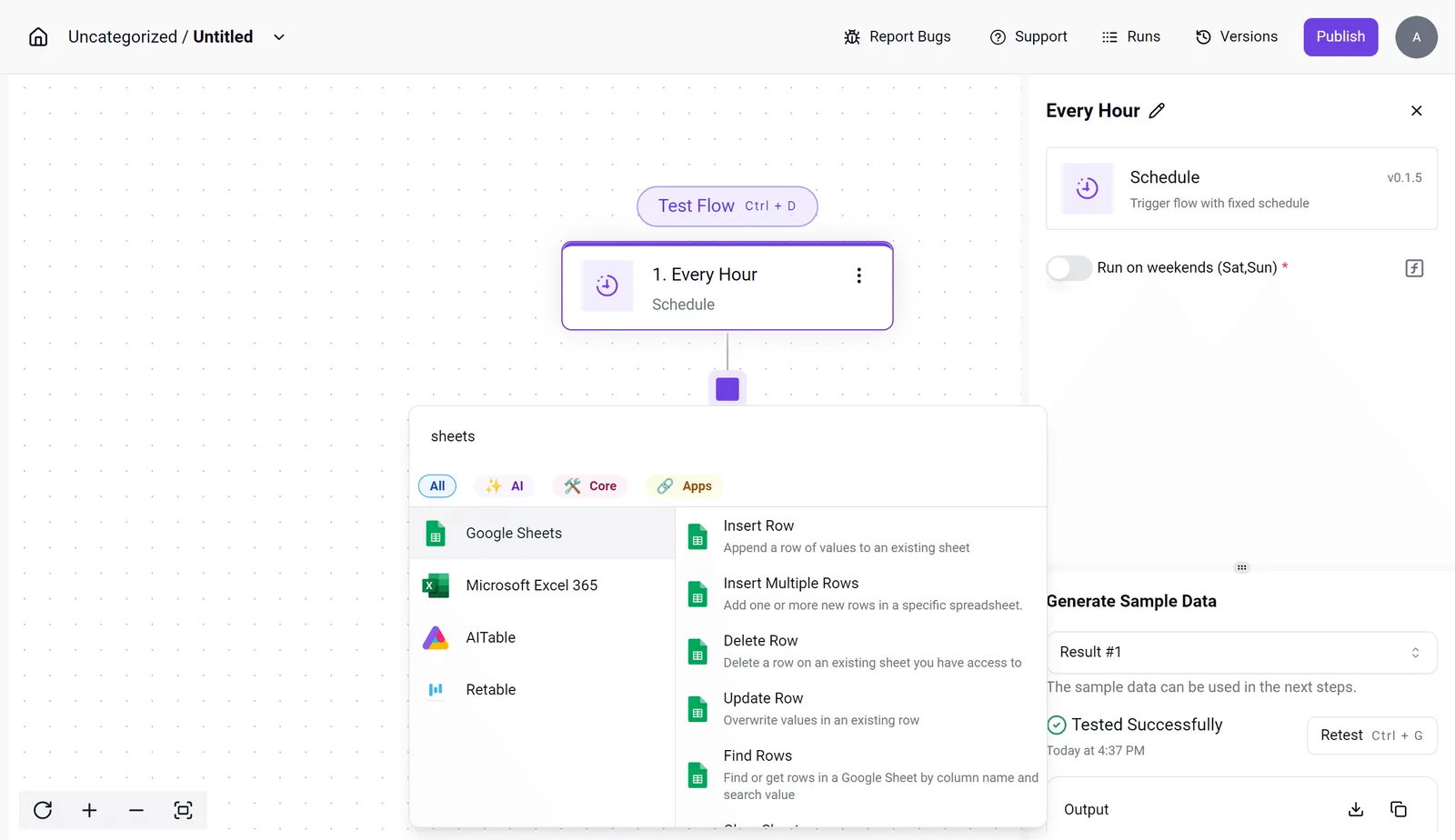
To see the shape of the test, look at the builder. It has a Schedule trigger set to every hour, the integration selector open on spreadsheet actions such as Insert Row and Find Rows, and a successful sample-data run in the settings panel.
Before any model is involved, settle that the trigger fires and passes data on, which is what the sample-data run proves.
Once that run is clean, add an HTTP request step after the trigger that calls Google's endpoint with a fixed test prompt. Then add an Insert Row action that writes the raw response beside the prompt.
Map the response field explicitly instead of dumping the whole body, so a changed output shape breaks visibly. If the call is rejected, the identifier's the first thing to check.
What sets Carbon apart on cost and speed
Carbon's own line carries only the launch post's rates, because Google hasn't published a speed figure for Gemini 4 Carbon that I can cite, so any speed comparison today rests on nothing.
Gemini 4 Carbon price and speed facts
Across current frontier models, Costmon lists output prices per 1M tokens. Claude Opus 5.5's $20, so the same output volume costs twice as much.

$50 is what Claude Fable 5.1 and GPT-6 Astra both charge, five times Argon's rate, which means any cost-conscious buyer gravitates toward Argon. A workflow that generates long outputs, such as drafted replies or summaries, feels that gap on every run.

Only cells with a source are kept in the table, checked on 2026-10-28. Carbon's cells come from Google's launch post.
For Haiku 5.5, Anthropic's model overview says it is built for fast, high-volume, latency-sensitive tasks, but gives no number I can put in a cell.
| Model | Input price | Output price | Speed | Check date |
|---|---|---|---|---|
| Gemini 4 Carbon | $2 intro, $4 after intro (launch post) | $10 intro, $20 after intro (launch post) | not published | 2026-10-28 |
| Gemini 4 Argon | not published | $10 | not published | 2026-10-28 |
| Claude Haiku 5.5 | $0.10 (prompts ≤ 100K tokens) | $0.50 (prompts ≤ 100K tokens) | not published | 2026-10-28 |
| Claude Opus 5.5 | $4 | $20 | not published | 2026-10-28 |
With most other cells empty, the only defensible budget for Carbon is the launch post's doubled $4 and $20 rates, set beside Argon's $10 output rate.
Set against the $10 to $50 range, Carbon's introductory output rate matches Argon's, and its later rate matches Opus 5.5's. Speed's blank for every model, which means latency claims, including Haiku's, are untested until you measure them on your own payloads.
What to watch next for Carbon
Watch three things on Google's own pages: whether the introductory pricing really ends on Nov 30, what the docs list as the Carbon model ID, and where the model is actually available. Latency stays unknown until you measure it yourself.
According to Google's launch post, Carbon is its strongest model, with state-of-the-art cybersecurity and long-horizon capabilities. That's a description of intent, not a spec sheet. The details that decide whether it fits a workflow sit elsewhere.
- Open Google's API pricing page and confirm the introductory-price end date the launch post gives, Nov 30, 2026. Any cost estimate you build before that date describes a price that'll change, so budget a re-run of your numbers once it passes.
- Read the Gemini API docs for the exact Carbon model ID. Workflow nodes and HTTP calls fail on a misspelled or preview-suffixed ID, so copy it rather than guess it from the product name.
- Check availability for your account and region. A model that appears in a blog post but not in your project's model list can't be called, whatever the announcement says.
Write down what each page says on the day you read it. If a page's silent on something, such as rate limits, treat it as unknown, not as unlimited.
A model that appears in a blog post but not in your project's model list can't be called, whatever the announcement says.
A small test to run on your own tasks
Pick a handful of real payloads from one workflow, such as the messy inputs that currently need a human fix. Send the same set to Carbon and to the model you run today, for example Gemini 3.8 Flash.
Log response time, whether the output parses into the fields your next step expects, and how often a person would still have to correct it.
Keep the set small and fixed so you can repeat it after the pricing date passes. The result's your own evidence, which is the only kind that covers speed.
Related reading
References
Running the numbers
See what the same workload costs here.
Free forever plan, and every paid plan self-hosts at no extra cost.
See pricing Talk to sales