Gemini vs ChatGPT for Unified Automation (2026)
A gemini vs chatgpt comparison helps you determine which platform aligns with your specific automation requirements and budget constraints for 2026.

Covers replacing WhatsApp and spreadsheet chaos with chat-based automation for resource-constrained small businesses, and why the fixes actually stick.
ContributorSeptember 26, 202615 min read
This article was researched and fact-checked by an advanced research system.
The landscape of generative AI has shifted dramatically as we enter 2026, with Google’s Gemini and OpenAI’s ChatGPT locked in a fierce battle for dominance.
While both platforms have evolved far beyond simple text generation, their distinct approaches to multimodal integration and real-time data processing continue to define their unique value propositions.
As developers increasingly rely on these models to build complex workflows, often utilizing tools like Activepieces to automate their internal business logic, the choice between the two ecosystems has become more about infrastructure than raw intelligence.
This comparison examines the latest pricing tiers, API capabilities, and specialized features that separate these two industry titans in the current market.
TITLE: Gemini vs ChatGPT: 2026 comparison of price and features
When Factory AI recently documented 204 fixes and 167 new features in a single release cycle, the sheer volume of data threatened to overwhelm a standard memory buffer.
Choosing the right AI model depends on whether a workflow must ingest these massive internal datasets or prioritize the precision of complex, multi-step creative reasoning.
Selecting an engine isn't about finding the smartest model. It's about matching specific architectural strengths to the environment where your data already lives.
When to choose Google Gemini
For teams that need to process vast amounts of information, Gemini is the operational choice. These teams might handle entire video archives or massive codebases without hitting the walls of a small memory buffer.
2 million tokens is the maximum context window for Gemini 1.5 Pro. Because of this, a developer can upload an entire legacy documentation library and receive answers that account for every edge case in the text rather than just a summarized fragment.
Activepieces allows these judgment-based steps to run on the same engine as your deterministic rules, rather than forcing you to bridge two products with a webhook.
By placing an Agent step alongside a fixed automation step in one flow, you can view the entire execution in a single run trace, ensuring the massive context handled by Gemini remains part of a unified, observable logic.
This scale is critical for organizations tracking rapid development cycles. The engineering platform Factory AI recently documented 204 fixes and 167 new features in a single release cycle. An AI with a smaller window would lose track of the product’s evolution within weeks.
When to choose OpenAI ChatGPT
High-precision coding and creative tasks remain the domain of ChatGPT. It excels where the logic of the prompt matters more than the sheer volume of the background data.
27K tokens is the limit of the OpenAI free tier context window. While this limits it to roughly 12 pages of text at a time, its reasoning engine typically produces fewer hallucinations in complex Python scripts compared to its competitors.
54K tokens is the capacity OpenAI's analysis puts on the "Go" plan. This capacity allows a marketing lead to analyze a full quarter of campaign transcripts while maintaining the nuance of the brand voice.
Even as Factory AI tracks 138 platform improvements and 11 enterprise-grade updates, ChatGPT’s mature plugin ecosystem allows it to bridge these changes with third-party tools more reliably than newer models.
Based on your primary output needs, the following decision tree for 2026 illustrates how these two paths diverge.
The 'Google Workspace' path leads to Gemini for context-heavy tasks like video analysis and codebase audits, while the 'Independent/Creative' path leads to ChatGPT for reasoning-heavy tasks and precise logic.
Following this logic ensures that your automation stack doesn't just run, but understands the specific scale of the data it handles.
Criteria for evaluating modern AI frontier models
Weighing raw cognitive speed against the friction of moving data is the first step in evaluating a frontier model. You must consider the distance between your workspace and the LLM's reasoning engine.
The 2026 Evaluation Framework focuses on Reasoning Depth for complex logic and coding, Ecosystem Gravity for integration with existing docs or mail, and Data Sovereignty for privacy and residency controls.
This framework ensures that a choice made for speed today doesn't become a security bottleneck or an integration silo next year.
GPT-5.6 Sol reasoning and multimodal performance
Model selection hinges on whether your automation requires instant reflex or deep, iterative logic for multi-step debugging. The GPT-5.6 Sol reaches 750 tokens per second.
A developer can generate and test an entire microservice architecture in the time it takes to sip coffee.
170 tokens per second is the speed at which Claude Opus 4.6 operates for workflows prioritizing stability over raw velocity. This pace suits high-precision legal or medical document synthesis.
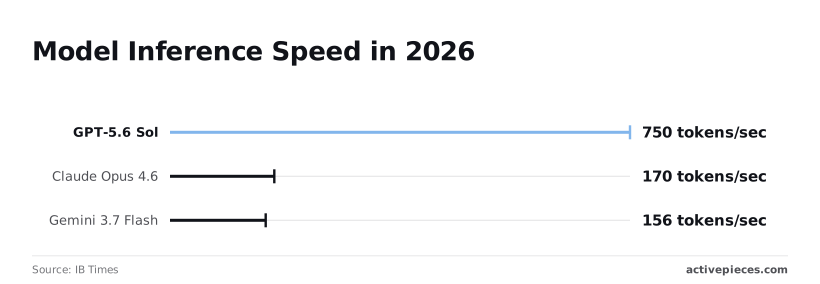
Gemini 3.7 Flash clocks in at 156 tokens per second. This is a baseline for real-time customer service agents that need to balance speed with the ability to process live video or image inputs.
Gemini context window and data retrieval capabilities
Utility is limited by how much of your specific business history a model can "remember" during a single prompt execution. A large context window reduces the need for RAG, a retrieval-augmented generation method that fetches external data.

This simplifies your stack by keeping all relevant project files in the model's active memory.
| Model | Context Window (Tokens) |
|---|---|
| Gemini 2.0 Pro | 2,000,000 |
| GPT-4o | 128,000 |
| Claude 3.5 Sonnet | 200,000 |
Prices and plan limits checked against gemini.google and openai.com on September 26, 2026.
Gemini and ChatGPT enterprise data residency compliance
Where your sensitive customer data physically resides and who has the legal right to view it is dictated by your choice of model provider. Data residency is a hard requirement for teams operating under GDPR or CCPA.
In these jurisdictions, a single data leak can result in fines totaling 4% of annual global turnover, which means a minor security oversight could threaten the company's entire financial stability.
You should verify the region-locking capabilities of the model's API to ensure data never leaves the European Economic Area or your specific sovereign cloud. Check the "Zero Retention" policy status.
This determines if the provider stores your prompts for human review or future model training. Audit the SOC2 Type II compliance reports of the parent company to confirm their internal access controls meet your department's insurance requirements.
The fastest way to settle a shortlist is to try one. Activepieces is free to try, no credit card.
Gemini and ChatGPT technical specifications compared
Standardizing on a model provider requires looking past the chat interface. You must look into the hard constraints of their subscription tiers. These limits dictate whether your automation workflows will stall mid-execution or scale with your data volume.
While both platforms offer comparable entry points, the underlying storage and message throughput create distinct operational boundaries for teams managing large-scale document processing or high-frequency customer interactions.
Current performance benchmarks for the primary paid tiers are outlined in the following table. Each provider balances processing depth against real-time responsiveness differently.
| 2026 Flagship Comparison | Google AI Pro | ChatGPT Plus |
|---|---|---|
| Monthly Subscription | $19.99 | $20.00 |
| Context Window (Tokens) | 2,000,000 | 256,000 |
| Message Limit (per 3h) | 50 | 40 |
| Speed (Tokens/sec) | 75 | 80 |
A fundamental trade-off is highlighted by these figures. Gemini has a significantly larger context window. A user can upload entire codebases or hour-long videos without losing the thread of the conversation. ChatGPT maintains a slight edge in raw generation speed for shorter, rapid-fire tasks.
For smaller teams or individual contributors, free-tier utility defines the "on-ramp" to these ecosystems. The Google Gemini entry plan costs $0/month with a Google Account. This provides an immediate starting point for basic task delegation, so users can begin experimenting without any financial commitment.
15 GB of cloud storage across Gmail, Google Drive, and Google Photos is included in this tier. This acts as a buffer for the documents and assets used in multimodal prompts so that your workflow remains uninterrupted by capacity limits.
$4.99/month is the cost of the Google AI Plus plan for those requiring higher performance without the full enterprise cost, so users can access advanced features for the price of a single coffee.

This is a middle ground for users who need consistent access to more capable models than the standard free version provides.
More complex reasoning is also allowed by the plan at a predictable, low expense. Ultimately, these specifications serve as the ceiling for your logic; if your workflow requires analyzing a 500-page PDF in one pass, the token limit is the only metric that matters.
Gemini context window versus ChatGPT productivity tools
Deciding between these models requires choosing whether your automation logic needs to ingest a massive, static library of information or needs a workspace to iteratively refine a single output.
While Gemini is built to hold an entire organization's technical debt in its active memory, ChatGPT is a collaborative editor that bridges the gap between a prompt and a finished document.
Gemini's 2-million-plus token advantage
Because of Gemini's massive context window, a user can upload an entire software repository or a library of hour-long video recordings. The model can identify a specific bug or a single quote without the developer having to manually slice the data into smaller, digestible chunks.
When a model can "see" millions of tokens at once, it eliminates the need for complex Retrieval-Augmented Generation (RAG) architectures. These often fail because the search algorithm pulls the wrong snippet of documentation.
This capacity transforms the AI from a simple chat interface into a system-wide auditor for a small team managing a sprawling codebase. The auditor understands how a change in the API documentation affects a function written three years ago.
ChatGPT Canvas and the evolution of GPTs
Through features like Canvas, ChatGPT prioritizes interactive productivity. This is a dedicated workspace for writing and coding where a user can edit specific lines of text without re-generating the entire response.
This shifts the workflow from a back-and-forth chat to a side-by-side collaboration. Consequently, this reduces the time spent copy-pasting code blocks into an IDE just to check for syntax errors.
· Canvas is a separate interface for long-form projects. · It allows for inline feedback and targeted edits. · SearchGPT is a real-time web indexing tool that cites current sources. · GPTs are custom-configured versions of the model that follow specific instructions or connect to external APIs.
Reading a table only gets you so far. Build the same workflow in Activepieces and compare it yourself.
Managing model diversity with Activepieces automation
Activepieces runs a company's chosen AI models, agents and automations across its own apps and data under central governance, using an MIT-licensed core to ensure the underlying logic remains portable.
Since reselling a model effectively locks you into a vendor's pricing and strategy, Activepieces lets you run Gemini or ChatGPT on your own provider key so that model spend stays on your own account at your direct rate.
You can verify this Bring-Your-Own-Key availability across every tier on the pricing page, ensuring you retain full control over your AI budget.
This prevents your business logic from being held hostage by a single AI provider’s pricing or API instability. You decouple the "what" of your process from the "who" of the intelligence.
If a marketing team builds a lead-scoring bot directly inside a vendor-specific playground, they're one price hike away from a broken budget. If they build it in Activepieces, switching from Gemini to Claude is a three-click swap of a single step.
Reducing operational risk with modular AI workflows
Against the operational instability inherent in the current AI arms race, this modularity is the only defense. When you hard-code your operations into one model, you inherit that model’s specific failures as your own.
Relying on a single provider leaves you vulnerable to four primary implementation risks.
When you hard-code your operations into one model, you inherit that model’s specific failures as your own.
If a provider changes their pricing tiers without warning, token cost volatility can lead to unpredictable monthly overhead. API latency spikes result in timed-out automations and stalled customer-facing workflows during peak usage hours.
Avoiding AI model drift and vendor lock-in
When a background update by the vendor causes previously reliable prompts to start hallucinating or failing, model drift in reasoning quality occurs.
Vendor-specific plugin lock-in prevents you from moving your data to a more efficient tool because your logic is trapped in a proprietary format.
The moment a vendor shifts their roadmap, these risks turn a "smart" workflow into a liability. Using a self-hosted or cloud instance of Activepieces ensures that the "brain" of the operation remains a replaceable component rather than the foundation of the house.
MoneyGram and FundingSocieties run Activepieces in production to maintain this flexibility across their departments. A small operations team can use this control to pilot new models the day they launch without rewriting a single line of their core connectivity logic.
By unifying deterministic logic and agentic steps within a single execution trace, Activepieces eliminates the fragmentation inherent in bridging separate systems via webhooks.
Activepieces is the better choice for organizations prioritizing architectural integrity and cost control, as it allows for seamless model swapping and direct provider billing within a single, governed flow.
This approach ensures that complex automations remain portable and transparent without the operational overhead of managing disconnected platforms.
Implementation plan for a multi-model AI strategy
To identify where you're paying for intelligence you don't actually use, a resilient multi-model strategy begins with a technical audit of your current API consumption.
Mapping your existing automated tasks against model strengths prevents the common waste of routing simple data extraction to high-reasoning models like GPT-4o. This avoids increasing your per-token costs without improving output quality.
- Categorize every active workflow by its primary demand: "Long Context" for analyzing massive technical manuals or hour-long meeting transcripts, and "High Logic" for complex code generation or multi-step reasoning.
- Assign Google’s Gemini models to the Long Context bucket to utilize their expansive token windows. This allows the processing of large documents in a single pass rather than being fragmented into lossy summaries.
- Assign OpenAI’s GPT models to the High Logic bucket for their consistent performance in structured data transformation and adherence to strict JSON formatting.
- Build a fallback sequence in your middleware so that if one provider hits a rate limit or suffers an outage, the request automatically reroutes to the other, maintaining your production uptime.
This architecture is best visualized through a live document processing chain. The following workflow demonstrates a document being ingested from a storage provider and passed through an AI analysis step before a router determines the next action based on the identified risk level.

[SCREENSHOT GOES HERE]
By separating the logic of the "Ask AI" step from the specific provider, you can swap the underlying model. You can move from Gemini to ChatGPT via a single dropdown menu if one starts hallucinating on your specific dataset.
This modularity ensures that your automation logic remains stable even as the frontier models underneath it shift their pricing and performance benchmarks every few months.
Gemini and ChatGPT pricing and subscription FAQ
Does Gemini Advanced include a Google One subscription?
Google AI Pro costs $19.99/month and includes 5 TB of cloud storage across Gmail, Drive, and Photos. The cost of the model is tied directly to this expanded cloud storage allotment.
For teams already hitting storage limits in the Google Workspace ecosystem, this integration forces a consolidated billing structure where access to the frontier model can't be decoupled from the user’s personal storage quota.

Which model is safer for sensitive corporate data?
Rather than the brand of the model, data safety depends entirely on the specific tier of service. Both providers offer enterprise-grade privacy that's absent from their free consumer versions.
ChatGPT Team and Enterprise tiers provide a contractual guarantee that inputs are excluded from the global training set. This prevents proprietary code or strategy documents from leaking into future public iterations of the model.
Under the Google Cloud Data Processing Addendum, Gemini for Google Workspace offers similar protections. This prevents organizational data from being reviewed by human annotators or used to improve the underlying Gemini model.
Conversations are typically retained for training by standard consumer accounts on both platforms. This creates a high risk of data exposure for employees who use personal logins for work tasks.
Can I use both Gemini and ChatGPT in the same workflow?
By using both models in a single automation, you can leverage the specific reasoning strengths of one while utilizing the massive context window of the other.
The OpenAI API is often used to perform high-precision logic on small data fragments. These results are then passed to the Gemini API to be synthesized into a long-form report. This approach prevents a single point of failure.
Related reading
References
Still comparing
The fastest way to settle it is to build something.
Open source under MIT, so you can self-host the same thing later.
Start free Talk to sales