
HIPAA Compliant Integration Platform: A 2026 Guide

Oct 19, 202616 min read
For your purposes, an integration platform, whether a hosted service or an open-source tool like Activepieces, is "HIPAA compliant" only under three conditions.
Its vendor has signed a Business Associate Agreement with you, your plan is one that agreement covers, and you have configured the product to protect the data you send through it.
A HIPAA compliant integration platform is a tool for moving data between systems that an organization can lawfully use with protected health information because its vendor has signed a BAA covering the plan in use and the organization has configured it to safeguard that data.
Nothing about the software alone settles that.
Read the phrase as a contract and a configuration; a vendor's badge describes neither.
A HIPAA compliant integration platform is a signed agreement
Miss any one of five things and the chain breaks; together they make a platform usable for PHI:
- A signed BAA
- A plan that includes it
- Security Rule safeguards
- A known data location
- Your own configuration

Set side by side in the graphic below, the five show that the vendor supplies the first four and you supply the fifth.
Read it as a checklist for a buying decision: a vendor that can only offer some of these isn't yet a candidate, however many logos sit on its security page.
What HIPAA actually requires of a platform
What HIPAA regulates is the handling of protected health information, not product categories. The Security Rule asks a covered entity, and any business associate working for it, to maintain administrative, physical and technical safeguards.
In practice that means access controls, audit logging, encryption in transit and at rest, and procedures for incidents and backups.
Because the platform supports those safeguards without discharging them for you, you'll be asked to show how your own workflows use those controls, not merely to point at the vendor's feature list.
Why there is no official HIPAA certification
Look for an official certification and you won't find one: the Department of Health and Human Services doesn't certify, endorse or accredit software products or vendors against HIPAA.
No government body issues a "HIPAA certified" mark, so any such badge is a private attestation or a marketing claim.
Useful as independent audits can be, they are evidence about a vendor's controls, not a legal status. So when a vendor says it's certified, the useful follow-up is who assessed it, against what, and whether it'll sign a BAA.
When a vendor counts as a business associate
When it creates, receives, maintains or transmits PHI on behalf of a covered entity or another business associate, a vendor becomes a business associate.
If an integration platform passes patient data between your EHR and another system, it does exactly that, even if it only holds the data briefly.
This is why the BAA isn't optional paperwork: without one, sending PHI through the platform is a compliance failure on your side from the first run, whatever the platform's security posture.
This takes minutes, not a project: automate it in Activepieces free.
Where HIPAA integration platforms sit in healthcare workflows
Every workflow built on an integration platform makes it a business associate in practice, because the platform sits between the systems that hold patient data. That is why the BAA decides whether any of it is permitted.
Common PHI workflows on HIPAA integration platforms
Ask what healthcare teams automate and four workflows account for most of it. Patient intake sends a submitted form into the electronic health record (EHR), so demographics, insurance details and the reason for the visit all travel as one payload.
Billing automation takes encounter data from the EHR and pushes it to the billing system, carrying diagnosis and procedure codes that identify a patient's condition.
Appointment reminders pair a patient's name and contact details with the time and type of visit. That pairing can itself reveal a diagnosis when the clinic is an oncology or behavioral health practice.
Lab result routing moves findings from the lab system to the ordering clinician or the patient portal, and it's the workflow where the payload is most clinically sensitive.
What these share is the shape of the flow: a trigger receives data, steps transform and forward it, and the final steps write to the EHR and billing system. PHI is present at every stage, not only at the endpoints.
The point to take from it is that the storage sits in the platform's own records, outside the EHR you already secure.
Where integration platforms store PHI by accident
Rarely does the workflow's design cause the exposure. The platform's housekeeping does. Task history keeps the inputs and outputs of each step so you can debug a run, which means a full intake submission can sit there long after the EHR write succeeded.

When a step fails, the platform often records the entire payload that caused the failure, so error logs go further. The records most likely to be opened by a support engineer are therefore the ones containing the most data.
Webhook queues hold incoming requests until they are processed, so a patient's form can be stored in a queue before any of your own steps have run.
Nothing here is a bug, and none of it shows up in the workflow canvas. They are defaults, and they are the reason configuration is your responsibility even after a BAA is signed.
Retention settings, payload redaction and who can view run history all need to be set deliberately.
Which integration platforms sign a BAA, by plan and price
Of the nine platforms here, only Microsoft's Power Automate is listed as covered by a vendor BAA. The other eight mostly route the question through sales, so what each page lets you verify is the real comparison.

Read every "not published" as a question to put to the vendor in writing, not as a no. The table shows what we could confirm on 2026-10-19.
Comparison on BAA, plan, price and data location
| Platform | BAA | Plan | Price | Hosting | Vendor link |
|---|---|---|---|---|---|
| Zapier | Not published | Not published | Not published | Not published | zapier.com |
| Make | Not published | Not published | Not published | Not published | make.com |
| Workato | Not published | Not published | Contact sales | Not published | workato.com |
| Boomi | Not published | Not published | Contact sales | Not published | boomi.com |
| Power Automate | Covered under Microsoft's BAA terms | Not published | Not published | Azure regions | powerautomate.microsoft.com |
| MuleSoft | Not published | Not published | Contact sales | Not published | mulesoft.com |
| n8n | Not published | Not published | Not published | Self-host on your own infrastructure | n8n.io |
| Tines | Not published | Not published | Contact sales | Not published | tines.com |
| Activepieces | — | Free | $0, free forever | Self-host in your own infrastructure or managed cloud | activepieces.com |
Hosting matters because a BAA doesn't decide where PHI sits. Under GDPR Article 44, a transfer outside the EU needs its own legal basis, so a platform with an unstated region can't be approved for EU patient data.
To see why Power Automate's position is distinctive, look at the hyperscaler scale. By the Opexia HIPAA-Eligible Services Lookup, Azure covers 195 services under its BAA, AWS covers 174 and Google Cloud covers 146.
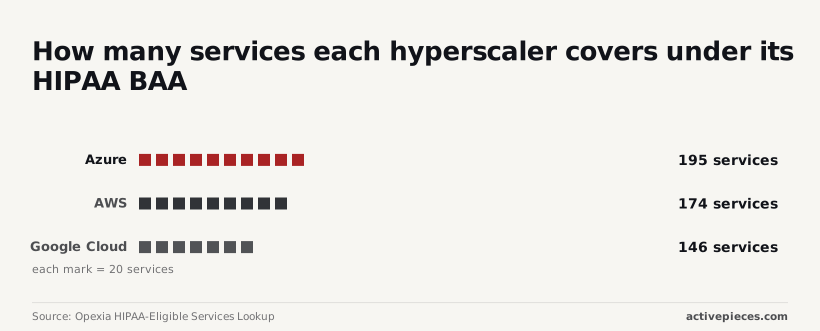
Because Azure's list is the longest, a Microsoft-based workflow has the most connectors that stay inside one signed agreement. Each count is still a list of eligible services, so you must confirm that every step in your flow appears on it.
"Contact sales" usually means the BAA is an enterprise-contract item, negotiated with the plan, so you should expect to name your PHI use case before anyone quotes a price.
On a vendor's trust page, look for three things: a statement that a BAA is offered, the plan it attaches to, and the regions where data is processed.
A page that gives only a SOC 2 badge answers none of them, so request the BAA terms themselves before you build.
You can follow the rest of this with the builder open. Start free, no card.
The strongest case for choosing a big-vendor BAA platform
Buying from a hyperscaler or enterprise integration vendor with a signed BAA is defensible. Auditors recognize its attestations, liability is easier to assign, and self-hosting loads security work onto a small team.
Auditor familiarity and shared responsibility for BAA platforms
Whether it comes from a large vendor or a small one, the business associate contract that 45 CFR 164.502(e) and 164.308(b) require is the same document. What differs is how much work it takes to show an assessor that the vendor's controls hold.
Believers in the big-vendor route give four reasons:
- Auditors already know the vendor's attestations and reports, so evidence review goes faster than it would for an unfamiliar tool.
- Liability is clearer, because the contract names one party responsible for the infrastructure and one for your configuration.
- Support and uptime are contractual, with service commitments you can enforce instead of a community forum.
- Self-hosting puts the security burden on a small team that must patch, monitor, and log without a dedicated security function.
Together these reasons describe a division of labor: the vendor answers for the platform, and you answer for how you use it. That division is real, and it's why a procurement or privacy officer often prefers it.
The catch is scope. Each hyperscaler's BAA covers a defined list of services, and the lists differ by vendor, so a workflow that touches one uncovered service can put PHI outside the agreement.
Read the covered-services list for each vendor you shortlist before you design around it.
The hidden cost of self-hosting a HIPAA platform
If you self-host, data stays in your own environment, which suits regulated teams with strict residency needs. It also means your team owns everything the vendor would otherwise carry: patching, access reviews, encryption key handling, backups, audit log retention, and incident response.
Under the HIPAA Security Rule those are your obligations either way, but a vendor's BAA at least shares the load for the layers it operates.
For a team of a few engineers, the risk is less a single breach than steady drift. A missed update or a lapsed access review is exactly what an assessor will find, and no attestation of someone else's will cover it.
Self-hosting is therefore a staffing decision as much as a data-location one.
How Activepieces fits regulated teams that keep data in-house
With Activepieces, a regulated team chooses where workflow data lives (self-hosted, air-gapped, or managed cloud in an EU or US region), and the platform holds SOC 2 Type II.
That covers the platform link in the chain, which is the one link you can fully control.
Because every later control inherits the location you pick first, the steps below run in the order the decisions constrain each other.
- Choose the deployment: self-host, air-gap, or managed cloud in an EU or US region.
- Connect single sign-on and SCIM so identity stays in your directory.
- Define custom RBAC roles that match your actual job functions.
- Turn on audit logs.
- Start on the public pricing page, where the self-serve plans are priced openly and the self-hosted Community edition is free, then confirm directly with Activepieces which compliance scope you need.
Under Chapter V of the GDPR (Articles 44 to 46), moving personal data outside the EEA requires a legal basis. The Court of Justice's Schrems II ruling turned that from paperwork into real transfer assessments. Choosing the EU cloud region keeps processing inside the region.
Self-hosting goes further: workflow data never leaves your environment, so the platform adds no new transfer to document. You inherit the operational work in exchange, including patching, backups and uptime.
An air-gapped install removes the outbound path entirely, which means every integration must be reachable from inside your network. Cloud-only apps won't connect.
HIPAA platform access control and audit trails
Remove someone from your directory and, with SSO and SCIM, their access to the platform goes too, with no orphaned accounts left behind by a manual offboarding.
With custom RBAC roles you can apply the least-privilege principle. Article 32 expects "appropriate" security, for example by separating who builds a flow from who can view its run data.
Audit logs then give you evidence of who changed what. They record platform activity, so how long you retain them and who reviews them remains your configuration.
Don't assume unverified HIPAA claims
You should not enter a HIPAA certification or a signed BAA for Activepieces in your vendor file as an assumption, because it states neither. A regulated team can self-host to keep protected data in its own environment, but the compliance determination stays with that team.
In a security review, ask for the SOC 2 Type II report, the data-location terms for each deployment, and the exact plan that includes SSO, SCIM, RBAC and audit logs.
Why a BAA alone does not make your workflows compliant
Once a business associate agreement (BAA) is signed, the vendor is answerable for its side of the data flow. Your own build decisions stay your liability, so the staff running the platform matter as much as the contract.
HIPAA integration mistakes that cause penalties
Three errors recur. The first is a non-BAA app in one step. A workflow that passes patient data to a notification tool without its own agreement has sent protected health information (PHI) outside your coverage, whatever the platform signed.
The second error is logging PHI. Run histories and error logs often store full payloads, so an unmasked field turns a debugging convenience into a retained copy of patient data.
The third error is weak access control: shared logins and broad editor rights mean you can't show who touched a record, and that's the question an auditor asks first.
HIPAA penalty and breach cost figures
Healthcare data breach costs by industry
IBM's 2024 cost-of-a-data-breach research puts healthcare at $9.77 million per breach, ahead of finance at $6.08 million, industrial at $5.56 million and energy at $5.29 million. So a healthcare team's incident costs roughly 60% more than a bank's.
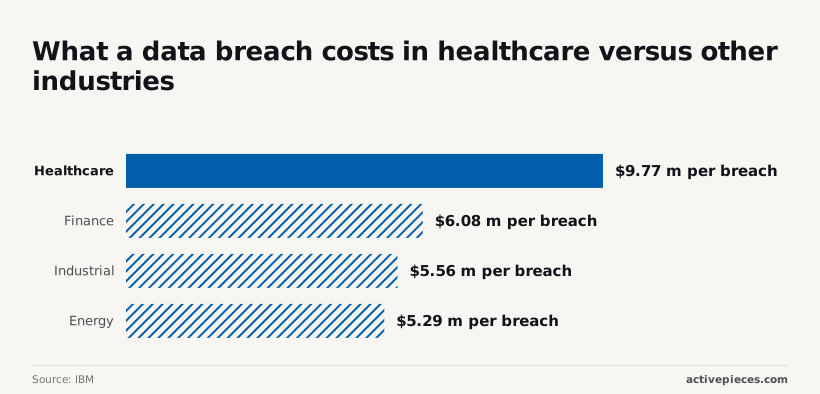
At $10.93 million in 2023, healthcare breach cost peaked, then fell to $7.42 million by 2025, as the trend below shows, though that is still higher than any other industry.
That's relief only until you compare it with the other sectors above.
(chart)
Even the lowest 2025 figure sits above every other 2024 industry average.
HIPAA per-violation penalty amounts
Then come the regulators' per-violation penalties. California HIPAA's civil penalty schedule sets the minimum at $145 per violation when you didn't know, $1,461 for reasonable cause, $14,602 for willful neglect that was corrected, and $73,011 for willful neglect left uncorrected.
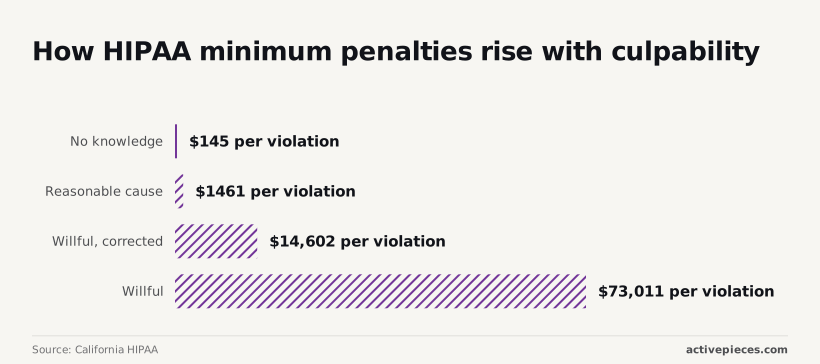
Leaving a violation uncorrected is therefore vastly more expensive than correcting it.
A workflow that runs thousands of times a day can repeat one flaw thousands of times. A documented, uncorrected flaw sits in the top tier, where the floor is about 500 times the lowest.
Third-party apps in HIPAA integration workflows
Your platform may hold a signed BAA, but every app a workflow touches is a separate data recipient. Before building, list each connected service, confirm it has its own agreement, and check what its API returns in logs.
The platform's contract covers the platform, while the chain is only as strong as its least-covered step.
Frequently asked questions
Is Zapier HIPAA compliant?
Not by default, because no integration platform is; what matters is whether Zapier will sign a business associate agreement (BAA) covering your account, and on which plan.
Get that answer in writing from its sales team rather than inferring it from a badge or a trust page.
Without a signed BAA, any workflow that touches protected health information (PHI) leaves you exposed, however good the vendor's security controls are.
Can I use a platform without a BAA if I remove PHI?
Only if the data is properly de-identified, and that's a higher bar than deleting names. HIPAA's de-identification standard, at 45 CFR 164.514, requires either an expert determination or the removal of a defined list of identifiers, including dates, locations and record numbers.
Somewhere in a free-text field, an appointment timestamp or a webhook payload sits an identifier you forgot, and that is how many automations fail it quietly. Check what the workflow's logs and error payloads retain too, since they often hold more than the happy path.
Does self-hosting remove the need for a BAA?
It removes the vendor from the data path, which can remove the need for a BAA with that vendor, but it doesn't make you compliant.
If the software runs entirely in your own environment and the vendor never sees PHI, there may be no business associate relationship to paper.
You then own everything the vendor would have shared: encryption, access control, backups, patching, audit logging and log retention. If you host on a cloud provider, that provider still needs a BAA, because it stores the data.
What should I ask in a security review? Ask questions that produce documents, not assurances:
- Will you sign a BAA, and on which plan?
- Where is data processed and stored for each deployment option, including logs and backups?
- Which plan includes SSO, SCIM, role-based access control and audit logs?
- How long are execution logs kept, who can read them, and can we shorten retention?
- Can we have the latest SOC 2 Type II report?
Push for specifics on the fourth question, because the answers show you where PHI will linger.
Related reading
Build it
Set this up in minutes.
No code required. Connect your accounts, and Activepieces runs it from there.
Start free Talk to sales