
How Much Does UiPath Pricing 2026 Cost?

Oct 10, 202617 min read
Navigating the complexities of enterprise automation requires a clear understanding of the financial commitment involved, especially as UiPath continues to evolve its licensing models.
While the platform offers unparalleled depth for large-scale digital transformation, many organizations are now evaluating how it stacks up against modern competitors, including open-source options like Activepieces that prioritize workflow simplicity, to ensure they are maximizing their return on investment.
This guide breaks down the current UiPath pricing tiers, hidden costs, and the most viable alternatives to help you determine which solution best aligns with your operational budget and technical requirements.
UiPath pricing refers to a tiered, consumption-based subscription model that scales based on the deployment of software robots, developer seats, and specific platform capabilities for enterprise-grade robotic process automation.
The cost gap between robot types
A steep financial trade-off exists within UiPath’s pricing structure, forcing a choice between human-triggered tasks and autonomous background processing. The platform has a unified interface for designing workflows, but the underlying license costs scale based on how much human supervision is required during execution.
UiPath attended robot pricing
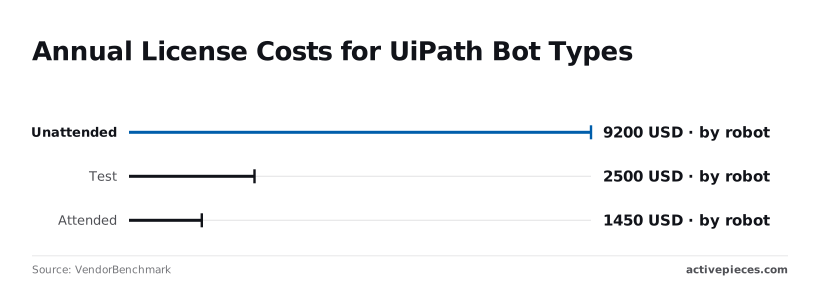
$1,450 per year is the price of an Attended Robot according to VendorBenchmark, which represents the baseline recurring cost for a single automated seat, meaning companies must justify this overhead for every individual user added to the automation pool.
You must prove that a single employee’s manual data entry overhead exceeds this amount before the seat breaks even.
Because these bots share the user’s workstation and session, they can't run independently at night. UiPath ties these licenses to specific users and requires manual intervention to start.
You must prove that a single employee’s manual data entry overhead exceeds this amount before the seat breaks even.
This makes them suitable for call center agents or accountants who need a sidekick to pull data from a legacy ERP. This limits their utility to the active hours of the human staff member.
The premium for unattended background automation
Transitioning to fully autonomous workflows requires an Unattended Robot at $9,200 per year. This 534% price jump effectively mandates high-volume use cases to justify the investment.
Without human oversight, the license allows the software to log into a virtual machine, manage its own Windows session, and process queues 24/7.
For your team, if you only need to sync leads between a CRM and a marketing tool, lightweight alternatives like Activepieces often cost less than this entry price.
The run is the meter, not the steps inside it; the published pricing page shows 1 credit per flow run regardless of the number of steps, which avoids the compounding costs of per-task or per-module billing found in other platforms.
The jump from supervised to autonomous execution is the single largest cost driver in the ecosystem, as shown in the Annual License Costs for UiPath Bot Types.
This pricing delta forces you to consolidate multiple small tasks into a single high-density robot to avoid wasting the $9,200 overhead on low-frequency triggers.
UiPath test robot pricing
Validating these automations before production adds a $2,500 fee for a Test Robot, which adds a fixed tax to the DevOps lifecycle of every new workflow, effectively increasing the barrier to entry for smaller automation projects, so teams with limited budgets may be forced to skip critical quality assurance steps.
This ensures that testing doesn't consume expensive production capacity.
In a staging environment, a developer can't verify a complex unattended bot without spending nearly double the cost of a standard attended license. Consequently, you might skip dedicated test licenses, increasing the risk of production failures when underlying application UIs change.
If you are running this arithmetic for your own team, see what the same workload costs on Activepieces.
AI Units: the hidden meter on intelligent automation
UiPath Document Understanding and specialized AI features use a consumption-based "AI Unit" currency. This currency decouples automation costs from fixed license fees and ties them directly to data throughput.
The actual expense of running a robot fluctuates based on the complexity of the documents it reads or the specific machine learning models it invokes, even if you have a fixed budget for the "Robot" itself.
How UiPath AI Units get consumed
AI Units function as a prepaid credit system where different activities deduct varying amounts from a central tenant pool. For example, performing Optical Character Recognition (OCR) on a standard PDF consumes a baseline amount of units.
The burn rate per page increases when applying a specialized model like Claude Sonnet 5.5 for complex classification or using Gemini 3.8 Flash for high-speed reasoning.
This granularity ensures that simple digitized documents don't cost as much as those requiring deep semantic analysis. Yet it forces you to account for the "cost per execution" during the design phase rather than treating compute as a sunk overhead.

Comparing UiPath DU to cloud native OCR
As volume scales from thousands to millions of pages, the financial gap between UiPath’s integrated Document Understanding (DU) and standalone cloud services becomes apparent.
UiPath has a unified interface that simplifies model training and deployment for non-coders, but the premium for this convenience is steep compared to using raw APIs from providers like Google Cloud or AWS.
The following data illustrates the annual cost of UiPath Document Understanding as page volume increases:
- 40,000 pages: $8,000
- 1,000,000 pages: $150,000
- 10,000,000 pages: $1,000,000
While the per-page cost decreases at the highest tier, the absolute expenditure reaches a point where the platform tax outweighs the labor savings of using a low-code environment.
At the million-page mark, the $150,000 price tag costs several multiples more than calling Mistral OCR 4.1 or Gemini 3.5 Flash-Lite directly. This makes the platform a luxury for high-volume back-office processing.
Managing unpredictable consumption costs
To prevent budget overruns, you must implement strict governance over how and when you trigger AI-heavy workflows.
Without these controls, a single loop error in an automation or an unexpected spike in incoming invoices can deplete a year’s worth of AI Units in a single afternoon.
A runaway bot will not exhaust your tenant's credit pool if you set hard caps on the number of pages a specific process can consume per day.
Routing simple tasks to cheaper models like GPT-6 Luna or deepseek-flash and reserving high-reasoning models like Claude Fable 5.1 for exceptions reduces the average unit burn per transaction.
Utilizing the Automation Cloud's dashboard to track consumption by folder allows you to charge back costs to specific departments rather than absorbing them into a general IT budget.
UiPath usage limits and upgrade triggers
UiPath enforces hard caps on concurrency and storage that mandate a transition from Community or Pro tiers to Enterprise agreements.
While the initial entry point is accessible, the vendor designed the architectural constraints to funnel growing operations into high-commitment contracts once basic task automation evolves into a production-grade pipeline.
UiPath Data Service storage limits
The transition begins when the Data Service hits its ceiling. The Data Service is the platform’s centralized storage for persistent automation data.
The Community plan limits you to 1 GB of storage, which means a high-volume logging process or a large-scale document extraction project will halt unless old records are manually purged.
If your workflow involves heavy document processing, the financial implications of scaling are immediate. According to data from InvoiceExtractor, processing 1 million pages annually costs $150,000 with UiPath Document Understanding (DU), whereas the same volume costs $10,000 with AWS Textract.
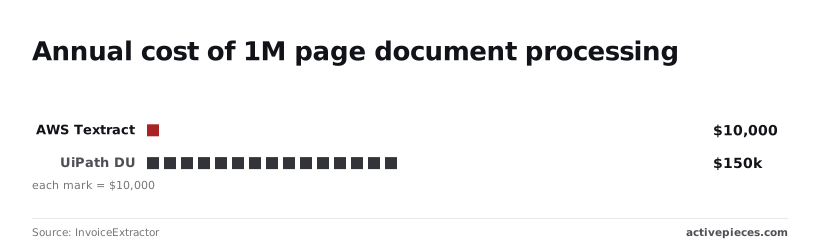
This is a fifteen-fold difference in annual expenditure for the same output. The $140,000 gap is the premium paid for integrated platform features over raw API usage. It quantifies the cost of convenience versus infrastructure-only services.
UiPath concurrency and queue limits
Operational bottlenecks occur when you attempt to run multiple automations simultaneously on shared infrastructure. The platform tracks the "upgrade trigger sequence," a specific progression of friction points that necessitates a higher spend:

- Reach 3 concurrent job limit stops you from running more than three processes at once, causing new tasks to fail rather than queue.
- Exceed community storage caps means the automation stops writing to the database, breaking any state-dependent workflows.
- Hit the 5-user ceiling restricts collaboration, preventing new developers from accessing the shared Orchestrator environment.
- Transition to mandatory commercial support occurs once the previous limits are breached, and you must move to a paid tier to regain functionality.
Exceeding these limits forces a shift from reactive task-running to a structured capacity planning model.
UiPath Enterprise support and SLA costs
Moving to the Enterprise tier is the only way to access a guaranteed Service Level Agreement (SLA) for platform uptime. On lower tiers, a system outage could stall a business-critical process for hours without a formal recourse.
Enterprise support is different because it has a dedicated technical account manager to resolve infrastructure failures. This transition isn't merely about headcount. It's a requirement for any team that can't afford the unpredictability of community-driven troubleshooting.
Decoupling costs from consumption through architecture
To avoid the per-task tax inherent in modern iPaaS models, organizations are increasingly adopting architectural strategies that prioritize cost predictability. By shifting away from proprietary clouds, teams can regain control over their automation budgets.
Self-hosted open-source automation alternatives
Self-hosting an automation engine on private infrastructure allows you to bypass the consumption meters used by major vendors. When you host the software on your own servers, your costs are tied to compute resources rather than the number of tasks executed.
This approach is common among teams using open-source frameworks or self-hosted versions of automation tools to maintain a flat budget.
Capping costs with infrastructure-based billing
Infrastructure-based billing models provide a safeguard against the unpredictable spikes of per-execution pricing. By paying for a fixed amount of server capacity or a flat annual license, you ensure that a high-volume day does not result in an emergency budget request.
This strategy is essential for scaling background processes that handle thousands of daily events without incurring incremental fees.
Worth checking against a plan that does not meter every step: one credit covers a whole run on Activepieces.
UiPath alternatives for enterprise automation compared
Microsoft Power Automate: The bundled alternative
If you're already operating within the Microsoft 365 ecosystem, Microsoft Power Automate has a lower barrier to entry because it uses existing identity management and data connectors.
This integration means you can grant automation permissions through the Microsoft Entra ID portal. This is the same interface used for standard email and file access.
Power Automate allows you to create flows directly in a web browser, reducing the local hardware requirements for your departmental developers.
While UiPath requires specialized Studio software for complex builds, the Microsoft platform relies heavily on the Power Platform environment. If you're automating legacy desktop applications, you must still license per-user or per-flow credits to access the necessary "premium" connectors.
Activepieces: The open-source and developer-friendly choice
Activepieces provides granular usage visibility across 739+ integrations, allowing teams to set hard cost caps per project or person to prevent the unpredictable credit depletion common in consumption models.
The following table outlines how the UiPath 2024 tiers distribute resources, highlighting the jump from individual learning to governed enterprise scale:
| Feature | Free Tier | Pro ($420/mo Developer) | Enterprise (Custom) |
|---|---|---|---|
| Orchestrator Access | Shared Community Cloud | Dedicated Tenant | Multiple Production Tenants |
| Support Level | Community Forum | Standard (Email) | 24/7 Premium / Mission Critical |
| Robot Types | 2 Attended / 1 Unattended | 1 Attended / 1 Unattended | Unlimited Scalability |
As soon as you require a dedicated production environment, this tiered structure demonstrates that the cost shifts from a flat software fee to a managed platform commitment.
Transparent pricing for scalable workflows
At the million-page mark, the $150,000 price tag costs several multiples more than calling Mistral OCR 4.1 or Gemini 3.5 Flash-Lite directly, suggesting that direct API integration offers a far more efficient path for budget-conscious organizations.
Unlike UiPath’s thousands-of-dollars entry point, the platform uses a task-based credit system where you only pay for what you execute.
For larger organizations, the Enterprise self-hosted version moves away from per-task billing to a flat annual fee based on the number of users or instances.
This allows you to run millions of automations on your own hardware without the per-execution tax that makes UiPath cost-prohibitive at scale.
By allowing you to self-host the entire stack on your own infrastructure, Activepieces avoids this specific escalation.
The enterprise feature list (including SSO, SCIM, custom RBAC, and audit logs) is identical in the self-hosted air-gapped documentation and the managed cloud, ensuring that regulated organizations do not lose control for the sake of functionality.
This setup ensures that data never leaves your corporate firewall. Because it uses a TypeScript-based framework, your software engineer can write custom logic using Gemini 3.8 Flash to generate specific automation scripts. They aren't restricted to the pre-built activities found in a proprietary library.
MoneyGram and Moneypenny run Activepieces in production to maintain this level of architectural flexibility while scaling their automation efforts.
Automation Anywhere: The direct legacy competitor
Automation Anywhere is the primary alternative for you if you require a web-based, cloud-native architecture for large-scale Robotic Process Automation. Unlike the thick-client installation required for UiPath Studio, the Automation 360 platform runs entirely in a browser.
At the million-page mark, the $150,000 price tag costs several multiples more than calling Mistral OCR 4.1 or Gemini 3.5 Flash-Lite directly, rendering the choice of vendor a critical factor in project profitability.
It maintains a similar focus on "Digital Workers," which are licensed as discrete units of labor to perform repetitive back-office tasks.
While the interface is designed to be accessible to business analysts, the underlying complexity of its Control Room demands a dedicated infrastructure team to oversee security and bot scheduling.
The Monday morning automation audit checklist
Determining whether to renew a UiPath contract requires a rigorous comparison of current execution volume against the total cost of the platform's infrastructure and management overhead.
Because the vendor has transitioned to a consumption-based model, if you built your workflows on legacy per-robot licensing, you may find your monthly AI Unit burn exceeds your budget.
As soon as you integrate intelligent document processing or advanced reasoning models, this happens.
For instance, calling Claude Sonnet 5.5 for complex knowledge work through the AI Center incurs a specific unit cost per request. This cost can fluctuate based on the volume of tokens processed.
You must verify if your current throughput justifies the expense of maintaining the Orchestrator alongside the specialized technical staff required to patch and secure it. The Orchestrator is the server-side management application.
The per-run cost of a consumption platform often outweighs the utility of a full-scale RPA suite if the majority of your active workflows are simple API-to-API transfers.
This is especially true if they don't utilize the proprietary computer vision features for legacy Windows applications. To evaluate this trade-off, perform a Monday Morning Audit: inventory active robots, calculate monthly AI unit burn, check concurrent execution peaks, and compare total cost against per-user alternatives.
What Activepieces does about this
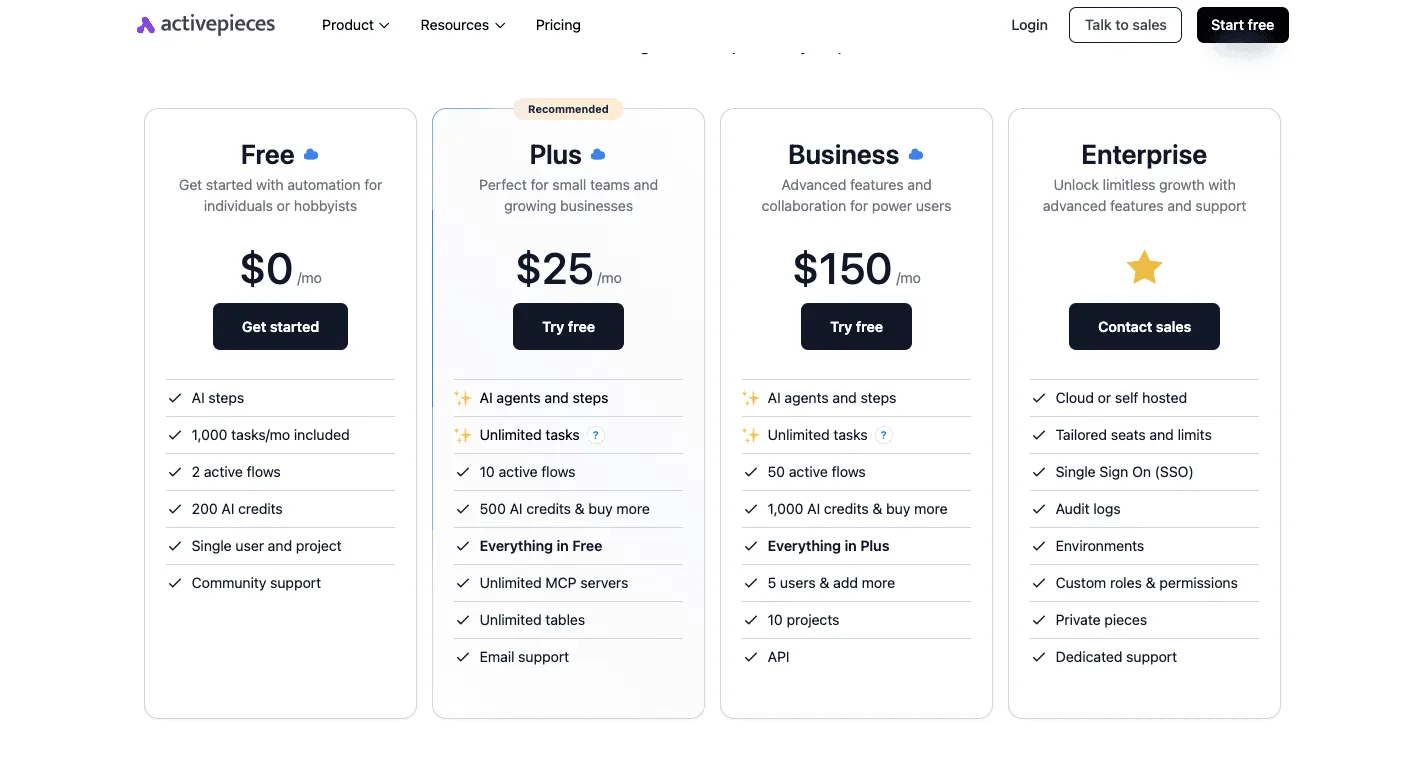
Activepieces addresses the cost-prohibitive nature of enterprise automation by replacing the rigid $9,200 unattended license with a flexible, task-based credit system. Instead of paying for a robot to sit idle, you only pay for the actual execution of a workflow.

The platform charges 1 credit per flow run regardless of the number of steps or modules involved, which eliminates the compounding costs found in UiPath’s AI Unit meters. This makes it financially viable to automate low-frequency tasks that would never justify a dedicated UiPath seat.
For organizations that need to scale without the "platform tax," Activepieces offers a self-hosted Enterprise version under an MIT-licensed core. This allows you to run millions of automations on your own infrastructure for a flat annual fee, completely decoupling your budget from your execution volume.
Companies like MoneyGram and Moneypenny use this model to maintain architectural flexibility, ensuring that high-volume data processing remains cost-effective as they grow.
The platform also solves the "black box" pricing of intelligent automation by providing granular visibility into usage across 739+ integrations.
While UiPath forces an upgrade to Enterprise tiers to access basic governance, Activepieces includes SSO, RBAC, and audit logs in its self-hosted version to ensure regulated teams stay compliant without a mandatory price jump.
Because the framework is TypeScript-based, developers can write custom logic to call models like Gemini 3.8 Flash directly, avoiding the proprietary markups associated with UiPath’s Document Understanding.
For organizations prioritizing cost predictability in complex workflows, Activepieces is the better choice for high-step automations. By billing a single credit per flow run rather than charging for every individual task or module, the platform removes the financial penalty associated with sophisticated logic.
This flat-rate execution model ensures that scaling operational depth does not lead to the compounding expenses typical of per-step competitors.
Frequently asked questions about UiPath costs
Does UiPath offer a student or academic discount?
UiPath is free via the Community Edition for students and small non-profit organizations, which removes the financial barrier to entry for individual learners.
This version includes access to the Studio development environment and a limited number of cloud-based robots. You can build and test automations without committing to an enterprise contract.
For accredited educational institutions, the Academic Alliance program is the source for access to curriculum resources and software for classroom use. This allows universities to integrate automation into their degree programs without incurring the per-user licensing fees typically charged to commercial entities.
Can I still buy a perpetual UiPath license?
UiPath has transitioned exclusively to a subscription-based model, meaning you no longer have the option to pay a one-time fee for lifetime software ownership.
This shift ensures that every customer is running a version compatible with their cloud-based Orchestrator, which manages the deployment and monitoring of automated tasks.
Existing perpetual licenses may be honored under specific legacy agreements, but they aren't a way to access the latest AI-driven features or cloud hosting services.
Consequently, if you're seeking to use modern tools like the Document Understanding framework, you must migrate to the recurring Flex or Cloud licensing tiers.
What happens if I exceed my AI Unit limit mid-month?
When your workspace exhausts its allocated AI Units before the billing cycle resets, all services that rely on consumption-based processing will stop functioning immediately. This hard cap affects specific high-intelligence tasks.
Document extraction workflows using OCR 4.1 to identify structured data from invoices will stop. Natural language classification tasks routed through Claude Haiku 5.5 for sentiment analysis will stop. Advanced reasoning steps performed by Gemini 3.8 Flash within the AI Center will also stop.
To resume operations, you must either purchase additional capacity bundles or wait for the next monthly allocation to refresh.
Because the system doesn't automatically scale or bill for overages by default, a sudden spike in volume can lead to a complete halt in your automated production pipelines until manual intervention occurs.
Related reading
References
Running the numbers
See what the same workload costs here.
Free forever plan, and every paid plan self-hosts at no extra cost.
See pricing Talk to sales