Inkling 2 Small Automation Within the Vendor's Limits

Nov 21, 202614 min read
Automating with Inkling 2 Small means one trigger, one model call and one checked output, and a workflow tool such as Activepieces can hold that trigger in place.
Build it inside the limits the vendor's model page publishes, and confirm them against that page on a stated date.
Anything wider is a guess about limits nobody has written down.
Inkling 2 Small automation in one paragraph
What Inkling 2 Small is, per the vendor
Whatever the vendor's own model page says Inkling 2 Small is, that is what it is, and nothing a forum thread adds. This guide leans on four facts from that page.
- The model identifier, copied exactly, because a near-miss string returns an error at run time, not at build time.
- The context size, because input past it is cut or refused, and a run that "worked" on short test data fails on real data.
- The input types, because a file type the page doesn't list is the first thing a trigger will hand you by accident.
- Anything the page leaves unpublished, recorded as unpublished and not filled in from memory, so no later step quietly depends on it.
Put the date you checked beside each item.
When a trigger fires, one model call runs, and one check decides whether the output moves on.
I wrote this guide on 2026-11-21. Treat any setting not confirmed on the vendor's page by that date as unpublished.
Everything below works on Activepieces' free plan. Start without code or a credit card.
Inkling 2 Small requirements, API access and pricing
Before the first run you need seven items from the vendor's docs. They are plan, access method, API key, model identifier, availability, input price and output price, each with the date you checked it.
The table records what this guide could confirm, so a blank is a finding.
| Item | Documented value | Source URL | Date checked | Not documented flag |
|---|---|---|---|---|
| Account or plan | None recorded | None | n/a | Yes |
| Access method | None recorded | None | n/a | Yes |
| API key | None recorded | None | n/a | Yes |
| Model identifier | None recorded | None | n/a | Yes |
| Availability | None recorded | None | n/a | Yes |
| Input price | None recorded | None | n/a | Yes |
| Output price | None recorded | None | n/a | Yes |
Because every row is flagged, fill each one from the vendor's page and write the date beside it before you build.
Copy the plan name and both prices from the vendor's page, with the date. Until a price is in your table, you can't estimate what a run costs, so don't guess one.
Copy the key's name and the model identifier character for character. A mistyped identifier fails the call, and a key from the wrong plan may fail the same way.
Inkling 2 Small local disk space by quantization
Go local and the weight files grow with each quantization level. According to Unsloth, UD-IQ1_S is 171.7 GB, the smallest option, and UD-IQ2_XXS is 190.6 GB, so storage availability is your first constraint.

Step up to UD-Q2_K_XL at 205 GB and then UD-IQ3_XXS at 226 GB, and a 256 GB drive has about 30 GB left before the OS and your outputs, which means neither model can be installed.

At 285.1 GB, UD-Q3_K_XL no longer fits that drive. UD-Q4_K_XL is 354.2 GB, more than double the smallest file, so check free space before you start a download.
Numbered steps to automate with Inkling 2 Small
With the download finished and the disk still standing, the path is five steps in a fixed order: one task, one request, one checked output, one trigger, one log, meaning progress is sequential. Skipping ahead is how a working demo becomes a silent failure.
Step 1: Pick one narrow, repeatable task
Choose a job that has the same input shape every time and an answer you can check by eye. A good example is sorting incoming support emails into a fixed list of labels.
If you can't say what a correct output looks like, you can't validate it in step 3.
Step 2: Send your first request with documented settings
Open the vendor's official quickstart and read each parameter name and its default from the page itself, not from a forum post or a memory of another model. Write the date you read them next to your configuration.
Send one call by hand before you wire anything to it.
Step 3: Constrain and check the output. Ask for a fixed structure, then reject anything that doesn't match it. Count a label outside your list, a missing field or an empty reply as a failure, and don't pass it downstream.
The check is the step that separates automation from hope, because the model will always return something that looks plausible.
Step 4: Run it on a schedule or trigger. Attach exactly one trigger: a new email, a file arriving, or a timed run.
Add a second trigger only after the first has run cleanly. Two triggers feeding one call is how duplicates and runaway loops start.
Step 5: Log results and failures. Record the input, the raw response, the verdict from your check, and the time. When something breaks, the log is your only evidence, and the settings date from step 2 tells you whether the documentation changed under you.
Documented limits of Inkling 2 Small
You will look for most of these limits in vain: they aren't stated in the sources checked for this guide. The table below shows six limits, and nearly all of it reads "not stated."

| Limit | Documented value | What happens when exceeded | Source | Check date |
|---|---|---|---|---|
| Context size | not stated | not stated | not stated | 2026-11-21 |
| Output length | not stated | not stated | not stated | 2026-11-21 |
| Rate limits | not stated | not stated | not stated | 2026-11-21 |
| Request size | not stated | not stated | not stated | 2026-11-21 |
| Input types | not stated | not stated | not stated | 2026-11-21 |
| Price per unit | not stated | not stated | not stated | 2026-11-21 |
Read every "not stated" as a number you must confirm on the vendor's page before the workflow depends on it.
Because the sources checked state neither context nor output limits, test with a deliberately oversized input, and record in the log whether the call fails, truncates or is silently trimmed.
Since no rate limit is stated, assume none you can count on.
If you want to go local, there's no laptop-sized option: Unsloth lists quantized files from 171.7 GB upward, with three quant levels in the smallest band, so budget for a large server before you plan a local trigger.
Before you promise a workflow that sends images or files, or that has a budget, check both: supported input types and per-unit price aren't stated.
Easier to see it running than to read about it: set it up free, no card.
Fix common Inkling 2 Small errors
Expect failures in four groups: access, limits, bad output, and tasks too hard for the model. Because input types and pricing are unstated, I give no error codes here; read the exact codes from the vendor's page and note the date.
When a key is rejected or a permission is missing, the run stops before any model call happens. Check the key, the account's access to this model, and the endpoint name against the official page.
Log the full response body, because the message usually names the cause.
Five failures are the ones an automation hits most often, and the table shows where each fix should be confirmed. Limit values are not filled in because I haven't confirmed them, so read them from the docs.
| Failure | Cause | Fix | Docs source | Community-reported? |
|---|---|---|---|---|
| Rate-limit rejection | Too many calls in a window | Queue calls, retry with backoff | Vendor limits page | No |
| Oversize request | Input exceeds the stated limit | Trim or split input | Vendor limits page | No |
| Truncated output | Output cap reached | Ask for shorter output | Vendor model page | No |
| Malformed output | Format not enforced | Validate, retry once | Not documented | Yes |
| Timeout | Slow or long call | Shorten the prompt, retry | Not documented | Yes |
Treat anything marked "Yes" as hearsay until you reproduce it.
When a sentence is cut off or a bracket is left unclosed, that is truncation. Validate every output against your schema and retry once. If the second attempt also fails, stop the run and flag it for a person instead of looping.
When the task is simply beyond a small model
On the Artificial Analysis index, Inkling 2 Small scores 31. That puts it five points above Mistral Large 4 at 26, a flagship open-weight model, and six above Muse Spark Open at 25.

Below that, Beam scores 18 and Nemotron 3 Ultra 12, so the gaps are real but modest, and an index is no guarantee your task passes. If validation fails on a sample of your real inputs, move up a model tier.
Connecting Inkling 2 Small to other apps with Activepieces
If validation still fails after you move up a tier, the problem is usually the glue around the model, not the model.
If Inkling 2 Small is reachable by API or HTTP, Activepieces can trigger it and route its output, and every connector you set up for that flow doubles as an agent tool.
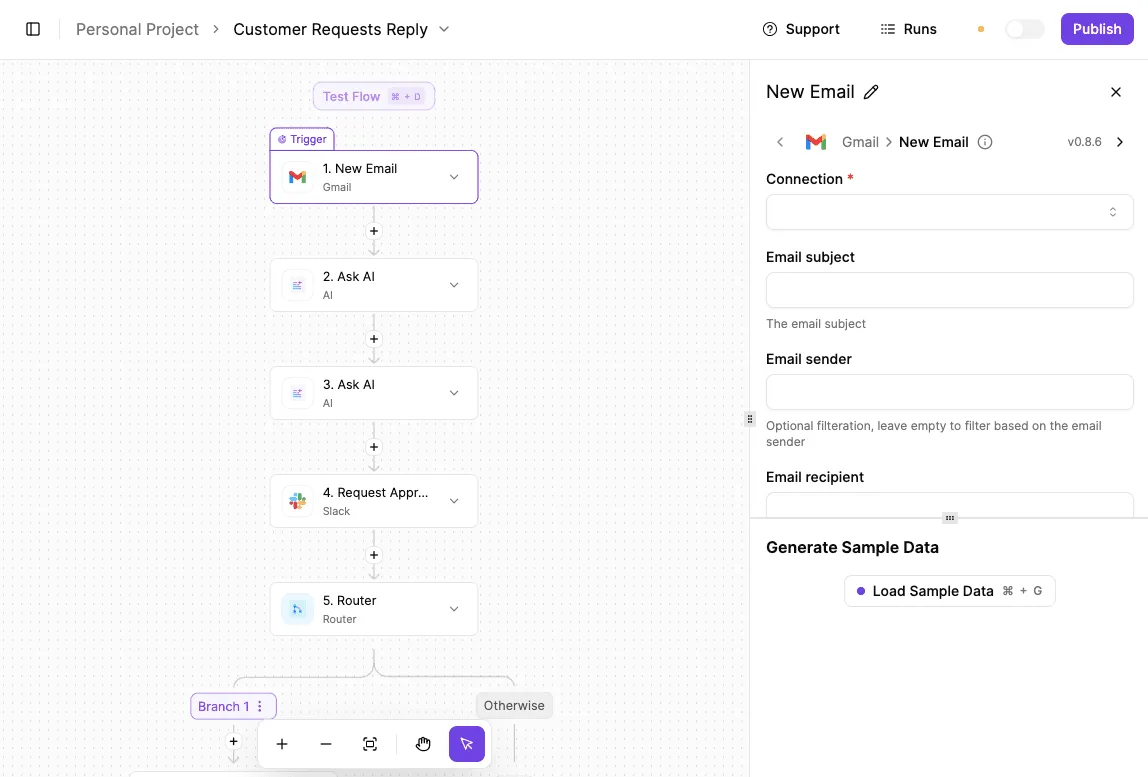
A integration registered once runs as a step in your flow and is also a tool schema on the project's MCP server, so Claude, ChatGPT, Cursor or an agent you built can call it without a second integration.
The mechanism is visible in packages/integrations in the open source repo, where the action a flow runs is the one the MCP server exposes. That automates the steps around the model, not the model itself, and it lifts no limit the vendor publishes.
Script, vendor integration or workflow tool
Whichever of the three routes you take, it assumes the vendor exposes an API, and none of them changes what the model accepts or returns.
The table shows where the real differences sit, and the takeaway is that you're choosing who writes the retry and failure handling, not what the model can do.
| Route | Setup effort | Error handling | Cost |
|---|---|---|---|
| Plain script | Highest: you write the trigger, call and check | Whatever you code, including silent failures | No platform fee, only the model calls |
| Vendor integration, if the vendor publishes one | Lowest, but confirm it exists on the official page | Limited to what the vendor chose to expose | Check the vendor's pricing page |
| Activepieces | Moderate: configure steps instead of writing them | Per-step failure settings and a run history | Free $0 for 1,000 credits, Plus $20 for 10,000, Team $200 for 50,000 a month |
On Activepieces, the free tier's 1,000 credits suit one trigger tested on real inputs. A flow that loops over a batch will spend an allowance faster than you expect. Confirm how credits are counted on their pricing page before you pick a plan.
Keep the flow to the narrow shape: one trigger, one step that calls the vendor's API, and one step that checks the output. Copy the endpoint, parameters and limits from the vendor's page, and note the date you checked them.
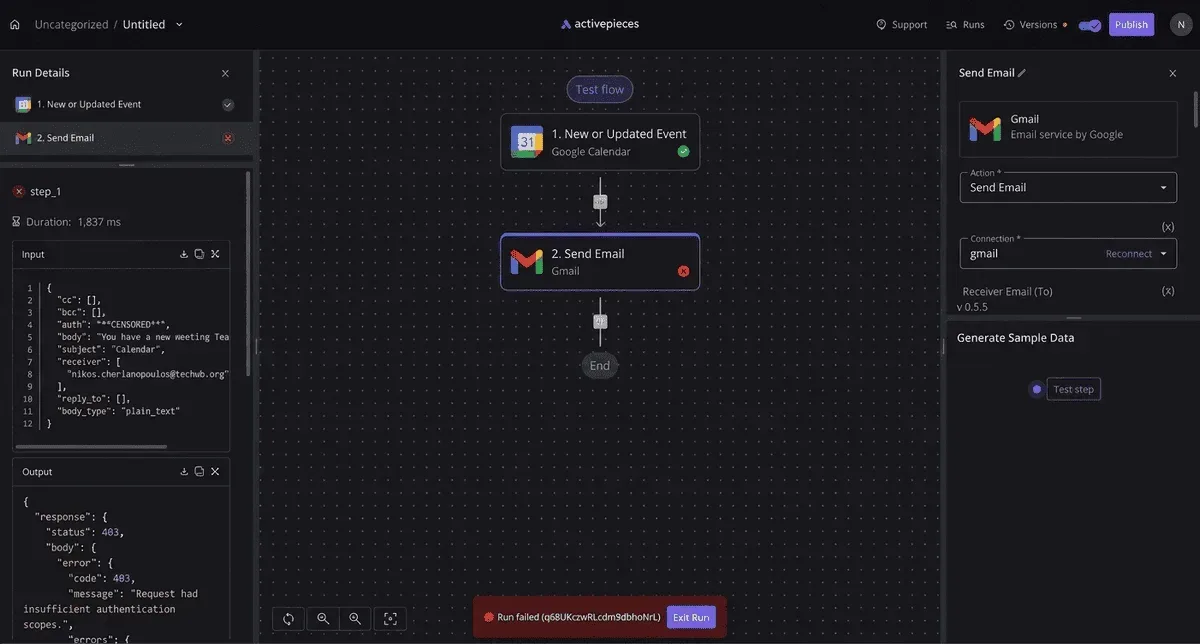
Set the failure behaviour on the model-call step explicitly, and route anything that fails validation to a person instead of the next step. A flow that quietly passes bad output downstream is worse than one that stops and shows you the failed run.

Steps for your first Inkling 2 Small automation
Spend your first week on five actions in a fixed order. The last one, deciding what a failed run does, is the one that keeps bad output from travelling quietly downstream.
- Pick one task with one trigger, one model call and one output you can check.
- Re-check the vendor's docs and pricing pages against today's date, and write that date down.
- Run twenty real samples from your own inputs, not invented ones.
- Set a spending cap before the flow runs unattended.
- Decide what a failed run does: stop, retry once, or alert a person.
Before you build an Inkling 2 Small automation
Choose a task narrow enough that you can say in one sentence what a correct output looks like.
Then open the official docs and pricing pages and record the date you read them. A limit or price you remember from a blog post is a guess.
Twenty is a small number of samples on purpose: it's enough to surface the malformed inputs and odd outputs you didn't predict, and it isn't a quality guarantee.
Pull them from real traffic, including the messy ones. Keep the failures, because they become your test set when you change a prompt later.
Set the spending cap now, and send a failed run somewhere a human will see it. Then put a recurring reminder to repeat the docs and pricing check, because a limit that changes after launch breaks a flow without any change on your side.
Frequently asked questions
Is Inkling 2 Small free to use? Not documented in the material this article draws on, so treat it as unconfirmed. Read the vendor's pricing page and note the date you read it.
A free tier that exists on paper can still carry usage caps that stop a flow midway, so confirm the caps too.
Can Inkling 2 Small run automations without code? Not documented here. The vendor's docs are the only source that can settle it.
If no-code triggers aren't listed there, assume you'll need a small amount of glue code or a separate workflow tool to start the model call. Plan the one-trigger, one-call, one-check flow around that.
Does Inkling 2 Small have an API? Not documented here, so confirm it before building.
Look for an API reference page, authentication instructions and a stated rate limit. If any of the three is missing, you have no basis for scheduling unattended runs, and a flow that depends on them will fail without warning.
How often do Inkling 2 Small limits change? No change schedule is documented here, so assume limits can change at any time. That's why the docs-and-pricing check needs a recurring date.
Compare the current page with your last saved copy. If a limit has moved, the flow can break even though nothing on your side changed.
What should I use if Inkling 2 Small is too limited?
Pick a model whose vendor documents the limits you need, then rerun the same dated check on it. Current options built for high-volume, low-latency work include Claude Haiku 5.5, GPT-6 Luna and Gemini 3.5 Flash-Lite.
Mistral Small 4 is another choice if you want a small general model.
Keep the same narrow design, one trigger, one call and one checked output. Then swapping the model changes one step and leaves the rest of the flow alone.