
What is x402? The AI Agent Payment Protocol (2026)

Nov 13, 202616 min read
Software agents can now purchase API resources individually rather than through human-managed subscriptions by using the x402 protocol. This system transforms the dormant HTTP 402 "Payment Required" status code into a functional machine-to-machine settlement layer.
When a connector is registered in Activepieces, it functions simultaneously as a workflow step and a tool schema on a per-project MCP server.
This allows an agent to call the same piece through Claude or ChatGPT without a separate export step or a second migration of the tool catalog.
The x402 protocol enables autonomous machine payments
How the 402 Payment Required status code evolved
Standard HTTP status codes typically manage technical states, but the 402 code remained a placeholder for decades until the demand for autonomous agentic commerce necessitated a standardized way for servers to request immediate compensation.
In a traditional SaaS environment, a developer pays OpenAI per token used for access to GPT-6 Astra, which means the developer bears the financial risk if the agent loops or scales unexpectedly.

The relationship between L402 and x402
The x402 protocol serves as the overarching standard for these payments, but its most prominent implementation is L402. While x402 defines the general behavior of the 402 status code for any digital asset, L402 is the specific technical implementation designed for the Bitcoin Lightning Network.
The "L" in L402 stands for Lightning, signifying that the payment layer is handled by off-chain Bitcoin micro-transactions.
This distinction is vital because Brave's implementation relies on x402 with USDC payments settled on the Base blockchain through its own facilitator, rather than on Lightning Network settlement.

Brave's analysis puts the x402 evolution as a shift of this burden to the agent itself, which must provide a cryptographic proof of payment before the server processes the request.
This allows for granular resource allocation where a high-reasoning model like Claude Opus 5.5 can be invoked for a single specific task without the overhead of a long-term contract.
The role of the Bitcoin Lightning Network in x402
High-frequency, low-latency settlement is required to make per-request billing economically viable for micro-transactions, and the Base blockchain provides that layer.
Traditional credit card rails impose minimum transaction fees that exceed the cost of a single inference call to a model like Gemini 3.8 Flash, making individual request billing impossible under current banking structures.
By utilizing the Base blockchain, x402 enables near-instant transfers of fractional value, ensuring that a fleet of agents running GPT-6 Luna can operate continuously across different providers without hitting the latency bottlenecks of on-chain settlement or the administrative friction of traditional invoicing.
Everything below works on Activepieces' free plan. Start without code or a credit card.
How the x402 handshake handles per-request billing
The x402 handshake automates value exchange by repurposing the standard HTTP 402 status code into a machine-readable demand for micro-payment.
This mechanism replaces the brittle practice of hard-coding API keys tied to corporate credit cards, which often leads to over-provisioning or service suspension when monthly limits are hit.
By moving the payment logic into the transport layer, an autonomous agent running GPT-6 Astra can negotiate access to a specific dataset or inference call without human intervention.
The 402 error as a payment trigger
When a server rejects an unauthenticated request with a 402 Payment Required status, it initiates the billing cycle by signaling that the resource is available but gated by a specific cost.
This response includes the payment requirements in the header, providing the exact instructions the agent needs to settle the debt. The following sequence defines the interaction:
- Agent sends GET request;
- Server returns 402 Payment Required + Invoice;
- Agent signs USDC payment;
- Agent retries request with proof-of-payment header.
This flow ensures that the service provider only commits compute resources after the agent has demonstrated the ability and intent to pay.
Preimage headers and proof-of-payment verification
Verification occurs when the agent resubmits the original request, now accompanied by a preimage, a cryptographic proof that the invoice has been settled on the blockchain.
The server validates this preimage against its own payment node to confirm the funds are secured before releasing the payload.
L402 Macaroon bearer tokens explained
The L402 standard uses Macaroons as the primary bearer token for authorization. A Macaroon is a decentralized credential that allows for granular caveats, such as limiting a token to a specific IP address or a single API endpoint.
Unlike a traditional API key that grants broad access, a Macaroon is cryptographically tied to the payment preimage. This ensures that the agent only gains access to the specific resource it has just funded.
For a high-reasoning model like Gemini 4 Carbon, this granular verification allows for "least privilege" financial access, where the agent is only authorized to spend the exact amount required for its next reasoning step rather than having open access to a broad departmental budget.
This atomic settlement removes the need for complex reconciliation at the end of the billing cycle.
Brave Search API uses x402 for agentic search
Brave Search implements the x402 protocol to enable autonomous agents to pay for search results at the moment of consumption without a pre-existing commercial contract.
This shift moves the financial barrier from the developer’s credit card to the agent’s own digital wallet, allowing a tool like Claude Opus 5.5 to independently fund its own data acquisition.
Pricing for the Brave Search x402 endpoint
Granular pricing allows agents to scale their intelligence gathering without the overhead of unused monthly quotas. By pricing at the request level, Brave ensures that an agent performing a single deep-research task only incurs the cost of the data it actually retrieves.
| Endpoint | Price per Request ($0.005) | Price per 1,000 ($5.00) |
|---|---|---|
| LLM Context | $0.005 | $5.00 |
| Web Search | $0.005 | $5.00 |
| News | $0.005 | $5.00 |
| Image | $0.005 | $5.00 |
Prices and plan limits checked against brave.com on November 13, 2026.
This transparency enables a model like Gemini 4 Carbon to calculate the exact ROI of a search query before executing the network call.
Why Brave chose x402 over traditional API keys
Traditional API keys create a liability loop where developers must over-provision credits to prevent agent downtime.
According to the Brave Blog, the search engine now runs its own facilitator on the Base blockchain (a Layer 2 network for Ethereum) to accept USDC directly. This architecture provides three distinct advantages for agentic workflows:
- Agents can pay for search access on the fly via Brave's HTTP 402 payment flow, meaning a new instance of GPT-6 Astra can begin searching immediately without a human creating a sub-account.
- Permissionless access: Unpaid requests return an HTTP 402 Payment Required status, providing the agent with the exact invoice details needed to settle the debt. Reduced counterparty risk: Since Brave accepts stablecoins on-chain, it bypasses the fees typically charged by credit card processors on micro-transactions.
By removing the friction of manual top-ups, Brave allows agents to treat web data as a just-in-time utility.
Comparing x402 to traditional API authentication methods
The x402 protocol replaces the heavy administrative overhead of identity-linked credentials with a stateless, payment-verified handshake.
Developers currently bypass official procurement cycles by using personal credit cards for team-wide access to Anthropic’s Claude Haiku 5.5, creating a security liability where credentials outlive the specific task they were meant to perform.
By shifting the verification from "who is requesting" to "is the request paid for," x402 allows a high-reasoning model like Gemini 4 Carbon to execute complex multi-step workflows without a human pre-authorizing a seat for every potential service in the chain.
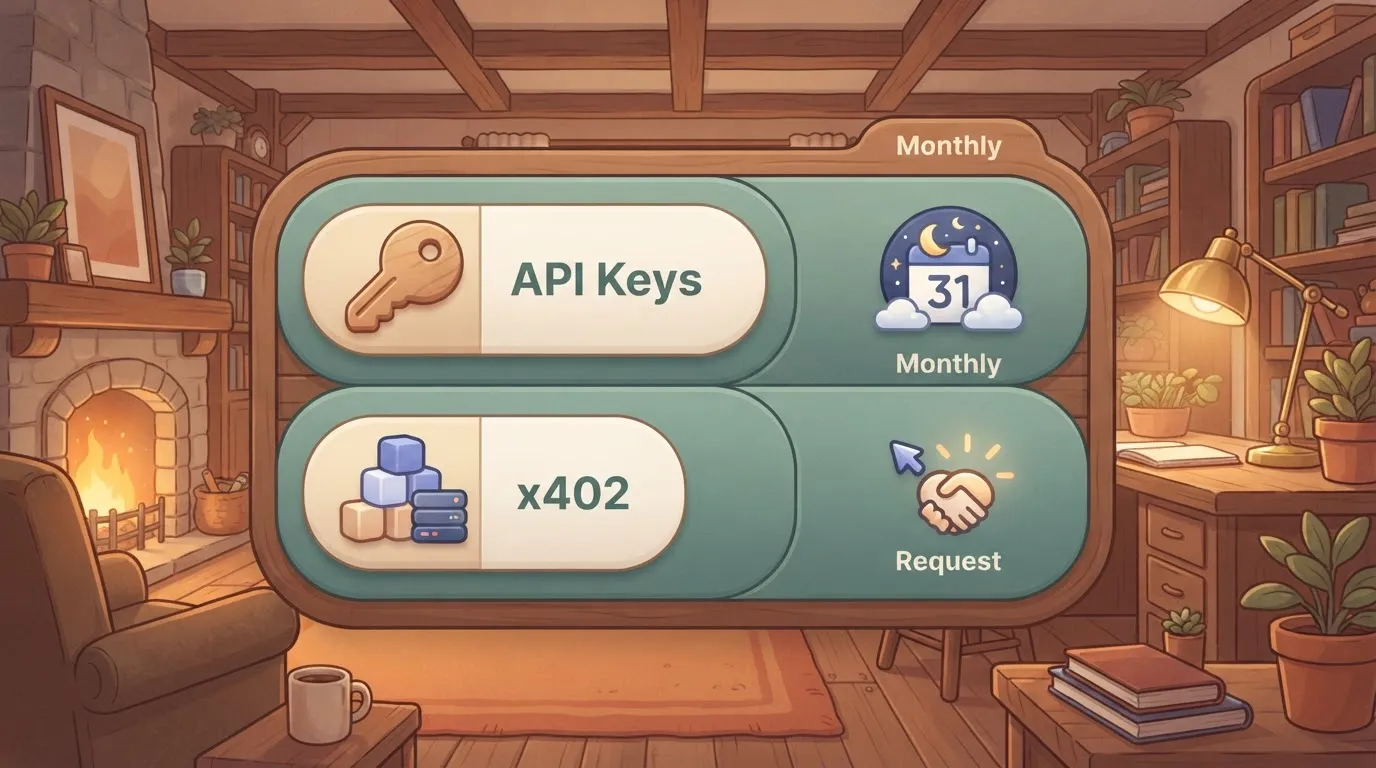
The following table demonstrates how x402 removes the structural barriers that prevent autonomous agents from scaling beyond single-vendor silos.
| Method | Setup Friction | Billing Unit | Identity Required |
|---|---|---|---|
| API Keys | High | Monthly | Yes |
| OAuth | Medium | Tiered | Yes |
| x402 | — | Request | No |
This comparison highlights a fundamental shift in the unit of economic exchange for software.
While OAuth requires a persistent relationship between a user and a provider, x402 enables a model like GPT-6 Astra to procure its own compute or data resources on the fly.
This transition moves the industry away from the brittle "all-or-nothing" access models of the past decade toward a granular, request-based economy.
Easier to see it running than to read about it: set it up free, no card.
Implementing x402 payments in agentic workflows
Standardizing x402 payments allows agents to negotiate access to restricted data at the exact moment of execution rather than relying on pre-shared API keys. This shift transforms a failed request into a commercial transaction, enabling autonomous agents to clear their own path through paywalled resources.
Standardizing x402 payments allows agents to negotiate access to restricted data at the exact moment of execution rather than relying on pre-shared API keys.
Handling the HTTP 402 payment required response
When a workflow triggers a request to a premium endpoint, the server returns a 402 Payment Required status to signal that the resource is available but locked.
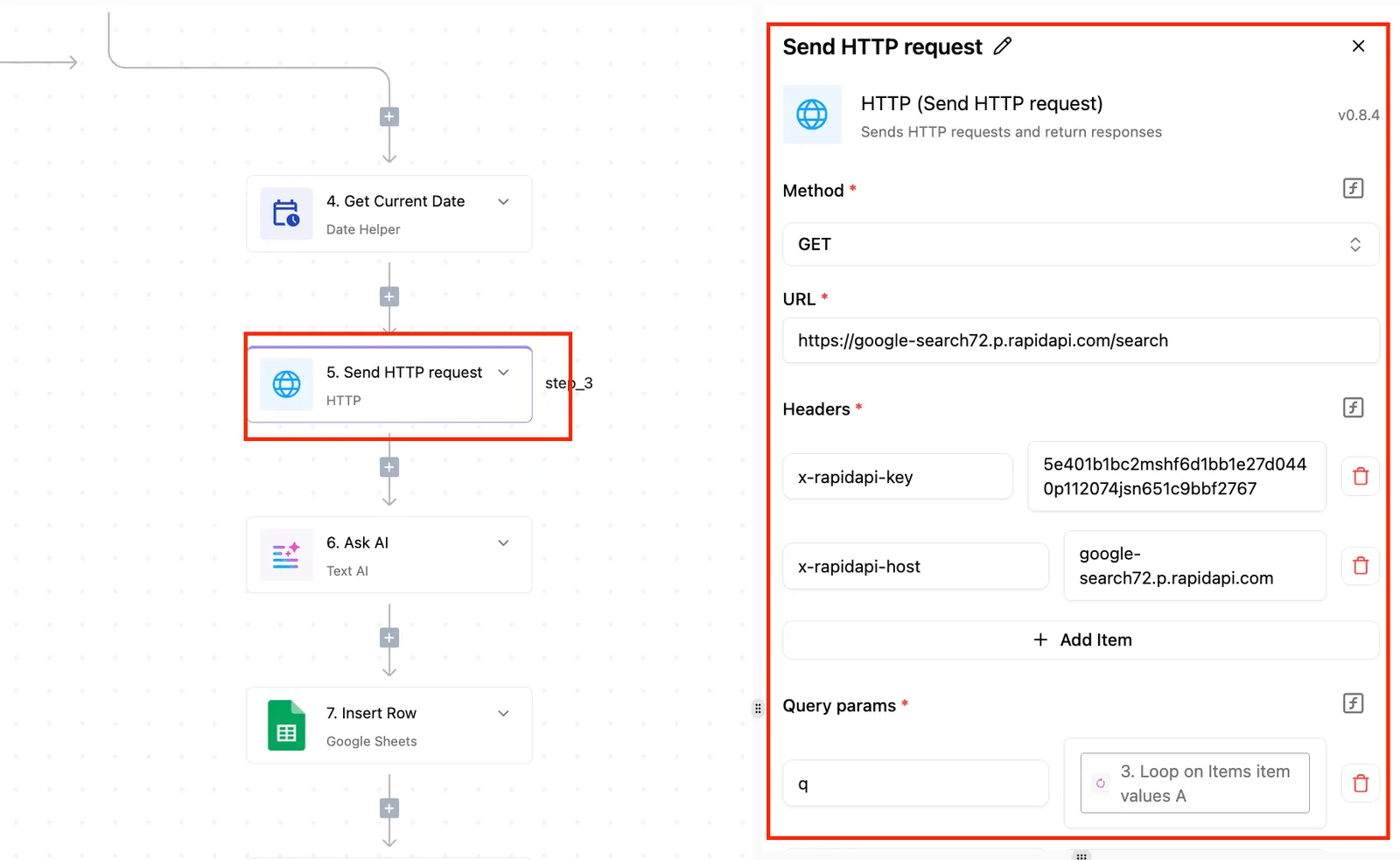
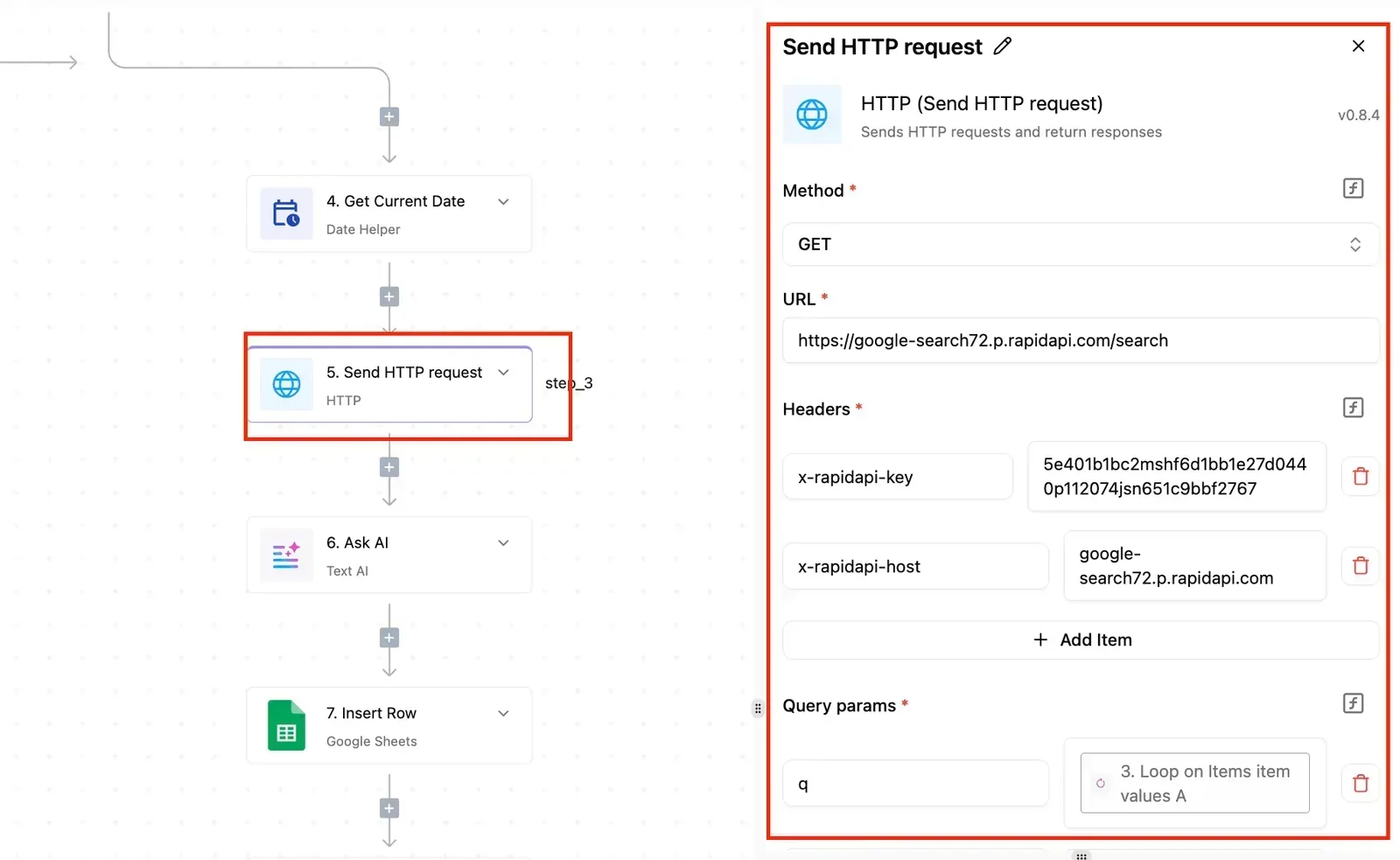
This response includes a header containing a payment invoice or a USDC payment detail string, which the automation platform must capture to prevent the entire flow from crashing.
The logic for these agentic decisions sits in the MIT-licensed core of Activepieces, where every tool call and automation retry is visible in the public monorepo.
By matching the Flow Execution Engine code against the step-by-step trace in the run-details UI, teams can audit exactly how an agent managed its per-request budget.
Once the transaction confirms, the platform automatically retries the initial request with a payment proof attached, ensuring the agent retrieves the necessary data without human intervention.
Passing search results to an AI agent step
A successful x402 transaction unlocks high-fidelity data that must be structured for the reasoning model to act upon.
The "SEO Blog Writer" configuration screen demonstrates this handoff by showing how an agent is primed with specific system instructions (such as scheduling or content creation) while waiting for external tools to populate its context.
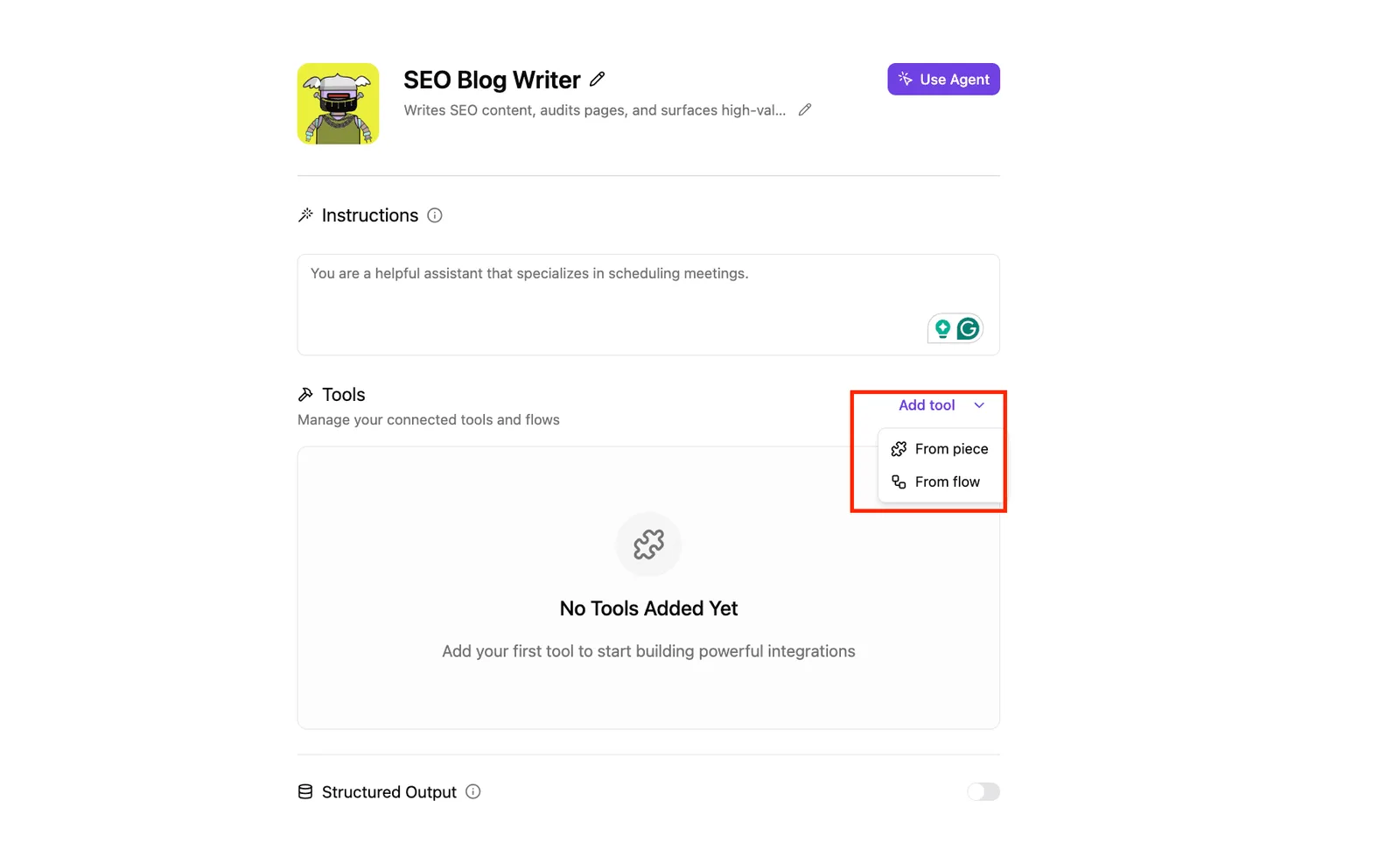
By selecting "Add tool" from the interface, a developer connects the output of the paid HTTP request directly to the agent's memory.
This ensures that the model, whether running on Claude Opus 5.5 for deep reasoning or Gemini 4 Carbon for complex logic, bases its output on fresh, paid-for intelligence rather than stale training data.
The subsequent structured output then becomes the reliable foundation for the next step in the automation.
Using MCP servers for standardized x402 access
The Model Context Protocol (MCP) provides a unified interface for agents to discover and pay for tools across different providers. Instead of writing custom logic for every unique API, developers use MCP servers to broadcast available capabilities and their associated x402 costs.
- Discovery: The agent queries the MCP server to find tools that meet its current goal.
- Negotiation: The server provides a manifest of costs per request, allowing the agent to calculate if the task fits its budget.
- Execution: The MCP server handles the underlying x402 handshake, abstracting the payment layer away from the core prompt logic.
Common risks when deploying x402 enabled agents
Standardizing these costs through the Model Context Protocol (MCP) allows an agent using Claude Opus 5.5 to pre-calculate the expense of a complex reasoning chain before committing to the first transaction.

While this transparency prevents the uncontrolled "spend loops" common in legacy credit-card-backed APIs, it introduces operational friction where the payment rail itself becomes a point of failure.
Managing automated wallet liquidity limits
Reliable agentic workflows require a deterministic handshake between the wallet balance and the Facilitator, the component responsible for verifying that a payment satisfies the API provider’s requirements.
If a long-running task on Gemini 4 Argon exhausts its allocated USDC balance mid-stream, the host environment must trigger an automated rebalance or the agent will stall, losing the context of its current execution state.
Developers must architect for four specific failure modes to ensure that the payment layer does not become a bottleneck for the logic layer:
- Insufficient Wallet Balance
- Gas Price Spikes
- Facilitator Fee Mismatch
- Network Latency
Each of these states requires a dedicated exception handler that allows the agent to pause and retry rather than failing the entire request.
Lightning Network latency in real-time search
Real-time tools, such as the Google Gemini Deep Research Max engine, demand sub-second response times that can be compromised by the overhead of a Lightning Network invoice settlement.
When an agent requests a high-velocity search, the time spent generating, transmitting, and verifying the x402 payment adds a "settlement tax" to the total round-trip time.
To mitigate this, engineers are moving away from per-request settlement for high-frequency calls in favor of pre-authorized state channels, which allow the agent to prove solvency once and then stream multiple requests without waiting for individual blockchain confirmations.
The Monday morning x402 implementation checklist
Implementation of the x402 protocol begins with transitioning from shared API keys to a discrete, agent-controlled financial identity.
This shift removes the bottleneck of centralized procurement by allowing a model like GPT-6 Astra to negotiate its own resource costs directly with a service provider.
Engineers are already bypassing rigid corporate billing cycles by using personal credit cards for "shadow AI" projects; providing a sanctioned x402 workflow replaces that liability with a verifiable audit trail.
Activepieces is an open source, MIT-licensed AI automation platform.
Companies run it in production to manage these agentic identities, ensuring that every per-request payment is governed by the same central policies as their traditional SaaS spend, so the scale of their automated operations does not outpace their financial oversight.
To move from theoretical agent autonomy to a live test against the Brave Search API (a service that provides web-scale data retrieval) follow this deployment sequence:
- Create a self-custodial wallet to give the agent its own cryptographic identity.
- Fund with USDC on Base to ensure the agent has liquid, low-fee capital for micro-settlements.
- Test the x402.new/services endpoint to verify the agent can discover and handshake with external API providers.
- Set a per-payment cap in your agent config to prevent a recursive loop from exhausting the wallet balance.
This sequence establishes a "least privilege" financial environment where the agent can only spend what is explicitly pre-allocated.
Once these credentials are live, the agent no longer waits for a human to renew a monthly subscription to retrieve data.
Instead, the infrastructure allows for immediate, granular consumption, which is the baseline requirement for any long-horizon task requiring real-time information.
What Activepieces does about this
Activepieces provides the orchestration layer where the x402 handshake is transformed from a raw protocol into a governed business process.
While the protocol handles the "how" of the payment, the platform manages the "why" and "how much" by wrapping every HTTP 402 trigger in a structured workflow.
Because the core engine is MIT-licensed, organizations like MoneyGram and Moneypenny can verify the exact logic used to handle preimage headers and proof-of-payment verification within their own private infrastructure.
This transparency is critical when moving away from fixed subscriptions toward a model where an agent might independently trigger hundreds of micro-transactions per hour.
The platform treats the x402 status code as a native event within its Flow Execution Engine, allowing developers to define global spending guardrails that sit above the agent's autonomous wallet.
If a request to the Brave Search API returns a 402 Payment Required status, Activepieces does not just pass the invoice to the agent; it validates the request against a centralized policy engine.
This ensures that even if a model like GPT-6 Astra attempts to scale its data acquisition exponentially, the platform can enforce a hard ceiling on the total USDC settled, effectively capping the financial exposure of the entire network, which means the system maintains solvency regardless of how aggressively an individual agent operates.
By functioning as a per-project MCP server, Activepieces also standardizes how these paid tools are presented to the reasoning model.
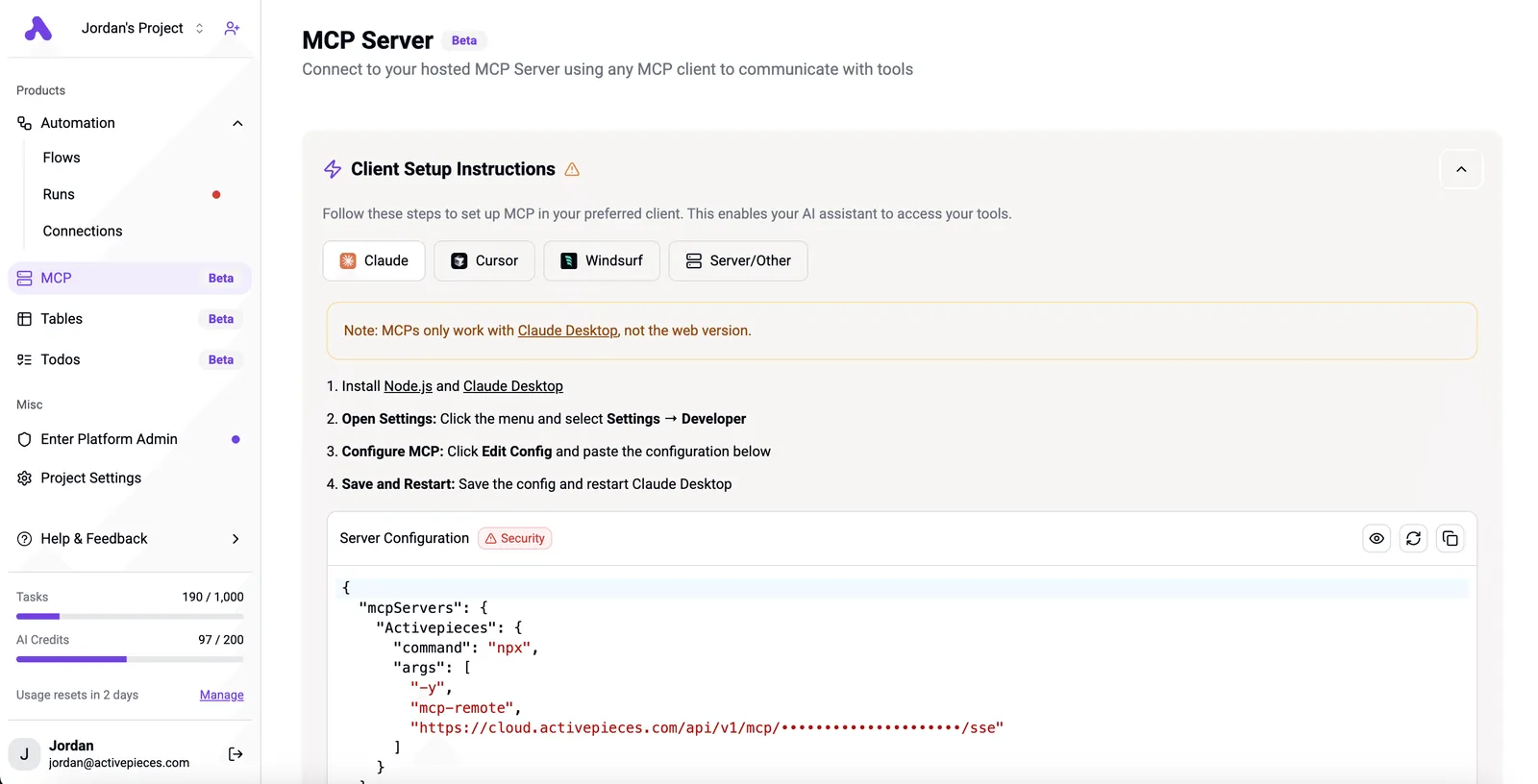
This allows a high-reasoning model to "see" the price of a search result before it signs the transaction, turning the x402 protocol into a deliberate economic choice rather than an invisible background cost.
Frequently asked questions
Which wallets support x402 Lightning payments?
Any non-custodial wallet that supports USDC on the Base blockchain can facilitate x402 payments.
Users currently rely on non-custodial wallets that support USDC on the Base blockchain to ensure their agents have direct control over liquidity without a middleman.
For developers building autonomous financial workflows, this compatibility means the agent can programmatically sign for its own micro-transactions.
Can I use x402 with fiat currency?
By utilizing a liquidity provider that performs real-time conversion between traditional bank balances and USDC on the Base blockchain, you can use x402 with fiat currency. This setup allows an enterprise to keep its treasury in US Dollars while the agent settles per-request fees in USDC.
- Strike: Provides an API for businesses to send and receive payments that settle in fiat while moving over the Lightning Network.
- OpenNode: Offers a checkout interface that converts incoming Lightning payments into local currency deposits for the service provider.
- Voltage: Supplies dedicated node infrastructure that can be paired with an exchange account to manage currency fluctuations.
Is x402 more secure than an API key?
The x402 protocol is more secure than a static API key because it replaces long-lived, reusable credentials with cryptographically signed proofs of payment that expire after use.
A leaked API key grants a thief indefinite access to the account’s full credit line, whereas an x402 Macaroon only authorizes the specific task the agent paid for.
When a model requests a high-reasoning computation, the credential it presents is scoped only to that request, ensuring that even if the token is intercepted, the attacker cannot drain the user's entire wallet.