
Lindy vs n8n: Pricing and Features Compared (2026)

Oct 17, 202614 min read
Pick Lindy if the people who will own the agent don't write workflows and want to describe the job in plain language.
Pick n8n if a technical team wants every step visible and the option to host it themselves, a preference shared by fans of open-source tools like Activepieces.
Lindy and n8n by use case
Lindy is a prompt-built AI agent platform
Describe what an agent should do and Lindy, a hosted platform, assembles the agent for you. You write the instructions the way you'd brief a new hire, connect the apps it needs, and it runs. There's no canvas of connected steps to design first.

The trade-off is that the logic lives in the agent's interpretation of your prompt, so you check its behavior by watching what it does rather than by reading a diagram.
n8n is a node-based workflow automation tool
Think of a canvas where each step is a node wired to the next one: that is n8n, a workflow builder. You choose the trigger, the actions and the branches, and AI models are one more node type you place where you want them.
It can be self-hosted, which matters when a client contract or a compliance review says the data stays in your environment.
Because every step is laid out, whoever inherits the workflow can open it and see what happens, in order. That visibility has a price: someone has to be comfortable building and debugging it, and that person's time is a real cost on any retainer.

If you're deciding quickly, four situations cover most cases, and each one points to the product whose design matches it.
- Lindy, if nobody on the team writes workflows.
- Lindy, if you want to run an agent from a plain description.
- n8n, if you need self-hosting.
- n8n, if you want every step visible.
If your situation matches more than one line, rank the two questions above: who maintains it, then where it must run. The sections that follow test each product against those questions in more detail.
If you are running this arithmetic for your own team, see what the same workload costs on Activepieces.
Five criteria that decide between the two
What separates Lindy from n8n comes down to five criteria, and each matters to a buyer who has to invoice the work:
- What is metered: the unit you are billed on decides whether a busy client costs you more than they pay.
- Who maintains it: someone owns the fixes when a step breaks, and that time is either billed or absorbed.
- Apps the agent acts in: an agent that can't reach the client's tools only drafts, and a person still does the work.
- Approval before actions: a human check is what keeps one wrong email or record update from reaching a client's customer.
- Where data lives: contracts and client policies often dictate hosting, and that can rule a product out early.
Not all five weigh the same. The first two decide the monthly cost, and the last three decide whether the agent is allowed to run at all.
Billing is where the two diverge. Lindy bills on the agent's activity, while n8n's cloud plans count workflow executions. Work out which unit your client's volume inflates, because a shared account quietly makes your quieter clients pay for the loud one.

Describing an agent in plain language moves the effort to the front, and fixes then fall to whoever wrote the description.
Building a workflow node by node takes longer upfront, but the logic is visible and anyone technical can repair it. Price that maintenance into the retainer either way.
Check the specific apps your client uses, not the length of a catalogue.
Then check whether you can put a human approval step before the agent sends, posts, or edits, because that step is what makes an agent safe to run unattended on a client's behalf.
If a client's contract names where data may sit, this criterion settles the question before the others come up. n8n can be self-hosted, which keeps client data on infrastructure you control. Lindy runs as a hosted service.
Lindy and n8n pricing comparison
Because Lindy charges per user and n8n charges per workflow execution, the two price lists measure different things and cannot be compared plan to plan.
The table below sets both on the same eight rows, with gaps marked "not stated", so you can see where the vendors' own pages stop answering.
| Lindy | n8n | |
|---|---|---|
| Entry price | $29.99/month per user (Plus) | $20/month, billed annually (Starter) |
| Plan structure | Per-user plans | Cloud tiers, plus a self-hosted option |
| What is metered | Credits spent as the agent works | Workflow executions |
| Free option | No free plan; 7-day trial for Slack workspace joiners | Free when self-hosted |
| Integrations | Not stated | Not stated |
| Human approval | Anything with outside impact waits for approval | |
| Self-hosting | Not stated | Yes |
| Stated limits | Not stated | 2.5K executions, unlimited steps, 1 shared project (Starter) |
Prices and plan limits checked against lindy.ai and n8n.io on October 17, 2026.
Checked 2026-10-17. Sources: Lindy and n8n.
Lindy and n8n plan limits and pricing
At $29.99 per user, Lindy's base cost grows with headcount, and credits are spent as the agent works, which means a struggling agent costs the same as a high-performing one. If one person builds and the whole team only receives output, you pay for one seat.
At $29.99 per user, Lindy's cost grows with headcount and not with how much the agent does, which means a struggling agent costs the same as a high-performing one.
Trigger a workflow a few hundred times a day and it will outrun n8n's Starter allowance of 2.5K executions within the month.
Lindy and n8n capabilities and integrations
Ask either pricing page, as checked, for an integration count and neither answers. Treat both as things to test in a trial before you promise a client anything.
The one structural difference on the page is that n8n's Starter allows a single shared project. Separating one client's work from another's means a higher tier or a separate account. That's how a shared account ends up quietly subsidizing the client who uses it most.
Lindy's page doesn't give a per-client cost cap, but it does bill in credits that bigger jobs use more of.
n8n states its limits, but leaves integrations and approval unstated. Ask each vendor for the missing cells in writing, since they decide what you can safely bill.
Worth checking against a plan that does not meter every step: one credit covers a whole run on Activepieces.
Where Lindy wins and where it breaks down
Lindy wins when the person who will own the agent isn't a builder. It breaks down when you need to bill a client for runs you can't predict or keep their data on your own servers.
Those missing cells from the vendor pages are where the weak points sit.
Lindy and n8n setup and maintenance
Lindy: describing the agent
You describe the job in plain language, Lindy assembles the agent, and it's running the same day. For an ops lead handing a lead-routing or inbox-triage agent to a client, that speed is the product.
Later, the cost shows up. Because the agent was generated from a description, the person maintaining it is editing prompts and steps they didn't design. A fix means rereading what the agent was told and guessing which instruction caused the miss.
Lindy: the explicit-steps canvas
Below, a canvas shows the other side of this. It's a four-step flow called "Test Flow": a daily schedule trigger, a code step that picks a topic, and an HTTP request that pulls SEO keywords.
The last step is an agent step, "SEO blog writer," selected with its prompt open on the right.
The prompt carries the length, keyword placement, tone and structure rules, and it pulls in values from the earlier steps by reference.
Take from it that Lindy does offer explicit steps around the agent, so the choice is less "no structure" than "how much of the structure you want to own."
Lindy and n8n cost as agent runs grow
Because Lindy bills in credits, an agent that loops, retries or calls several tools uses more of them per task than one that answers once.
When one shared account serves several clients, the busy client's runs draw down the same pool as everyone else's. You're quietly subsidizing whoever triggers the most work.
Price the retainer on a measured credit cost per completed task, not on the plan's headline allowance. Keep a separate workspace per client if you want the usage to be attributable.

Approvals, apps and data control
For anything client-facing, Lindy documents steps where a person can confirm before the agent sends or changes something.
Its integrations list is the boundary of what the agent can act in; anything outside it goes through an HTTP request or a custom step.
On hosting, the vendor pages describe a managed cloud service, and I found no self-hosted option documented. If a client's contract requires data to stay on infrastructure you control, Lindy is the wrong tool for that engagement.
Where n8n wins and where it breaks down
When you need to control every step of a workflow and keep it on your own servers, n8n wins. When nobody on your side can read a workflow canvas, it breaks down, because every fix lands on you.
You build an n8n agent by wiring nodes together. The canvas below shows what that looks like: a trigger, a chat-message receiver, and an AI Agent node with an OpenAI chat model and simple memory attached.
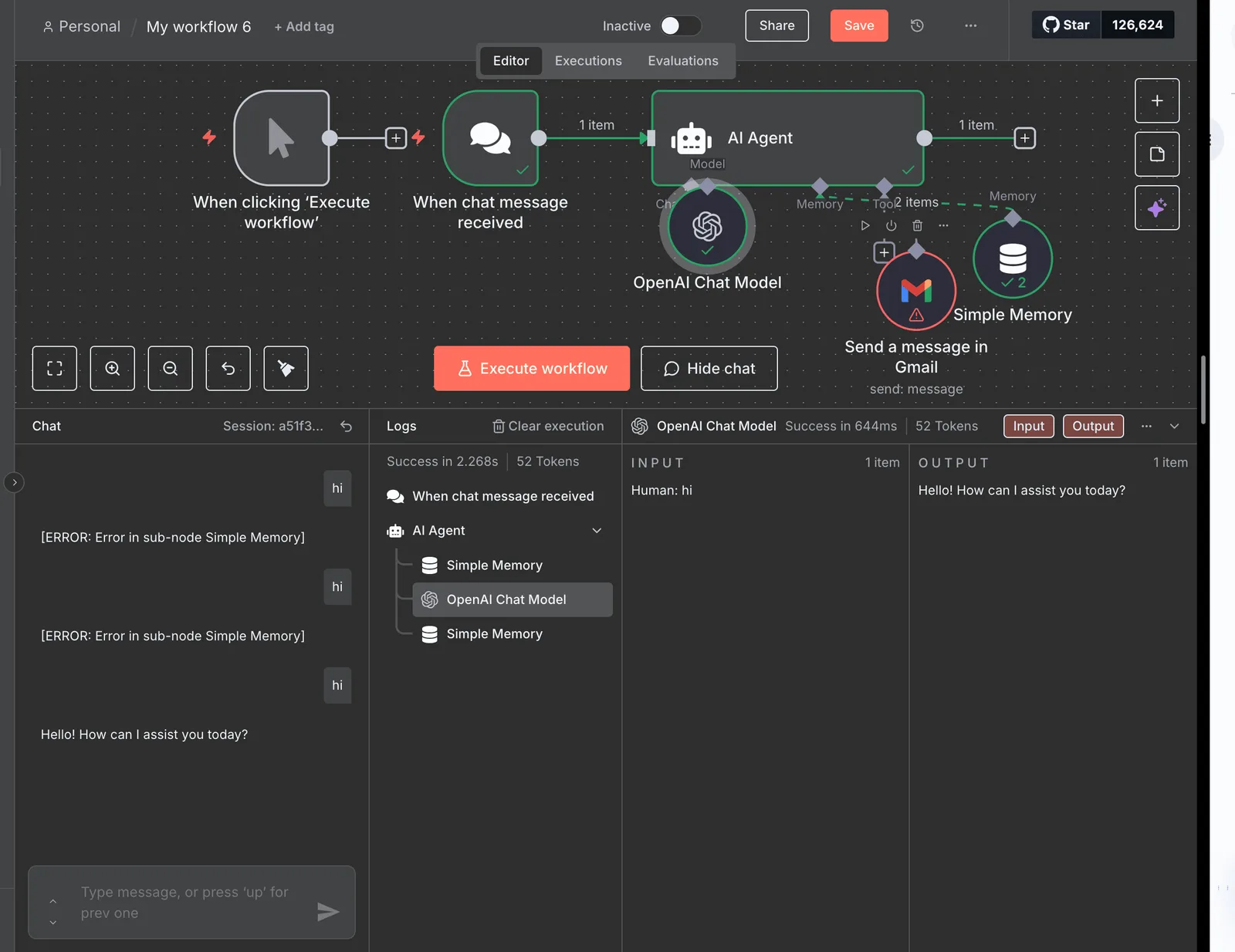
It also shows execution logs with the input and output of a test message.
The logs show what went into each node and what came out, and the chat panel also surfaces an error from the memory sub-node.
Seeing inside each node is the control you're paying for: you can find the failing step yourself. It also means someone has to read that error. If the person who built the workflow leaves, you have to bill for the handover or absorb it.
However many steps a long workflow has, it still counts as one run, because n8n's cloud plans meter by workflow execution, not by individual task inside it. For agency work, that makes the cost per client run easier to predict than a per-step model.
Once you self-host, the execution meter is gone, but you then pay for servers, upgrades and whoever is on call. Put that labour in the retainer, or a client who barely uses the workflow is subsidised by the one who breaks it weekly.
With a large library of app nodes and an HTTP node for apps that lack one, n8n widens where an agent can act.
Approval is something you design: a Wait node can pause a run until someone resumes it, so a human check before a send or a payment is a step you place deliberately and test.
If open source plus an agent step is your deciding criterion, the useful design detail is that Activepieces, which MoneyGram, Moneypenny, Alan and FundingSocieties run in production, keeps the agent and the fixed-rule steps in one flow.
Put an Agent step next to an ordinary automation step, run a test, and the trace shows a single execution, with no webhook passing work between an agent tool and a workflow tool.
Self-hosting is what answers the data-residency requirement from the previous section. n8n publishes its code under the Sustainable Use License. It allows internal business use but restricts offering n8n itself to others as a hosted product.
Read the licence before you build a client-facing service on top. If you want a hands-off agent and have no one to maintain it, n8n is the wrong tool.
Self-hosted and open source alternatives worth knowing
Which self-hosted agent platforms qualify
If self-hosting is the requirement rather than a hands-off agent, two platforms qualify: n8n under its Sustainable Use License, and Activepieces under MIT. Both put the server, the upgrades and the on-call burden on you, which is the maintenance cost the last section warned about.
n8n carries a separate enterprise licence for some features. Activepieces is MIT for the community edition, with a commercial licence for enterprise features.
Both are self-hostable and both have an AI agent step.
What the licence means for agencies
For anyone billing for the work, the licence matters most. n8n's licence limits use to internal business purposes. An agency hosting workflows on behalf of several clients should confirm that its arrangement counts as internal use before pricing the retainer.

Activepieces in practice
On the open source side, Activepieces is an automation platform whose AI agent step can act across its integrations, which are listed at https://www.activepieces.com/integrations. Its repository has 25,063 GitHub stars.
25,063 stars tell you the code is public and widely inspected, so your team can read how a step behaves before a client depends on it. They don't tell you the platform will suit your workload, so test it against a real job.
You can try it free at https://cloud.activepieces.com/sign-up before deciding whether to host it yourself.
Either way, you still have a server to patch and a person responsible for it. Self-hosting is the reason to pick either one, not a way around the choice between Lindy and n8n.
Frequently asked questions
Is Lindy cheaper than n8n?
Cost
Neither is cheaper in general; the answer depends on run volume and who spends the hours. Lindy is hosted and bills on usage, so the invoice grows as agents run more.
n8n can run on your own server, which removes a per-run platform fee but adds hosting and the time of whoever keeps it patched. If one shared account serves several clients, that cost lands on you unless you split it out.
Building and hosting
Can n8n build AI agents like Lindy? Yes, n8n has an AI agent node that you wire into a workflow with a model, tools and memory.
The difference is who assembles it. In Lindy you describe the agent and it configures itself. In n8n you place and connect each part, which means more control and more to maintain.
Can I self-host Lindy? Lindy runs as a hosted service, and self-hosting isn't something it offers. If your data must stay on infrastructure you control, that settles it before pricing does. n8n is the one of the two that you can run yourself.
Coding and next steps
Do I need to code to use n8n? You can build many workflows without code, but you'll meet code the moment a workflow gets specific.
Reshaping data, handling errors and calling an API with no ready-made node often call for a short script or expression. Someone on your side should be comfortable reading that.
What should I do on Monday to choose? Run a small, honest trial instead of debating features, and follow these steps in order:
- Pick one workflow to automate, ideally one that already costs you time every week.
- Name the person who will maintain it when it breaks, because that person's skills decide how much building you can take on.
- Decide whether the data must be self-hosted, since a yes removes Lindy from the running.
- Trial the workflow on Lindy or n8n, whichever the first three answers point to.
- Compare cost after 100 runs, counting platform charges and the hours spent fixing it.
That last comparison is the figure you can put on a client invoice, so keep the numbers.
Running the numbers
See what the same workload costs here.
Free forever plan, and every paid plan self-hosts at no extra cost.
See pricing Talk to sales