Jasper Pricing: Which Plan Is Worth Buying in 2026?

Oct 11, 202614 min read
Jasper remains a dominant force in the AI writing space, offering a suite of tools designed to streamline content creation for marketing teams and individual creators alike.
As businesses look to scale their output, many are exploring how to connect these generative capabilities with their existing workflows, often using automation platforms like Activepieces to bridge the gap between drafting and publishing.
Understanding the current Jasper pricing structure is essential for determining which tier aligns with your production volume and budget requirements. This guide breaks down the 2026 plan costs, seat limits, and credit allocations to help you make an informed decision for your organization's growth strategy.
Jasper pricing structure for marketing teams
Jasper has transitioned into a specialized enterprise marketing platform where costs scale based on seat count, credit consumption, and the depth of brand governance required.
While the entry-level Creator tier exists for individuals, the Pro and Enterprise tiers provide the collaborative workflows and centralized brand memory that's required for business use.
The Creator plan for solo marketers
$39 per month is the starting price for the Creator plan, which functions as a baseline for individual contributors who need a single brand voice and basic access to models like Claude Sonnet 5.5 or GPT-6.1 Sol.
This tier limits the user to one seat and one brand voice.
When a freelancer needs to toggle between different client style guides, they cannot do so without manually overwriting their settings. It lacks the campaign folders and user permissions that are necessary for team-based execution.

The Pro plan for small teams
Because it introduces the ability to manage two distinct brand voices and lets teams add seats as needed, the Pro plan is the minimum viable entry point for small teams.
SpendHound reports a single Pro seat averages $708 annually, which means a small department could quickly exhaust a limited software budget.
By signing up, a three-person team is committing to a $2,124 baseline before accounting for credit overages, which means the initial investment is significantly higher than the per-user cost suggests.
This investment is required to unlock the "Campaigns" feature, allowing a manager to generate a blog post, social captions, and an email sequence simultaneously from a single brief.
A typical three-seat marketing team will find Jasper Pro significantly more expensive than generalist alternatives.
| Platform | Annual Cost (3 Seats) | Focus |
|---|---|---|
| Jasper Pro | $2,124 | Marketing-specific templates |
| Generalist Alternatives | Lower | Broader utility |
Prices and plan limits checked against jasper.ai on October 11, 2026.
Activepieces provides a broader utility for these teams by offering an MIT-licensed core that connects to any model provider, ensuring that the software layer doesn't dictate the AI strategy.
This price gap widens as teams scale, leading many organizations to evaluate the shift toward custom-quoted infrastructure.
Enterprise tiers for brand-governed content
Large organizations use the Enterprise tier for network isolation, single sign-on (SSO), and unlimited brand voices for various product lines.
SpendHound reports an enterprise minimum of $15,000 annually, effectively pricing out smaller organizations that do not require high-volume features, so these businesses must seek more affordable alternatives.
Procurement approval is a necessity here, as the platform is a significant line item.
At this level, "Credits" (a proprietary currency used to run high-reasoning models like Gemini 3.8 Flash or Grok 4.7) drive the cost. Teams must monitor usage closely to avoid mid-quarter budget exhaustion.
If you are running this arithmetic for your own team, see what the same workload costs on Activepieces.
Comparison of Jasper plans and usage limits
Jasper's pricing structure forces a choice between individual experimentation and team-wide brand consistency.
The Pro tier is the entry point for professional workflows. While the Creator plan exists for solo users, it lacks the collaborative features that are required to maintain a unified voice across a marketing department.
Jasper's pricing structure forces a choice between individual experimentation and team-wide brand consistency.
The following table breaks down the core limitations you'll hit as you scale from a single user to an organization-wide deployment.
| Plan | Monthly Cost (per seat) | Included Seats | Brand Voices | Knowledge Assets |
|---|---|---|---|---|
| Creator | Contact Sales | 1 | 1 | 50 |
| Pro | $69 | 1 | 2 | 5 |
| Enterprise | Custom | Custom | Unlimited | Unlimited |
Choosing the Pro plan at $69 per month per seat grants access to one seat by default, according to Jasper's documentation, meaning teams must add additional seats individually as they grow. Each additional user beyond the first adds to the monthly overhead.
Because the Pro tier limits users to two Brand Voices, a mid-sized agency can only automate the style guide for two clients before they must negotiate for an Enterprise plan.
Because Knowledge Assets (the documents used to ground models like Gemini 3.8 Flash) are capped at 5 on the Pro tier, teams must frequently rotate old campaign data out to make room for new product launches.
High-volume teams will eventually hit a ceiling due to this friction between seat costs and asset limits. Once you exceed these hard caps, the transition to Enterprise is the only way for high-volume teams to secure unlimited Brand Voices for diverse market segments.
Hidden costs and the reality of Jasper credit limits
Jasper's pricing scales aggressively because the platform tethers its most powerful automation features to a credit-based consumption model and per-seat expansion.
While the base subscription grants access, the actual budget for a functional marketing department is determined by how many team members need concurrent access and how frequently they trigger specialized agents.
The true cost of additional user seats
$708 annually is what a single Pro seat costs, according to SpendHound. A solo marketer is paying a premium just to move beyond basic templates.
The financial floor rises quickly for teams. A 3-seat Pro team costs $2,124 per year, leaving only a small margin before hitting the $2,454 average annual spend for small-to-medium businesses (SMBs) identified by SpendHound.
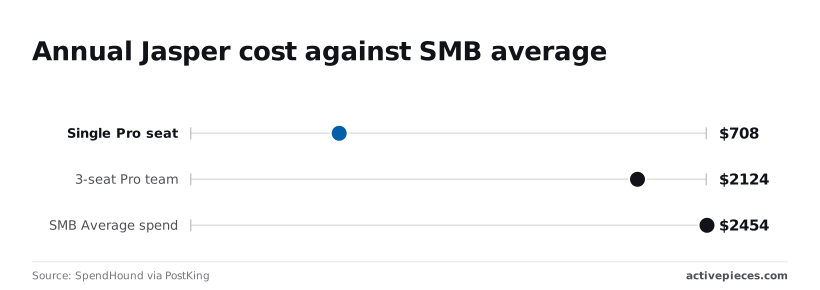
This narrow gap means that adding a fourth or fifth specialist effectively pushes a team's software spend above the market average for their size.
Credit consumption by content type
Every specialized task in Jasper carries a specific credit tax that depletes your monthly allowance faster than standard text generation. According to Usage Pricing, running the Optimization Agent costs 100 credits.
Refining ten long-form articles a month consumes 1,000 credits before accounting for the initial drafts.
High-frequency tasks like the Research Agent and Translation Agent each cost 40 credits per run. Every individual API or MCP call costs 1 credit, making high-volume technical integrations a steady drain on the balance.

Activepieces removes the penalty for building more complex, multi-step marketing flows by charging for the run rather than the steps inside it.
A ten-step content distribution process costs the same as a simple two-step draft, whereas Zapier's per-task billing or Make's per-module billing would tax the builder for every added level of granularity.
The published pricing page shows 1 credit per flow run regardless of complexity, ensuring that teams can refine their automation without increasing their per-run cost.
Training costs for Brand Voice accuracy
The Jasper IQ 'Brand Context' layer is a central hub that's receiving inputs from the Brand Voice, Style Guide, and Knowledge Base to output a consistent document.
This architecture ensures that a draft generated by Gemini 3.8 Flash or GPT-6 Astra sounds like your company rather than a generic LLM.
To achieve this, staff must manually audit and upload hundreds of pages of documentation to the Knowledge Base to prevent the model from hallucinating outdated product specs. Once these layers are tuned, the system maintains a unified output across all marketing channels.
Worth checking against a plan that does not meter every step: one credit covers a whole run on Activepieces.
Scaling from Pro to Enterprise tiers
Jasper's Enterprise tier shifts the platform from a self-service utility to a managed infrastructure service for complex organizational hierarchies. While the Pro plan allows small teams to share assets, the Enterprise level is the only tier that provides dedicated success managers.
You will not find a help-center article mapping your internal workflows here; instead, a human representative handles the software integration.
The functional gap between these tiers centers on governance and data security.
- Single Sign-On (SSO) centralizes user access through your company’s existing identity provider.
- Unlimited Brand Voices allows a parent company to maintain distinct stylistic guidelines for dozens of sub-brands.
- Role-Based Access Control ensures that a freelance copywriter can only view their assigned project folders.
Choosing the Enterprise route also unlocks a wider array of underlying intelligence.
While standard users might rely on a single default, Jasper Enterprise allows teams to toggle between flagship models like Gemini 3.1 Pro for deep reasoning or GPT-6 Luna for high-volume execution.

Jasper vs Copy.AI and Writer: Which fits your workflow?
Choosing between enterprise content platforms requires weighing the cost of entry against the specific technical architecture your marketing stack demands.
Jasper positions itself as a centralized brand hub, using a proprietary memory layer to ensure that every output from Gemini 3.1 Pro or GPT-6 Luna adheres to a company’s specific style guide and product terminology.
Writer focuses on industrial-scale compliance and the ability to self-host Large Language Models (LLMs) within a private cloud, while Copy.ai prioritizes the automation of repetitive GTM (Go-to-Market) tasks through a flexible workflow builder.

Compliance and infrastructure control in Writer
Writer is the superior choice for organizations that view data sovereignty as a non-negotiable requirement. By allowing teams to build on top of their own proprietary Palmyra models, Writer ensures that sensitive corporate data never leaves the controlled environment.
This architectural choice appeals to legal and healthcare sectors where multi-tenant cloud platforms like Jasper present a compliance risk. The platform also excels at enforcing factual accuracy through its Knowledge Graph.
Workflow automation and cost efficiency in Copy.AI
Copy.ai offers a more accessible entry point for teams that prioritize operational speed over deep brand governance. Its workflow builder allows users to automate entire go-to-market sequences, such as turning a webinar transcript into LinkedIn posts, without the steep per-seat overhead of Jasper.
For high-growth startups, Copy.ai provides a better balance of price and utility.
It functions as an agile automation layer that connects to various sales and marketing tools, making it ideal for teams that need to scale content volume rapidly without hitting the restrictive credit caps found in Jasper’s Pro tier.
When to choose Jasper, Writer, or Copy.ai
If you require strict brand consistency across multiple voices and departments, choosing Jasper Pro is best. Choose Writer if you need self-hosted LLMs and high-level data security for regulated industries. Choose Copy.ai if you need the lowest entry price for high-volume automated workflows.
Opting for the wrong tool leads to immediate friction. Conversely, paying the premium for Jasper’s brand memory is only efficient if your team actually manages two or more distinct brand voices that require automated enforcement.
Run Jasper content workflows in Activepieces
Activepieces automates the handoffs between Jasper and your existing data sources, ensuring that 739+ integrations are available to move content through a production line without manual intervention. Without this automation, your marketing team is stuck copy-pasting prompts between tabs.
Alan and Moneypenny run Activepieces in production to manage these high-volume handoffs, ensuring that every row in a strategy spreadsheet results in a finished draft without manual intervention.
The same enterprise controls that Jasper reserves for its managed cloud are available in the Activepieces air-gapped build. Regulated organizations like MoneyGram and FundingSocieties run this edition in production because features like SSO, SCIM, and custom RBAC are identical across the self-hosted and cloud versions.
The enterprise feature list in the self-hosted documentation confirms that full governance is not sacrificed for the sake of infrastructure control.
The following sequence demonstrates how to bridge the gap between raw data and a published post:
- Select the Google Sheets 'New Row' trigger to monitor your content calendar for approved topics.
- Add the Jasper 'Run Research Agent' step to pull real-time context and brand voice guidelines.
- Add the Jasper 'Create Content' step using the research output to generate the actual copy.
- Add a WordPress 'Create Post' step to move the generated text into your CMS as a formatted draft.
Activepieces offers unlimited flows on every plan, including free, ensuring your enterprise credits are spent on high-value output rather than administrative overhead. You can build this entire automation flow for free in Activepieces to begin scaling your content operations immediately.
While Zapier and Make charge for every individual task or module executed, Activepieces simplifies the cost structure by billing only for the complete flow run regardless of complexity.
Because high-volume content workflows often require numerous internal steps to transform raw data into finished drafts, Activepieces is the better choice for organizations prioritizing predictable scaling and cost-efficiency.
Its ability to provide enterprise-grade governance and air-gapped security ensures that teams can automate sophisticated Jasper pipelines without the financial penalty of per-step pricing.
Final verdict on the best Jasper plan for your scale
Because it is the entry-level tier that unlocks Brand Voices, the Jasper Pro plan is the functional baseline for marketing teams. This ensures every generated draft adheres to your specific style guide rather than generic AI prose.
Without this, your team spends more time editing outputs for tone than they would have spent writing from scratch. While the Creator plan exists, its lack of user management tools means you can't prevent contributors from overwriting shared assets.
Choosing between Jasper and its competitors depends on your specific infrastructure and security requirements.
Jasper Pro is best for mid-sized agencies that need a centralized hub for campaign briefs and multi-model generation using frontier models like Claude Sonnet 5.5 or GPT-6 Astra.
Writer is the preferred choice for enterprises in regulated industries that require self-hosted LLM options to keep data within their own virtual private cloud.
Copy.ai is a viable alternative for teams focused strictly on high-volume GTM plays where workflow automation takes precedence over creative brand management.
If your priority is maintaining a unified voice across a growing headcount, the Pro plan’s seat-based scaling is the intended path.
However, if you're operating in a high-security environment where data can't leave your servers, the architectural flexibility of Writer provides the necessary isolation that Jasper’s multi-tenant cloud structure doesn't offer.
Frequently asked questions about Jasper costs
Can I get a refund if I run out of credits?
Jasper doesn't offer prorated refunds for unused portions of a billing cycle or for accounts that have exhausted their credit limits. This means your financial commitment is locked in once the credits are consumed, even if the output quality didn't meet your specific campaign requirements.
When you hit your ceiling mid-month, the platform requires a manual top-up or a plan upgrade to resume generation. a team mid-sprint must choose between a budget overage or a total production halt.
Is there a free version of Jasper in 2026?
Jasper doesn't provide a perpetual free tier, maintaining a strict pay-to-play model for all enterprise and professional users. While a limited-time trial is available to test the interface, it requires credit card authorization up front.
The moment the trial period expires, this authorization triggers an automatic transition to a paid subscription.
For teams using flagship models like GPT-6 Astra or Claude Fable 5.1 through the Jasper API, this lack of a free sandbox means every prompt iteration during the setup phase carries a direct cost against the marketing budget.
How do I add more seats to a Pro plan?
Adding seats to a Pro plan is managed through the billing dashboard, where each additional user incurs a flat monthly fee. Because Jasper's Pro tier is priced per seat rather than offering a bulk license, your monthly overhead scales linearly with your headcount.
Every contractor or agency partner you onboard will have a unique login for audit trails. It also means a growing social media team will see their software bill climb every time a new intern is granted access to the workspace.
Related reading
References
Running the numbers
See what the same workload costs here.
Free forever plan, and every paid plan self-hosts at no extra cost.
See pricing Talk to sales