Klaviyo Alternatives for Ecommerce Brands in 2026

Oct 1, 202613 min read
As the e-commerce landscape evolves, finding the right marketing automation platform requires balancing sophisticated segmentation with operational efficiency. Many brands are exploring alternatives to Klaviyo that offer different pricing models or workflows for multi-channel engagement.
Modern teams often prioritize tools that integrate seamlessly with their existing tech stacks, sometimes using Activepieces to bridge data gaps between their storefronts and email providers.
Whether you are looking for a more intuitive drag-and-drop builder, deeper SMS integration, or advanced predictive analytics, the current market provides several robust options tailored to different business scales and technical requirements.
Criteria for Evaluating E-commerce Marketing ROI
Decoupling your data strategy from your execution layer is how you maximize e-commerce ROI and avoid the "complexity tax" of all-in-one platforms.
As your mid-market team moves through the adoption curve from basic email blasts to sophisticated agentic workflows, the technical debt of a rigid stack becomes a measurable drag on your margins.
Decoupling your data strategy from your execution layer is how you maximize e-commerce ROI and avoid the "complexity tax" of all-in-one platforms.
To maintain a competitive edge, you must benchmark your performance against three specific pillars that dictate long-term scalability.
These pillars are the scorecard for any modular transition:
- Cost-per-contact efficiency: Targeting a rate of less than $0.01 per profile ensures that your audience growth doesn't outpace your revenue. For a list of 50,000 subscribers, Omnisend charges $400 per month, whereas Klaviyo costs $720 for the same volume. This 80% price delta means a brand on the latter must generate significantly higher attribution per email just to maintain the same net margin.
- Integration depth: The distinction between real-time and hourly sync determines the relevance of your triggered flows. A "real-time" sync processes a cart abandonment event in seconds, while an hourly sync might delay the recovery email until after the shopper has already purchased from a competitor.
- Data portability: The ability to export full event logs, rather than just aggregate open rates, allows you to feed historical behavior into models like Gemini 3.8 Flash for predictive churn analysis.
Standardizing these metrics allows your growth team to treat the marketing stack as a series of interchangeable levers.
The run is the meter, not the steps inside it. Activepieces bills 1 credit per flow run regardless of how many steps the automation contains, which ensures that building a robust, ten-step recovery sequence costs exactly the same as a fragile two-step workaround.
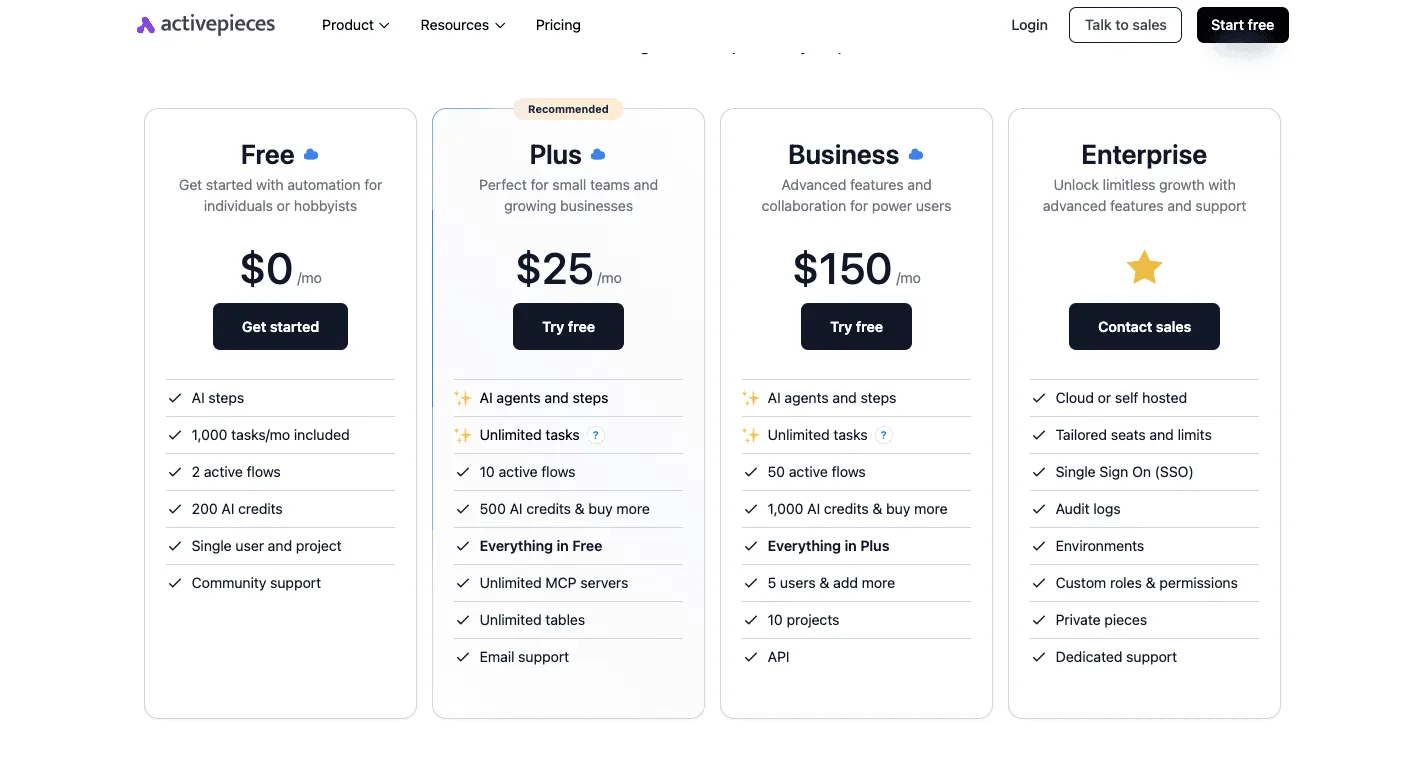
Pricing that scales with granularity effectively taxes the discipline required for reliable e-commerce logic, whereas this model allows your team to break work into smaller, more resilient modules without a financial penalty.
The fastest way to settle a shortlist is to try one. Activepieces is free to try, no credit card.
1. Activepieces: decoupling data for ultimate flexibility
Orchestration and the "Contact Tax"
Activepieces is an MIT-licensed AI automation platform that routes e-commerce events to specialized delivery tools without paying the "contact tax" associated with monolithic platforms.
By serving as the connective tissue between your brand's data warehouse and its communication channels, it removes the requirement to store redundant customer profiles in expensive marketing clouds.
This transition represents the "Build" phase of the adoption curve, where your engineering team reclaims control over the logic that triggers a message.
Connectivity and Ecosystem Depth
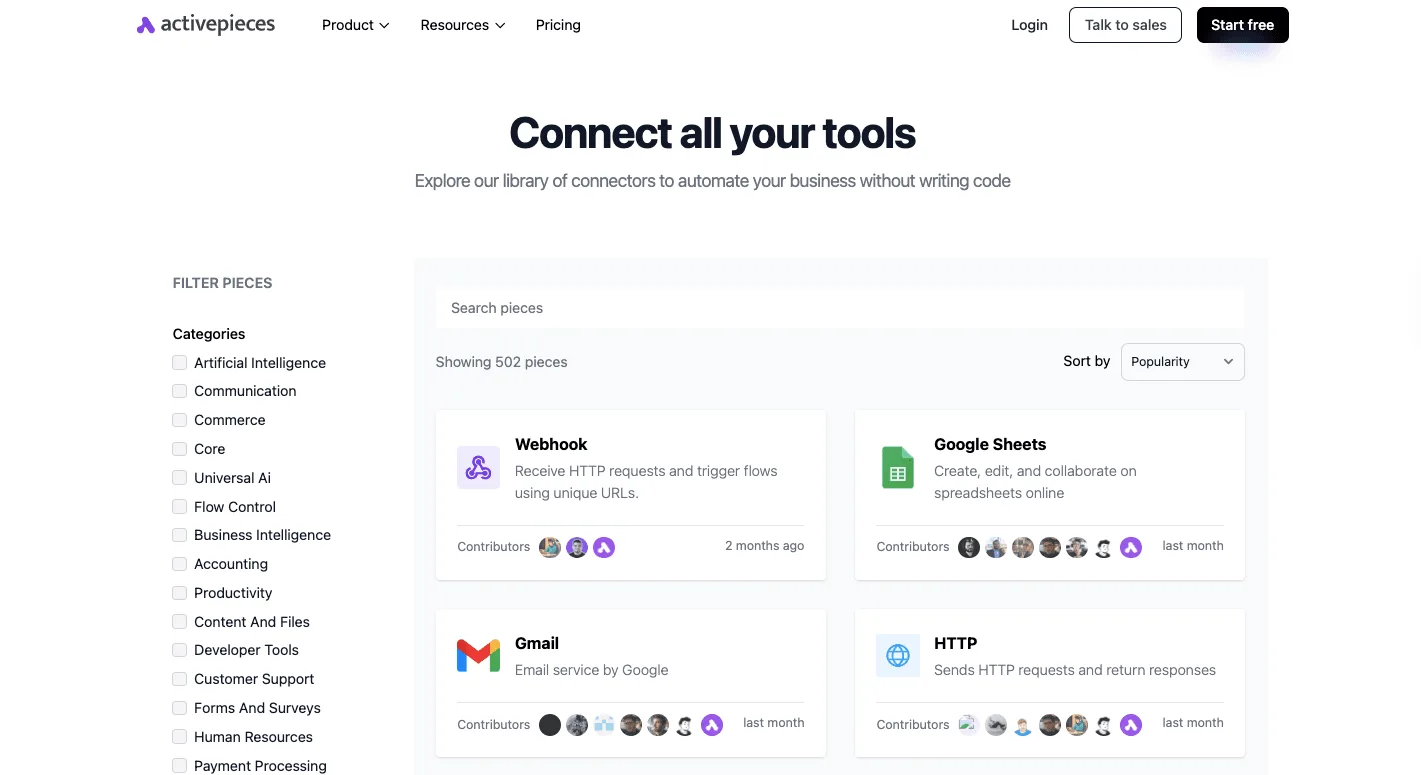
738 community-built connectors are provided by the platform, according to Activepieces, which means your technical team can integrate niche loyalty programs or custom ERPs without waiting for a vendor's official roadmap.
In contrast, a specialized ESP like Sendlane offers 62 integrations, restricting you to a narrower ecosystem of supported third-party tools, so your ability to connect disparate software stacks is significantly limited.
For your growth team, this 12x difference in connectivity ensures that your data-driven workflows remain portable rather than trapped behind a single vendor's proprietary API, providing a substantial advantage in technical flexibility, so your infrastructure is no longer hostage to a single platform's limitations.

Modular Architecture in Practice
Deployment on Activepieces is a setting rather than a permanent commitment to a specific vendor's cloud.
A flow built on managed infrastructure and a flow built self-hosted run on the same codebase, allowing teams to git-sync and promote logic across environments or move it to their own servers via Docker and Kubernetes as data privacy needs evolve.
This flexibility ensures that where a flow runs never decides whether you can leave, protecting your brand's margins as the database grows.
By treating Activepieces as the brain of the operation, your marketing team can swap a high-cost sender for a utility-scale provider like Amazon SES or Twilio without rebuilding your entire automation library, a strategy already used in production by companies like MoneyGram and Moneypenny.
Scaling with AI Logic
To manage this complexity at scale, you'll use AI models to maintain the underlying code.
- Developers use Gemini 3.8 Flash to generate the TypeScript snippets required for custom Activepieces "integrations," which reduces the time spent on manual API mapping.
- Operations leads deploy GPT-6 Astra to audit complex multi-step flows for logic errors. This prevents high-volume triggers from resulting in duplicate message spend.
- Data analysts utilize Claude Sonnet 5.5 to transform raw PostgreSQL outputs into the specific JSON schemas required by downstream delivery tools, treating templates as a measurable lever for conversion.
This shift toward intelligent orchestration ensures that your brand's infrastructure remains agile enough to adopt new models as they arrive.
For organizations prioritizing cost-efficiency in high-volume workflows, Activepieces is the better choice because it bills per flow run rather than per individual action.
While competitors like Zapier and Make charge for every task or module executed, this platform allows for complex logic and numerous steps without increasing the price of a single execution.
This decoupling of cost from complexity makes it the better fit for developers and brands looking to scale sophisticated automation without the burden of per-step billing.
2. Omnisend: the mid-market efficiency leader
Omnisend is a streamlined alternative for Shopify brands that decouples advanced automation from the "enterprise tax" typically associated with high-volume contact tiers.
While Klaviyo’s pricing scales aggressively as your brand moves past the startup phase, Omnisend maintains a flatter cost curve that allows your marketing team to reinvest savings into customer acquisition rather than platform overhead.
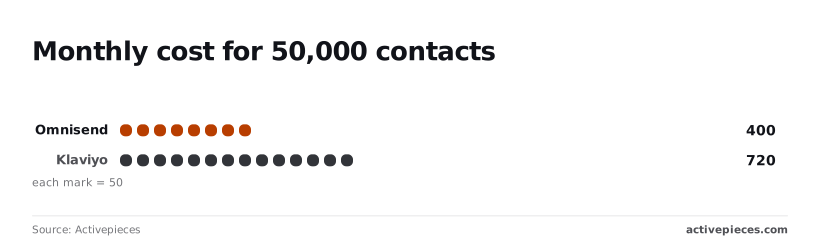
The immediate margin impact for a brand managing 50,000 contacts is demonstrated in the following table. It shows the premium charged for integrated data complexity.
| Provider | Monthly Cost (50,000 Contacts) | Primary Value Driver |
|---|---|---|
| Klaviyo | $720 - $825 | Integrated CDP and predictive analytics |
| Omnisend | $400 | Multi-channel automation for e-commerce |
| Sendlane | Custom / Volume-based | Event-driven attribution and delivery |
| Activepieces | — | Open source AI automation platform with 738 integrations |
Moving to a specialized mid-market tool can reduce your software spend by nearly 50%, as these figures show, effectively doubling the capital available for other marketing initiatives, which means you can reinvest those savings directly into high-impact campaigns.

This provides the same core email and SMS delivery without forcing you to subsidize enterprise-grade data science features you may not yet utilize.
You can reallocate a significant portion of your marketing budget to customer acquisition. The disparity becomes even more pronounced when compared to legacy providers.
Mailblast reports that for instance, Mailchimp charges approximately $800 for a similar list size, which means a mid-market brand is paying a legacy premium for a generalist tool.
Conversely, Klaviyo reaches as high as $1,380 for specific high-frequency configurations, effectively doubling the cost of communication for the same audience size, so your business must achieve twice the conversion rate just to maintain its current profit margins.

For your growth marketing lead, this delta is the difference between funding a new influencer campaign and being locked into a rigid contract.
This pricing pressure drives you to seek modularity. You pay for the execution of the message rather than the storage of the data. This shift toward leaner stacks reclaims the agility required to pivot strategies without platform-induced friction.
Reading a table only gets you so far. Build the same workflow in Activepieces and compare it yourself.
3. Sendlane: enterprise deliverability without the CDP tax
Sendlane is technical infrastructure for high-volume merchants that decouples retention marketing from the high-margin pricing of a full-scale Customer Data Platform.
As your brand scales, your marketing operations team often finds that the cost of storing and syncing historical purchase data in an all-in-one platform begins to outpace the actual revenue generated from those segments.
Sendlane addresses this by positioning itself as a specialized execution layer for commerce, focusing on the mechanics of inbox placement and multi-variable attribution rather than charging for the privilege of acting as your brand's primary data warehouse.
When deliverability becomes a specialized engineering hurdle rather than a background feature, you have reached the late-stage growth phase.
For your technical team managing these transitions, the move to Sendlane is often a strategic decision to regain control over the email service provider (ESP) relationship without inheriting the "CDP tax." This tax refers to the escalating fees associated with data ingestion and storage that don't directly improve your send reputation.
| Feature Area | Enterprise Impact | Consequence for ROI |
|---|---|---|
| Multi-Store Sync | Unified view of customers across distinct Shopify or BigCommerce instances. | Eliminates the need for third-party middleware to aggregate cross-brand purchase history. |
| Deep-Sync Attribution | Direct integration with commerce backends to track post-click behavior. | Your marketing team can verify the exact revenue impact of a flow without relying on directional platform estimates. |
| Dedicated IP Management | Isolation of sending reputation from the shared pools of smaller, higher-risk senders. | Large-scale campaigns avoid the throttling and blacklisting risks inherent in multi-tenant environments. |

By utilizing Gemini 3.8 Flash to analyze customer sentiment and purchase patterns via external logic, you can feed refined segments into Sendlane for execution.
This modular approach ensures that you only pay for the high-performance delivery of those messages, rather than paying an enterprise platform to perform the underlying data processing.
4. Mailchimp: AI-driven marketing for generalists
Mailchimp serves as the primary entry point for generalist brands that require high-level AI assistance and native integration into the Intuit ecosystem to manage cross-channel marketing.
While Klaviyo’s pricing scales aggressively based on the depth of the data profile, Mailchimp maintains a lower price floor for brands that prioritize breadth of reach over granular data modeling.
This positioning allows your marketing team to use automated insights without the overhead of dedicated data engineering.
To lower the technical barrier for creative and analytical tasks, the platform utilizes a centralized AI suite. Embedding these tools directly into the campaign builder allows Mailchimp to help your generalist team execute sophisticated workflows that would otherwise require specialized headcount.
- Content optimizer: This tool compares draft email copy against industry benchmarks to provide actionable suggestions on readability and imagery. This ensures that non-designers maintain brand standards.
- Creative assistant: This design engine pulls assets directly from your website to generate on-model multi-channel graphics. This reduces the time spent in external photo editing software.
- Intuit Assist: This generative AI agent uses the Gemini 3.8 Flash model to draft entire email sequences and segment lists based on natural language prompts. You can move from ideation to deployment without manual list filtering.
Integration with Intuit QuickBooks is a critical advantage for brands that treat their marketing stack as an extension of their financial operations.
This connection allows the system to trigger marketing automations based on real-time invoice status or payment history. To handle the complex reasoning required for these financial-to-marketing bridges, you can deploy Gemini 3.1 Pro via the platform’s advanced logic paths.
This setup ensures that high-value customers receive personalized retention offers the moment their lifetime value crosses a specific threshold. It maintains ROI without the complexity of a standalone CDP.
5. Klaviyo: the gold standard for integrated data intelligence
Native Predictive Analytics and Data Science
Klaviyo remains the benchmark for brands that prioritize a unified data science layer over modular flexibility. By housing the database and the execution engine in a single environment, it provides out-of-the-box predictive modeling that requires zero engineering resources to deploy.
Your marketing team can immediately leverage machine learning to calculate predicted next order dates and customer lifetime value (CLV) without writing a single line of SQL.
This "all-in-one" convenience is the primary reason high-growth brands accept the higher price point, as it eliminates the friction of syncing data between disparate tools.
Seamless Commerce Integration
The platform’s deep integration with Shopify and BigCommerce allows for a level of event granularity that is difficult to replicate in a decoupled stack. Every product view, checkout step, and refund is captured automatically, creating a rich historical record that fuels highly personalized automation flows.

For a brand scaling rapidly, the time-to-value of these native integrations often outweighs the cost savings of a more complex architecture. You are paying for the speed of implementation and the assurance that your data remains synchronized across every customer touchpoint without manual intervention.
Centralized Campaign Management
Managing email, SMS, and push notifications from a single dashboard provides a level of cross-channel coordination that modular stacks struggle to match.
This centralized approach ensures that your frequency capping and attribution logic are consistent across all touchpoints, preventing the "over-messaging" that often occurs when using separate delivery tools.
While the "complexity tax" is real, the trade-off is a highly polished user experience that allows non-technical marketers to build sophisticated, data-driven campaigns.
For teams that lack the engineering bandwidth to manage a decoupled stack, this integrated model provides the most reliable path to sophisticated retention marketing.
Transitioning Your E-commerce Data Stack
Executing a migration from an all-in-one platform to a modular architecture requires a phased handover to protect your sender reputation and data integrity.
Your retention team must prioritize continuity over a "big bang" switch, as any interruption in event tracking or email delivery directly suppresses the conversion rates established in your previous environment.
By treating the transition as a series of technical checkpoints, you ensure that your new stack inherits only clean, high-intent data while the old system remains a fail-safe for critical revenue streams.
Related reading
References
Still comparing
The fastest way to settle it is to build something.
Open source under MIT, so you can self-host the same thing later.
Start free Talk to sales