
LangSmith vs Braintrust: Which AI Eval Platform Wins?
LLM evaluation platforms require balancing framework integration with testing flexibility. Engineering leads can select the right tool for their stack.

Covers identity platform technical debt: Kubernetes RBAC, LDAP queries, and the implementation constraints that shape fixes.
ContributorSeptember 25, 202612 min read
This article was researched and fact-checked by an advanced research system.
When choosing between LangSmith and Braintrust, engineering teams must weigh the importance of deep ecosystem integration against specialized evaluation performance. LangSmith offers a seamless experience for those already utilizing the LangChain framework, providing end-to-back visibility into complex chains and agentic workflows.
On the other hand, Braintrust distinguishes itself with a high-performance, code-first approach to testing and evals that appeals to teams prioritizing speed and custom scoring scripts.
As developers increasingly automate these testing cycles through tools like Activepieces to trigger evaluations on every pull request, the choice often comes down to the specific developer experience.
LangSmith excels at debugging and tracing within its own environment, while Braintrust provides a more modular, lightweight alternative for teams t
Define production boundaries with evaluation platforms
LLM evaluation platforms are the formal gatekeeper that transforms non-deterministic model outputs into verifiable software assets through automated scoring and regression testing.
Without this boundary, a generative feature is merely a prototype subject to "vibe checks" rather than a production-ready service with a predictable error rate.
Why logging is not evaluation
Logging records what happened in the past, whereas evaluation predicts how a system will perform against future inputs. A Claude Dev Suite benchmark shows that in a typical retrieval-augmented generation (RAG) stack, latency accumulates across discrete stages.
Logging records what happened in the past, whereas evaluation predicts how a system will perform against future inputs.
A vector database lookup takes 10 to 30 milliseconds, which means the retrieval step alone consumes up to 3% of a standard 1-second response budget.
Claude Dev Suite logging captures that a specific query took 30ms. Evaluation platforms test if the 20ms spent on embedding ingestion or the 15ms spent on reranking actually improved the relevance of the final answer.
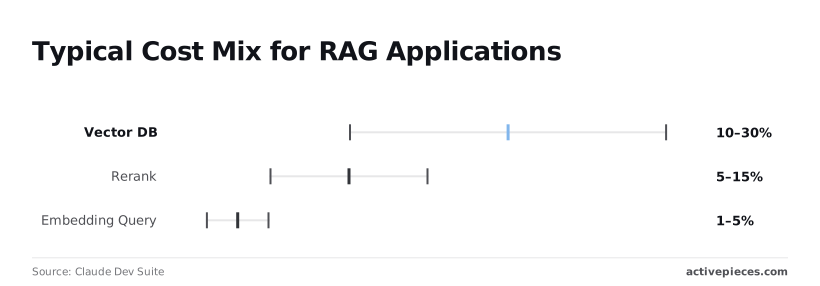
Claude Dev Suite notes that embedding queries typically range from 1 to 5 milliseconds.
The overhead of logging these events is negligible, but the cost of failing to evaluate them is a production environment where developers cannot distinguish between a slow database and a failing model.
The following diagram illustrates how an evaluation platform acts as a high-pass filter, converting a messy cloud of manual playground prompts into a linear, version-controlled pipeline.
By enforcing this transition, teams ensure that only prompts that pass specific heuristic or model-based scorers reach the end user.
Moving from manual review to automated LLM scoring
Transitioning to automated scoring allows teams to scale testing volume beyond the limits of human review.
When a workflow running on Activepieces (which provides unlimited flows on every plan) triggers an LLM chain, manual inspection can only verify a handful of traces before the cognitive load becomes prohibitive.
Transitioning to automated scoring allows teams to scale testing volume beyond the limits of human review.
Automated platforms replace this with "LLM-as-a-judge" metrics, which process thousands of iterations in the time a human takes to read one. If a developer spends 5 minutes reviewing a single trace, it would take over 80 hours to validate a modest 1,000-row test dataset.
The fastest way to settle a shortlist is to try one. Activepieces is free to try, no credit card.
Comparing LangSmith and Braintrust on core evaluation capabilities
LangSmith and Braintrust differ primarily in their architectural coupling. LangSmith prioritizes deep integration with the LangChain ecosystem while Braintrust functions as framework-agnostic middleware for CI/CD pipelines.
Integration: ecosystem vs. framework-agnostic
LangSmith is the native observability layer for LangChain, meaning developers gain automatic trace logging with minimal configuration. Braintrust operates independently, allowing teams to instrument codebases using various SDKs without importing framework-specific dependencies.
| Dimension | LangSmith | Braintrust |
|---|---|---|
| Integration | LangChain-native | Framework-agnostic |
| Latency | Standard overhead | 1-3ms overhead |
| Data Retention | 14-400 days | 14-30 days |
This distinction ensures that while LangSmith users benefit from "one-click" setup, Braintrust users maintain a decoupled architecture that survives transitions between different LLM orchestration libraries.
Performance: latency in the evaluation loop
Braintrust minimizes execution overhead to a range of 1-3ms per trace, ensuring that the evaluation layer is not a bottleneck during real-time inference. LangSmith follows standard API request patterns which can introduce higher variability in response times.
In a typical RAG pipeline, these overheads stack. According to the Claude Dev Suite, a standard workflow allocates 30 units to the Vector Database and 20 units to Embedding Ingest.
Adding 15 units for Reranking, 5 units for Query Embedding, and 30 units for Other Ops creates a complex latency budget. Every millisecond of platform overhead reduces the time available for actual model computation.
LangSmith vs Braintrust data retention and datasets
LangSmith has data retention tiers ranging from 14 to 400 days, allowing enterprise teams to audit historical performance over several quarters.
Braintrust limits its standard retention to between 14 and 30 days, which forces a tighter feedback loop where developers must promote important traces to permanent "golden datasets" quickly.
LangSmith vs Braintrust pricing models compared
LangSmith utilizes a seat-based pricing model that scales with the number of developers, making costs predictable for stable teams. Braintrust employs a consumption-based model tied to the volume of traces and evaluations processed.

For a team running the Claude Dev Suite stack (where Reranking accounts for 15 units and the Vector Database for 30), consumption-based pricing means costs scale linearly with traffic.
Seat-based models remain flat regardless of how many thousands of Embedding Ingest (20 units) or Query Embedding (5 units) operations the system logs.
Choose LangSmith for LangChain ecosystem integration
LangSmith is the A path to observability for teams utilizing LangChain’s orchestration library that requires zero manual instrumentation. By hooking directly into the BaseCallbackHandler interface, the platform automatically logs every prompt, retrieval, and tool call.
LangSmith tracing for LangChain LCEL chains
Tracing in LangSmith is a side effect of using the LangChain expression language (LCEL). The dashboard automatically visualizes any chain defined in code as a hierarchical tree.
An engineer can verify exactly how the system transformed a user’s query before it hit the vector store. Because the platform understands the specific schema of LangChain objects, it can surface the "hidden" prompts used by the library’s internal utility chains.
LangSmith playground to production feedback loop
The platform bridges the gap between a failed production run and a successful patch by allowing developers to port any logged trace directly into an interactive playground.
When a trace shows a hallucination, an engineer can open that specific prompt and model configuration in a sandbox environment for immediate iterative testing.
The moment a connector is registered in Activepieces, it functions as an agent tool without a second migration. A single integration runs two ways: as a step in a deterministic flow and as a schema on a per-project MCP server reachable by Claude or Cursor.
You can verify this in the packages/pieces directory of the MIT-licensed core, where the same action logic serves both structured automations and LLM-driven tool calls.
Developers identify a fix in the playground and save it back to the LangChain Hub, a centralized repository for prompt versioning. This keeps the production environment synchronized with the latest tested instructions.
LangSmith debugging tools for AI agents
A specialized view that groups iterations by "turns" simplifies debugging autonomous agents. This allows developers to follow the agent’s reasoning loop as it decides which tools to invoke.
Since LangSmith captures the full context of the agent’s scratchpad, an engineer can see exactly where a loop became recursive or where the LLM misinterpreted a tool’s output.
Reading a table only gets you so far. Build the same workflow in Activepieces and compare it yourself.
Braintrust wins for high-velocity teams prioritizing evaluation speed
Braintrust is a specialized evaluation engine. It decouples the testing lifecycle from the application framework, allowing engineering teams to run thousands of test cases within their existing GitHub Actions or GitLab CI pipelines.

CI/CD integration as a first-class citizen
Integration with automated deployment pipelines allows Braintrust to function as a blocking gate for code merges. A drop in model accuracy prevents broken logic from reaching production.
The platform uses a lightweight SDK that does not require the LangChain library. Consequently, developers can wrap any Python or TypeScript function to generate evaluation scores without refactoring their entire codebase to fit a specific vendor's abstractions. This framework-agnostic approach means a team can migrate from an OpenAI wrapper to a custom local model without losing historical evaluation data.
Braintrust UI for side-by-side model comparisons
The platform has a centralized view for comparing outputs across different model providers. Unlike tools that bury comparisons inside individual trace logs, Braintrust aligns outputs in a spreadsheet-style grid so that reviewers can spot regressions across hundreds of rows simultaneously.

Handling large-scale regression testing without lag
Braintrust utilizes a distributed backend architecture to process high-volume test batches. When a developer pushes a change, the platform executes evaluations in parallel, meaning the time to receive feedback remains constant even as the dataset grows.
Automating the evaluation pipeline with Activepieces workflows
Activepieces syncs flows to git and promotes them through Release Management, ensuring that the logic connecting production runtime logs to Braintrust evaluation suites is versioned and reviewed like software.
MoneyGram and FundingSocieties run this in production to maintain rigorous control over how edge cases are promoted into regression tests.
Syncing production logs to evaluation datasets
Activepieces reaches every model provider a company uses among its 735+ integrations to move a specific payload into a Braintrust dataset when a production trace is flagged through a low confidence score or an explicit user thumbs-down.
- An Activepieces automation workflow begins with a 'Webhook' trigger that receives production logs.
- This is followed by a 'Filter' step to isolate low-confidence scores.
- It concludes with a 'Braintrust' action that adds the problematic trace to a specific dataset.
This immediate capture prevents engineers from losing track of transient failures. Once the data resides in Braintrust, it serves as a permanent reference point for future model iterations.
Triggering re-evaluations on GitHub pull requests
Activepieces, an automation platform with 24,721 GitHub stars, listens for pull request events and triggers a Braintrust evaluation run against the proposed code branch, comparing results to the main branch baseline.
This gatekeeper logic prevents regressions in prompt engineering or RAG retrieval logic from being merged.
Routing low-score alerts to Slack or Microsoft Teams
Activepieces, which carries an MIT licence on the core, monitors evaluation outputs and, upon detecting a score drop, formats a message containing a direct link to the failing Braintrust trace and the specific input that caused the error.
By pushing these insights into the developer's workspace, teams can initiate debugging immediately.
By treating every connector as a native agent tool through its Pieces Framework and MCP server integration, the platform ensures that automation logic and model capabilities remain perfectly synchronized.
Activepieces is the better choice for engineering teams who require a unified architecture where production workflows and agentic tools are managed through a single, version-controlled repository. This seamless transition from flow-based automation to tool-enabled agents makes it the superior framework for maintaining rigorous evaluation pipelines.
The verdict for evaluation-heavy engineering teams
Choosing between these platforms depends on whether your primary bottleneck is the visibility of complex chains or the velocity of your deployment pipeline.
| Choose LangSmith if... | Choose Braintrust if... |
|---|---|
| Your stack relies on LangChain | You require sub-5ms latency overhead for real-time logging |
| You require data retention exceeding a year | You prefer a framework-agnostic SDK |
| Your primary goal is debugging the internal state of complex agents | You need to run evaluations as a blocking step in a CI/CD pipeline |
This matrix highlights that the choice is rarely about feature parity and more about the architectural constraints of your environment. If your team treats LLM outputs as unit tests that must pass before a git push, the lower overhead and CLI-first approach of Braintrust prevents the evaluation suite from becoming a deployment bottleneck.
Frequently asked questions about LLM evaluation tools
Can I run LangSmith or Braintrust on-premises?
Self-hosting options are restricted to enterprise-tier agreements for both platforms. LangSmith offers a self-hosted deployment via a Docker image, which allows organizations to keep trace data within their own Virtual Private Cloud (VPC).
Braintrust provides a private cloud installation that utilizes an AWS CloudFormation template to deploy the stack into the customer’s account. The underlying database and compute resources remain under the user's direct administrative control.

Do these tools support image and audio evaluation?
Support for non-text modalities is currently limited to basic storage and visualization rather than native automated scoring. Both platforms can render images within their trace views, which allows developers to manually inspect the output of vision models like GPT-4o.
Teams working on multimodal applications must write custom Python evaluators. These convert outputs into text-based descriptions or numerical scores before the platform can aggregate the results.
How do these platforms handle PII and data privacy?
Both platforms achieve compliance through SOC2 Type II certification and offer Business Associate Agreements (BAAs) for HIPAA compliance.
To prevent Personally Identifiable Information (PII) from ever reaching the cloud, developers typically implement client-side scrubbing using tools like Presidio. This ensures that sensitive strings are redacted before the SDK transmits the trace.
Is there a significant performance overhead when using their SDKs?
The SDKs for these platforms are designed to be non-blocking by using asynchronous logging, which prevents the evaluation logic from increasing the latency of the user-facing LLM response.
By offloading the telemetry data to a background thread, the application can continue its execution without waiting for the trace to be acknowledged.
Related reading
References
Still comparing
The fastest way to settle it is to build something.
Open source under MIT, so you can self-host the same thing later.
Start free Talk to sales