LangChain vs LlamaIndex: Which Should You Build With?
Read our LangChain vs LlamaIndex review and find out how the two platforms compare. Discover what makes Activepieces superior to both.

February 13, 202613 min read @ashrafsam
LangChain or LlamaIndex? If you’re asking that question, you’re already thinking ahead.
Each is designed for a different setup and workflow. Before you invest time learning and integrating one of them, it helps to understand what you’re getting into.
This detailed comparison will walk you through the key differences so you can choose the right tool from the start.
Still comparing frameworks? Skip the rebuild and start executing with Activepieces for free!
TL;DR
- Build with LangChain if you need agent orchestration, complex workflows, tool calling, and flexible control flow.
- Build with LlamaIndex if your main focus is fast, accurate retrieval over large datasets with structured indexing.
- Both support RAG, but LangChain is more workflow-driven while LlamaIndex is more retrieval-first and optimized for search.
- LangChain is better for multi-agent systems and advanced logic, while LlamaIndex is better for clean query routing across different index types.
- If you want to skip heavy setup and deploy AI workflows quickly with hundreds of integrations, Activepieces is the faster path.
The fastest way to settle a shortlist is to try one. Activepieces is free to try, no credit card.
What Is LangChain?
While a raw large language model (LLM) like GPT-4 is incredibly smart, it only knows what it learned during training. It can’t see your private files, query your database, or call application programming interfaces (APIs) unless you connect it to those systems.
LangChain integrates retrieval algorithms with LLMs, indexing data and storing it in vector databases so the system can search through all the data you provide.
When user queries arrive, it retrieves the most relevant data using semantic similarity and sends the context to the language model.
It also offers memory management for context retention and LangChain agents that can call external tools through API calls.
Developers use it to build complex and interactive applications quickly, especially when working with LLMs, large datasets, and complex workflows that require more than simple text replies.
What Is LlamaIndex?
LlamaIndex (formerly GPT Index) helps a language model answer questions using your own data.
The flow usually starts with data ingestion. You use data connectors to pull data from files, databases, Slack, Notion, or other external sources.
The framework organizes content into data structures. It builds indexes using embedding models and ranks documents based on semantic similarity, so the system can return relevant information.
It further excels at building search and retrieval applications through accurate information retrieval algorithms.
For internal search systems, knowledge management, and enterprise solutions, LlamaIndex excels in performance metrics, efficiently utilizing GPU resources.
LangChain vs LlamaIndex: Retrieval Augmented Generation Applications
Both tools support retrieval-augmented generation (RAG), but they handle RAG systems differently when you want answers grounded in your own data beyond the training data.
LangChain
You can use document loaders for content such as PDFs, URLs, or Slack exports. Large files get split into shorter pieces so the language model doesn’t lose context.
After that, those pieces turn into embeddings and go into vector databases like Chroma, Pinecone, or FAISS.
When user queries arrive, the system performs data processing to search the index and return the most relevant results based on semantic similarity. You’re not locked into a simple search-and-answer pattern.
With the LangChain Expression Language, you can add logic to check whether retrieved content truly matches the question before sending it forward.
The framework can remember earlier messages, so someone can ask, “Can you summarize that?” without repeating the topic. A RAG agent can also decide if it needs to search documents or reply directly.
LlamaIndex
LlamaIndex prioritizes structured retrieval.
The first stage, data loading, uses data loaders (or data connectors) to fetch and process data from multiple data sources. After ingestion, it builds specialized indexes that organize content for fast access.
There are two different index types:
- A summary index helps answer the question, “What is this whole document about?”
- Vector index supports precise retrieval tasks.
The router query engine reviews a user’s question and decides, “Should I use the vector index for a specific fact, or the summary index for a broad overview?”
When querying databases to retrieve relevant information, LlamaIndex ranks documents based on semantic relevance, enabling consistent retrieval even with large datasets.
LangChain vs LlamaIndex: AI Agents
AI agents move beyond simple questions and answer flows. They decide what action to take, call tools, read results, and adjust their next step based on what they learn.
Agent Framework
An agent framework defines how the language model thinks, chooses tools, and loops through actions until it reaches a goal.
LangChain
LangChain agents follow a clear reasoning cycle. The loop often looks like this:
- Thought: The agent reads the user prompt and decides what it needs to do.
- Action: It selects a specific tool, such as a Google Search API or a Python REPL.
- Action input: It writes the exact command for that tool.
- Observation: It reads the output returned by the tool.
- Repeat: It uses that result to form its next thought until it produces a final answer.
In LangChain, any function can become a tool. You wrap a Python function with a decorator, describe its purpose, and the agent decides when to call it.
Toolkits group related tools together. A GitHub Toolkit, for instance, can create issues, commit code, and read files.
You can build anything from a simple search agent to a complex autonomous research assistant that spends ten minutes browsing the web.
LlamaIndex
LlamaIndex enables agents to use models’ native tool-calling capabilities.
Data agents specialize in research. When you ask, “How do our 2024 sales compare to 2025?”, the system runs a query for 2024 and another for 2025. It then combines the results into a comparison to support efficient data retrieval for large datasets.
The framework treats every query engine as a tool. If you’ve already built a search engine for internal documents, you can turn it into an agent tool with one line of code. That design is important when agents should answer questions from structured indexes built with embedding models.
Responses often feel faster during heavy retrieval tasks because the agent relies on optimized indexing logic.
Multi-Agent Systems
Some tasks require more than one agent. Multi-agent systems divide work so each agent handles a specific responsibility.
LangChain
LangChain manages multi-agent flows through graph-based logic. A shared memory or folder holds the current draft, chat history, and any files created during execution.
Each agent becomes a node in that graph. You can define a researcher agent node and a writer agent node.
Rules define who acts next. For example, “If the researcher finds the info, go to the writer. If the info is missing, go back to the user.”
It also includes built-in checkpointers. If a multi-agent task runs for ten minutes and stops at minute nine, the system can resume from that exact state.
Breaking a large assignment into smaller assignments reduces AI hallucinations.
LlamaIndex
LlamaIndex organizes multi-agent systems around knowledge domains. Each agent handles a specific data silo, such as finance documents, support tickets, or SQL records.
You can have Agent A summarize Document 1, Agent B summarize Document 2, and a third agent compare their findings. That will help when answering complex queries that require analysis from multiple data sources.
Event-driven workflows control how agents trigger one another. When a researcher agent completes a task, it emits an event that starts the writer agent automatically.
Shared state allows agents to access needed context without copying large blocks of text back and forth.
Memory Handling Differences
Memory determines how long an agent remembers context and how it handles ongoing conversations.
LangChain
LangChain uses modular memory management. You can maintain thousands of independent conversations by assigning each user a unique “thread_id.” The system can refer to previous interactions and maintain accuracy during long sessions.
Memory types vary. For example, a buffer stores recent messages, while a summary compresses older exchanges into shorter notes
For agents, you can pause execution, let a human edit memory to fix an error, and then resume the process.
LlamaIndex
LlamaIndex builds memory into its chat engines.
Whenever someone asks, “Can you summarize the second point?”, the system rewrites it into a standalone question such as, “Can you summarize the second point regarding the Q4 Revenue section of the PDF?”
It automatically manages threading, so when a user returns with a “specific user_id,” the agent loads prior context and document history.
For new questions, the system searches past conversations like documents to find relevant context, which is necessary for simple search and retrieval tasks.
API and Tool Integrations
Agents should be able to connect to outside systems.
LangChain
LangChain integrates multiple LLMs and external data sources in a single flow.
In this framework, any function can become a tool. You wrap a Python function with a decorator, describe it, and the agent handles the rest. Structured tools let the agent pass detailed arguments to APIs.
Meanwhile, LangChain’s library of document loaders can gather data from external sources, including Google Workspaces. It even supports workflows that combine multiple models with databases, search APIs, and messaging services.
LlamaIndex
LlamaIndex turns APIs into searchable knowledge layers. It connects to multiple data sources and makes them feel like structured indexes.
You can wrap any Python function as a tool with a single command. The agent reads the function’s docstring to understand when to call it.
Some LlamaHub connectors support audio and video files, which expands the types of content you can load from and pull data into your system.
Integration with external tools and services focuses on structured retrieval first, then action.
Reading a table only gets you so far. Build the same workflow in Activepieces and compare it yourself.
LangChain vs LlamaIndex: Production Systems
Running either framework in production means you now manage cost, visibility, and security.
Infrastructure Requirements
Infrastructure decides how your system handles scale, storage, and reliability under real traffic.
LangChain
In production, LangChain behaves like a distributed system. You deploy it as a service, connect it to databases for memory, and store embeddings in the database.
LangSmith requires an API key and serves as your control panel, displaying every “Thought,” “Action,” and “Tool Call” in real time. It helps you find exactly where a chain failed and how much money that specific run cost you.
Security also moves from optional to mandatory. Every user session has a unique “thread_id” or “session_id” to prevent data leakage between different people’s chat histories.
Once an agent has an “SQL Tool,” that agent should live in a private VPC with “read-only” access to your database to prevent an AI from accidentally deleting your tables.
In multi-agent systems, different agents should have different permissions. A “Customer Support Agent” shouldn’t have the same API keys as a “Financial Reporting Agent.”
LlamaIndex
Production with LlamaIndex focuses heavily on data ingestion and index reliability.
For enterprise-grade RAG, many teams use LlamaCloud, a managed platform that handles the heavy lifting of data parsing, ingestion, and synchronization.
Embeddings move into managed databases, while document text and metadata live in durable storage systems. As you index a document, you can tag it with metadata like role: “finance” or access_level: “top-secret.”
During retrieval, those filters restrict what the system can see.
Multi tenancy also receives attention. It makes sure that “User A” from “Company X” can never retrieve context from “Company Y,” even if they use the same database.
Authentication and Security
Security covers identity, permissions, and content filtering.
LangChain
You can integrate Open Authorization (OAuth) or Single Sign-On (SSO) with your application and pass the user identity to each session. Isolation between sessions prevents memory crossover.
Permissions follow least privilege rules. Tool access, on the other hand, stays limited to what each agent truly needs.
Sensitive actions can pause for human approval before execution.
LlamaIndex
Security operates at the data level. Document metadata filters restrict retrieval before generation starts.
It also integrates with tools like LLM Guard to scan incoming user queries for malicious intent and check outgoing responses for sensitive data leaks. On-premises deployment remains an option when data can’t leave private infrastructure.
The Advantage Activepieces Has Over LlamaIndex and LangChain
Now let’s step back.
LangChain and LlamaIndex are developer frameworks. You write code, manage infrastructure, deploy services, wire databases, and monitor logs.
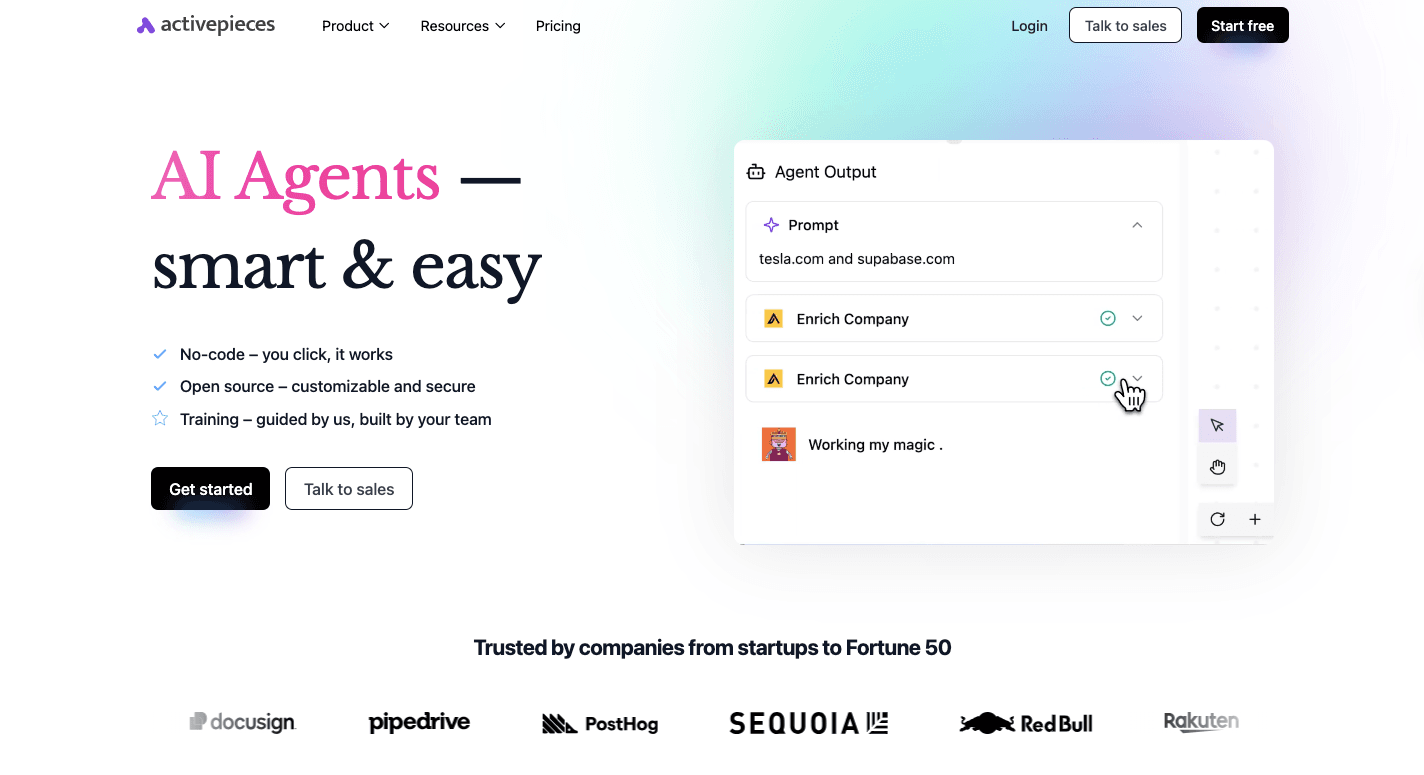
Activepieces gives you a visual automation engine that connects AI, apps, and logic.
RAG Applications
With LangChain or LlamaIndex, you write ingestion scripts, configure embeddings, connect databases, and keep indexes up to date yourself. Even a basic retrieval flow requires backend setup and deployment planning.
But with Activepieces, you can just drag a Google Drive piece, connect it to a vector store, attach an AI piece, and publish. When a new file appears, a trigger can re-index automatically.
Activepieces offers 632+ integrations, called pieces. That means you connect AI with CRM, finance, marketing, and analytics tools without writing connectors.
AI Agents
LangChain agents are flexible, but you build their environment yourself. If an agent needs Gmail and Google Sheets, you manage OAuth, tokens, and API limits manually.
Activepieces includes built-in authentication for hundreds of data integrations. You click Connect once, and the agent can act in those systems immediately.
You also see every step visually. Each action appears as a block in the flow.
Want approval before sending an email? Drag a human-in-the-loop step. Need the agent to wait two hours? Add a delay piece.
Triggers make agents proactive. For example, when a new lead appears in HubSpot, the workflow starts automatically. The agent can research, draft a reply, update records, and notify a team.
Production Systems
Running LangChain or LlamaIndex in production supports Docker, orchestration, databases, retries, logging, and secret management. You design and maintain the stack.
Activepieces includes that layer by default. Click Publish, and the flow runs inside a managed execution engine.
As an API fails, the run history shows the exact input and output for each step. You can re-run instantly or enable automatic retries.
You can also deploy in the cloud or self-host inside your own virtual private cloud (VPC).
Less DevOps. More execution. Launch your flows with Activepieces!
Move Beyond RAG Pipelines Into Autonomous Workflows With Activepieces
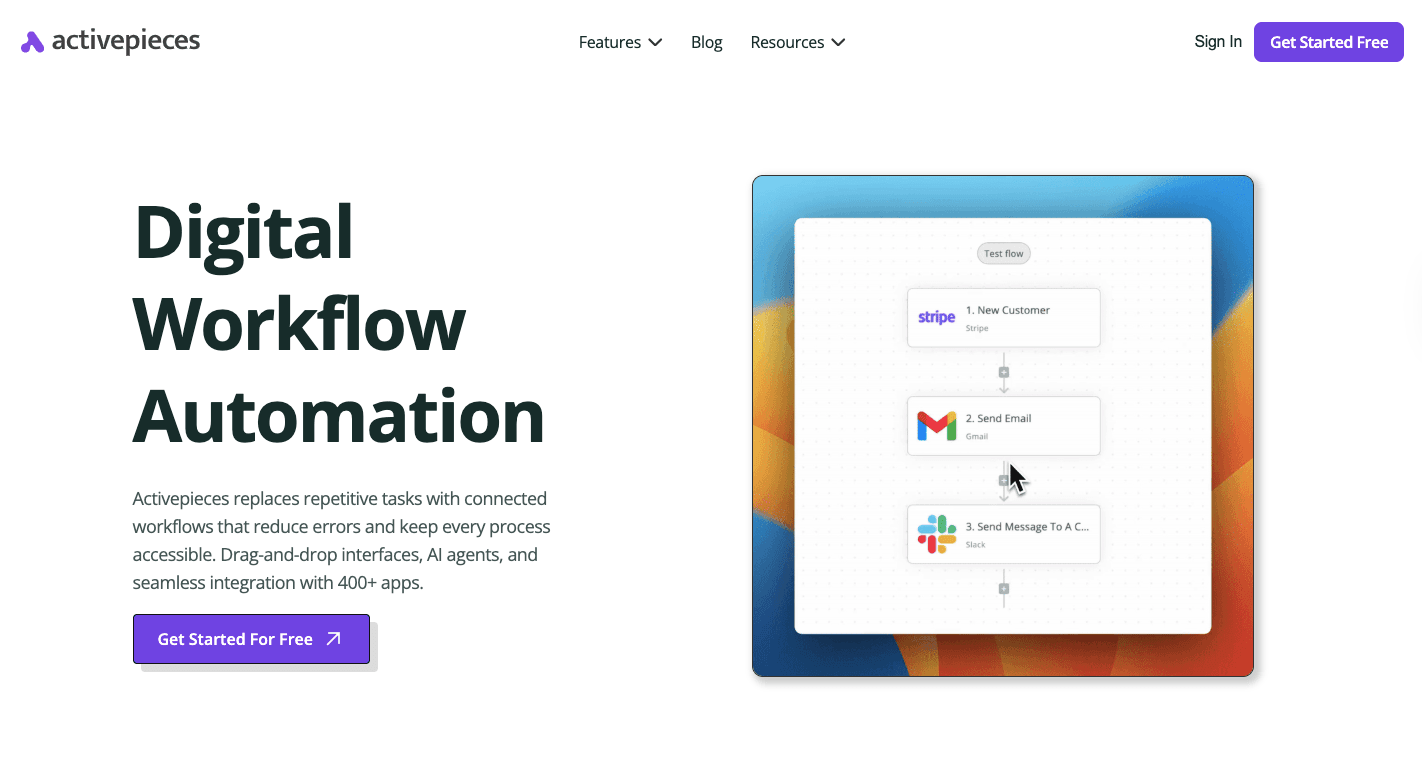
RAG pipelines answer questions. Autonomous workflows run your business.
Activepieces lets you connect with generative AI, generate an answer, then trigger actions in Slack, HubSpot, Google Sheets, or Zoho. The visual builder allows you design full workflows where AI outputs become inputs for the next step.
Currently, Activepieces includes 632 integrations. These cover AI providers, CRM systems, finance tools, business intelligence apps, and collaboration platforms. Authentication is built in. You connect once and reuse the integration in any flow.
Developers can create custom pieces in TypeScript and publish them through the open ecosystem. The majority of integrations come from community support, which keeps the library growing.
You move from prototypes to real automation without rebuilding infrastructure.
Move from RAG demos to autonomous workflows. Contact Activepieces now!
FAQs About LangChain vs LlamaIndex
Is LangChain better than LlamaIndex?
LlamaIndex is for projects that require advanced search and precise data indexing over large document collections.
LangChain is efficient at handling complex data structures and can operate within its modular architecture to support sophisticated workflows that integrate tools, memory, and logic.
Both frameworks offer powerful capabilities. If you care more about retrieval depth, choose LlamaIndex. When you need orchestration, agents, and flexible control flow, LangChain may fit better.
Can you build LLM applications with LangChain?
Yes. LangChain was built for that purpose. It connects language models with tools, memory, and external systems so you can build chatbots, AI agents, and systems that produce context-aware outputs.
Additionally, it supports document ingestion, splitting, indexing, and tool execution inside one framework.
Are LangChain and LlamaIndex open source?
Yes. Both frameworks are open source and allow developers to extend, customize, and deploy them in their own infrastructure.
Does LlamaIndex support agents?
Yes. LlamaIndex supports agents that can query structured indexes, route questions to the right tools, and reason over documents.
Still comparing
The fastest way to settle it is to build something.
Open source under MIT, so you can self-host the same thing later.
Start free Talk to sales