
Le Chat Pro Pricing 2026: Plans, Limits and What You Get

Oct 29, 202613 min read
Le Chat's pricing and plans
Direct answer: what Le Chat Pro costs today
Le Chat Pro is the paid subscription plan for individual users of Mistral's Le Chat assistant, giving higher usage limits and fuller access to its features than the free tier in return for a recurring fee.
Le Chat is Mistral AI's chat assistant, sold as a free plan plus paid plans for individuals, students and teams. The limits matter more than the headline number.
Every plan in one table
The table lists each plan Mistral sells, with price, limits and storage as the pricing page states them. Where I couldn't confirm a figure, the cell says "not stated".
| Plan | Monthly price | Annual price | Message, search and image limits | Storage |
|---|---|---|---|---|
| Free | $0 | not stated | not stated | not stated |
| Pro | $14.99 | not stated | not stated | not stated |
| Student | not stated | not stated | not stated | not stated |
| Team | not stated | not stated | not stated | not stated |
| Enterprise | not stated | not stated | not stated | not stated |
Because most cells read the same, the table makes little comparison between plans beyond price. Open Mistral's pricing page, find the row for the plan you are considering, and check the limits before the price.
What the pricing page doesn't state

Distrust a plan page that names a limit but gives no number. If messages, searches or image generations are described as "extended" or "higher" and never counted, you can't know which of them runs out first for your use.
Before you pay, look for three things:
- a stated count for each limit, not an adjective
- whether the limit resets daily or monthly
- whether storage has a stated size
If any of these is missing for the plan you want, treat the missing item as the cost you haven't yet priced.
If you are running this arithmetic for your own team, see what the same workload costs on Activepieces.
Which Le Chat plan fits your needs
Free covers occasional drafting, Pro covers daily research and most individual work, and Team applies only when several people need shared limits on one account. Each job below breaks on a different limit, so the plan that covers one doesn't automatically cover the next:
- Email and document drafting hits the message allowance first, and Free covers it for a light user.
- Research with web search and uploads runs into the cap on those gated features first, and Pro raises it.
- Daily coding or images hits the usage allowance for that feature first, and Pro covers it for one person.
Le Chat Free for light writing and summaries
Drafting a reply or condensing a document uses plain chat messages, the cheapest thing the app does. If you open Le Chat a few times a week, the free message allowance will probably outlast you.
Watch for one sign: the app stops mid-task on a day you needed it. That day, not the price, is your reason to upgrade.
Daily research and documents: Pro
On the third long document of the day, a plan that looked adequate for chat can run out. Research needs web search and file uploads, and tiers ration those most often.
Here Pro earns its place, because it lifts the limits that bind this work without paying for seats you don't use.
For a single user who works in Le Chat every day, Pro is the right stop, and it's the plan this article recommends for most individuals.
Heavy or shared use: when Team applies
When the binding constraint stops being your own usage and becomes the number of people who need access under one bill and one workspace, Team makes sense.
A solo user who keeps hitting Pro limits should first check whether the pattern is steady or a one-week spike. Move up only if it's steady.
If two or three colleagues each need Pro-level access, compare the per-seat Team price against separate Pro subscriptions on the vendor's pricing page. That comparison is the point where Team starts to pay for itself.

What Le Chat costs monthly
At list price, one Pro seat is $14.99 a month and a Team seat is $24.99, so the Team premium is $10 per person before anyone has typed a prompt. The figures below are illustrative arithmetic on those published per-seat prices, not measured spend.
Le Chat Pro monthly versus annual billing
Twelve months of Pro billed monthly comes to $179.88. The saving is whatever the annual price on the vendor's pricing page undercuts that figure by.
If you've used Le Chat for a few weeks and keep hitting the same wall, annual billing makes sense. If you're still testing, paying monthly costs you a little more but lets you cancel without a prepaid year sitting unused.
Three and ten seats compared
For three seats Pro costs $44.97 a month, and for ten it costs $149.90, against $74.97 and $249.90 on Team, which means the Team option costs you an extra $30–$100 monthly.

Take from it that Team's extra cost scales with headcount, so it needs a reason that scales too.
(chart)
Ten people each needing Pro-level limits can run on ten Pro subscriptions at the lower price.
Team earns the $10 premium only if you need something Pro lacks, such as shared administration, which you should confirm against the plan descriptions rather than assume.
The break-even point for upgrading
Do not look for a dollar amount at the break-even between Free and Pro. It's the first time the Free cap stops work you were in the middle of: a message refused, a feature greyed out, a reset time you now have to wait for.
One such interruption is an annoyance. The same interruption in a second week is the signal that $14.99 is cheaper than the time you are losing, at which point the upgrade is worth the cost.
A rough test: if you would pay a freelancer $14.99 to remove one hour of waiting or rework in a month, Pro has already paid for itself. That assumption's mine, so substitute your own hourly value.
Worth checking against a plan that does not meter every step: one credit covers a whole run on Activepieces.
Le Chat's hidden costs and limits
Five things change what Le Chat costs you beyond the subscription price: unnumbered caps, plan-specific features, tier-specific privacy defaults, separate API billing, and tax.
- Soft daily caps with no stated number, so you learn the ceiling when a request is refused mid-task.
- Tools differ by plan, so one you tried on another tier may be missing on yours.
- Privacy settings by tier, so whether your chats can be used for training depends on the plan you hold.
- API usage billed separately, with Mistral Large 3 listed at $0.50 per 1M input tokens and $1.50 per 1M output tokens, none of it covered by the subscription.
- Tax on top of $14.99, so the charge on your card is higher than the advertised price.
The first three limit what the plan lets you do. The last two are costs the sticker price leaves out.
Soft caps and feature gating
Mistral describes its paid limits as generous, yet it doesn't publish a daily message count, and I couldn't tie a figure to its help pages or changelog. Treat the cap as real but unmeasured.
The practical test is to run your heaviest ordinary day on a trial and note when throttling starts, not to trust the plan name.
Feature access is the same story: which tools sit on which tier has changed between releases, so check Mistral's current plan comparison, not a review from last quarter, including this one.
API billing is separate from the subscription
A Pro subscription gets you the chat app, not API credit. If you wire Le Chat's models into a script, an automation, or a teammate's tool, that usage is metered on its own account at per-token rates.
The Large 3 rates above are the figures I was given and I haven't re-checked them against Mistral's live pricing page, so confirm them there. A workflow that looks free because you already pay for Pro can produce a separate invoice.
Data and privacy settings by plan
Whether your conversations may be used to improve models is a setting that has differed by tier, and the default is not always the one you would pick.
**A workflow that looks free because you already pay for Pro can produce a separate invoice.
I haven't verified the current terms for each plan, so read the data-use section of Mistral's terms before putting client material in.
Le Chat Pro versus alternatives
Of the four plans compared here, Le Chat Pro is the cheapest at $14.99 a month, about $60 a year less than any of its three rivals.
Price and stated limits side by side
The monthly prices below come from the llms.blog October 2026 comparison.

The table shows that the sticker prices sit in a narrow band: $14.99 against $19.99 for Google AI Pro and $20 for both ChatGPT Plus and Claude Pro.
Take from it that price alone won't separate these plans by much, and that the real choice lies in the limits.
| Plan | Monthly price | Check date |
|---|---|---|
| Le Chat Pro | $14.99 | October 2026 |
| Google AI Pro | $19.99 | October 2026 |
| ChatGPT Plus | $20 | October 2026 |
| Claude Pro | $20 | October 2026 |
A $5 monthly gap is real money over a year, but it's also smaller than the cost of hitting a cap in the middle of a working day.
Where Le Chat is stronger or weaker
On price Le Chat is stronger, and nothing else in this comparison is as clearly settled. It undercuts Google AI Pro by $5.00 and ChatGPT Plus and Claude Pro by $5.01.
Adoption is a separate question from quality, but it's some context.
According to AlphaMoat, the Le Chat app's monthly downloads over ten months fall into these bands: one month at 80–120K, two months at 120–160K, six months at 160–200K, none at 200–240K and one month at 240–280K.
Six of ten months in the same 160–200K band means steady demand rather than one launch spike. Only one month passed 240K, so do not read growth into the chart.
The practical split: choose Le Chat Pro if you want the lowest bill and your use doesn't push against a cap.
Choose a $20 rival if you already work inside its ecosystem or have found that the limit on the cheaper plan binds before the month ends.
What Activepieces does about this
The cost this article keeps pointing at is the one the Pro subscription doesn't cover: the metered API bill that appears when Le Chat's models start feeding scripts and automations. Activepieces is where we address it.
You build the workflow that sends a prompt to Mistral, or takes the result and passes it to your email, docs or chat tool, and every run is counted before it happens, not discovered on an invoice.
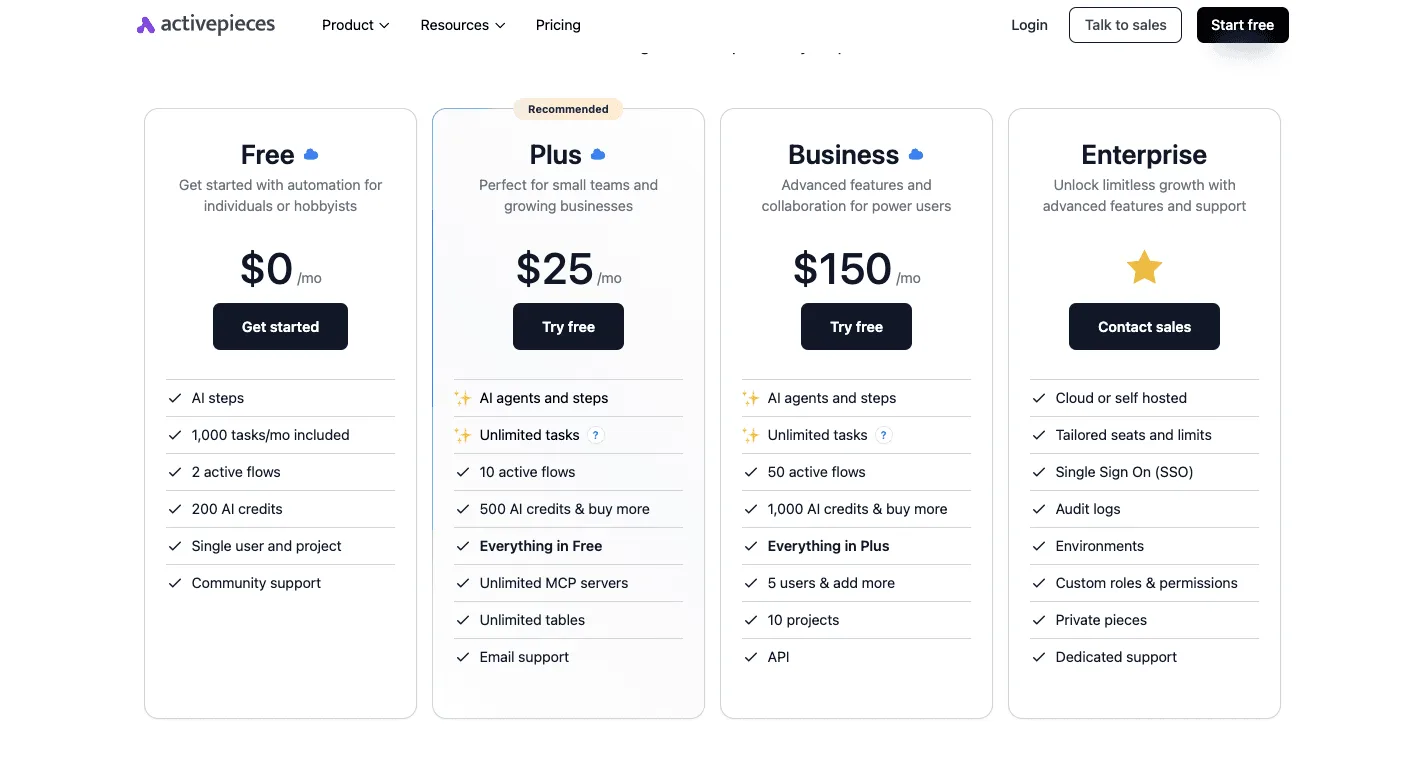
Billing is by credit, and one run costs 1 credit regardless of how many steps it has.
The free plan includes 1,000 credits a month and unlimited flows, so you can test your heaviest ordinary day, as the earlier sections advise, without paying for the test. Zapier counts tasks and Make counts modules, which means a longer flow costs more there.
In Activepieces a ten-step flow and a two-step one cost the same, so you can split a job into smaller, more reliable steps without raising the bill.
One thing stays outside our pricing. The model calls inside a run are billed on your own Mistral account at its per-token rates, so Activepieces doesn't hide or replace that line item.
What you get is a clear split between the two: a credit count on our side that you can read off the run history, and a token count on Mistral's side that you can check against its live pricing page.
The code is open source under the MIT licence, so you can self-host if you would rather not run client material through a hosted service.
That matters for the privacy question above, because it lets you decide where the workflow runs, though what Mistral does with the data you send it is still set by the plan you hold there.
For one person on Pro, the sensible order is to keep the subscription for the chat app, put anything scheduled or repeated into a flow, and budget the API as the second line item.
Frequently asked questions
Is there a free trial of Le Chat Pro?
Le Chat has a free plan, so use that as your trial. Whether Pro carries a separate trial period is something only Mistral's pricing page can settle on the day you read it.
Test your heaviest real task on the free plan first. If the free limit stops you mid-task, that error message is your evidence that Pro is worth paying for.
Can I cancel Le Chat Pro any time?
Read Mistral's terms of service and the billing page in your account before you enter a card; they set cancellation and refund terms.
The question to answer is narrow: does cancelling end access immediately, or at the close of the paid period? Whichever it is, the answer decides whether you should cancel on day one of a month you no longer need or wait until the last day.
Do students or nonprofits get a discount?
This is stated only on Mistral's pricing page, and this article doesn't assert a discount it can't confirm. If you qualify, look for an education or nonprofit line there before paying the list price.
Eligibility usually turns on proof, such as a school email address, so gather that before you start checkout. A discount applied after payment is a support ticket, and support tickets are slow.
Can I use Le Chat Pro inside other apps or automations?
Treat the Pro subscription and Mistral's API as separate products unless the pricing page says otherwise. Paying for Pro buys you the Le Chat app and its limits.
It doesn't, on that basis alone, give you programmatic access from your own scripts or from an automation tool.
When an automation runs overnight, it can accumulate charges that your Pro subscription doesn't cover, because API use is metered and billed on its own.
If your workflow needs Le Chat to call out to other tools, check Mistral's documentation for the connectors Le Chat itself supports. If it needs other tools to call Le Chat's models, budget for the API as a second line item.
Related reading
References
Running the numbers
See what the same workload costs here.
Free forever plan, and every paid plan self-hosts at no extra cost.
See pricing Talk to sales