
Momentic: AI Testing Platform Review (2026 Guide)

Nov 2, 202611 min read
Momentic is an AI testing product from a company of the same name, and it's new. Everything below comes from the maker's own site, momentic.ai, read on 2026-11-02, much as you would read any workflow tool's pages, say Activepieces, before trying it yourself.
Nothing independent backs Momentic yet. It is a newly released AI testing product made by Momentic, and the only evidence for it today is the maker's own pages.
That makes this a spec-reading job: you can judge what it claims, but no independent track record exists yet to confirm those claims.
Before you read further, here are the four facts this article rests on and where each came from. Treat any claim beyond these as unverified until the maker's pages say it.
Momentic launched: what was released and when
- Maker: Momentic, per momentic.ai
- Released: an AI testing product, per the product description on momentic.ai
- Release date: not confirmed from the pages we read, so we state none
- Date checked: 2026-11-02, on momentic.ai
With no date we can pin down, the product's age is unknown. That is why the gap in the third bullet matters.
We record only what the maker's pages state. We leave out reviews, directories and reposted summaries, because a newly released product collects secondhand claims quickly.
Questions about wiring it into Activepieces, whose core is MIT-licensed and so can be read in full in its public repository, come later, once we have pinned down the product itself.
This takes minutes, not a project: automate it in Activepieces free.
Why automation teams need testing oversight
Because an unattended workflow also fails unattended, a test step is what tells your team before a customer does, and a product like Momentic aims to be that step.
Picture the loop in the drawing below:
- the app and the AI-driven workflow on the left
- an automated test step checking them
- a team member reading the pass/fail result on the right
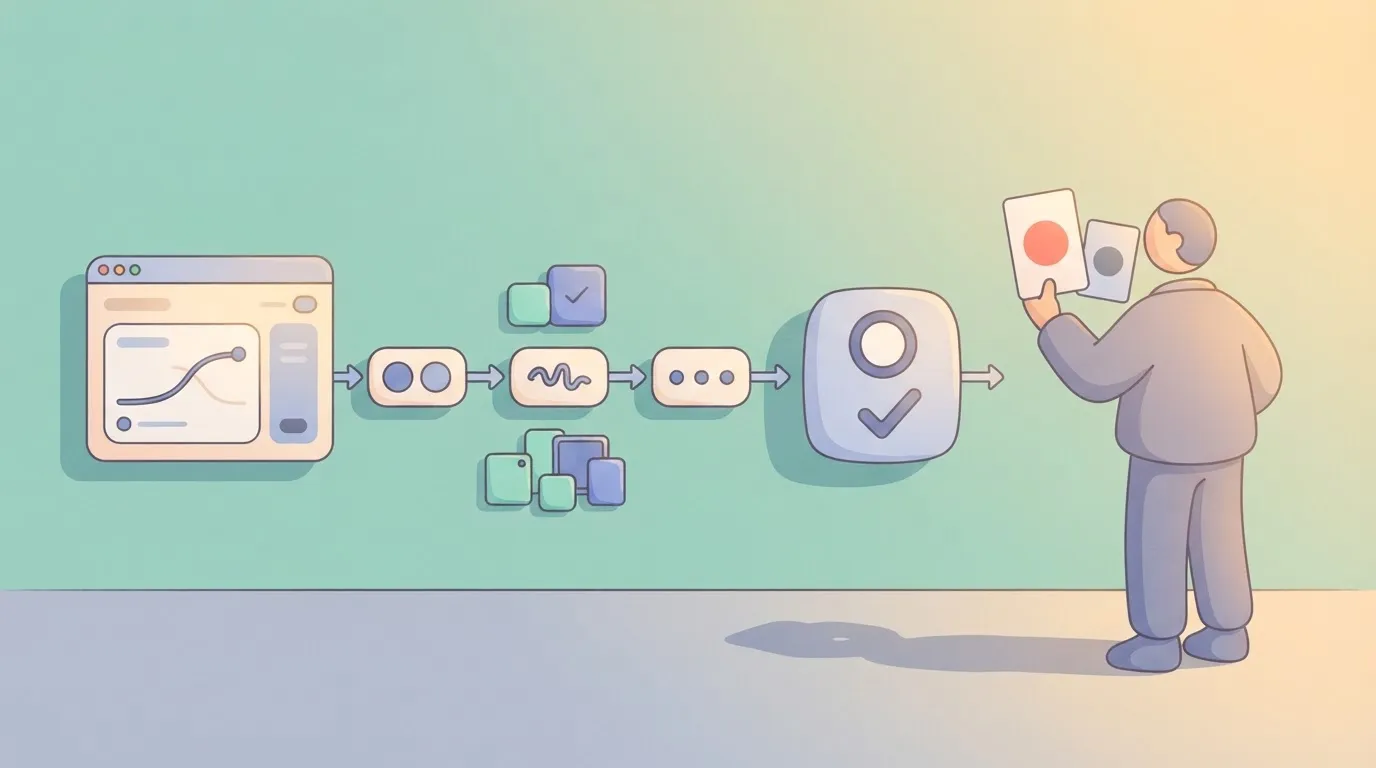
The point is that a person reviews outcomes, not every run.
Most teams are still early in that loop. The Software Testing Magazine write-up of the World Quality Report puts 52% of organisations at piloting AI testing and 37% in production, which means only a minority have moved AI testing to production.

So fewer than four in ten run it for real, and most of your peers are still proving it out.
That leaves 11% doing neither, which means a pilot isn't an outlier.
Next comes how to size up a tool with so little track record.
To see how much outside evidence exists, look at review volume. On Gartner Peer Insights, Katalon has 866 reviews, BrowserStack 693, Tricentis 562, TestMu AI 427, Parasoft 101 and Keysight 77.

Those established names have hundreds of users to check against. A newly released product has almost none, so the maker's own pages carry the weight, and you should press them on:
- which triggers start a test run, and which fields the result returns
- how it reports a failed step, and to whom
- what the product states about pricing, limits and supported apps
Anything the pages leave unstated, treat as unknown.
What is measurably new, from momentic's own pages
Momentic's five claimed improvements in AI testing
There is little here to measure: Momentic's landing page, read on 2026-11-02, offers five claimed improvements, and every one's the maker's own number, not a test result.
If it breaks mainly from other causes, you gain nothing.
Treat all five as hypotheses to test against your own suite, because no page states the baseline, the sample size or the method.
Momentic access, output and pricing details
The pages do say how to get the product: try it free in the web app or run the CLI locally and in CI.
Momentic presents itself as an AI testing product, and its pages say it is free to start with no credit card, via a web app at app.momentic.ai/mo or a CLI you run locally and in CI, though fuller trial terms are not stated.
If you plan to move test data into other tools, read the docs' extract command first. Before you map any fields, confirm in the docs what it returns, in what format, and with what limits.

Nothing I can cite settles those, so assume nothing about its output.
You will find no price, tier or usage limit on the cited landing page; they are on the separate pricing page. Any figure you see elsewhere isn't from the maker, so check the pricing page, and ask Momentic for a quote only for Enterprise, and get the billing unit in writing before you build on it.
You can follow the rest of this with the builder open. Start free, no card.
Connect momentic without native support
Until you have a quote and a billing unit, you also have no integration to lean on. Activepieces has shipped nothing specific to momentic: none of the 746 integrations counted in packages/pieces/community in its repository is named for it.
We haven't run momentic ourselves either, so what follows is built from the maker's pages and the generic steps any workflow tool offers. The three options below run from simplest to most involved, and each has one condition that must hold first.
Connect momentic with an HTTP request step
This is the plainest route: a workflow step that sends a request to an address you give it. The condition is that momentic exposes an endpoint you can call to start a run or read a result.
momentic.ai describes Mo as an AI QA engineer that tests your app end to end from a prompt, but a product description isn't an API reference.
Find the documented endpoint, its authentication method and its response fields before you map anything. If you can't find them, this option is closed.
Connect momentic through an AI step custom provider
When an AI step runs, it sends a prompt to a language model and returns text. A custom or OpenAI-compatible provider setting lets you point that step at a different address than the default vendor.
The condition is that momentic serves a model endpoint that speaks that request format.
Nothing we have read says it does. Momentic's extract command, which reads a value from the page, runs inside a test and isn't a chat endpoint. So treat this as a possibility to verify, not an assumption.
Connect momentic through an MCP server
MCP, the Model Context Protocol, lets an AI agent call outside tools through a server. The condition is that momentic, or someone you trust, publishes such a server, and that your workflow tool can act as a client for it.
Without both, there's nothing to connect.
If both hold, this route gives an agent the most freedom, and it also demands the most review of what the agent may trigger.
The agent side is the part Activepieces already has in place.
Each of the 746 integrations in packages/pieces/community in the MIT-licensed repository is a integration, and the action that runs as a step in a flow is the same one the per-project MCP server exposes as a tool schema, reachable from Claude, ChatGPT, Cursor or an agent you built, so you don't need to write 746 custom connectors.
The Integrations Framework and MCP Server documentation describe that mechanism, and packages/pieces in the open source repo holds the single action definition behind both. So if a Momentic integration ever lands there, it serves your flows and your agents at once, with no second integration.
MoneyGram, Moneypenny, Alan and FundingSocieties run Activepieces in production.
Compare momentic against current tools
We have no speed or cost-per-task measurement of our own.
Anything beyond that would be a guess, so the table below shows what exists and marks the rest. Read it as a map of where evidence is missing, since an empty cell tells you what you would have to measure yourself.
| Approach | Cost | Speed |
|---|---|---|
| Manual testing | no measurement from us | no measurement from us |
| Scripted suites | no measurement from us | no measurement from us |
| Other AI testing tools | no measurement from us | no measurement from us |
| Momentic | pricing page figures only | no measurement from us |
Prices and plan limits checked against momentic.ai and momentic.ai and momentic.ai on November 2, 2026.
The Gartner review-count chart shows how established the rest of the field is: the older tools have a long run of user reviews, and a newly released product doesn't.

The consequence is that you can lean on outside experience for those tools but not for Momentic, so any claim about it comes from the maker.
What momentic's own pages support for comparison
The maker's pages support one concrete thing: you can read the pricing and decide whether the plan structure fits your team before you run anything. That makes the pricing page the only legitimate source for a Momentic cost comparison.
Check what the plan actually meters, whether that's seats, runs or something else, because the unit decides whether a busy suite costs more than a quiet one.
Momentic claims that cannot be verified yet
We can't say Momentic is faster or cheaper than a scripted suite, a manual pass, or a competing AI tool. Nobody here has timed a run or priced a finished task, and the maker's own pages aren't a substitute for that.
If speed matters to your decision, run the same small set of flows through your current approach and through Momentic, and record the results yourself.
What to watch next after the momentic launch
Re-check a short, fixed list of pages on a schedule, because what the maker publishes will change faster than anything written about it, including this article.
Momentic pages to re-check for updates
Momentic describes its product, Mo, as an AI QA engineer that tests your app end to end from a prompt. That's the claim to hold the docs and changelog against.
The table shows where to look and when I last looked. A two-week gap on the maker's own pages and a longer one on third-party listings fits how quickly each is likely to change.
| Page | What to look for | Last checked | Next re-check |
|---|---|---|---|
| Momentic docs | Setup steps, any API or webhook trigger | 2026-11-02 | 2026-11-16 |
| Momentic changelog | Release pace, integration entries | 2026-11-02 | 2026-11-16 |
| Momentic pricing page | Published tiers, run or seat limits, trial terms | 2026-11-02 | 2026-11-30 |
| Activepieces repository | A new Momentic folder or pull request | 2026-11-02 | 2026-12-01 |
| Activepieces piece catalog | A Momentic listing with named triggers and actions | 2026-11-02 | 2026-12-01 |
If a re-check finds nothing new, the generic building blocks remain your route. If it finds a listing, read the trigger and action names before trusting the catalogue entry.
Questions to ask in a momentic trial
A trial answers what the pages can't. Ask whether a finished run can fire a webhook, or whether results only appear in a dashboard someone must open.
Ask whether a run can be started by an authenticated HTTP call, since that decides whether a workflow can launch tests at all.
Look at a failure payload: does it name the test and the failing step, and link a screenshot, or only say "failed"? Finally, run one flow twice and compare. A prompt-driven tester that gives different verdicts on identical input can't gate a deployment.
Related reading
Build it
Set this up in minutes.
No code required. Connect your accounts, and Activepieces runs it from there.
Start free Talk to sales