Muse Ember Pricing: Cost per 1M Tokens (2026)

Nov 15, 202614 min read
Muse Ember Pricing Today and What It Is
Muse Ember API Cost per 1M Tokens
You cannot read your bill off Muse Ember's listed rate. Token mix, usage limits and tier thresholds set the cost, so the useful number is cost per million tokens at your own volume.
Muse Ember is a usage-priced AI service: you pay for the text it reads and writing, not for a seat. Any plan labelled with one headline rate hides several rates underneath.
Here's a test run in Activepieces is more honest than a pricing table. The screenshot below shows a three-step chat workflow: a trigger, a chat receiver, and an AI agent with a model and short-term memory.
The execution panel logs a one-word greeting and a one-line reply, and still reports a token count and a run time. Even a "hi" has a metered cost, so log tokens per run before you multiply by anything.

Muse Ember Prices I Could Not Verify
I wrote this section on 2026-11-15. I didn't confirm any Muse Ember price, limit or tier threshold against the vendor's pricing page for this draft.
No figures appear here. A number I can't trace to the page would be worse than none, because you would budget against it.
When you check the page yourself, copy three things:
- The input and output rates, separately.
- Any usage limit that throttles or blocks you.
- The volume at which a rate changes.
If any of the three is missing and the page says "contact sales", treat that plan as unpriced until someone puts the number in writing.
If you are running this arithmetic for your own team, see what the same workload costs on Activepieces.
Every Muse Ember Plan in One Table
Cheapest means written down: the plan whose rates, cached-input discount and limits are all published. In the table below only some Muse Ember plans clear that bar. Each row lists the five things to check, so a gap shows up as a gap.
Muse Ember Plan Prices and Limits Table
The table shows what each current plan publishes for price, input and output rates, cached input, inclusions and limits.
| Plan | Price | Input / output per 1M | Cached input | Inclusions | Limits |
|---|---|---|---|---|---|
| Standard | Metered by tokens used | Separate input and output rates | Discounted rate on repeated prompt content | Base model access | Rate and usage caps per account |
| Long-context | Metered by tokens used | Rates that can change once a prompt passes the long-context threshold | Check whether the discount survives the threshold | Larger context window | Caps tied to context size |
| Muse Code subscription | Flat recurring fee | Folded into the subscription | Not billed separately | Coding-focused access | Usage allowance per period, then throttling or overage |
| Custom | Quoted by sales | Not published | Not published | Negotiated | Negotiated |
Divide a flat subscription by the tokens you actually burn and it stops looking cheapest. The allowance is the denominator, so read that column before the fee. The metered rows hide the same trap in a different place: the threshold where the rate changes.
Custom-Quoted and Retired Muse Ember Plans
Because the custom row fails the standard set earlier, it counts as unpriced. Until a quote arrives with all three numbers in writing, leave it out of any comparison.
Watch for retired plans, a separate hazard. Old blog posts, forum threads and cached comparison pages keep quoting them.
A rate that no longer exists will make a current plan look dearer or cheaper than it is. Use only the plans on the live pricing page, and treat anything else as history.
What Muse Ember Costs at Realistic Usage
Converting a plan to a cost per million tokens at a 4:1 input-to-output mix means weighting four parts input price to one part output price. The blend is four-fifths input rate plus one-fifth output rate.
The table writes that out with I as the input rate and O as the output rate, each per million tokens. Plug in the rates of whichever plan you're pricing.
| Monthly tokens | Input cost | Output cost | Monthly total | Effective cost per 1M |
|---|---|---|---|---|
| 5M | 4 × I | 1 × O | 4I + O | (4I + O) / 5 |
| 50M | 40 × I | 10 × O | 40I + 10O | (4I + O) / 5 |
| 500M | 400 × I | 100 × O | 400I + 100O | (4I + O) / 5 |
Look down the last column: the effective rate is identical on every row, so volume alone never changes it. It moves only when a tier threshold or usage limit changes I or O, and that's where the budgeting risk sits.

At 5M tokens, the bill is small enough that the blend matters less than any minimum or included allowance. Check those first, because a flat fee can make your effective rate far higher than the formula suggests.
At 50M tokens, the output term starts to dominate the surprise. Output is only a fifth of your volume but vendors usually price it above input, so a longer-winded prompt design raises the blend more than a bigger input does.
At 500M tokens, you're most likely to cross a threshold, and that's the one row where the effective rate can drop or a limit can force an upgrade.
Hidden Costs and Limits Muse Ember Users Hit
Your Muse Ember bill departs from the headline rate mainly through token mix. The vendor prices input and output separately, so the blend you send decides the total more than the rate does.
Input versus output pricing
In agentplanners.com's task-cost breakdown, fresh input, cached input and output take shares that vary widely by model. DeepSeek V4 Flash splits 60%, 28% and 12%, so a cheaper input rate would move most of its bill.

For Llama 3.3 70B the split is 76%, 17% and 8%, which makes fresh input the only line worth negotiating.
GPT-6 Luna splits 58%, 13% and 29%, so output is already nearly a third of spend. Gemini 2.5 Flash splits 48%, 11% and 41%, meaning a verbose answer can cost nearly as much as the prompt that produced it.
In SyFI TraceLab the chart shows the same effect, with fresh input, cached input and output taking 30.5%, 58.6% and 11.0% of cost, against an output share of just 8% for Astraas, so cached input becomes the dominant cost factor.
Caching reshapes the bill more than the rate card does.
Ask sales whether Muse Ember prices cached input separately, and under what conditions a cache hit applies.
Muse Ember Limits and Fees to Ask About
I couldn't confirm Muse Ember's request or token ceilings. Ask what happens at the limit: throttling is free, while overage billing isn't. Also ask whether limits differ by tier.
Ask about minimum commitments, support charges and any context-length surcharge. A fee that applies per account rather than per token is invisible in cost per million tokens until your volume is low.
I found no confirmed record of Muse Ember price changes. Ask how much notice customers get, and whether committed rates survive a change.
Worth checking against a plan that does not meter every step: one credit covers a whole run on Activepieces.
Muse Ember Compared with Its Closest Alternatives
At 100M tokens a month Muse Ember only ties two rivals on price and costs more than three others, yet it is the cheapest small model per finished benchmark task.
In the table below, from LLM API Comparison, the monthly bill at 100M tokens puts Muse Ember, Claude Haiku 5.5 and GPT-6 Luna on the same $18, so the monthly bill alone can't separate them.
| Model | Monthly bill at 100M tokens |
|---|---|
| Muse Ember | $18 |
| Claude Haiku 5.5 | $18 |
| GPT-6 Luna | $18 |
| M3 Mercury | $15 |
| Mistral Small 3.2 | $14 |
| Ministral 3 3B | $10 |

I read the 100M tokens as the 4:1 input-to-output mix used earlier, though the source doesn't state its own. On that reading $18 per 100M works out to about $0.18 per 1M blended, which is the figure to hold against your own cost-per-million calculation.
Cost per task is where the three-way tie breaks.
When Muse Ember wins on cost
On xhigh, Artificial Analysis puts Muse Ember at $0.12 per benchmark task, and at $0.14 on max.
Xhigh and max are reasoning-effort settings, meaning how much the model thinks before it answers. More effort uses more output tokens, so cost per task rises with the setting.
A benchmark task is one complete problem from the test suite, run through to a graded answer.
The 3.4x and 5x ratios below divide by Ember's xhigh figure, and I'm treating the Haiku and DeepSeek numbers as xhigh runs too, since the source doesn't label them otherwise.
Claude Haiku 5.5 costs $0.41 per task, about 3.4 times Ember's xhigh figure, so the identical $18 bill hides a large gap in what each task costs you.
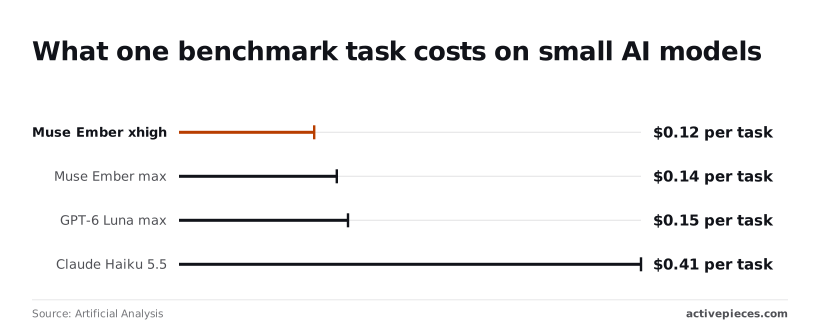
DeepSeek V4.1 Flash, at $0.60 per task, costs five times as much, which means you can run only one-fifth as many tasks on the same budget.
If you pay per completed job rather than per token, Ember is the clear pick.
When an alternative is cheaper
On raw token volume, three models undercut Ember. M3 Mercury saves $3 a month, Mistral Small 3.2 saves $4 and Ministral 3 3B saves $8, which is 44% off Ember's $18.
If you pay per completed job rather than per token, Ember is the clear pick.
At 100M tokens those are small dollars, and none of the three has a per-task figure here, so a lower token bill doesn't prove a lower cost per task.
One cent is the margin with GPT-6 Luna, the closer call: its max setting costs $0.15 per task against Ember's $0.14. Across 100,000 tasks that's $1,000, which matters at scale but isn't decisive for a small team.
Tracking Muse Ember Spend with Activepieces
At small volume the rate isn't what hurts you, the cap is. Activepieces, an MIT-licensed automation builder, can watch it for you if Muse Ember exposes a usage export or API.
What the workflow does
Activepieces chains a trigger and a series of steps into one flow, and none of it needs custom infrastructure.
Its pricing page bills 1 credit per flow run, whatever the number of steps, so the five-step flow below, fired once a day, uses 30 credits a month out of the free plan's 1,000.
Zapier's pricing page bills per task and Make's per module, so on either of those the same flow is metered by its steps rather than its runs.
The sequence turns raw token counts into a daily spend figure and a warning before you hit a limit.
The first you hear of a cap is then an alert rather than a failed job.
- A schedule trigger fires once a day.
- An HTTP step requests the usage export from Muse Ember, returning token counts split by input and output.
- A code step multiplies each token count by the rate for your plan and sums the result. Because input and output have separate prices, this step is where your real token mix shows up as a number.
- A branch checks whether usage has passed 80% of your cap, so you're monitored at a threshold before hitting the limit. Below that line, the flow ends quietly.
- Above it, the flow posts to Slack, the team chat, or sends an email, with the figure and the remaining headroom.
Dividing the spend by the day's tokens gives your running cost per million tokens, which is the comparison this article recommends. Keep the plan rates in one variable, and you can rerun the same math against a rival plan's rates without rebuilding anything.
When Muse Ember Spend Tracking Isn't Worth It
If Muse Ember offers no usage export or API, the flow has nothing to fetch, and you're back to reading the billing dashboard by hand.
Skip it too if your usage is so steady that a monthly invoice check already catches any surprise. The flow earns its setup time only when volume swings enough, or a cap is tight enough, that a day's delay in noticing costs real money.
The Monday Checklist for Budgeting Muse Ember
If the automated flow isn't worth building for your volume, a five-step manual routine gets you most of the protection in about an hour. Run it once now, then keep it on the calendar.
- Pull last month's total token volume and split it into input and output. The ratio matters because output tokens usually cost more than input, so a shift in mix moves your bill even when volume stays flat.
- Price that volume against the table earlier in this integration and divide by total tokens. The result is your real cost per million, which is the only number that compares fairly across plans.
- Set a spend alert at 80 percent of your budget or cap. That leaves you room to react before the limit bites, instead of learning about it from a throttled service.
- Send sales your open questions in writing: where the tier thresholds sit, how overage is billed, and what happens at a usage limit. A written answer can be audited later, and a call can't. If a question needs a call to answer, treat that as a cost in itself.
- Schedule a pricing re-check, monthly or whenever your volume changes noticeably. Stale rates make a sound budget wrong.
I wrote this section on 2026-11-15 and it quotes no Muse Ember rates, because none were confirmed for it. That's why step five exists: confirm current figures against the vendor's pricing page before you commit a budget.
Frequently asked questions
Does Muse Ember have a free tier?
We haven't confirmed one, so don't budget around it. If the pricing page lists a free allowance, test it with your real token mix, because a free tier sized for a demo tells you nothing about what production volume will cost.
Is Muse Ember billed monthly or per use?
Confirm this on the vendor's pricing page, since we haven't verified the current billing model. The distinction decides your forecast: a flat monthly fee is a fixed line, while per-use billing moves with every request.
Switching plans, discounts and price changes
Can I switch Muse Ember plans mid-month?
We haven't verified the vendor's switching rules. Before you commit, find out whether a change takes effect immediately or at the next cycle, and whether usage already billed is prorated.
If a mid-month upgrade resets your tier thresholds, the order in which you move can change your bill.
Does Muse Ember offer discounts for annual or high-volume commitments?
We haven't confirmed any commitment discounts. If a discount exists only behind a sales call, treat it as unpriced and keep it out of your base case.
Build the budget on published rates, then request a written quote and compare it against your own cost-per-million calculation.
How often does Muse Ember change its prices?
We have no verified record of the vendor's pricing history, so assume rates can change and stamp every figure in your spreadsheet with the date you read it.
Recheck before each renewal or volume increase.
Related reading
Running the numbers
See what the same workload costs here.
Free forever plan, and every paid plan self-hosts at no extra cost.
See pricing Talk to sales