Muse Spark Open API Pricing: Per-Token Rates (2026)

Oct 25, 202614 min read
You pay per token on Muse Spark Open API, with separate rates for what you send in and what comes back.
It is a pay-as-you-go interface to Muse Spark models, and it's easy to wire into a workflow tool like Activepieces if you'd rather not write glue code. The vendor hasn't confirmed free tier terms, so budget as if there isn't one.
Muse Spark Open API pricing basics
What the pricing page bills for
You pay once for the text you send (input) and again for the text the model writes back (output). A token is a chunk of text, roughly three-quarters of a word.
Skip that split and you'll misjudge the bill, because the two rates aren't close. The figures below come from third-party trackers, as of 2026-10-25:
- Input rate: $1.25 per 1M tokens
- Output rate: $4.25 per 1M tokens
- Contributor tier: rate unconfirmed
- Unconfirmed: free tier terms and other items the page doesn't state plainly
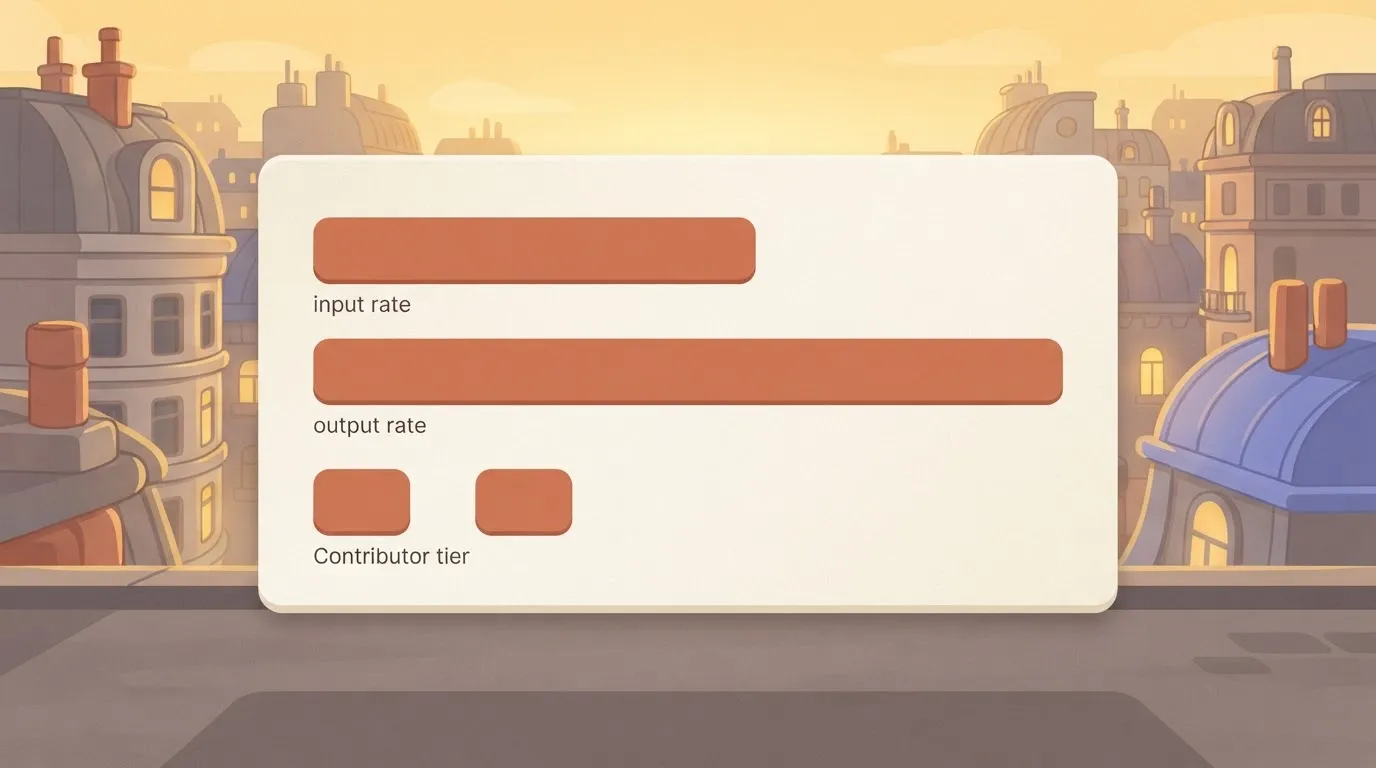
Output costs about three and a half times as much as input. A workload that writes long answers from short prompts therefore costs far more than the headline input rate suggests.
The Contributor tier is reported to be a fraction of the standard rates, but that is unconfirmed, so check you qualify before you plan around it.
I took the figures from third-party price trackers on 2026-10-25. I marked anything that page didn't state as unconfirmed rather than estimating it. Prices change, so confirm the rates on the vendor's page before you commit a budget.
If you are running this arithmetic for your own team, see what the same workload costs on Activepieces.
Muse Spark plans, pricing and limits
The rates come from third-party price trackers, so check the vendor's page before relying on them. Muse Spark comes in two tiers, Standard and Contributor, and we have no confirmed rate for either, so treat every cell below as unverified until the vendor's page says otherwise.
Muse Spark plan table and unconfirmed pricing
Checked on 2026-10-25. The table shows which questions each tier must answer before you can price a workload, and where we couldn't confirm the answer.
| Standard | Contributor | |
|---|---|---|
| Input and output price per 1M tokens | Not confirmed | Not confirmed |
| Billing unit | Not confirmed | Not confirmed |
| Requests and tokens per minute | Not confirmed | Conflicting reports; not confirmed |
| Context window | Not confirmed | Not confirmed |
| Model access | Not confirmed | Not confirmed |
| Gating | Not confirmed | Not confirmed |
Trust the Contributor limits least, because that row is the shakiest. If you see two different limits quoted, budget on the lower one. A ceiling you hit mid-month stalls your work, and that costs more than the headroom you assumed.
We couldn't confirm whether either tier has a free or preview allowance. Don't build a plan around free usage you haven't seen in writing.
We found no confirmed enterprise or custom tier. If you need guaranteed capacity, a signed contract, or limits above the published ones, ask the vendor directly and get the answer in writing.
Muse Spark monthly costs by workload
Roughly $4, $314 and $63 a month: that is what the three workloads cost, and the batch job costs about 75 times the team, which means batch processing is a major capital expense, not routine work.
That uses list rates of $1.25 per million input tokens and $4.25 per million output tokens. The table shows the arithmetic, and the token counts are my assumptions, so swap in your own.
| Workload | Input tokens | Output tokens | Cached share at $0.15/1M | Arithmetic at $1.25/$4.25 | Monthly total |
|---|---|---|---|---|---|
| 5-person support team | 2M | 0.5M | 25% | 0.075 + 1.875 + 2.125 | $4.08 |
| 50,000-document batch | 200M | 15M | 0% | 250 + 63.75 | $313.75 |
| 10,000-conversation chatbot | 60M | 5M | 50% | 4.50 + 37.50 + 21.25 | $63.25 |
Because output tokens cost more than three times as much as input tokens, the mix of reading versus writing moves the bill more than the headline rate does.
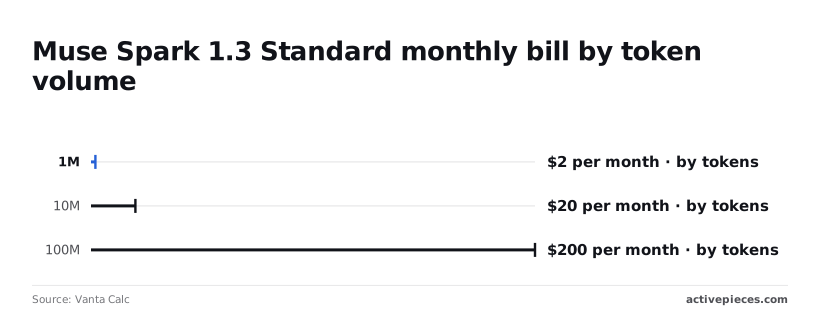
For the five-person team with light daily use, 2.5M tokens comes to about $4. Vanta Calc puts 1M tokens at $2 a month, so a blended estimate lands near $5.
In the batch summarisation of 50,000 documents, each document is about 4,000 words-worth of tokens in and a short summary out. Nothing repeats between documents, so nothing is cached, and you pay the full $313.75.
At 215M tokens, this job is past Vanta Calc's 100M-token point, which is $200 a month. Shortening inputs saves more than cutting summary length here, because input is the larger share of the bill.
Muse Spark cost for a customer chatbot
Half of the input is the same instructions and history resent each turn, so caching cuts the input cost from $75 to $42.
This chatbot handles about 65M tokens, well past the 10M-token point on that chart, which is $20 a month, far less than this deployment actually costs. Expect $63 if caching holds, which requires sustained cache hit rates.

If your setup breaks the cache, the bill rises toward $100.
On top of these figures, real bills add rate-limit upgrades and surrounding services.
Muse Spark hidden costs and limits
Behind the headline rate sit five charges:
- the output-to-input price gap
- reasoning tokens
- any long-context surcharge
- retries counted against your rate limit
- tool or data-handling add-ons

Skip checking them and you'll find them on the invoice. The list below sets them side by side, so you can see which ones apply to your workload before you budget.
Where the extra charges come from
The output price is a multiple of the input price, and the vendor bills reasoning tokens as output. A long-context surcharge belongs on the list only if the vendor's current terms confirm it.
Failed calls that you retry still count against your tokens-per-minute ceiling. Search, tool and data-handling terms sit outside the per-token rate entirely.
Output and reasoning tokens
Output costs several times what input does, so a chatty answer costs more than a long question. Reasoning tokens, the model's hidden working, are billed as output even though you never read them.

A short prompt that triggers heavy reasoning can cost more than a long prompt that doesn't.
Muse Spark rate limits and retries
Hit a rate limit and requests queue or fail. The limit caps how much you can send per minute.
A short prompt that triggers heavy reasoning can cost more than a long prompt that doesn't.
Moving to a higher tier fixes that, but tiers are often gated by spend or by a paid upgrade, so a busy team can be pushed into a bigger plan before the token math says it should be.
After a timeout, every retry spends tokens again and eats into your per-minute allowance. Built-in search and other tools usually carry their own charge per call, separate from the tokens they return. Count both in your estimate.
Muse Spark data-handling terms for sensitive data
If you handle customer records, health data or regulated material, data-handling terms decide whether you may send them at all.
If the standard terms rule out your use, the fix is a different agreement or a different vendor, and that costs more than any token rate.
Worth checking against a plan that does not meter every step: one credit covers a whole run on Activepieces.
Muse Spark pricing beside its closest alternatives
Muse Spark 1.3 costs $1.25 per million input tokens and $4.25 per million output tokens, well under the earlier listed rates for GPT-5.6 Sol and Claude Opus 5 but not under every rival. Current premium models such as GPT-6 Astra and Claude Opus 5.5 should be priced on the vendors' own pages.
A token is roughly three-quarters of a word, so these rates are what you pay per stretch of text read and written.
The table shows the two premium rivals next to Muse Spark. The gap between them is far larger than any difference among the cheaper models.
| Model | Input (per 1M tokens) | Output (per 1M tokens) | Suits |
|---|---|---|---|
| Muse Spark 1.3 | $1.25 | $4.25 | High-volume work on a tight budget |
| GPT-5.6 Sol | $4 | $20 | Teams already built around OpenAI |
| Claude Opus 5 | $5 | $25 | Hard tasks where quality outweighs cost |
Compare rates only after you know your input-to-output mix, because output costs three to five times more than input on every row.
Against GPT-5.6 Sol's earlier listed rates, Muse Spark's input price was under a third and its output price about a fifth. Against Claude Opus 5's, output was about a sixth. If your work produces long answers, that gap is most of your savings.
Where Muse Spark pricing loses to rivals
Undercutting Muse Spark on both counts, Gemini 3.8 Flash lists at $0.75 input and $3.75 output, making it the economical choice if performance proves comparable.
DeepSeek V4 Pro lists at $1.32 input and $3.96 output, which is slightly dearer on input and slightly cheaper on output, a pattern that advantages output-heavy workloads.
If your workload is mostly long answers, that small output edge adds up.
You can pay less still with open-weight models such as Qwen3 235B and DeepSeek-V4.1-Flash, but you take on hosting or a reseller's terms. Choose Claude Opus 5.5 or GPT-6.1 Sol only when a cheaper model fails your own test documents.
Tracking Muse Spark spend with Activepieces workflows
If you call Muse Spark from a business process, Activepieces, a workflow automation tool, can watch the bill for you, but it doesn't change what you pay.
It's a monitoring layer around the API, not a cheaper way to buy it. Skip the watching and you find out about a runaway job when the invoice arrives.
To see what that looks like, take the flow below.
A weekly schedule pulls rows from a spreadsheet, loops over them, sends each one to the model through an HTTP step, records the result, and ends with a router that decides whether anyone gets an email.
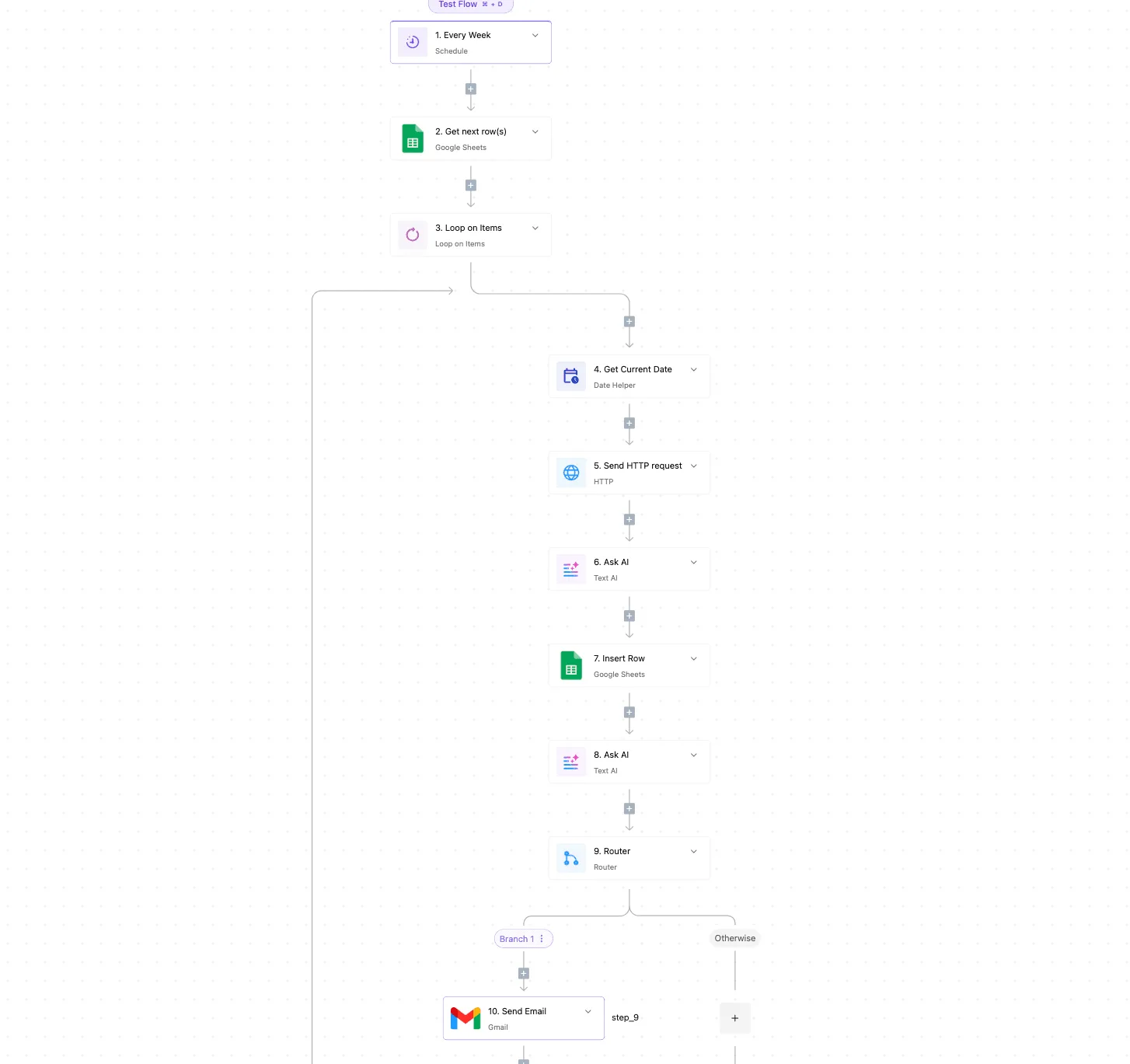
Every step you can see is a place where cost either gets measured or goes unnoticed.
What to take from it is that the model call is one box among ten, and the other boxes are where you keep track of it.
Activepieces counts that ten-step flow as 1 credit per run, the same as a two-step version, so adding the logging and alert steps costs nothing extra, and the free plan's 1,000 credits a month, with unlimited flows, cover a weekly run many times over.
The published pricing page states the rule as 1 credit per flow run, any number of steps, whereas Zapier's pricing page bills per task and Make's pricing page bills per module. The token charges from Muse Spark still arrive on top.
Logging usage per run
At the HTTP step the call to Muse Spark happens, and the response that comes back reports how many tokens that request used.
Add a spreadsheet step right after it that writes one row per run: the date, which job it belonged to, and the input and output token counts.
With the log in place you have a ledger of your own, so when a month looks expensive you can point to the exact job that drove it instead of guessing from a single total.
Because the loop handles one item at a time, each row also shows you what a typical item costs, which is the number you need to forecast next month.
Budget alerts before the limit
Once the log exists, the router at the bottom of the flow can total it and compare the total to a ceiling you choose.
If the total crosses that line, one branch sends a message to a Slack channel or an email to whoever owns the budget; the other branch does nothing.
Set the line below your real limit, not at it. An alert that fires when you're already over is only a receipt, while one that fires early leaves time to pause a job or switch to a cheaper model.

A Monday checklist before committing to Muse Spark
Spend one Monday on five checks, done in this order, because alerts only help if someone's set them up:
- Sample 500 real requests and measure the tokens in and out.
- Re-check the pricing page and the changelog.
- Set a hard spending cap.
- Load-test the rate limits.
- Compute break-even against a rival.
Skip the order and you end up pricing guesses, not your own work.
Measure a week of Muse Spark usage
Pull 500 real requests from a normal week, not invented test prompts, and record how long each input and output runs.
Then read the pricing page and changelog the same day and note the date. Rates and limits change, and a bill built on last quarter's page is an estimate of the past.
Set Muse Spark spend caps and alerts
Set the hard cap first, so a runaway job stops instead of billing you. Then send the sample at full speed to see where rate limits bite.
A limit you meet in a test costs you an afternoon, while one you meet on a busy customer day costs you the customer.
Keep your early-warning alert below the cap, so you have time to pause a job or move to a cheaper model before the cap cuts you off.
Price the same sample on the nearest rival, using its own token counts and its own limits. Write down the monthly difference at which you'd move, and who decides.
Without a written number, "we will switch if it gets expensive" never turns into a decision. Once that threshold exists, the bill stops being a surprise and becomes a figure you check against it.
Frequently asked questions
Is Muse Spark Open API free to use?
Treat it as a paid service unless your own account dashboard shows a free allowance.
Even where one exists, it's a trial budget, so a real workload will run past it and land on the paid rate. Test with your actual prompts before you rely on it.
Does Muse Spark charge for cached or repeated prompts?
Check whether the current rate card lists cached input as its own line. If it does, repeated text is billed differently from fresh text.
If it doesn't, assume every repeat is billed in full. That matters most when you send the same long instructions with every request, because you pay for them every time.
How often does Muse Spark change its prices?
I can't point to a fixed schedule, and neither should you. AI services revise their rate cards without much warning.
Date your estimate, note which rate card you used, and re-check it each month when the invoice arrives. A bill built on last quarter's rates is a guess.
Can I set a hard monthly spending limit on Muse Spark?
Look in your billing settings for a cap that stops service, not just an alert that emails you.
By the time an alert tells you, the money is spent. A cap stops the spending but can also take your product offline. If you only find alerts, put a cutoff in your own code so a runaway job can't drain the month's budget.
Is Muse Spark cheaper than ChatGPT or Claude for the same job?
It depends on the job, and the headline rate won't settle it. Price the same workload on each: same prompt length, same number of requests, same retries.
Use a current comparison model such as GPT-6.1 Sol or Claude Sonnet 5.5, then compare the monthly totals. The cheaper rate can still produce the larger bill if it needs more retries or longer prompts.
Related reading
References
Running the numbers
See what the same workload costs here.
Free forever plan, and every paid plan self-hosts at no extra cost.
See pricing Talk to sales