
Self Hosted Workflow Automation for Government: 2026

Nov 24, 202614 min read
Choose self-hosted workflow automation for government by constraint, not connector count. Pick the tool your agency can keep running, on infrastructure it controls, under a licence procurement will accept, whether that is an open-source option like Activepieces or something else entirely.
Different agencies will land on different tools.
Failing any one of three tests removed a candidate from this shortlist, and every candidate faced the same three:
Self-hosted workflow automation for government: the short answer
- Data stays in the required location, meaning workflow payloads, credentials and logs never leave the approved network or jurisdiction.
- It fits procurement and licence rules, meaning the licence terms and support model clear your buying process without an exception request.
- A non-developer can maintain it, meaning a program analyst can fix a broken flow after the original builder has moved on.
If your team has an engineer who can read licence terms and carry upgrades, a source-available tool such as n8n suits it. A permissively licensed open-source tool suits an agency whose procurement requires that licence class.
Power Automate suits an agency already inside a Microsoft government cloud tenant, where residency is met by the tenant rather than by self-hosting.
What counts as self-hosted, and what does not
Pull the network cable out and the tool should keep working. That is what self-hosted means here: the engine, the stored credentials and the run logs all sit on servers you control.

Tools you can run that way include n8n and Activepieces, whose MIT-licensed core can run self-hosted or fully air-gapped.
For any workload with a residency rule, Zapier and Make fail the first test, because they are hosted services. A hosted tool with a local connector agent still sends run data out, so it doesn't count.
Re-check licence terms before you buy, because they change between releases. Every price, plan limit and hosting claim here comes from the vendors' own pages as of November 2026, and anything those pages didn't state is left out.
This takes minutes, not a project: automate it in Activepieces free.
Comparison table of self-hosted automation tools
Self-hosted automation tool prices and limits compared
Prices come from the vendors' own pages as of November 2026; for sales-quoted tiers, get a current quote from the vendor.
| Tool | List price (checked Nov 2026) | Hosting | Strength | Limit | Best for |
|---|---|---|---|---|---|
| n8n | not confirmed | Self-hosted or vendor cloud | Runs inside your network, with custom code steps when no connector exists | Someone on your team must patch and upgrade it, and its fair-code licence needs reading against your procurement rules | Teams with an engineer who can own the server |
| Power Automate (Microsoft's workflow product) | not confirmed | Vendor cloud; an on-premises gateway reaches internal systems, but flows still run in Microsoft's service | Fits agencies already licensed for Microsoft 365 | Not confirmed as fully self-hostable, so data may leave your boundary | Microsoft-centred agencies whose rules already permit that cloud |
| Zapier | not confirmed | Cloud only | Very wide app coverage, easy for non-coders | No self-hosted option, so it fails any no-outbound-internet rule | Low-sensitivity tasks where data may leave |
| Make | not confirmed | Cloud only | Visual scenario builder that handles branching well | No self-hosted option, and audit features aren't confirmed | Cloud-approved teams that want a visual editor |
| Activepieces | Free: $0; Plus: $20 a month; Team: $200 a month (prices checked 2026-10-23); Ultimate, Embed and self-hosted paid licences are quoted by sales | Activepieces Cloud or on-prem; self-hosted or fully air-gapped on your own servers | MIT-licensed core with 750 integrations counted from the open source monorepo, and unlimited flows on every plan including free | The enterprise directories (packages/ee/) are under a separate commercial licence, and the SOC 2 programme is in progress, so it holds no SOC 2 certification |
Teams that need to run automation on their own servers or air-gapped, starting from an MIT-licensed core |
Read the table in this order:
- Remove every tool whose hosting breaks your data-location rule.
- Ask who patches and upgrades what remains.
- Check the licence terms and audit logging against the procurement text.
Whatever survives all three steps goes on your shortlist, and for many agencies that will be one tool or none. No row wins for every agency, so run the shortlisted tool on an isolated test machine before you commit.
n8n, Activepieces and other self-hostable options
Because no row wins everywhere, the self-hosted shortlist splits on who maintains it and which licence procurement accepts: n8n suits agencies with a developer on staff, and Activepieces, whose core is MIT-licensed, suits agencies that need a permissive licence.
Licence terms and gated features
Under the Sustainable Use License, n8n is source-available with use limits. The community edition is free and the self-hosted tiers are paid, and SSO and audit logs come only with the paid tiers.
On the Activepieces side, the core is MIT-licensed, with enterprise features under a separate commercial licence. The air-gapped self-hosted build carries the same enterprise controls as its managed cloud, so an agency that must stay inside its own network is not handed a cut-down edition.
Those controls cover single sign-on, SCIM provisioning, custom roles, audit logs, release management and secret managers. Confirm that, and any government-specific compliance claim, on Activepieces' own pages rather than assuming it. MoneyGram, Moneypenny, Alan and FundingSocieties run Activepieces in production.
The community edition is free and the enterprise tier is paid, it's designed for staff who don't code, and SSO and audit logs come only with the enterprise tier. Check those against your audit requirements first.
Ask each vendor for certification documents in writing before procurement review.
How each automation tool performs in government use
Have counsel confirm that running n8n for your own agency's work is within terms, because its Sustainable Use License restricts commercial redistribution. Its strength is flexibility: custom code inside a workflow.
That's also the upkeep risk, because a workflow that leans on code leaves a non-developer unable to repair it.
For teams without developers, Activepieces ranks first, on merit rather than connector count. Its MIT core means you can audit and fork the base code under permissive terms.
The constraint is that SSO and audit logs are only in the enterprise edition, so an audit window may force a paid tier. Test that on a disconnected machine:
- Install the community edition with no outbound internet.
- Build one approval flow using only local apps.
- Confirm what the logs record without the enterprise edition.
Other self-hostable open-source options include Node-RED, a flow-based tool suited to technical staff wiring devices and internal systems; Windmill, which centres on scripts and so assumes a developer maintains it; and Huginn, an older agent-based tool that also assumes technical upkeep.
Power Automate, Zapier and Make for government use
Of the three large cloud products, only Microsoft's Power Automate has a documented route into government-grade hosting, and none of the three is a self-hosted tool.
Power Automate and government cloud tenants
Power Automate is Microsoft's workflow product, and Microsoft documents a separate government cloud for US public-sector customers, with its own tenants and its own service boundaries.
For an agency already licensed and authorised on Microsoft's government cloud, that matters: the automation sits under an existing procurement and audit arrangement, not a new one.
Before you treat that as a fit, two constraints apply. First, the data still lives in Microsoft's hosted environment.
If your rule is "on our hardware, inside our network," a government tenant doesn't satisfy it. It satisfies a different rule: "in a cloud approved for government workloads."
Second, feature availability in government regions can differ from the commercial service. Check Microsoft's documentation for the specific connectors and capabilities you need in your target cloud.
So the question to ask is which rule your procurement actually states. If it names an approved cloud, Power Automate is a legitimate candidate. If it names a location you control, it's not.
Zapier and Make are cloud only
On their vendor pages, neither Zapier nor Make describes a self-hosted edition; both are offered as hosted services. Every workflow runs on the vendor's infrastructure, and every record passing through a step passes through their systems.
My test is simple: can I reproduce the workflow on a machine with the network cable pulled out? With these two, the answer is no, because the product is the hosted service.
For an agency with a residency or air-gap constraint, that ends the evaluation before connector count comes into it.
You can follow the rest of this with the builder open. Start free, no card.
The strongest case against self-hosting automation in government
Run your own automation servers in a small agency team and you take on patching, uptime, accreditation and staff turnover. A government cloud region run by a provider may be both safer and cheaper. That's the objection, and it's a good one.
Why self-hosting automation burdens government staff
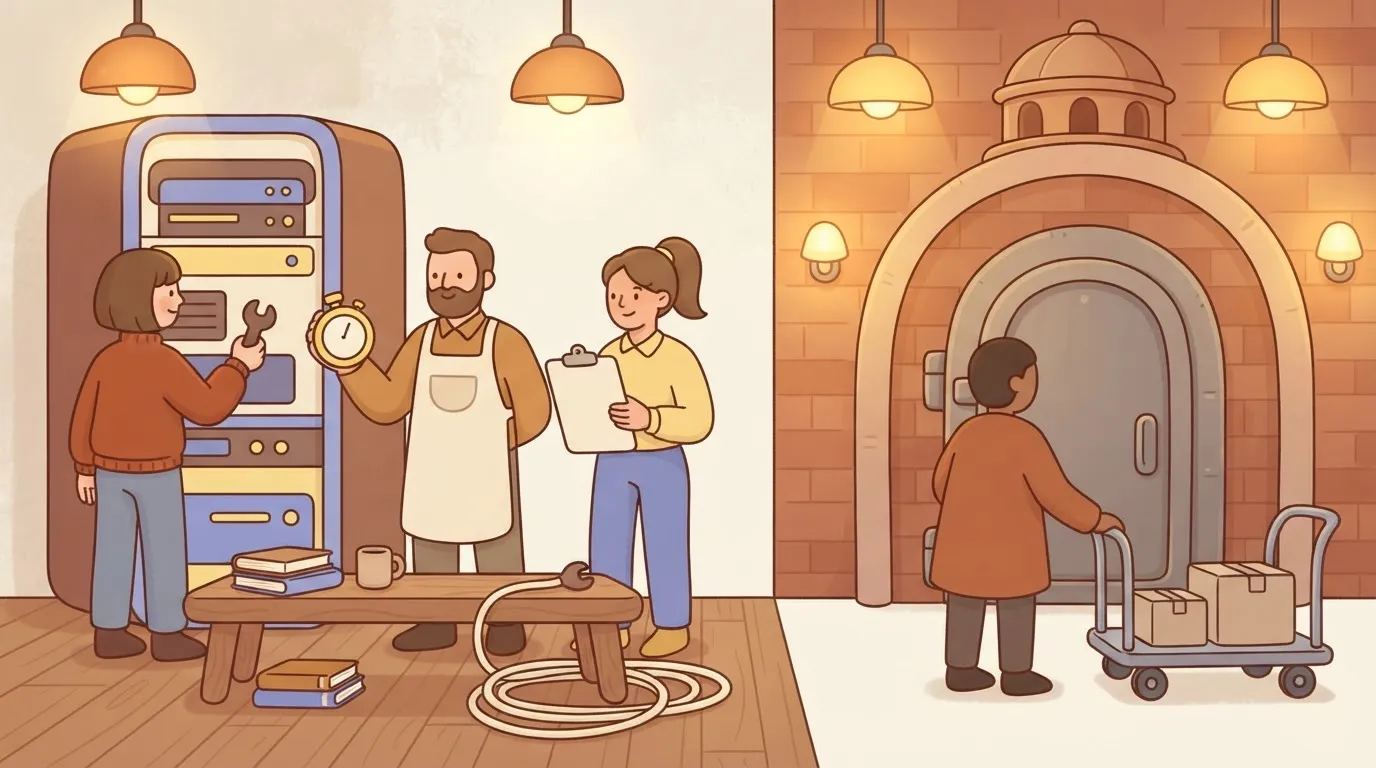
Under self-hosting, every operational duty moves onto people who already have other jobs.
Someone must apply security patches on a schedule, keep the service up when the workflow engine stalls, and maintain the accreditation evidence an auditor will ask for.
Under self-hosting, every operational duty moves onto people who already have other jobs.
Someone must also hand all of it over when the one person who understands the setup leaves. In a team of three, that last item is the one that fails first.
Failure is not trivial in cost. IBM's Cost of a Data Breach 2025, as summarised by Think Digital Partners, puts the average healthcare breach at $7.42m, which is the highest of the sectors compared.
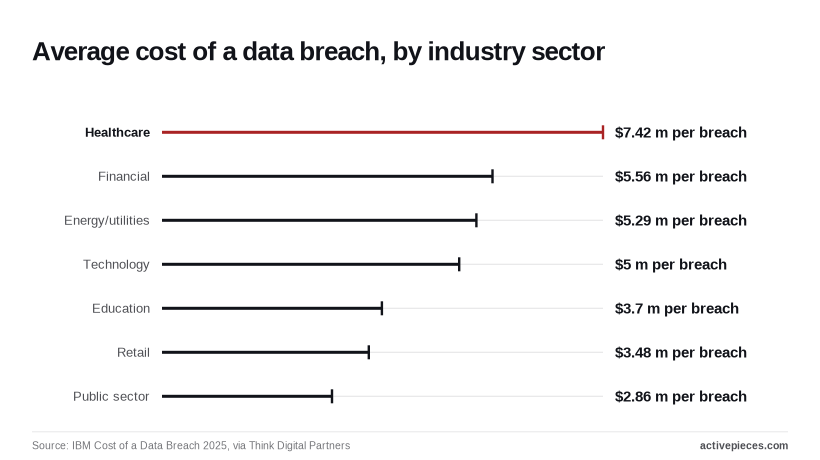
Financial services follow at $5.56m, energy and utilities at $5.29m, and technology at $5m, so technology companies sit well above the lowest average breach costs of the sectors analyzed. Education sits at $3.7m and retail at $3.48m.
Even the lowest figure in the set, public sector at $2.86m, is a sum most agency budgets can't absorb, so an unpatched server is a liability whichever sector's average you pick.
Across many customers, a provider with a dedicated security staff carries that risk, and the agency doesn't carry it alone.
When a government cloud beats self-hosting automation
Only one assumption keeps the objection standing: that the data in question may sit in a government cloud region. Where it can, the provider-run option usually wins, because it removes the maintenance burden the team cannot staff.
Where residency or air-gap rules apply, the assumption fails.
If the data must stay on infrastructure the agency controls, or the network must have no outbound path, a provider region isn't a cheaper option. In that case, it's a non-compliant one, and self-hosting is the only route that passes review.
The deciding condition is therefore a single question: does a cloud region that satisfies your residency and isolation rules exist? If yes, use it. If no, self-host, and size the team to patch it.
Steps to choose a self-hosted automation tool
Start with five steps, in this order, and don't open a vendor's pricing page until the first two are done, so you define your requirements before pricing influences them. The steps below are the change request you file before any tool is chosen:
- List the first three workflows to automate: permit forms, approvals, and records handoffs.
- Write the data-location and audit rules.
- Ask each vendor in writing for the claims its pages lack.
- Trial on a test server with the person who will maintain it.
- Cost the tool at your expected run volume.
Write down the three workflows and data rules
Name the three workflows in the words your staff use. Then record for each one where the data sits, who may read it, and what an auditor must be able to reconstruct.
Put constraints first: if records may not leave a given network, any tool that needs outbound internet to run is out before you compare features.
This also shrinks the connector question. You need the apps those three workflows touch, not a catalogue of hundreds you will never connect.
Trial self-hosted automation tools with the maintainer
Stand up each remaining candidate on a test server and have the person who will own it build one of the three workflows.
Do this on a machine with the network cable pulled, if your rules demand it, because a claim that holds only with internet access isn't a claim you can rely on.
Record how long the build takes, whether the maintainer can fix a failed run without outside help, and whether the audit log answers the questions you wrote down. A tool the developer likes and the maintainer can't patch has failed the trial.
Questions to ask automation vendors in writing
Send written questions about licence terms for government use, hosting options, log retention and export, and how security fixes reach a self-hosted install. Keep the replies; a verbal assurance won't survive a procurement review.
Then cost each survivor at your expected run volume, because a price that looks small at pilot scale can change shape once every permit and approval passes through it.
Frequently asked questions
Is open-source automation software allowed in government procurement?
Often yes, but the licence decides, not the label "open source." Procurement rules usually ask whether the licence permits government use, modification and hosting without a separate commercial agreement.
A permissive licence such as MIT usually clears that check. A source-available licence that restricts commercial use or hosting for others needs a read by your counsel before anything is installed.
In some tools, paid features such as single sign-on or audit logging also stay outside the open core. An MIT core therefore doesn't mean every feature you need is free. Check each required feature against the licence it actually ships under.

Can workflow automation run fully air-gapped?
It can, if you prove it with the network cable pulled. The constraint is that the server has no outbound internet, so every dependency must arrive by approved transfer: container images, packages, and any connector code.
Test a clean install and a restart offline before you commit.
Look for calls home, because some tools make them through licence checks, update notifications, template galleries and telemetry. Connectors to cloud apps are useless inside the boundary, so the connector count matters less than whether the tool reaches your internal systems.
When you host the software yourself, FedRAMP mostly doesn't apply to the tool, because it covers cloud services. It applies to any hosted service you connect it to, and your own environment's authorisation still covers the server.
Does self-hosting mean no per-task fees?
Usually the vendor's per-task metering goes away, but the cost doesn't. You pay in servers, storage, backup capacity and staff time. Some vendors still charge for a licence or a support tier, particularly for the features procurement asks about.
Price the whole arrangement: licence, infrastructure, and the hours someone spends on upkeep. Compare that against the hosted plan at your expected volume.
Who patches and backs up a self-hosted automation server?
Your agency does, and the decision should name the person before it names the tool. Assign an owner for these steps:
- Apply security updates to the operating system, container runtime and the automation tool.
- Back up the database and the encryption key together, since one without the other can't be restored.
- Test a restore on a separate machine.
- Review the audit logs on a schedule.
If no one on the team can take these on, a hosted option or a vendor-supported deployment may fit better than the tool that looks strongest on paper.
Related reading
Build it
Set this up in minutes.
No code required. Connect your accounts, and Activepieces runs it from there.
Start free Talk to sales