Strands Decider API Pricing: What It Costs in 2026

Nov 16, 202613 min read
Three things on the vendor's pricing page set the price you pay for Strands Decider, much as they do when you compare it with workflow tools like Activepieces: the unit it counts, the limit attached to each plan, and what happens when you pass that limit.
Strands Decider API plans, prices and limits today
What Strands Decider is
Strands Decider is a paid API, sold in plans, that your application calls to get decisions back. The vendor's own documentation is the authority on what a "decision" is.
Every current plan in one table
Five figures for each plan decide a bill:
- monthly price
- billing unit
- included usage
- rate limit
- support tier
I couldn't confirm individual plan names or figures, so I haven't built a table of guesses: for every current plan, the price, unit, allowance, rate limit and support tier are not confirmed here, and the vendor's pricing page and docs are where to find them.
How the pricing unit is counted
Work out your bill from the unit, not the plan name. Take the unit exactly as the vendor defines it, then estimate how many of those units your workflow produces in a month.
Next, compare that estimate with each plan's included usage and rate limit.
Finally, read the overage rule: it tells you whether going over means a per-unit charge, a forced upgrade or throttled requests.
If you are running this arithmetic for your own team, see what the same workload costs on Activepieces.
What each plan costs at realistic usage
Monthly volume times the published unit rate, minus the free allowance, plus whatever the overage rule adds: that is your bill.
Stage 1: Find the billing unit and free allowance
Find what the page actually counts: a run, a step, a credit, a seat. Plans that look alike on price can count different things, so you can't compare the monthly fee alone across them.
Write down the unit, the allowance included in each tier, and the overage rule from the section above.
Estimating your monthly Strands Decider API volume
Convert your workload into the vendor's unit. Count how many times a process runs in a typical month, then multiply by how many billable units each run consumes.
A run that branches or retries may use several units, so the multiplier is where estimates go wrong.
Then add a margin for your busiest month, since the allowance resets monthly and the vendor bills a spike in the month it happens.
Run the same arithmetic three times, once per usage profile, and show each step.
- For a pilot (a few processes and a handful of users), check whether the free allowance covers the estimate. If it does, the cost is zero, but note which limit you would hit first, since that's the point where the plan stops working.
- For a steady team (your typical month), subtract the allowance from your volume, multiply the remainder by the overage rate, and add the base fee. Compare that total with the next tier up. If the upgrade costs less than the overage, move.
- For high volume (your spike month, repeated every month), price it on the published rates, then ask whether a custom quote could beat them, since that's where a sales conversation is justified.
Once you have the three totals, take a screenshot of the billing or usage dashboard after a week of real use. Compare its count with your estimate, and treat any gap as an error in your unit-per-run assumption.
What costs and limits surprise Strands Decider users
Three places on the vendor's pricing page hold the costs that surprise people. They are the rate limits and quotas attached to each plan, the overage and upgrade terms, and the charges that never reach the Strands Decider invoice.
I have no confirmed figures for any of them.
Rate limits and quota caps
Only one of two numbers decides whether your workload runs, and it isn't the headline allowance. Look for a per-minute or per-second request cap on each plan, separate from the monthly quota.
If the burst cap throttles your batch jobs into a queue, a nightly run takes hours longer than you planned, and the monthly allowance you could afford was no use.
Questions to put to the vendor in writing:
- Is the rate limit per account, per workspace or per API key?
- Does a throttled or rejected request still count against the quota?
- Do retries count as new usage units?
- Is the quota hard-capped, or does the service keep running and bill the excess?
The third question matters most. If retries are metered, your unit-per-run estimate from the earlier test is too low whenever the service is under load, and the error rate becomes a cost line.
Overage and upgrade jumps
Read the overage rule before the plan price. Some vendors stop service at the cap, others keep serving and bill at a higher per-unit rate, and the two behave very differently when a loop runs away at 2 a.m.
I couldn't confirm which applies here, so ask for the overage rate per unit and whether a spend cap or alert can be set.
The upgrade jump is the second thing to check. When the next plan up changes the price in a step rather than a slope, a workload that slightly exceeds one plan's limits can cost far more than its size suggests.
Divide the next tier's price by the extra capacity it adds and compare that with the overage rate. Whichever is cheaper at your volume is the right choice.
Costs outside the Strands Decider invoice
Some charges arrive from somewhere else: support, retention and underlying-provider charges. Ask which support tier your plan includes and whether response-time commitments are written into the plan or only into a higher tier.
Ask how long run logs and decision history are retained, and whether longer retention is an add-on, because an audit request can land after the window has closed.
Where Strands Decider calls a third-party model, ask whether that provider's usage is billed through the vendor or to your own account. If it's your own, you pay twice, with two sets of limits and two invoices.
A $0 per-token price on a self-hosted option isn't a $0 bill. Compute, storage, monitoring and the engineering hours to keep it running are all yours, and none of them appear on the vendor's pricing page.
A $0 per-token price on a self-hosted option isn't a $0 bill.
Strands Decider against its closest alternatives on price
On input tokens, Self-hosted Strands Decider is the cheapest option at $0 per 1M, which means there is no per-token fee, though you bear your own hosting costs.
Any bill you receive comes from something other than input, and those charges are the ones you have to find on its pricing page.
Input-token prices compared
Perplexity Decider charges $0.02 per 1M input tokens, so even the cheapest paid rival adds only cents at moderate volume. Clef-flash is $0.038, and Jev and Microsoft Decision-1 both sit at $0.042, which means Clef-flash is cheaper than those two, though not than Perplexity Decider at $0.02.
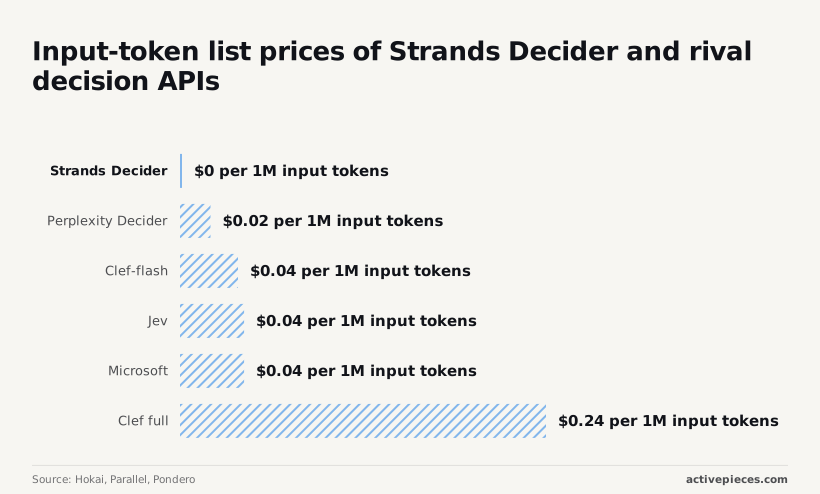
Clef full costs about six times Clef-flash, at $0.24 per 1M, so you pay that premium only if the full model measurably beats the flash tier on your decisions. All six figures come from the same comparison of decision-model pricing, checked 16 November 2026.
The table puts the four options side by side. Wherever a cell says "Unpublished", I found no figure to confirm, so you shouldn't assume it's zero or generous.
| Input per 1M tokens | Entry price | Free tier | Billing unit | Rate limits | Cost at three usage profiles | |
|---|---|---|---|---|---|---|
| Strands Decider | $0 | Unpublished | Unpublished | Unpublished | Unpublished | Unpublished |
| Jev | $0.042 | Unpublished | Unpublished | Unpublished | Unpublished | Unpublished |
| Clef-flash | $0.038 | Unpublished | Unpublished | Unpublished | Unpublished | Unpublished |
| OpenAI Decisions API | Unpublished | Unpublished | Unpublished | Unpublished | Unpublished | Unpublished |
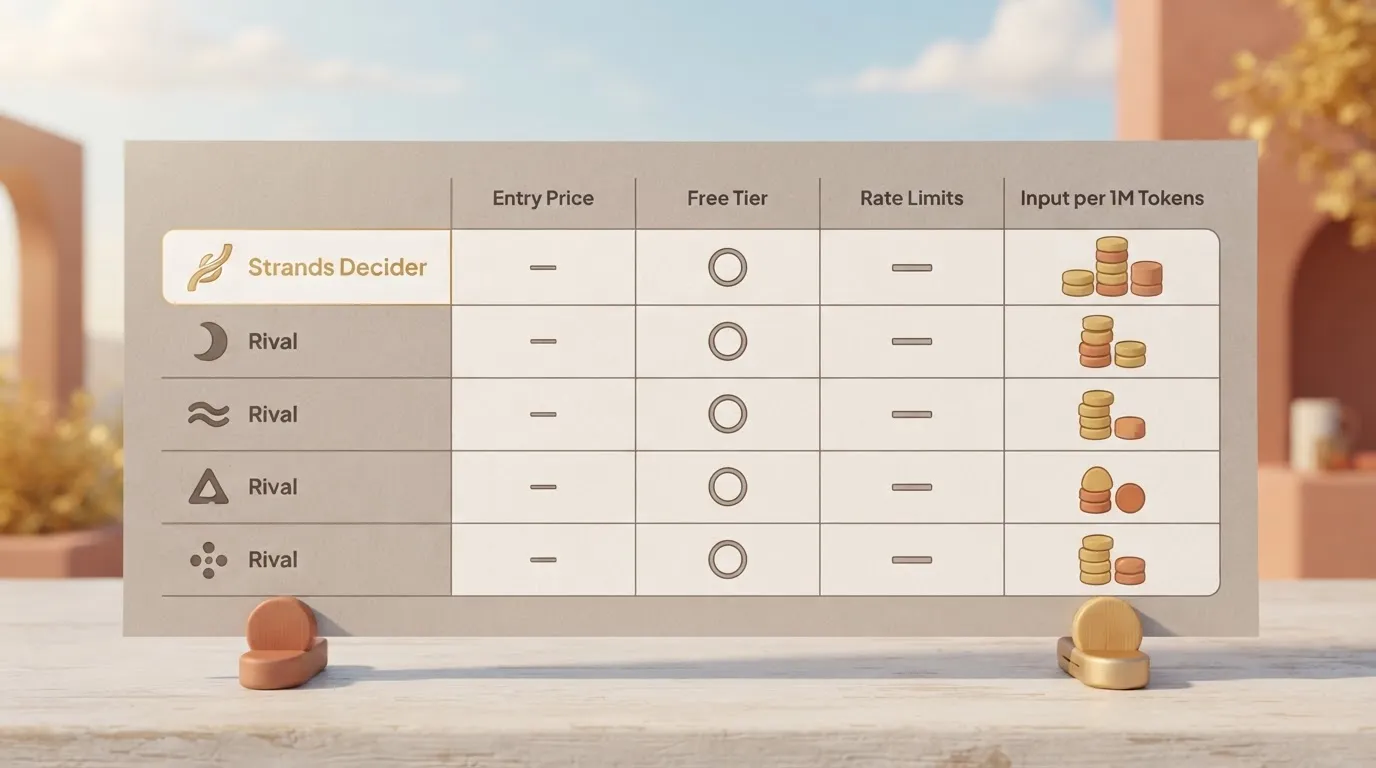
Only the input column is filled, so no row can be costed at your usage profiles from these figures alone. Fill the empty cells from each vendor's pricing page before you compare totals.
When Strands Decider or alternatives cost less
Strands Decider wins only while input is your dominant cost. A $0 input rate says nothing about output charges, request caps or what happens past a quota, so its advantage can vanish at the first overage rule.

Clef-flash is cheaper than Jev and Microsoft Decision-1 by $0.004 per 1M tokens, roughly 10 percent, so only billion-token deployments make this savings material.
That saves about $4 on a billion input tokens, which rarely outweighs a difference in rate limits, so rate limits become the determining factor in your choice. Perplexity Decider is cheaper than all three of them on input alone.
Worth checking against a plan that does not meter every step: one credit covers a whole run on Activepieces.
Tracking Strands Decider API spend with Activepieces
If your calls to the API already come from workflows, Activepieces can help with Strands Decider costs; otherwise it can't.
It's an MIT-licensed, open-source workflow automation tool with 750 integrations, HTTP and Google Sheets steps among them; it counts your usage, and it doesn't change or reveal your price.
When a workflow tool is relevant
If people on your team call Strands Decider by hand, or from application code that already has its own logging, skip this.
Activepieces earns its place when a scheduled or event-driven automation makes the calls, because then nobody is watching the count.
Those are the setups where a quiet loop or a retry can run up usage while everything looks healthy, and on Activepieces's free plan a runaway loop meets a ceiling on its own side: flows stay on when the credits run out, and runs wait until the credits refresh.
Be clear about the limit. Activepieces publishes its own overage rule, $0.007 a credit past the 10,000 included on the $20-a-month Plus plan, but it won't tell you what a Strands Decider call costs, what your plan includes, or what happens when you pass it.

Those answers sit on the vendor's pricing page, in the usage unit, the limits and the overage rules.
The workflow only gives you your own number to hold up against them.
Its own cost is easy to predict: Activepieces's pricing page lists 1 credit per flow run however many steps the run has, on a free plan of 1,000 credits a month with unlimited flows, whereas Zapier's pricing page bills per task and Make's per module, so the Sheets logging step you add after each API call leaves the run at 1 credit.
Build a call-logging workflow
Four boxes in a line make up the workflow. A trigger starts it, an HTTP step calls the Strands Decider API, a Google Sheets step adds a row recording the call, and a monthly review note reminds you to read the total.
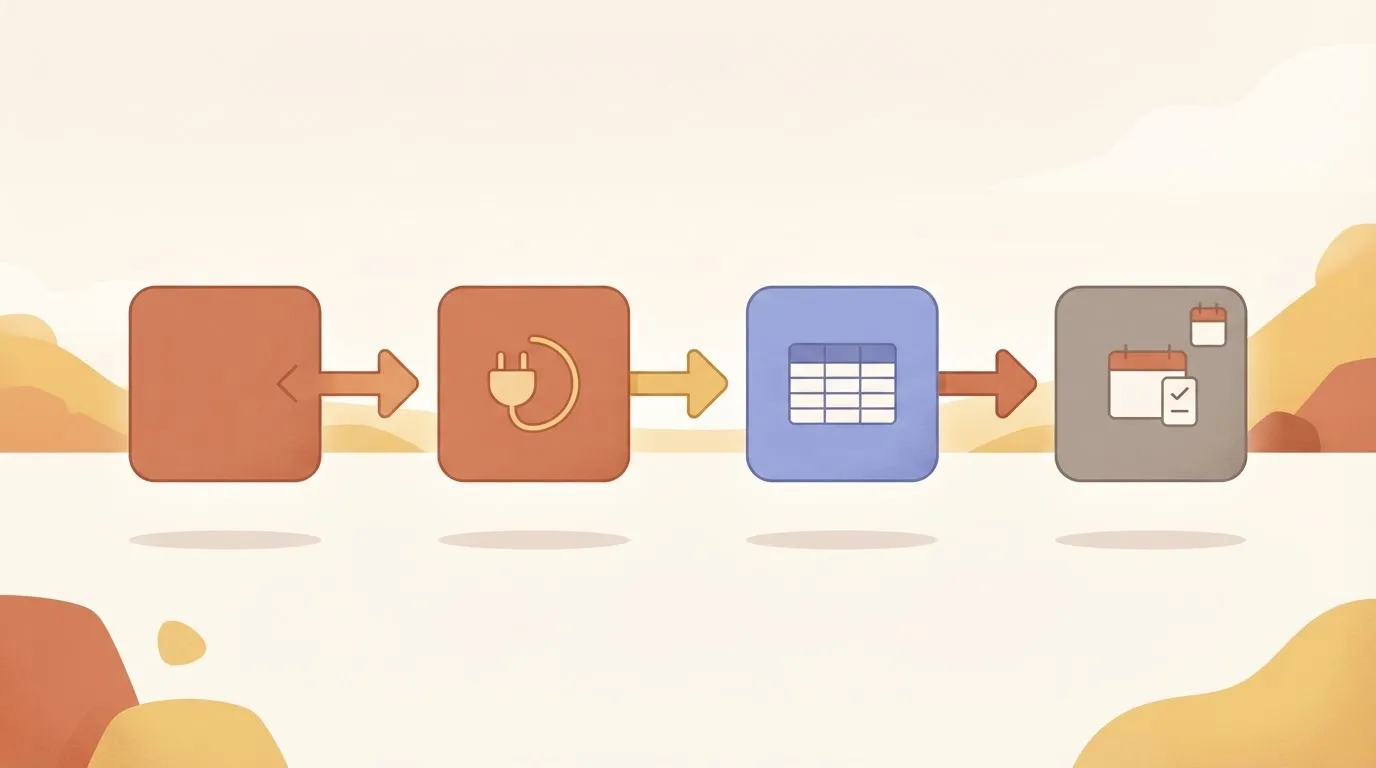
Place the Sheets step after the HTTP step, not beside it. Log a row only when the API call returns, and include the timestamp, the workflow name and the response status.
Failed calls and retries then show up as rows too. Whether they count against your quota is a question for the pricing page, so record them now and decide later.
The sheet counts calls. If the vendor's usage unit is something other than a call, your row count won't match the bill. Add a column for whatever the unit is, once you've read it.
On Monday:
- Open the vendor's pricing page and write down the usage unit, the limits and the overage rules in your own words.
- List every workflow, script and person that calls the API, so you know what the sheet must cover.
- Build the four-box workflow for each automated caller, with its own sheet or a shared one with a workflow column.
- Compare the first full month of rows against the limits you wrote down, then price the plan and any alternative from that count.
- Add the review note to your calendar, so the total gets read and not just collected.
Frequently asked questions
Five questions are left that a unit column can't settle, so the table below gives a short answer for each and says whether the vendor's own page states it.
Every source cell reads "Unpublished" because I have no vendor page confirming any of these points, and a guess would defeat the purpose.
| Question | Short answer | Source |
|---|---|---|
| Free plan? | Not confirmed | Unpublished |
| Per request or per seat? | Not confirmed | Unpublished |
| Allowances roll over? | Not confirmed | Unpublished |
| Mid-cycle plan changes? | Not confirmed | Unpublished |
| Price change frequency? | Not confirmed | Unpublished |
None of these is a "no". Each is a line item to find on Strands Decider's pricing page or terms before you commit, and to put to sales in writing if the page is silent.
Free plan and billing unit
Does Strands Decider have a free plan? I couldn't confirm one, so treat it as unknown until the pricing page names a free tier.
If it does, read what the tier caps and whether the cap is on the same unit as the paid plans. A free tier measured differently from the paid ones tells you nothing about your future bill.
Is Strands Decider billed per request or per seat? I couldn't confirm the unit, and it's the most important question here.
Per-seat pricing scales with headcount and per-request pricing scales with usage, so the same plan can be cheap for a small team with heavy traffic and expensive for a large team with light traffic.
Take the unit from the vendor's page and put it in the column from the previous section.
Rollover and mid-cycle changes
If unused allowances don't roll over to the next month, you lose them. I can't confirm either way. Rollover is the kind of rule that sits in terms of service rather than on a pricing grid.
If the page doesn't say, assume unused allowance expires, and size your plan to your peak month instead of your average one.
Can I change plans in the middle of a billing cycle? Not confirmed. What to look for is whether an upgrade takes effect immediately, whether it's prorated, and whether a downgrade waits for the next cycle.
Any of those can leave you paying for a tier you've already left.
Price changes
No change history is published that I could verify, which leaves you unable to say how long a quoted price will hold.
Ask whether the price is fixed for the term of your contract, and save a copy of the pricing page on the day you sign.
Related reading
References
Running the numbers
See what the same workload costs here.
Free forever plan, and every paid plan self-hosts at no extra cost.
See pricing Talk to sales