Sudowrite Pricing 2026: Which Plan Should You Get?

Nov 9, 202614 min read
Sudowrite Pricing in November 2026, Plan by Plan
The short answer
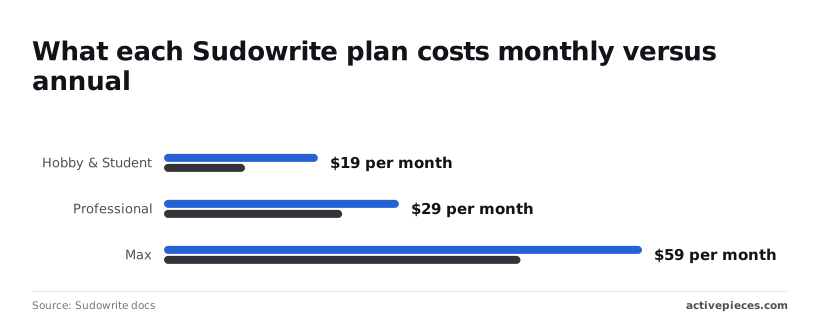
Pay monthly and (source), the AI fiction writer, costs $19, $29 or $59 on its three plans, a price list that is easy to drop into a spreadsheet or an Activepieces flow if you track subscriptions; pay annually and it is $10, $22 or $44 a month.
Sudowrite pricing is the tiered subscription structure under which the AI fiction-writing tool charges a monthly allowance of credits, spent on each generation or rewrite, rather than a count of words written.
Each plan buys credits rather than words, so your cost per story depends on the credit conversion rate.
Checked against sudowrite.com/pricing on 2026-11-09, the prices here come from Sudowrite's plans documentation.
The full plan table with monthly and annual prices
The table sets each monthly price beside its annual-billed monthly price and shows the yearly saving.
| Plan | Monthly price | Annual-billed monthly price | Saving per year on annual billing |
|---|---|---|---|
| Hobby & Student | $19 | $10 | $108 |
| Professional | $29 | $22 | $84 |
| Max | $59 | $44 | $180 |
Prices and plan limits checked against editor.sudowrite.com on November 9, 2026.
Annual billing is paid up front, so commit to a year only once you know one plan covers your heaviest month.
If a writer or small team logs each renewal date and charge through a workflow, Activepieces counts one credit per run however many steps it has, so a ten-step version costs what a two-step one does, whereas Zapier's per-task billing counts every step.
What Sudowrite credits actually buy you
225,000 credits a month is what Hobby & Student includes, according to Sudowrite's pricing page. That figure is a ceiling on how much generation you can run before a top-up, not a word count.
Redraft the same scene and the credits are spent again, so a writer who regenerates a chapter five times has used the allowance five times over.
Estimate your plan by counting how many passes you run in your busiest month, not by how much finished prose you expect.
If you are running this arithmetic for your own team, see what the same workload costs on Activepieces.
Criteria for Judging a Sudowrite Plan
Judge every plan, Sudowrite's and any alternative's, on the same five measures, each read against the passes you run in your busiest month rather than the words you finish.
- Effective monthly cost on annual billing
- Output per month, in real writing terms
- Behaviour at the credit limit
- Features locked to higher plans
- Ease of cancelling or downgrading
Four of them get their own treatment below.
The fifth, cancelling, is a single check at the end: whether you can downgrade or stop without losing access to work already done.
Judging Sudowrite plans against the criteria
Because annual billing is a prepayment, divide the yearly charge by twelve and book that as the monthly cost. Compare plans on that figure only, and treat any monthly-billed price as the premium for being able to leave early.
Until you convert it into passes, a credit allowance means nothing:
- Drafting a scene
- Rewriting a passage
- Expanding a chapter
Take the number of passes you ran in your busiest month and check whether the plan covers it with room for the redrafts you didn't plan. A plan that covers only your first drafts will run short once you revise.
Check what happens when credits run out:
- Generation stops
- You buy a top-up
- Sudowrite pushes you to a higher plan
Approve a top-up month by month and it is a variable expense, while a forced upgrade is a standing commitment. Read the vendor's pricing page for this rather than assuming.
List every feature you rely on and confirm the plan you are considering includes it. A tool you need that sits one tier up changes the real price of the cheaper plan, because the upgrade is no longer optional.

Which Sudowrite Plan Fits Three Everyday Writing Uses
Buy the cheapest plan that covers your heaviest month: Hobby & Student for a hobbyist, Professional for a novelist redrafting, and Professional or Max for a ghostwriter or small team.
The deciding figure is cost per credit at annual billing, shown below per 100,000 credits for each plan.
About $4.44 for Hobby & Student and $2.20 for Professional, against $2.20 for Max, which means at the same usage level, Max costs far less.
Upgrade from Hobby & Student to Professional and the unit price roughly halves. Upgrade again to Max and the unit price halves.
Moving to Max is therefore a decision about both capacity and savings. It pays only when your heaviest months would otherwise need top-ups costing more than the gap between the two plans.
Check that top-up price on Sudowrite's own pricing page before you decide.
Hobbyist finishing a short novel
When you are drafting a few chapters, mostly first pass, credits are spent slowly, because little text is regenerated. Hobby & Student, at 225,000 credits for $10, is enough if your busiest month fits inside that balance.
If you overrun only now and then, that doesn't justify Professional. Compare the top-up price against the plan gap, and pay the smaller of the two.
Novelist redrafting a full manuscript
Because redrafting spends the same passages again on every pass, credit use tracks the number of passes, not the length of the book. Professional holds 1,000,000 credits per month at $22 on annual billing.

If a redrafting month overruns Hobby & Student, it would be bought at the higher rate, so Professional is the plan that fits. Max pays only if your heaviest month exceeds 450,000.
Ghostwriter or two-person team
With several manuscripts running at once, the heaviest month is the one to budget against. The editor's analysis shows Max gives 2,000,000 credits at $2.20 per 100,000, well below Professional's rate, so you gain per credit by choosing it.
Start on Professional, and move up only after a month where top-ups cost more than the upgrade would have. Confirm on the pricing page whether two people can work from one plan before you buy a second.
Hidden Costs and Limits Writers Hit on Sudowrite
Beyond the monthly price, six lines move your bill: credit burn, expiry of unused credits, top-ups, annual commitment, refunds and sharing.
Sudowrite's pricing page states some of them, and the rest I couldn't confirm. The summary here marks each as sourced or unverified.
How Sudowrite credits get used up faster
Produce a chapter three times and it costs three times, because credits are spent per action, not per finished word. Every redraft, rewrite or regenerated passage draws from the same monthly balance.

On the credit model itself, Sudowrite's pricing page confirms it (sourced). The per-feature credit cost for each tool, and whether longer outputs cost proportionally more, I couldn't verify. Check it against a single scene before committing a heavy month.
Sudowrite credit rollover, top-ups and refunds
In a light month, the credits you skip are gone, and you start the next month from the plan's allowance. The pricing page states that unused credits on Hobby and Professional don't roll over (sourced), so a light month subsidises nothing.
To cover a heavy month without changing plan, top-ups exist (sourced). Their price per credit relative to the next plan up isn't something I could confirm, and that comparison decides when upgrading pays.
I couldn't verify whether you can reverse annual payment mid-term, or whether Sudowrite returns any part of it.
Read the terms of service before choosing annual billing, and keep the confirmation email.
Sudowrite seats and account sharing rules
Whether one subscription may be used by two people is unverified. Plans are priced for an individual account, and nothing I could confirm says a second collaborator may log in under the same credits.
If you share a login and the terms forbid it, you risk the account along with the credits in it.
Treat each unverified line as a question for Sudowrite support, and ask for the answer in writing.
Worth checking against a plan that does not meter every step: one credit covers a whole run on Activepieces.
Sudowrite Compared With Its Closest Alternatives
Of these four options, Sudowrite is the one whose plan is metered in credits that every redraft draws down; NovelAI, Novelcrafter and a chatbot subscription are priced as flat tiers. That's the line to reconcile against the written answers you asked support for.
Comparison table on the same measures
Set side by side on the same five criteria, the four options appear in the table below.
| Criterion | Sudowrite Hobby | NovelAI Tablet ($10) | Novelcrafter Hobbyist ($8, AI included) | Chatbot subscription |
|---|---|---|---|---|
| Billing basis | Monthly credits | Flat monthly tier | Flat monthly tier | Flat monthly subscription |
| Effect of a redraft | Spends credits | Governed by the tier's limits | Governed by the tier's limits | Governed by the plan's usage limits |
| Built for fiction | Yes | Yes | Yes | No, general purpose |
| Story reference tool | Story Bible | Lorebook | Codex | Projects or memory, not fiction-specific |
| Where you write | Web editor | Web editor | Web editor | Chat window |
Where a flat tier has a cap, the cap sits on that vendor's own pricing page, so read it there before treating "flat" as "unlimited".
When an alternative beats Sudowrite
When you redraft heavily and want the monthly charge fixed before the month opens, a flat tier beats credits. NovelAI at $10 and Novelcrafter at $8 both give you that line item, and you can enter it in a budget without modelling credit burn.
When fiction is only part of what you pay for, a chatbot subscription wins. If the same account also covers email, research and outlines, you're not buying a second tool for one genre.
Sudowrite wins when you want the writing tools and the Story Bible in one place and your heaviest month is predictable.
Verdict and What to Do on Monday
Sudowrite plan verdict and when it changes
Buy the cheapest Sudowrite plan whose monthly credits cover your heaviest month, unless you redraft whole manuscripts or share one account, in which case compare top-up cost against the next tier up first.
That follows from how the plans are built. Credits are the unit on the invoice, and words are only what you happen to get for them.
Draft once and polish by hand and you draw down slowly, so a small plan holds. Regenerate entire chapters, then regenerate the regenerations, and you spend credits in proportion to the number of passes, not the length of the book.
Credits are the unit on the invoice, and words are only what you happen to get for them.
Share an account and the problem takes a different form: several people draw on one balance, so your heaviest month is the combined total, not yours alone.
Treat any claim about how far a plan will stretch as unverified until your own usage record supports it.
The list below is the audit trail. Each step produces a record, and the next step depends on that record existing.
- Log one month of credit use. Note the date, the task (drafting, rewriting, brainstorming) and the credits spent. Then find your heaviest month: if you have only one month of data, that month is your floor, not your ceiling, so add a margin for a deadline push. The heaviest month sets the plan you buy.
- Set a renewal reminder on your calendar before the billing date. A plan that renews unnoticed is a charge nobody approved, and the reminder is your prompt to check last month's log against what you are paying for.
- Decide between monthly and annual billing only after steps one and two. Annual billing commits you to a plan before you have a usage record that justifies it. Monthly lets you move up or down when the log says to.
What Activepieces does about this
The advice in this article depends on a usage ledger and a renewal reminder, and both are chores that get skipped in a busy month. Activepieces can run them for you.

A flow can take a form entry (date, task, credits spent) and append it to a sheet, then send you a reminder a few days before the billing date.
I couldn't confirm that Sudowrite exposes credit use to outside tools, so the entries are typed by you, and the flow only does the filing and the nagging.
Cost matters here because you'd run this flow every month. Activepieces counts one credit per run, however many steps it has, so adding a monthly total or an email to the flow doesn't raise the bill. Zapier counts every step.
The core of Activepieces is open source under the MIT licence, so a writer who wants the ledger on their own machine can self-host it instead of paying for a hosted plan.
Activepieces is the better fit for a writer who wants a small monthly ledger-and-reminder flow, judged on what it costs to keep that flow running.
Because its published pricing counts one credit per run however many steps the flow has, adding a monthly total or an email doesn't raise the bill, whereas Zapier counts every step and Make counts every module.

A writer who would rather keep the ledger on their own machine can also self-host the MIT-licensed core, though anyone who needs Sudowrite's credit use fed in automatically won't find that here, since I couldn't confirm it's exposed to outside tools.
Frequently asked questions
Does Sudowrite have a free trial or free plan?
Sudowrite has offered new accounts a starting allowance of credits to test the tool before paying, but the current terms are Sudowrite's to state, on its own pricing page. Check there before you rely on it.
Spend the allowance on a real chapter you would normally redraft, and write down how many credits that one chapter consumed. That figure is the first line of your ledger.
Can I cancel Sudowrite and keep my stories?
Export every project before you cancel, and don't assume you will have access afterwards. Your manuscript is your own work, but the only copy you control is the one saved outside the app.
Confirm in Sudowrite's help documentation what access remains once the subscription ends. Then keep the exported files in your own storage as the record of what you wrote.
Does Sudowrite pricing change if I pay annually?
Yes, annual billing is priced separately from monthly billing, and Sudowrite shows both on its pricing page. Paying annually commits you to a plan for the full term, so it only makes sense once your records show a stable heaviest month.
If your usage still swings, stay on monthly billing. Otherwise a discount on a plan that no longer fits is simply a larger prepayment.
Do unused Sudowrite credits roll over?
Budget as though they don't. The article's premise is that plans are priced in monthly credits, which means each month's allowance is sized to that month.
Whether any balance carries forward, and whether purchased top-ups behave differently from the plan allowance, is stated on Sudowrite's pricing page. Read that wording for your plan before you count on a surplus.
Is Sudowrite cheaper than ChatGPT for writing fiction?
Not by default, and the two aren't priced on the same basis. Sudowrite meters your use in credits, and you pay for its fiction-specific tooling on top of the underlying generation. ChatGPT is sold as a subscription with usage limits set by OpenAI.
Compare them the way you would compare any two vendors: take the credits your ledger shows for a finished chapter, convert them to a monthly cost, and set that against the other subscription's price for the same output.
Related reading
References
Running the numbers
See what the same workload costs here.
Free forever plan, and every paid plan self-hosts at no extra cost.
See pricing Talk to sales