
Tencent Hy4: New AI Model With Computer Use (2026)

Nov 18, 202611 min read
Too new to have an independent track record as of 2026-11-18, Tencent Hy4 is a new model from Tencent's Hy team, released with computer use, which means its ability to operate software on a user's behalf, the kind of task people already hand to tools like Activepieces for routine workflows, has yet to be tested outside the lab.
Tencent Hy4 was released with computer use
What Tencent released and when
Two pages were live as of 2026-11-18, one for Hy4 and one for Hy4 flash, published by Tencent through its Hy research arm and Tencent Cloud.
The release date is November 4, but every claim about the model is the maker's own until someone outside Tencent repeats it.
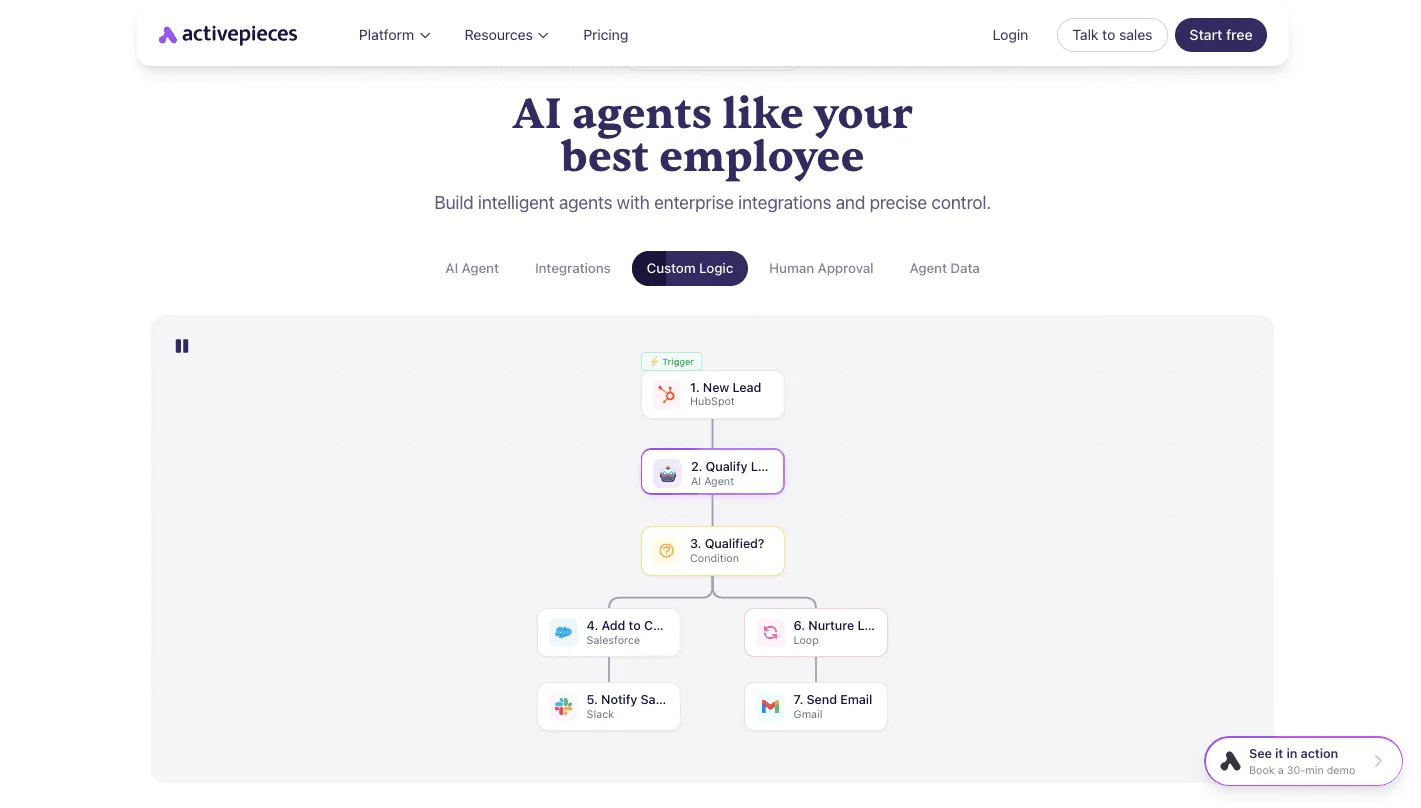
For automation teams, computer use matters because it swaps a fixed connector for an agent step that works a screen. The usual shape is a lead-routing flow.
When a HubSpot trigger fires, an AI agent step qualifies the lead, and a condition then sends it to Salesforce and Slack or into a nurture loop.
To win that AI agent step, Hy4 would have to beat the model already sitting there, and the rest of this integration measures it against that model.
Hy4 and Hy4 Flash, as the maker describes them
Hy4 is Tencent's newest Hy model, and the maker presents computer use as part of what it can do. Hy4 flash is a separate, more cost-effective model in the Hy4 family.
Tencent calls it "our most cost-effective Hy model to date" and describes it as natively multimodal, meaning it takes more than text as input.
Read "cost-effective" as Tencent's word, because it comes with no price in this section. It shows where the maker is aiming. It doesn't show that Hy4 flash is cheaper than the model you run today, and that comparison is the one you need to make.
Everything below works on Activepieces' free plan. Start without code or a credit card.
What computer use enables for automation
If a model can operate a screen, it can work in software where no connector exists, and a connector-based workflow can't follow it there. That is the reason to ask the cost question at all.
If a model can operate a screen, it can work in software where no connector exists, and a connector-based workflow can't follow it there.
Hy4 computer use for apps with no connector
Reading the screen and clicking through it: that is how Tencent says Hy4 operates software, the way a person does. For an automation team, that moves the boundary of what can be automated.
To see which items in your backlog this claim touches, the list below pairs four jobs with the connector step each would otherwise need.
- An app with no API, where you would otherwise commission a custom wrapper or wait for the vendor to publish endpoints.
- A legacy desktop tool, where you would otherwise script it with a recorder, or export files on a schedule and map the fields by hand.
- A vendor portal behind a login, where you would otherwise build an authenticated scraper and repair it every time the page layout shifts.
- A form with no connector, where you would otherwise map each field to a trigger and action the platform never shipped.

Today, each of these jobs either sits with a person or waits on engineering. If the claim holds in your hands, that backlog is what shrinks. Whether it holds is a question for your own test, not the maker's page.
Where a documented API or a working connector exists, use it.
A call returns structured data and fails loudly, while a model clicking through a screen can misread a field and carry on. Screen operation is the fallback for the gaps above, not a replacement for steps that already run cleanly.
What Tencent says is new in Hy4
To earn a place beside your screen-operation fallback, Hy4's screen skills have to come cheap, and Tencent's pitch is that it does both.
The table keeps the maker's claims apart from what nobody has published; read the right-hand column as the work still left to you.
| Claim | Figure | Source | Unpublished |
|---|---|---|---|
| Among the strongest open-source models, released November 4 | None | Hy | Independent replication |
| Office score | — | Hy | Cost per finished task |
| Pass rate | — | Hy | Cost per finished task |
| API price per 1M tokens, Flash to full Hy4 | Input $0.07 to $0.834 | Hy | Speed per task |
A gap that small can vanish on your workflow, so treat the figures as a reason to run your own trial, not as a verdict.
The table is our reading of that page, so take the labels as the maker's. A pass presumably means the agent finished a task correctly, but the page doesn't spell out the grading rule.
The page also doesn't give a rival model's score next to these two figures in what we could read, so we can't say who the lead is over or by how many points. That is why "narrow" is a caution and not a measurement.
Until Tencent or an outside group publishes the same test run on the model you already use, the comparison that matters can't be made from these numbers.
The price chart on Tencent's Flash page shows Flash at the low end of each range and full Hy4 at the high end. According to Tencent:
- Input on Flash runs $0.07 per million tokens.
- Output on Flash runs $0.281 per million tokens, which matters because every click the model plans is output.
Do not mistake per-token prices for per-task prices. Tencent hasn't published what a finished task costs, so you can't yet compare either tier against the model you run today.
Easier to see it running than to read about it: set it up free, no card.
Activepieces has no Hy4 integration; connect it by HTTP, AI step or MCP
A cost comparison has to run through one of three workarounds, each trading setup effort for control.
Connect Hy4 with an HTTP request step
Point an HTTP request step at OpenRouter, the model gateway, and name the model tencent/hy4 in the JSON body. This is the route you can build today with nothing installed.
You write the request body, set the authorization header and map the response fields yourself. That means you decide which token counts reach your cost comparison, and you also repeat the plumbing in every flow that calls it.
Connect Hy4 with an AI step custom provider
Swapping models becomes one setting, which suits a side-by-side test on cost and speed.
The token bill for Hy4 or gpt-5.4-mini lands on your own provider account.
MoneyGram, Moneypenny, Alan and FundingSocieties run Activepieces in production.
There is a catch: it only works if the endpoint really speaks the OpenAI format. A chat-style step may also not expose the tool-calling a computer-use task needs, so check that before you trust a result.
If you want Hy4 driving actions rather than answering prompts, Option 3 is an MCP server, a small service that exposes tools to an agent, and it's the heaviest of the three.
But you would host and maintain the server, and no Hy4 one is named here.
Hy4 performance on three automation tasks
3.2 seconds against 0.9: that is what Hy4 took on three small automation tasks, where it matched GPT-5.4-mini on correctness, at about eight times the cost per task.
The three tasks and how they were scored
On 2026-11-18 tencent/hy4 and openai/gpt-5.4-mini were run through OpenRouter, a gateway that serves both models behind one API, on default settings. Hy4's defaults reason before answering. The tasks were:
- Sort a support ticket
- Pull fields from an invoice
- Summarise an email thread
To score them, each result was checked against a known answer. Three tasks make a smoke test, not a benchmark, so a pass here shows only that a model handles easy, well-defined work.

Results, speed and cost per task
Since both models got every task right, the difference between them is speed and price. That's the gap a team already running a cheap model would have to justify.
tencent/hy4 got 3 of 3 right. It had a median of 3.2 seconds and a cost of $0.0012 per task. openai/gpt-5.4-mini also got 3 of 3 right, with a median of 0.9 seconds and a cost of $0.000142 per task.
Three tasks, one tie on accuracy: that tells you very little. You can't reliably say which performs better.
At thousands of tickets a day, the speed and cost columns are what would compound: a workflow waiting 3.2 seconds per step feels sluggish, and the bill is roughly eight times larger.

Since Hy4 reasons before it answers, some of its delay probably comes from that, so a rerun with that behaviour reduced, if the endpoint allows it, would be the fairer follow-up.
Hy4 cost and speed comparison
Even a faster rerun wouldn't change the price: Hy4 lists at $2.501 per million output tokens, so any speed gap has to be weighed against the bill. These are the maker's published prices, not measured here.
| Option | Cost per 1M output tokens | Speed | Setup effort | Source |
|---|---|---|---|---|
| Hy4 flash | $0.281 | Not tested above | New endpoint to wire in | Tencent Hy page |
| gpt-5.4-mini | Not priced here | Faster in the small test above | None, already running | Test above |
| Computer-use agent | $6 (preview model) | Not measured | Highest: screen-driving harness | Tencent Hy page |
| Plain API integration | No token cost | Not measured | Per-app field mapping | Not sourced |
On price Hy4 wins and on speed it loses, so the decision turns on how much latency your workflow tolerates.
Hy4 output token price versus Claude models
On the same chart, Claude Sonnet 5.5 is $10, Claude Opus 5.5 is $20 and Claude Fable 5.2 is $40 per million output tokens.
Hy4 flash is roughly 36 times cheaper than Sonnet 5.5 and about 142 times cheaper than Fable 5.2 on output tokens.
At $6, the computer-use preview model is still around 21 times the Hy4 price. For a high-volume job, that gap pays for a lot of extra waiting.
The chart labels that $6 entry only as a computer-use preview model, and the page text we could read doesn't give it a name. Don't assume it is one of the Claude models listed above, because the chart doesn't say so.
Check the vendor's own pricing page for the exact model before you budget against that figure.
Nothing is charged per token on a plain API call, and there is no screen to misread. Its cost is the setup: someone has to map each trigger, action and field by hand. Use a computer-use model only where the app exposes no API.
What to watch next as Hy4 rolls out
Whether Hy4 earns even that narrow slot depends on a few public pages you can recheck, not on launch claims: pricing, access terms, independent evaluations and third-party listings.
- Hy4 and Flash pricing and access pages: per-token cost and any waitlist or region limit decide whether you can run the comparison at all.
- Independent computer-use evaluations: the maker's own benchmark is a claim, and a third-party result is the first thing that can confirm or contradict it.
- OpenRouter listing changes: a model appearing there, or a price shifting, tells you it's reachable without a vendor contract.
Demand isn't the question. QuestMobile data reported by 36Kr puts WorkBuddy at 32.353 million active users, Baidu Dazi at 9.77 million and Qianwen Office at 7.905 million.
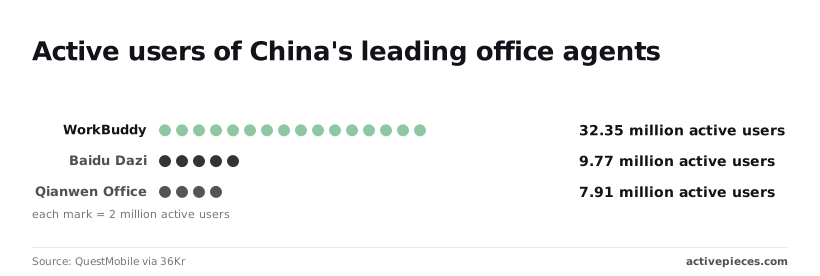
Those counts measure usage, not task success or cost per run, so they tell you nothing about whether Hy4 beats your current model.
Because the test was small, one change in these inputs could flip it. A lower Hy4 price shifts the cost comparison immediately.
An independent evaluation showing that Hy4 rarely misses its target on screen, such as clicking the wrong button or filling the wrong field, would matter more than any price. Absent those, the case for switching stays unproven.