
Vellum AI Alternatives in 2026, Sorted by Job

Nov 4, 202614 min read
If you are looking for one product to replace vellum.ai, there isn't one; the right alternative depends on the job you were doing with it, whether that was prompt testing, workflow orchestration (where a tool like Activepieces may come up), or evaluation, and the rest of this article sorts options that way.
Pick by job. Running AI workflows across business systems under governance points to one platform. Narrower jobs, such as prompt testing alone, point to narrower tools. Read each section's job description before its product list.
Here is the source: the maker's own documentation at vellum.ai/docs. Its definition is one sentence: "Vellum is a personal AI assistant that lives in the secure Vellum Cloud, has its own identity, and actually does things in the world."
That describes a personal assistant with its own identity, hosted by its maker. It doesn't describe a workbench for building and testing prompts. If you arrived expecting the latter, the mismatch is already visible in the first line of the docs.
The rest of this article treats Vellum as a prompt and LLM-app development tool, because that is the job most departing teams say they hired it for. The docs page we checked leads with the assistant.
Which Vellum alternative fits your job?
Both readings point the same way: neither is a platform for running governed AI workflows across business systems.
Vellum publisher, access and pricing facts
Checked on 2026-11-04, the facts below all come from that docs page. We haven't run the product, so nothing here is a hands-on finding.
Made by Vellum, the publisher of the docs at vellum.ai, Vellum is a personal AI assistant hosted in Vellum Cloud, with its own identity. You get it through vellum.ai, with setup steps in the docs.
It has a free tier and paid tiers above it. It's new, so expect the docs and behavior to keep changing.
The newness cuts the other way: a product this recent has little track record in audits, so verify any governance claim against the docs yourself before relying on it.
The fastest way to settle a shortlist is to try one. Activepieces is free to try, no credit card.
Reasons teams leave Vellum for job mismatches
When a team leaves Vellum, it is usually because it asked a prompt and LLM-app development tool to do a different job, so the exit is a mismatch rather than a defect. Six reasons recur, and each can be checked on the maker's own pages:
- Plan or price fit, on the pricing page
- Maturity, in the changelog and release notes
- Lock-in, in the documentation on exporting prompts and workflows
- Missing integrations, on the integrations list
- Self-hosting or open source, in the deployment docs and the licence file
- Process automation need, in the product overview
You can settle your own case in an afternoon, because none of the six needs a sales call. The three groups below take them in turn.
Vellum pricing and plan fit
From $0.50 for Claude Haiku 5.5 to $50 each for Claude Fable 5.1 and GPT-6 Astra: that is the range of output prices per million tokens for models a prompt platform routes to, according to Vantasoft, which means your routing strategy can make the difference between pennies and dollars per million tokens.


In between sit $10 for Claude Sonnet 5.5 and $20 for Claude Opus 5.5.
That's a hundredfold spread, so a surprising bill often traces to model routing rather than the platform fee. Read the plan limits against your actual model mix before blaming either.
31.4% of AI pilots reached production, Code Ninety finds; 48.6% stalled for six months or more, and 20% were abandoned.

Fewer than a third ship, so many departures are stalled pilots rather than tool failures. With a newer tool, check the changelog for release cadence and whether your prompts leave in a usable format.
If the job is running AI workflows across business systems under governance (RBAC, SSO, SCIM, audit logs, environments, git sync), a prompt-development tool is the wrong shape. One platform covers that job, self-hosted or cloud. Specialist tools fit narrower ones.
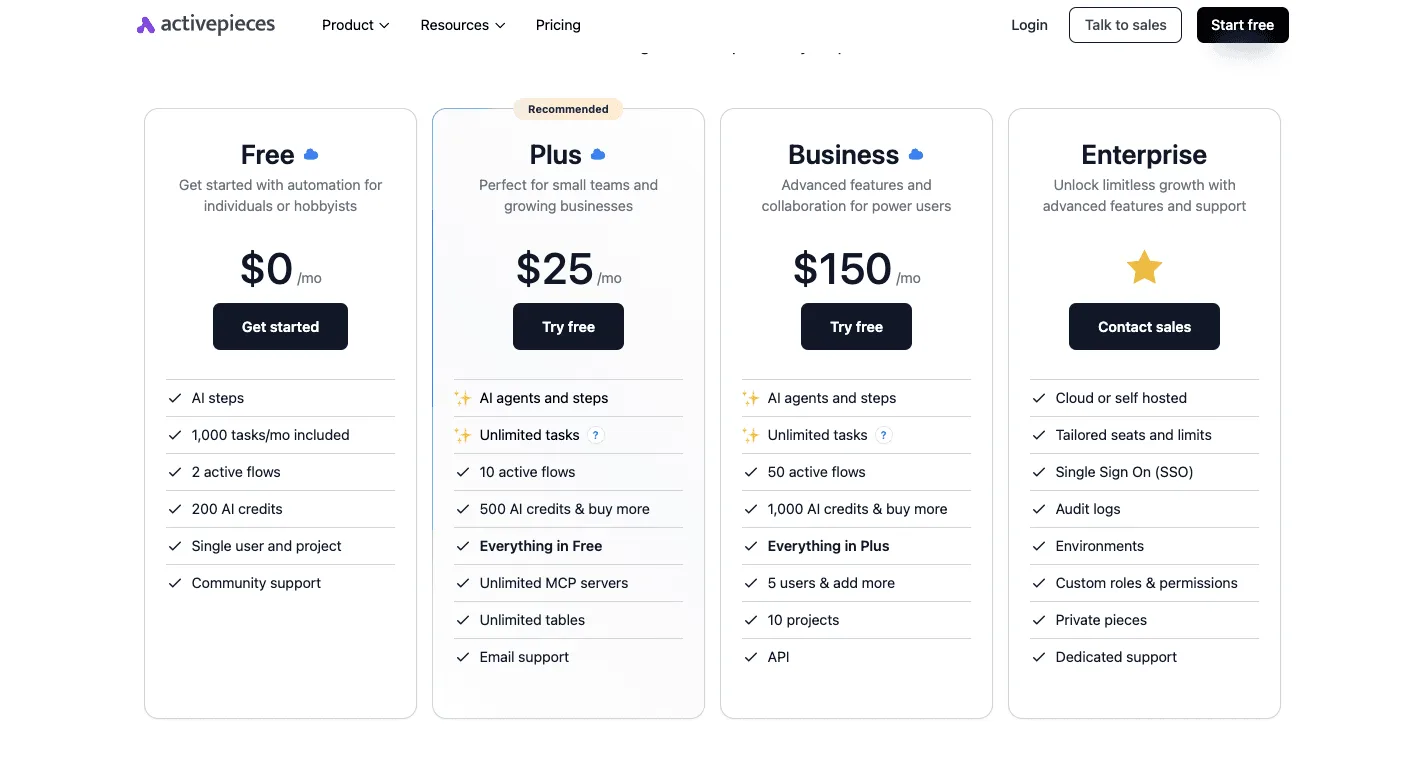
That list is the whole switch decision, so here it is in plain words. RBAC means permissions by role, SSO is one company login for every tool, and SCIM provisions and removes users automatically.
Audit logs record who did what, environments keep development apart from production, and git sync keeps workflow definitions in a repository you control.
When to stay with Vellum
When a narrow tool wins
If your job is the one Vellum documents, stay: a tool built for one purpose beats a platform stitched together from several, and switching costs are real. That's the best argument against this article, and it holds whenever the job hasn't changed.
Start with the artifact: Vellum's own docs. They describe a personal AI assistant that lives in the secure Vellum Cloud and has its own identity. Read them against your current work, line by line.
If every item you do each week appears there, the product's narrow focus is the advantage. Fewer moving parts means fewer places for a workflow to break, and one vendor answers for the whole path.
Cost of migrating away from Vellum
Leaving costs something too. Prompts, test suites, and deployment settings live in one place. Moving them means re-creating each one and re-running every evaluation to confirm nothing drifted. A team that migrates without a changed job pays that bill and gets the same capability back.
When to switch from Vellum
So the test is the job, not the tool. Price discomfort alone is a negotiation, not a reason to migrate. Switch when the work itself has moved: from building LLM apps to running AI across business systems under governance, or to hosting it yourself.
To compare, the table below sets four situations against the signal you would see, the call to make, and what to check before acting on it.
| Situation | Signal | Stay or switch | What to verify |
|---|---|---|---|
| Job matches the maker's docs | Everything you do weekly is described in Vellum's documentation | Stay | Re-read the docs against your actual workload, not the plan you started with |
| Job unchanged, price worry | Same work, bigger invoice | Stay, and negotiate | Compare your usage against the plan terms before comparing vendors |
| Job changed to process automation | Workflows now touch business systems and need RBAC, SSO, SCIM, audit logs, environments, git sync | Switch | Confirm each governance control in the product's docs or source, not the sales deck |
| Job changed to self-hosting | Requirement to run inside your own network | Switch | Read the deployment files yourself and confirm what runs where |
Prices and plan limits checked against vellum.ai on November 4, 2026.
Reading a table only gets you so far. Build the same workflow in Activepieces and compare it yourself.
Compare Vellum alternatives by job and price
If you leave, the job decides the destination. Use Langfuse or LangChain's tooling for tracing and evaluating prompts, Flowise for an open-source agent builder, and Zapier, Make or n8n for business automation.
The table below sets each against price, strength, limit and fit. Only Langfuse's price is confirmed here; the rest read "not stated" rather than a guess.
| Tool | Job | Price | Strength | Limit | Suits |
|---|---|---|---|---|---|
| Langfuse | Observability | $0 to $2,499/month | Tracing and evaluation | Not a workflow builder | Teams debugging prompts |
| LangChain | Observability | Not stated | Framework plus tracing | Code-first | Developers |
| Flowise | Open-source builder | Not stated | Visual agent flows | Governance not stated | Self-hosting tinkerers |
| Zapier | Automation | Not stated | Hosted app connectors | Cloud-hosted | Non-technical teams |
| Make | Automation | Not stated | Visual scenario builder | Not stated | Ops teams |
| n8n | Automation | Not stated | Self-hostable workflows | Not stated | Technical ops teams |
| Activepieces | Open-source automation | Free plan $0; Plus $20 a month; Team $200 a month | 747 integrations, MIT-licensed core, unlimited flows on every plan | Enterprise directories (packages/ee/) are under a separate commercial licence | Teams wanting self-hostable automation |

Check the limit column before the strength column, since each row answers a narrower question than a governed platform does.
Prompt and evaluation platforms
Only one row has published steps: Langfuse. Langfuse lists Hobby at $0 per month, so a single developer can trace prompts at no cost. Core is $29 per month, a low entry for a small team, so there's no budget barrier to running a pilot.

Outgrow Core and the jump is steep: Pro is $199, roughly seven times Core. Enterprise is $2,499, about twelve times Pro, which makes that tier a procurement decision rather than a card swipe. LangChain's tracing suits teams already writing its code.
Because Flowise is open source, you can read the compose file and source tree yourself before trusting it. Its governance coverage isn't stated, so confirm RBAC, SSO and audit logging against the repository before relying on it.
None of Zapier, Make or n8n develops prompts; they move data between business systems.
Their prices aren't stated here, so read each vendor's pricing page before comparing totals. Of the three, only n8n is described here as self-hostable, which matters if data must stay in your environment.
Connect vellum.AI to business workflows with Activepieces
If the job is automating the processes around vellum.ai rather than replacing it, Activepieces fits, and where the data lives is a separate question from whether it fits.
Agents, integrations, flows, shared tables, an AI chat and MCP tools are one product there, under a single set of access, audit and release controls on cloud or self-hosted, and MoneyGram and Moneypenny run it in production.
Build the same span from point tools and you have six vendors and six places to reconstruct what happened when a run failed.
Nothing specific to vellum.ai ships in it (checked 2026-11-04), so there's no native integration, and every route below is a general connection method.
I haven't run vellum.ai against any of them, so read each one as a pattern to verify, not a tested recipe.
Option 1: an HTTP request step
This is the simplest route and the easiest to audit, because the whole integration is one request you can read.
The workflow below shows the shape: a trigger fires, and a single HTTP step sends a POST with an Authorization header and a body to Square, a payments platform, to revoke an OAuth token.
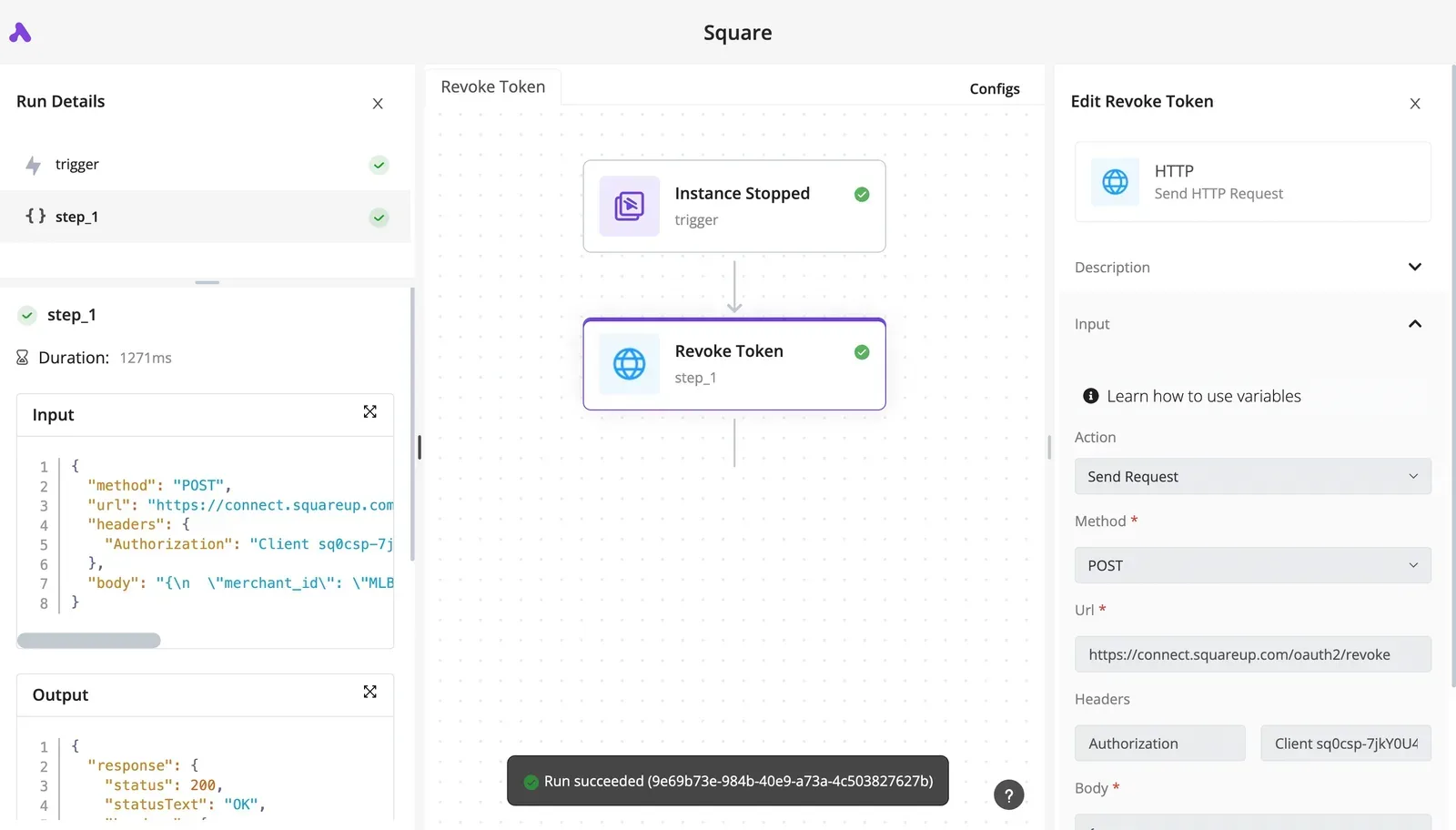
According to the run details, both steps completed, so you can check the input and output JSON of each one.
Point the step at whatever endpoint vellum.ai's API documentation lists, and put the key in the header; the same pattern works there. Check the documented URL and auth scheme yourself before you build on it.
Option 2: an AI step with a custom provider
If you want the workflow to call a model hosted behind vellum.ai as if it were any other provider, an AI step with a custom provider is the next option.
It only works if vellum.ai exposes an endpoint in a request format the step accepts. I couldn't confirm that it does.
Read the provider settings in your Activepieces version and the vellum.ai API reference side by side before committing.
Option 3: an MCP server
Third is the Model Context Protocol (MCP), a standard for letting an AI client call tools. Here the question is whether vellum.ai, or something you place in front of it, publishes an MCP server that Activepieces can reach.
I found nothing confirming one, so treat this as the route that needs the most checking. If you build a small server yourself, the source tree is the artifact to review.
What to verify before leaving Vellum
The short answer
Write down the one job you hired vellum.ai for, check every replacement against that job alone, and only then move. The answer turns on whether you're building AI features or automating business processes.
- Write the one job in a single sentence, such as "ship and version prompts for our support assistant" or "run approved AI workflows across our business systems under audit."
- List what you'd lose, naming each feature your team actually uses today. Include governance items such as RBAC, SSO, SCIM, audit logs, environments and git sync if your job needs them.
- Re-check each pricing page on decision day. Print or save the page, because plans change and a remembered price isn't evidence.
- Run one real task from your own backlog through a shortlist. A demo proves the vendor can follow a script, while your task proves it can follow yours.
- Move, and keep the old account readable until the new one has handled a full cycle of real work.
Skipping step one is the usual failure, because without it the comparison drifts toward whichever tool has the longest feature page.
What the maker says vellum.AI is
Read the product's own description and hold it against your sentence from step one. The vendor positions vellum.ai as a personal AI assistant with its own identity, hosted in Vellum Cloud.
If your job is that, a departure is probably a mistake. If your job is governed workflows across business systems, the description tells you the mismatch is in the fit, not in any defect.
You reach vellum.ai through its own site and documentation; Vellum is the company behind it. I'm not quoting prices here. Open the pricing page on decision day, record the plan names and what each tier includes, and confirm whether self-hosting is offered for your tier.
Do the same for every candidate, so the comparison rests on pages you saved yourself.
Frequently asked questions
Is vellum.AI free to try?
Check the pricing page: that's the only source that settles it, and I have no confirmed figures to quote. Save a dated copy of the page and read the plan comparison for what a free or trial tier caps, such as seats, runs, or environments.
If a limit is missing from the page, you have no basis for assuming it exists or doesn't. Ask the vendor in writing and keep the reply with the saved page.
Can I export my work if I leave vellum.AI?
Read the docs before building anything you can't move, because export is supported only to the extent the documentation says so.
Look for three artifacts: a downloadable definition of each workflow or prompt, a git sync option that puts those definitions in a repository you control, and an API that reads them back out.
If you own the repository, you have the strongest exit path, because you can diff it and restore from it without the vendor.
If the docs describe none of the three, treat your prompts and workflow logic as locked in, and keep a copy by hand.
Does Activepieces integrate with vellum.AI?
No vendor page I can confirm shows a native integration. Look for it in the integrations directory on each side, and check the vellum.ai docs for a published API.
Without a native connector, the usual route is an HTTP call from one tool to the other's API, which you build and maintain yourself. Whether that's acceptable depends on who owns the glue code when an endpoint changes.

Is a new AI platform safe to build a business on?
It's safe to the extent that you can leave it, so test the exit before you commit. Ask for the controls you'd otherwise build yourself: role-based access, single sign-on, audit logs, separate environments, and git sync.
Ask whether you can self-host, which decides whether a vendor change can strand you.
Run a small, reversible workflow first. If you can export it, restore it elsewhere, and explain who touched it from the audit log, the platform has earned a larger one.
Related reading
References
Still comparing
The fastest way to settle it is to build something.
Open source under MIT, so you can self-host the same thing later.
Start free Talk to sales