
What Is an Agent Harness? Architecture and Terms for 2026
Agent harness infrastructure defines the critical interface between model reasoning and external software execution.

Covers credential sprawl from unsanctioned tools: access risk, exposure tradeoffs, and controls that hold up under audit.
ContributorSeptember 18, 202615 min read
This article was researched and fact-checked by an advanced research system.
An agent harness is the dedicated infrastructure layer that translates a Large Language Model’s probabilistic text into deterministic system commands while enforcing security and operational constraints.
When an LLM operates without this wrapper, it remains a closed loop. It's capable of suggesting a database query but unable to authenticate with a server or handle the resulting error codes.

Define agent boundaries between thought and action
The distinction between the brain and the body
The LLM acts as the reasoning engine. The harness provides the mechanical interface required to interact with production environments.
You can see this separation of concerns in the latency overhead introduced by orchestration frameworks, where the complexity of the body dictates the speed of the response. According to benchmarks by Markaicode, the overhead varies significantly:
| Framework | Latency Overhead | Operational Characteristic |
|---|---|---|
| DSPy | 3.5 ms | Most lightweight option for programmatic prompt optimization. |
| Haystack | 5.9 ms | Middle-ground for document-based agents. |
| LlamaIndex | 6 ms | Reflects the efficiency of data-retrieval-heavy workflows. |
| Gateway | 7.5 ms | Baseline cost for simple request routing. |
| LangChain | 10 ms | Forces a trade-off between its vast tool library and execution speed. |
| LangGraph | 14 ms | Complex state machines add the highest delay to every turn. |
| Activepieces | — | Open source, MIT-licensed AI automation platform with 735 integrations. |
The three pillars of a functional harness
A robust harness manages the lifecycle of a task across three domains: environment isolation, identity management, and observability.
By executing code in sandboxed containers, environment isolation ensures that a hallucinated command can't delete a root directory. Identity and access management provides the agent with scoped API keys rather than broad administrative credentials.
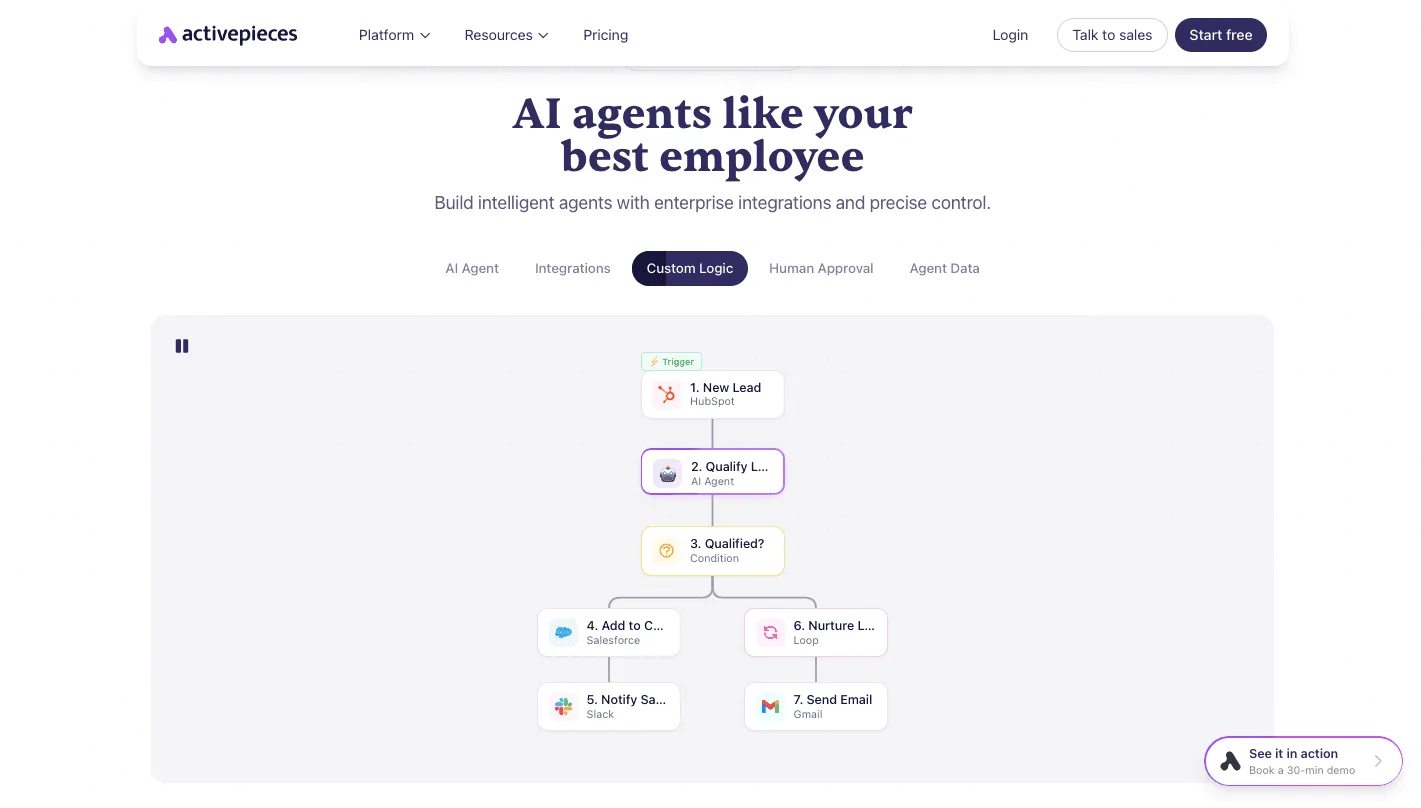
Observability logs every intermediate thought and tool call so that failures are auditable.
Why LLMs need a harness to work safely
Raw API calls lack the persistence and safety guardrails required for industrial-grade automation. Whether an agent is a liability or an asset is determined by the structural differences between a simple prompt and a managed harness.
Activepieces provides this structure by exposing every one of its 735+ integrations as a tool schema on a per-project MCP server, allowing agents to interact with production apps through a governed interface rather than raw, unmediated code.
Whether an agent is a liability or an asset is determined by the structural differences between a simple prompt and a managed harness.
The Model Context Protocol as a standardized bridge
The Model Context Protocol, or MCP, is the open standard that allows the harness to communicate its available tools to the LLM in a language the model understands.
Without a protocol like MCP, every new tool would require a custom integration written specifically for each different model provider.
How MCP servers translate agent commands
An MCP server is a standardized interface that sits between the model and the tools. Physically, it is often a small process or container that acts as a translator, converting the model's intent into specific API calls.

This logical layer ensures that the agent only sees the functions it is permitted to use, rather than the entire underlying system.
MCP works by creating a structured server that hosts a list of functions, their required inputs, and their expected outputs.
When the LLM needs to perform an action, it queries the MCP server to see what is possible, receives a standardized schema, and then sends back a request that the harness can execute.
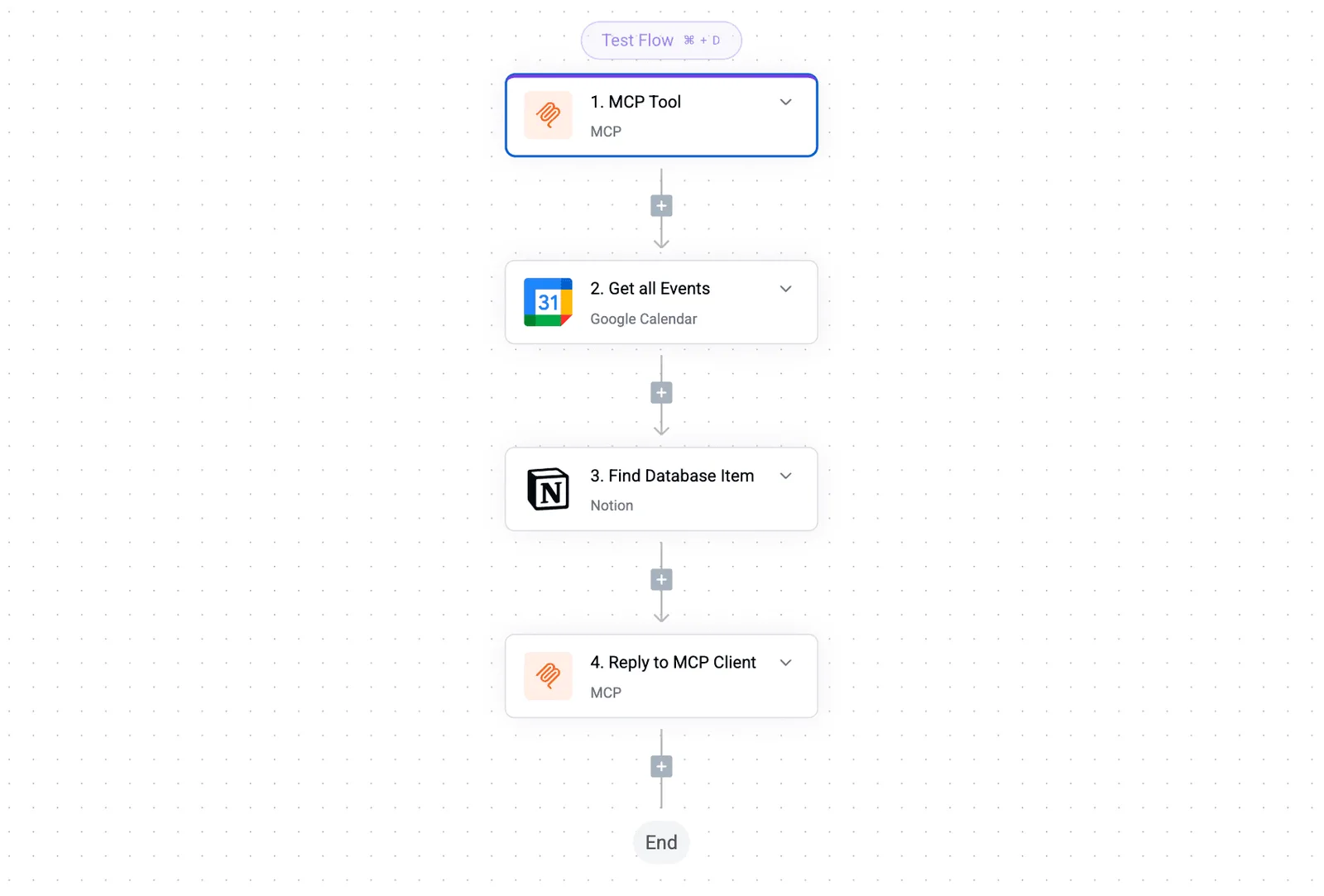
This protocol ensures the agent stays within the boundaries of the tools it has been granted.
- State persistence: Tracking conversation history across multiple turns so the agent retains context without you manually re-injecting the entire thread.
- Token budgeting: Capping the maximum spend per task. This ensures a recursive loop doesn't result in a four-figure surprise on the monthly invoice.
- PII scrubbing: Masking sensitive data before it leaves your internal network to meet compliance standards when using third-party model providers.
- Tool output validation: Checking that a tool's response matches the expected schema before passing it back to the LLM to prevent downstream logic errors.
These layers ensure that the agent operates within a predictable failure domain.
The moment a connector is registered in Activepieces, it functions as a dual-purpose asset: a step in a flow and a tool schema on a per-project MCP server.
This eliminates the need for a separate publishing step or a second integration effort to make your catalog reachable from Claude, ChatGPT, or a custom agent.
The mechanism in the packages/pieces directory of the open-source repo ensures the same integration action running in a flow is exposed as an MCP tool.
Everything below works on Activepieces' free plan. Start without code or a credit card.
The etymology of the harness in software engineering
The harness is the structural interface that converts raw, unmanaged energy into predictable mechanical output. By adopting this terminology, you shift your focus from the internal logic of the model to the external constraints that make that logic usable in a production environment.
Borrowing from automated test harnesses house logic
Software testing utilizes a harness to isolate code from the complexities of the live environment. This ensures that a specific input produces a repeatable result. This infrastructure includes the stubs and drivers to simulate external dependencies.
The harness allows you to validate a single function without triggering a cascade of unintended side effects across your entire system. In the context of AI, this same principle applies to prompt evaluation.
The harness includes the fixed context and mock data necessary to measure the model’s reliability. Performance and safety have no baseline if the model's output drifts based on fluctuating environmental variables.
The mechanical metaphor of restraint and direction
The term "harness" bridges the gap between biological unpredictability and industrial utility by providing a framework for control. The following table illustrates how this concept has evolved across different domains to solve the problem of undirected force:
| Domain | Primary Function | Operational Outcome |
|---|---|---|
| Animal Husbandry | Connects beast to plow | Converts raw physical strength into the linear path required for agriculture. |
| Software Testing | Provides test data and records output | Standardizes the environment so code can be validated against known benchmarks. |
| AI Engineering | Enforces guardrails and data schemas | Limits the stochastic nature of the model to ensure it follows specific business logic. |
This comparison highlights that a harness is never about changing the nature of the engine, but rather about ensuring the engine’s power isn't wasted or destructive.
From simple wrappers to structured agent harnesses
A "wrapper" is a thin layer of code that merely passes data to an API. A "harness" is an integrated system that manages the entire lifecycle of the interaction.
Early AI implementations relied on wrappers. This meant the model had direct, unmediated access to the user’s prompt and the system’s response.
A harness replaces this thin layer with a robust architecture of interceptors and validators. By moving to a harness, you gain a centralized point of audit for every token generated.
This ensures that security policies apply consistently regardless of which specific model is currently under the hood.
An SDK gives an agent code to run, but it does not provide the identity or audit trail required for enterprise governance. Activepieces puts every agent inside the same access model as employees, using RBAC and SSO to govern what it may connect to.
The run detail view for any agent step lists each tool call separately with its own input and output, ensuring that an agent is treated as a managed user rather than an opaque script.
Arguments against the distinct harness category
Equating a harness to a mere API integration or a static prompt template ignores the persistent state management and real-time intervention required to prevent autonomous agents from breaching operational boundaries.
While a standard API acts as a passive pipe for data, a harness functions as an active containment vessel.
The harness evaluates the intent of a request before it reaches the model and scrubs the output before it touches your production environment. Skeptics often argue that existing middleware can handle these tasks.
Yet standard integration layers lack the specific semantic filters needed to catch prompt injection attacks. A developer relying on basic REST protocols leaves the system vulnerable to unauthorized data exfiltration.
The necessity of this architectural distinction is best visualized by separating the raw computational power from the operational safeguards. The following diagram illustrates the Inference Engine (the central LLM sphere) encapsulated by The Harness, a multi-layered ring that includes the necessary infrastructure for safe deployment.
- Tool Access (MCP): Standardizes how the engine interacts with external databases so that the model never possesses direct credentials to sensitive systems.
- Security Rails (PII): Scans outgoing tokens for protected health information or credit card numbers. This ensures that a creative model hallucination doesn't result in a regulatory fine.
- Policy Enforcement: Applies role-based access controls to the agent’s reasoning process, preventing a junior staffer’s bot from accessing executive payroll data.
- Audit Logging: Records the chain of thought alongside the final output, providing a forensic trail for when a logic error leads to a financial discrepancy.
This structural separation ensures that the "intelligence" of the model remains isolated from the "authority" of the system.
By treating the harness as a distinct layer, you can swap an outdated model for a more efficient one without rebuilding your entire security and compliance framework from scratch.
Easier to see it running than to read about it: set it up free, no card.
Why integration alone is insufficient for autonomous agency
Standard API connections provide the plumbing for data transfer but lack the governance structures required to manage an agent’s non-linear decision-making process.
While a traditional integration executes a predictable command, an autonomous agent interprets a goal, creating a risk profile where the system might take valid but catastrophic actions to achieve an objective.
Why unmonitored agent automation fails
Direct integration without a harness creates a visibility gap where an agent can initiate a chain of API calls that no human operator can intercept before completion. In a standard webhook setup, the system lacks a circuit breaker mechanism.
Nobody notices the spike in activity until a single misinterpreted prompt has triggered thousands of unauthorized database writes.
Without an intermediary layer to enforce human-in-the-loop checkpoints, you lose the ability to audit the intent behind a specific action. This transforms a helpful tool into a black-box liability.
State management as the harness's primary job
The harness acts as the external memory and logic gate that prevents an agent from hallucinating its own progress or repeating failed loops. Because large language models are stateless by design, they can't inherently remember that a previous attempt to contact a server failed.
Infinite retry loops are the result, draining compute budgets. By offloading state management to the harness, the system maintains a persistent log of every interaction. The agent then operates against a single source of truth rather than its own drifting internal context.
Safety sandboxes for non-deterministic code execution
A harness is a restricted execution environment where the agent can test generated code without risking the integrity of the host operating system. If an agent generates a Python script to analyze a spreadsheet, the harness forces that script to run in a containerized environment.
This prevents the code from accessing sensitive local files or lateral network segments. This isolation ensures that even if the agent produces a malicious or poorly optimized script, the blast radius stays within a disposable virtual space.
Building a secure agent harness with Activepieces
Activepieces provides an MIT-licensed core that enforces strict governance over how Large Language Models interact with external business software.
Every automated action follows predefined permissions rather than the unconstrained logic of the model itself. By decoupling the reasoning engine from the execution layer, the platform prevents an agent from exercising administrative privileges it doesn't strictly require to complete a task.
Providing agents with authenticated tool access
The platform secures the integration between an AI agent and third-party services like the customer relationship tool Salesforce or the communication app Slack by centralizing credential management.
Companies like MoneyGram and FundingSocieties run Activepieces in production to manage these connections under a unified governance model.
Instead of passing API keys directly to the LLM, the platform stores these secrets in an encrypted vault and only exposes functional integrations as scoped tools, ensuring that even a compromised model cannot bypass the access controls defined in the harness.
This separation of concerns means that even if a model is compromised, the attacker can only perform the specific, scoped actions defined within the workflow. The attacker is prevented from gaining full access to your underlying service accounts.
Defining the limits of autonomous decision-making
A visual flow builder maintains control by acting as a hard boundary for what the agent is permitted to execute. You define the logic gates and data paths an agent can take. This restricts the model to a human-in-the-loop or pre-approved set of outcomes.
This structure ensures that an agent can't spontaneously decide to delete a database or email a client unless that specific path was explicitly built into the harness. This effectively turns the agent from a free-roaming actor into a component of a strictly defined industrial process.
Monitoring agentic loops for cost and logic errors
The harness is a central audit log for every step the agent takes. It allows you to identify where a recursive loop or a faulty prompt is wasting resources.
Because every execution is logged as a discrete event, you can spot patterns where an agent is repeatedly failing to call a tool or is generating excessive tokens due to a logic trap.
This visibility transforms the black box of agentic behavior into a transparent ledger. It makes it possible to kill runaway processes before they result in significant API overages or data corruption.
The Monday morning agent infrastructure audit
Standardizing the agent harness allows you to swap underlying large language models without re-engineering your entire business logic or risking the integrity of your internal data connections.
When an agent is hard-coded into a specific model's proprietary environment, you lose the ability to migrate when a competitor releases a more efficient or cheaper reasoning engine.
By decoupling the brain from the hands, the harness ensures that the rules of engagement remain constant regardless of which model is currently leading the benchmarks. These rules include who can access the database, which APIs are read-only, and where the budget stops.
Frequently asked questions
Is an agent harness the same as an agent framework?
An agent harness is the external security and connectivity layer that encapsulates an agent. A framework is the internal scaffolding used to build the agent’s logic.
While a framework like LangChain (a popular library for orchestrating LLM workflows) provides the tools to write code, it doesn't inherently include the network isolation or audit logging required for production.
Relying solely on a framework for security means your internal logic is exposed to the execution environment. Using a harness ensures that even if the framework has a vulnerability, the agent can't move laterally into your private network.
Can a harness prevent LLM hallucinations?
A harness can't stop a model from generating incorrect text, but it acts as a circuit breaker that prevents those hallucinations from becoming unauthorized system actions.
By applying a schema validation layer to every outgoing request, the harness ensures that if an agent imagines a command that doesn't exist in the API documentation, the request is blocked before it reaches the server.
This shift moves the risk profile from unpredictable behavior to a handled exception. It ensures that a confused agent results in a failed task rather than a corrupted database.
Does every AI agent need its own unique harness?
Standardizing on a single, modular harness architecture is more efficient than building bespoke wrappers, as it centralizes the enforcement of your security policies. Managing ten different security configurations for ten different agents creates a fragmented audit trail.
The following steps allow for a more secure and efficient deployment:
- Standardize on a single, modular harness architecture to centralize the enforcement of your security policies.
- Rotate API keys across all agents simultaneously to minimize the window of exposure during a leak.
- Apply a universal deny-all egress policy that prevents any agent from communicating with unauthorized external domains.
- Funnel all telemetry into a single monitoring tool, such as Datadog, so that your operations team has a single pane of glass for all AI activity.
Managing ten different security configurations for ten different agents creates a fragmented audit trail. This fragmentation increases the likelihood that a single misconfigured permission will go unnoticed by your compliance team.