
What Is Respan AI Gateway? (2026 Guide)

Oct 20, 202613 min read
Respan AI Gateway defined, and who makes it
What Respan AI Gateway is in short
Respan AI Gateway's a layer that sits between your application and the AI model providers it calls, much as a workflow tool like Activepieces sits between the apps it connects, and the company behind it describes it that way itself.

Everything below rests on that description, because nothing else about it is yet independently established.
Respan AI Gateway is a software layer that routes an application's requests to one or more AI model providers, so the application connects to a single intermediary instead of calling each provider directly.
You can't lean on a reputation here. Older gateways have years of production use behind them. This one has a product description and little else, so the fair test is whether its own pages state what you need, in terms you could check.

Who made it and when it appeared
Start with the maker: Respan, at respan.ai, makes the gateway. The facts we could establish about the company are these:
Nobody outside the company has had much chance to test any claim about its behavior under load, during a provider outage, or across a model upgrade.
That sequence shows a company that's young and a gateway that's newer still, and the product has had little time in the wild.
A gateway sees the model call, which is one of several places a team must look when something breaks.
Activepieces keeps agents, 742 integrations, MCP tools and approvals in one product under one set of controls (RBAC, SSO, SCIM, audit logs, git sync), and MoneyGram, Moneypenny, Alan and FundingSocieties run it in production.
How we sourced this Respan AI Gateway guide
If a statement about Respan appears here, it comes from Respan's own documentation and blog, checked on 2026-10-20. Those are vendor pages, so they describe intent and design, not measured results.
I didn't run the gateway. No request went through it, no failure was triggered, and no output was compared with a direct provider call.
Nothing in this article comes from a test of that kind, so read each claim as "the vendor says," and treat it as unverified until you reproduce it with your own input.
This takes minutes, not a project: automate it in Activepieces free.
What the gateway does, according to respan's docs
According to Respan's own documentation, the gateway is a layer that sits between your application and the model providers you call, and that description is all we can check here.
The overview page calls it "the AI gateway with built-in observability, evals, and security testing," which means one product claims to cover routing and the monitoring around it.
Where it sits in the request path
Instead of going straight to a provider, the request goes from your app to the gateway, and the gateway forwards it. Because every call passes through one point, the gateway can record logs, cost, latency and reliability for all providers in one place.
Because no model API has perfect uptime, one point that sees every call is the plain reason to want a gateway. A layer that sees every call is where you'd notice a provider failing and where you'd hope to route around it.
The app's at left, the gateway in the middle with its panel for those four measures, and arrows run out to providers, Nebius AI Studio among them.
Take from it that the gateway's a single point all traffic crosses, which is both its value and its risk.
Respan model provider connections, with Nebius as example
You can call models hosted on Nebius AI Studio, according to the Nebius integration page. Its examples are Z.ai GLM 5.3 and DeepSeek V4.1 Flash, used "while keeping unified observability (logs, cost, latency, reliability) in Respan."
Take from it that the gateway's a single point all traffic crosses, which is both its value and its risk.
Practically, that means a Nebius-hosted model should show up in the same dashboards as any other provider you connect. Reproduce that with one real call before you rely on it.
If you want an uptime figure for the gateway itself, the pages I read give none, and they don't describe what happens when a provider fails mid-request.
I found no stated added latency per call. Until those appear, treat failover and overhead as open questions you must test.
Get started with Respan
To get access you need a Respan account, a Respan API key, and your own provider credentials added as the docs describe. That setup's also the quickest way to start testing the open questions above.
Run these in order, and stop at the first step that fails, because that failure's your first finding.
- Create a Respan account.
- Create a Respan API key in that account.
- Add your provider credentials as the docs describe.
- Point the app's base URL at the gateway.
- Send a first request.
- Check the log.

That's the whole path from nothing to a logged request. The last step matters most, because a request that returns an answer but leaves no log entry means you can't yet verify anything the gateway claims.
Pointing an app at the gateway
In practice step four's a configuration change, not a rewrite: the app keeps its request code and sends it to a different address. Use a throwaway script for the first request, not production code, so a mistake costs you nothing.
Then compare what you sent with what the log shows: the model name, the prompt, and the response should all match.
Because pages alone don't settle these, ask before routing real traffic:
- Where your provider credentials are stored, and who at the vendor can read them.
- What the log retains, and for how long.
- What the gateway does when a provider call fails.
- Whether a free tier exists for testing.
Until you have answers, send test traffic only.
What respan costs, per its pricing page
For test traffic, the Free plan fits: respan.ai/pricing lists three plans, Free at $0 a month, Team at $199, and Enterprise at custom pricing, checked on 2026-10-20.
Respan plans and prices as listed
In the table: price and proxy throughput per plan. Free allows 412 requests a minute, about seven a second, so any production app with real concurrency will hit that ceiling. Team's 8,400 is roughly 140 a second.
| Plan | Monthly price | Proxy requests/min |
|---|---|---|
| Free | $0 | 412 |
| Team | $199 | 8,400 |
| Enterprise | Custom | Custom |
Prices and plan limits checked against respan.ai and respan.ai and blog.respan.ai and respan.ai on October 20, 2026.
If you keep every request, log volume's the bill to watch: extra logs cost $8 per 100k. The page also lists log, score and seat allowances; read those there before sizing.
What the Respan pricing page leaves out
On markup for model usage, the page says nothing. Whether you pay providers' rates at cost, or something added on top, is unanswered, so ask before you commit.
Expect the page to change. Dataku's chart of flagship output prices per million tokens shows GPT-4 at $60 in March 2023, GPT-4 Turbo at $30 in November 2023, and GPT-4o at $15 in May 2024.
By July 2024, 4o mini cost $0.60. Gemini 2.0 cost $0.40 in December 2024 and Gemini 2.5 $0.30 in April 2025.
200-fold: that's how far flagship output prices fell in two years. A flat $199 that looks fair today may look steep, or a hidden markup may dominate, once model costs fall further.

You can follow the rest of this with the builder open. Start free, no card.
What respan does well and badly so far
Respan's pages describe real strengths. This is a reading of documents, not a test: I haven't sent a single request through it, so every claim below is the vendor's own.
Respan AI Gateway strengths in the docs
Three things are stated on Respan's pages today. One API fronts many model providers, so switching from one vendor's model to another should be a configuration change rather than a rewrite.
Logs and cost tracking are built in, so you see spend per request without bolting on a separate tool. And there's a free tier, so you can run your own traffic through it before paying anything.
You can check each of these in an afternoon. Send the same prompt to two providers, read the log entry, and compare the cost it reports with the provider's invoice. If they differ, you have found the markup the previous section warned about.
Gaps and risks of a new product
| Supported by vendor pages | Inherent to a new product |
|---|---|
| One API for many models | No track record |
| Built-in logs and cost | Few independent reviews |
| Free tier | Unknown outage history |
Today you can check the left column; only time in production can fill the right. Treat the right column as the open items.
Because a gateway sits in front of every call, outage history matters. Dataku measured Anthropic at 99.72% uptime, OpenAI at 99.31% and Google Gemini at 99.14% in early 2025. Even the major providers fell short of 100%.
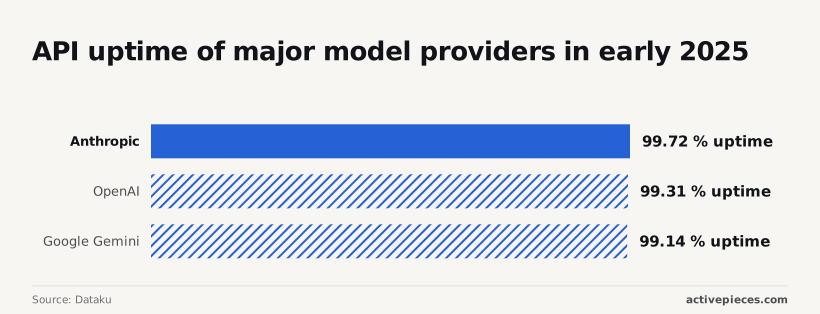
A 99.14% figure means roughly 75 hours of downtime in a year. A gateway adds its own failure rate on top of whichever provider you call, and Respan hasn't published one we can compare against these.
So until it has a record, run it in parallel with a direct provider path and keep a fallback you've tested.
Respan against established AI gateway options
Against the established gateways, Respan's biggest difference is maturity: it has no track record, and the category is young too. Gartner via Kong found 15% of software engineering leaders have a gateway deployed and 31% are rolling one out.

That's 46% with one running or close, while 22% are still evaluating and 32% aren't engaged, so 54% haven't committed.
Take from this table that only the maturity column separates the options cleanly, and treat every "verify" cell as unchecked until you read the vendor's page. It sets Respan beside four established options on five dimensions.
| Maturity | Hosting model | Pricing model | Provider coverage | Observability | |
|---|---|---|---|---|---|
| Respan | New, vendor-described | Open-source gateway | Free plan at $0 | Not stated on pages reviewed | Logs, scores, datasets, evaluators |
| OpenRouter | Verify | Verify | Verify | Verify | Verify |
| LiteLLM | Verify | Verify | Verify | Verify | Verify |
| Cloudflare AI Gateway | Verify | Verify | Verify | Verify | Verify |
| Portkey | Verify | Verify | Verify | Verify | Verify |
Verify each row against its vendor's pricing and docs pages before you commit to it.
Choose an established gateway if an outage would reach customers. Respan's cells describe intent, while the others have years of public incidents and fixes you can read.
Trying Respan is reasonable for a non-critical path. Its free plan costs $0 and includes 100k logs, 1k scores, 5 datasets and 2 evaluators, so you can run real traffic through it and see what breaks before paying.
Connect respan to automated workflows with Activepieces
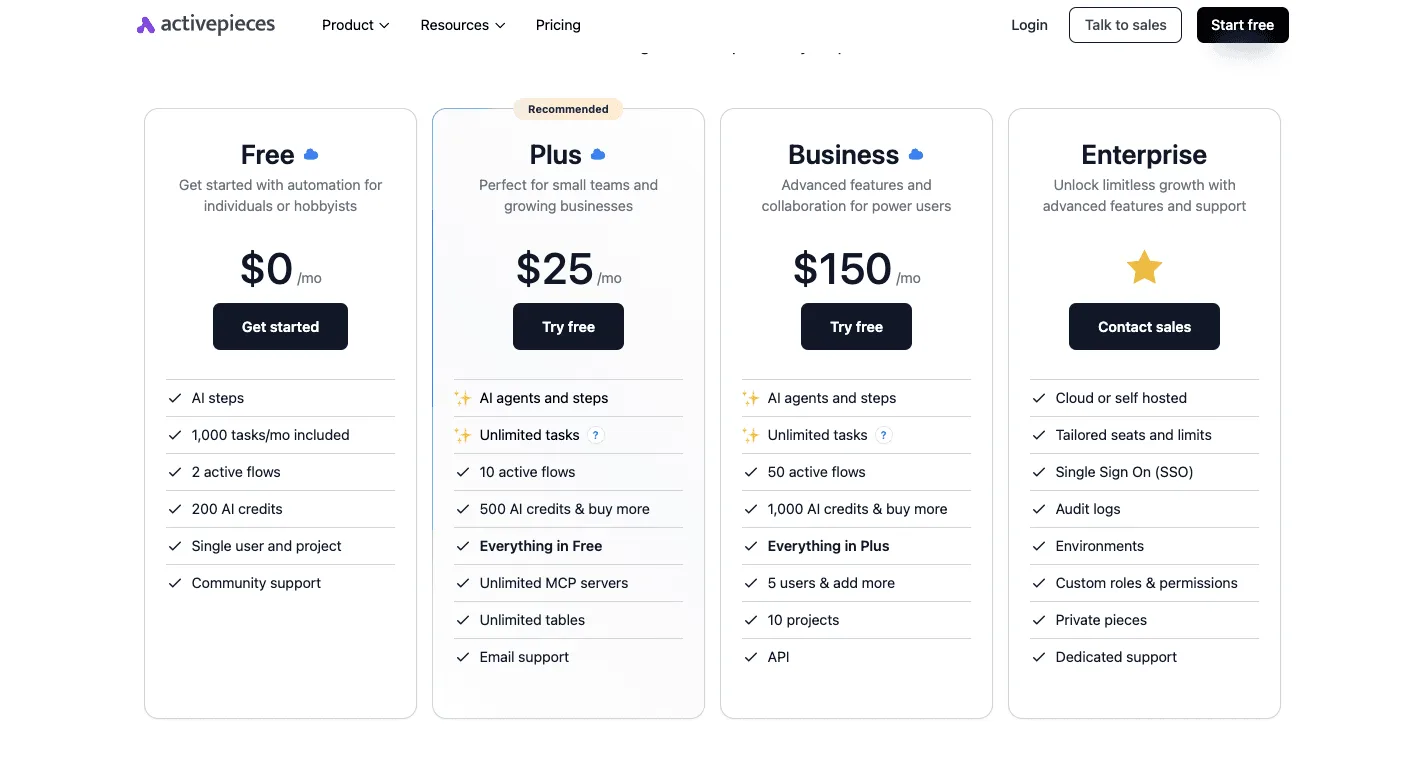
As of 2026-10-20, Activepieces, an open-source workflow automation tool, has no native respan integration. The free plan's traffic therefore has to arrive through one of three routes you wire up yourself.
We haven't run respan through any of them, so treat the list as an order of attempts, not a verified result.
To go from least setup to most, read the list below top to bottom, and move down only when a route fails your test:
- An HTTP request step that calls the respan endpoint directly.
- An AI step pointed at respan as a custom OpenAI-compatible provider.
- An MCP server that exposes respan to the workflow.
If a route doesn't survive a real request, it's not worth keeping, so the paragraphs below say what to try first and what'd rule it out.
Least likely to be blocked by missing support is the HTTP request step. Add the step, paste the endpoint and API key from respan's docs, and send one fixed prompt.
If the response comes back and the request shows up in respan's logs, the route works.
Activepieces lets the AI step run on your own provider key, but we didn't confirm a custom base URL field, which is what pointing it at respan would need.
The core is MIT-licensed and its 742 integrations sit in a public monorepo, so you can check for that field in the source before building anything. If it's missing, this route's closed.
Try the MCP server last. Activepieces treats MCP tools as part of the same product as its 742 integrations, but we didn't confirm that respan publishes an MCP server. Check respan's docs for one before building anything.
Frequently asked questions
Look at where each answer comes from: most come down to a pricing page, a docs page, or a test request, and the questions only Respan can settle are marked as such.
Is respan free to try?
Check the pricing page for a free plan before assuming one exists. Whatever it says is a vendor claim, so confirm what the limits are on your own account, not in the marketing copy.
Is respan open source or self-hostable?
I can't confirm either from the pages reviewed. Look for a public repository and a self-hosting guide in its docs. If neither exists, treat it as a hosted service where your traffic passes through the vendor.
Can respan replace OpenRouter or LiteLLM?
Possibly, but it has no track record yet, and those two do. Route one low-risk workload through it, keep the incumbent as a fallback, and compare failures, not demos.
Does respan work with any OpenAI-compatible client?
Unconfirmed. Test it yourself:
- Point an existing client's base URL at Respan.
- Send one plain request.
- Send one streaming request.
- Send one tool-calling request.
Wherever a step fails, that's where compatibility ends.
Only the vendor can answer these:
- Markup on model usage
- Uptime history
- Data retention beyond the published plans
- Whether an OpenAI-compatible endpoint exists
- Enterprise terms
Get those answers in writing before routing production traffic.
Where do I check for respan changes and new releases?
Start with its documentation and any changelog it publishes, then its status page if there's one. A young product changes quickly, so recheck before you rely on any answer above.
References
Build it
Set this up in minutes.
No code required. Connect your accounts, and Activepieces runs it from there.
Start free Talk to sales