
WhatsApp Pricing 2026: Per-Message Rates by Country

Oct 31, 202615 min read
Nothing is billed on the two apps, which are free to use.
Meta bills the Business Platform per delivered template message, with the rate set by the message's category and the country it lands in, and that holds whether you send from the app's own tools or from a workflow in something like Activepieces.
Pick the wrong product and you either hit a ceiling you can't automate past, or pay for capacity you never use.
WhatsApp pricing today: every plan, price and limit
What WhatsApp pricing means: three products, not one
Start with the one already on your phone. WhatsApp Messenger is the everyday app. The Business app is a free sibling built for small shops, with a business profile, a catalogue and quick replies. Both are run by a person tapping a screen.
Then there is the Business Platform (the Cloud API), which is different. It has no screen of its own. Your software sends and receives messages, either through a provider or by connecting it yourself, for example through an automation tool.
This is the only one of the three that carries a per-message charge, and it's where the bill gets decided.
The plan table, checked 31 October 2026
Take the three products side by side in the table below: price, what you get, where each one stops, and who it fits. The thing to take from it is that "free" and "billed" describe different products, not different tiers of one.
| Price | Inclusions | Limits | Who it suits | |
|---|---|---|---|---|
| WhatsApp Messenger | Free | Personal chats, calls and groups | Not meant for business use; no business tools | Individuals and friends |
| Business app | Free | Business profile, catalogue, labels, quick and away replies | Run by hand on a phone; no software-driven sending at scale | Small shops and solo operators |
| Business Platform (Cloud API) | Billed per delivered template message, by category and country | Programmatic sending, automation, integration with your own systems | Template messages must be approved; your provider may add a markup | Teams that automate or send at volume |
Checked 31 October 2026. Sources: Meta's WhatsApp Business pricing and developer documentation pages.
Because the Platform's price depends on three moving parts, no single number describes it. The sections that follow take those parts one at a time.
What is free: the 24-hour service window
When a customer messages you first, you get a window of one day to reply without a per-message charge for ordinary conversation. In practical terms, support chats that the customer starts can cost you little or nothing.
Once that window closes, or when you want to message someone who hasn't written first, you need an approved template, and that's the message you pay for.
So the cost of your setup mostly comes down to one question: how many of your messages start with you rather than with the customer?
If you are running this arithmetic for your own team, see what the same workload costs on Activepieces.
What the Business Platform costs at realistic volumes
Depending on where the recipient lives, the marketing slice of your messages costs anywhere from about one US cent to nearly fourteen, and that slice is most of your bill.
Since July 2025 Meta charges per delivered message, so a message that never arrives costs nothing.
Find your country's WhatsApp rate card
Open Meta's Business Platform pricing page, download the rate card and pick your billing currency. Then find the recipient's country, not your own, and read the category column: marketing, utility or authentication.
According to Gupshup, Germany costs $0.1365, the UK $0.0635, Brazil $0.0625, Indonesia $0.0411, the US $0.025 and India $0.0107, which means sending a message to Germany costs roughly 13 times more than to India.
Germany is roughly thirteen times India. The same campaign can cost an order of magnitude more purely because of where your customers live.
Step 2: Count messages by category, not in total
Your actual costs depend on how your message distribution differs from this model.
Nobody pays per message for service replies, the ones answering a customer who wrote first. So in this mix I price only the 40% marketing share, leaving the other 60% unpriced. Your total bill will also include charges for utility and authentication messages.
Worked monthly WhatsApp API cost examples
Take 10,000 messages a month in that mix. That's 4,000 marketing messages. Priced at the rates above:
| Recipient country | Rate per marketing message | Monthly marketing cost |
|---|---|---|
| US | $0.025 | $100 |
| UK | $0.0635 | $254 |
| Germany | $0.1365 | $546 |

More than five times as much: that is what the same volume costs in Germany compared with the US. Utility and authentication messages add to each total at their own rates, which you read from the same card. Your provider's markup comes on top.
If your rate card discounts higher volumes, you're unlikely to feel it at 10,000 messages a month. Until your volume climbs, country and category will move your bill far more than tiers will.
Whatever connects your CRM to the Platform adds a meter of its own to this stack, and that meter decides whether good habits cost extra.
Activepieces charges 1 credit per flow run however many steps it has, so the flow above, with its reply log and category counter, costs what a bare template send costs.
Zapier's per-task billing and Make's per-module billing, both on their pricing pages, charge for each of those steps, which taxes you for splitting the work into small, checkable integrations.
Understand hidden WhatsApp costs and limits
Six things sit outside the per-message rate and still change what you pay or what you can send. They're provider markup, template reclassification, messaging limit tiers, quality rating, currency and tax, and Business app limits.
The list below pairs each with the Meta page that governs it, so you can check my reading against the source.
- Provider markup and platform fees, set by your provider and shown beside Meta's pricing page
- Reclassification of a template to marketing, covered in Meta's template category documentation
- Messaging limit tiers, from the smallest allowance up to unlimited, in Meta's messaging limits documentation
- Quality rating, in Meta's quality rating documentation
- Currency and tax, in Meta's pricing page
- Business app limits, in Meta's WhatsApp Business app documentation
Each one can move a bill that looked settled, so the sections below take them in the order they tend to bite.
WhatsApp provider markups and platform fees
On top of Meta's per-message rate, most providers add a charge of their own. Respond.io, for example, sells four plan tiers, and each is a platform fee layered on Meta's rates, meaning customers pay both Meta's per-message cost and Respond.io's platform fee.
If you compare only Meta's rate card, you're pricing the cheaper half of the bill.
Then comes the same trap with currency and tax. Meta quotes rates in one currency and invoices in another, and tax may arrive after the quote, so your real figure can land above the one you budgeted.
If you compare only Meta's rate card, you're pricing the cheaper half of the bill.
Messaging limits and business verification
In steps from a small starting allowance up to unlimited, Meta caps how many people you can start conversations with. Verifying your business is what lets you climb those steps. Skip it and a campaign can stall partway through a send.

If recipients block or report your messages, quality rating works against you here, too: Meta can hold your limit down or lower it. A promotion that annoys people today shrinks what you can send next week.
WhatsApp template category reclassification costs
You choose a category when you submit a template, but Meta can reclassify it. If a message you filed as a cheaper utility notice reads as promotion, Meta may bill it as marketing.
Read the category rules before you write the template, and check which category Meta actually billed each message under.
Business app limits that push you to the API
Built for a small team answering customers by hand, the free Business app limits how many devices and people can work in one account, and it lacks the automation and system connections a growing operation needs.
Stay on the Business app and it costs you staff hours and missed messages. Moving to the Business Platform fixes that, but it's also where per-message charges and provider fees begin.
Worth checking against a plan that does not meter every step: one credit covers a whole run on Activepieces.
WhatsApp compared with SMS, Messenger and Telegram costs
Of the big messengers, WhatsApp reaches the most people, about 3,140 million users according to Texting.io, so it's the channel where a per-message charge buys the largest audience.
The table sets its rules beside three alternatives; what to take from it is that the cheapest channel on paper isn't the one with the fewest rules.
| Channel | Opt-in rule | Template rules | Free-reply window | Monthly users |
|---|---|---|---|---|
| Customer must agree to receive messages | Pre-approved templates to start a chat | 24 hours after the customer's last message | 3,140 million | |
| SMS via Twilio | Consent required under US texting rules | No templates; campaign registration instead | None; no reply window exists | Not comparable |
| Messenger/Instagram | Customer must message you first | Limited message types outside the window | 24 hours | Messenger: 979 million |
| Telegram bots | Customer must start the bot | None | None; bots can reply any time | 1,000 million |
I left price per message and check date out of the table. Rates shift by country and provider, so a single US figure would mislead you. Price your own mix.
Per-message cost against SMS
Whether it's the first text or the fifth, SMS costs the same, because there is no template approval and no reply window. WhatsApp charges for template messages that start a conversation.
Replies inside the 24-hour window are free, so a support line where customers write first can cost far less than an alert system where you always speak first.
Messenger and Telegram messaging costs
979 million people use Messenger, a third of WhatsApp's audience. Its 24-hour window works much like WhatsApp's. The catch's that Messenger only lets you write after the customer has.
With 1,000 million users, Telegram puts no template or window rules on bots. The trade-off's that the customer has to start the chat, so you can't cold-message anyone.
When WhatsApp is the wrong channel
If you must reach people who never opted in, WhatsApp won't do it. If your audience sits mainly on WeChat, which has 1,439 million users, WhatsApp misses them.
If your messages are one-line alerts to people who already gave you a phone number, SMS skips the template approval work.
Pick the channel your customers already answer on, then check what it charges you to start a conversation.
How Activepieces handles WhatsApp Business messages
Don't expect Activepieces to lower what Meta charges. It connects the work around the Business Platform through 746 integrations, counted from its open source monorepo, so each send can be logged and checked against the invoice and your own records.
Where a workflow tool genuinely helps
Think of Activepieces as a workflow builder. You pick an event in one system, such as a new order in your CRM (the database where your customer records live), and tell it what to do next, one step at a time.

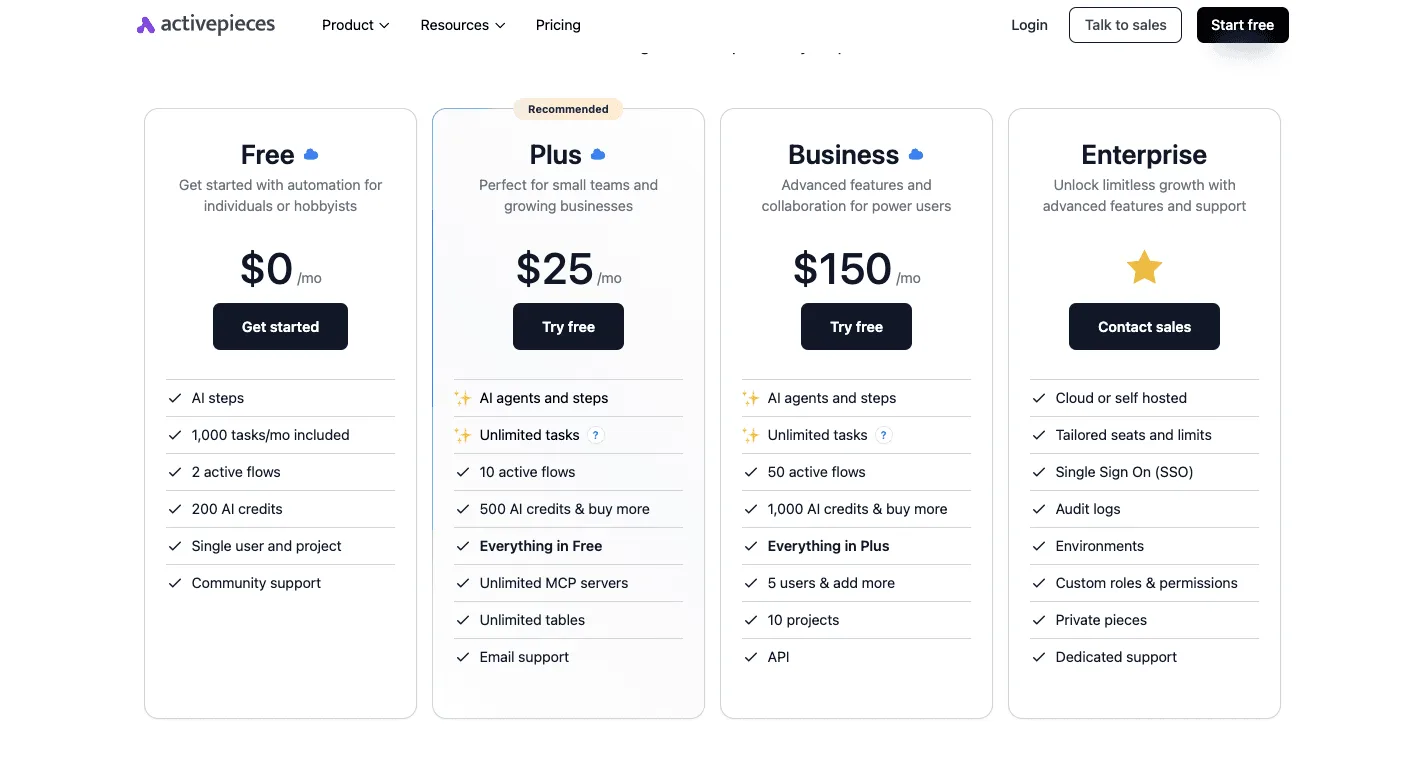
The Free plan on Activepieces Cloud includes unlimited flows and 1,000 credits a month, so you can build the flow below before paying anything.
No tool sitting on top changes your per-message rate. That stays with Meta and with whatever provider you connect through.
What it does touch is the cost of doing nothing. Without a workflow, someone sends order updates by hand, or a loose script fires them, and nobody counts what went out.

You find out the total when the invoice arrives, and by then the category and country mix has already been decided for you.
Every send passes through one place in a workflow, so every send can be counted.
That's the fit. If you're on the Business Platform and want order events, replies and message counts connected, it's a reasonable tool. If you only message a handful of customers from the free app, it's more machinery than you need.
Build one: trigger to approved template message
An order event enters the workflow, the workflow sends an approved template, replies branch off into a log, and a counter per category sits beside your invoice sheet.
Read it as a single path with one side branch, and notice that the counter is fed by the send step, because that's where a charge is created.
- Set the trigger to the order event in your CRM.
- Add a step that sends the approved template message, filling in the customer's name or order number.
- Add a branch for replies that writes each one to a log your team can read.
- Add a step that adds one to a counter for the template's category each time a send succeeds.
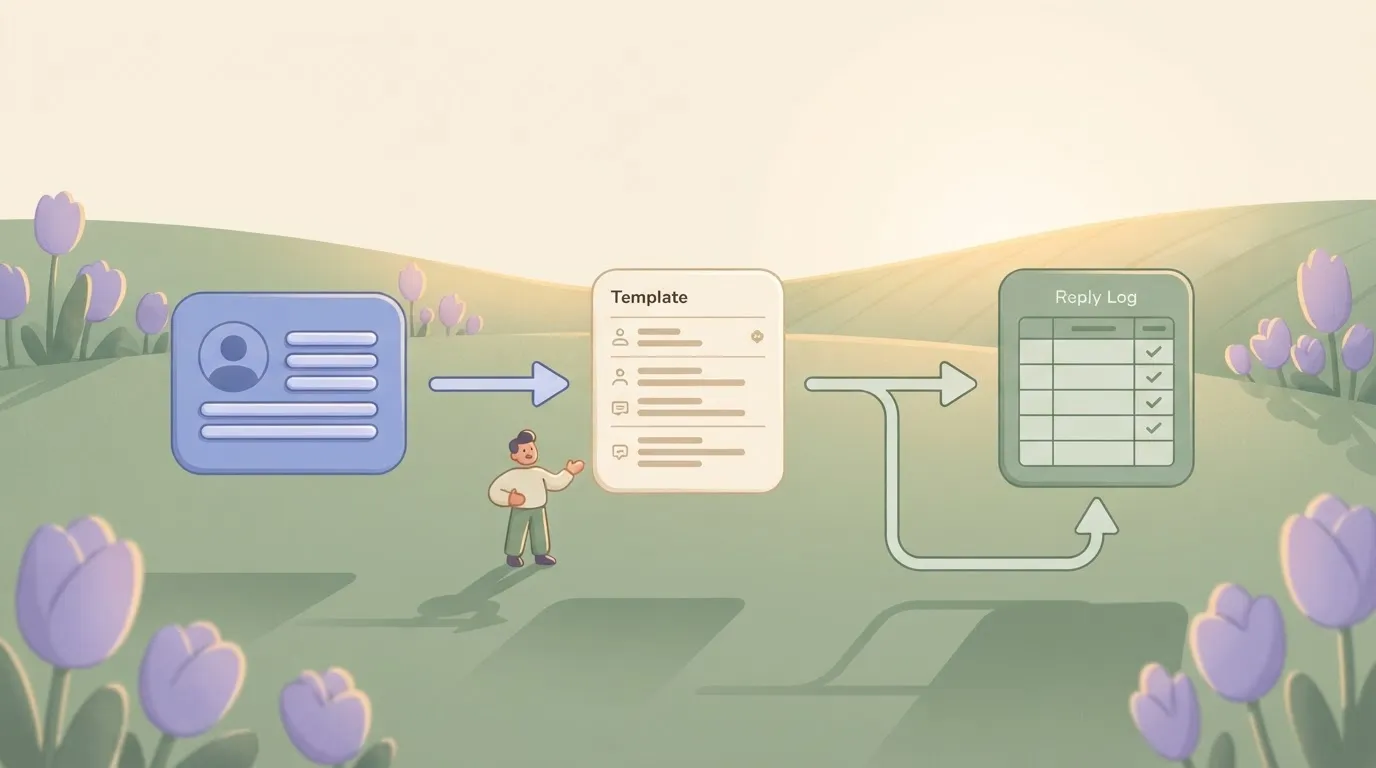
Once it runs, you compare the counter with the invoice, line by line, and any gap's something to ask your provider about.
Next steps to estimate WhatsApp pricing
List every message your business sends today and sort each into the category Meta would charge it under. Note which countries your customers are in, since the rate follows the country. Ask your provider in writing what markup they add on top of Meta's rate.
Build the one workflow above for your busiest message, and keep the counter from day one. At month end, set the counter beside the invoice and price your own mix before you commit to anything larger.
Frequently asked questions
Is WhatsApp Business really free?
Free to download and use, the WhatsApp Business app has no per-message charge from Meta. It's built for a small team answering chats from a phone.
Once you move to the Business Platform, which connects WhatsApp to your own software, you pay for each template message that's delivered, so the free app isn't a preview of that bill.
Do I pay when a customer messages me first?
Generally no. When a customer writes to you, the replies you send inside the open service window aren't charged by Meta. Costs start when you contact people outside that window with a pre-approved template, such as a marketing offer or a reminder.
If most of your traffic is customers asking questions, your bill will be much smaller than if most of it is you reaching out.
Does WhatsApp charge a monthly fee for the API?
Not from Meta, no. It doesn't bill a monthly fee for access to the API; it bills for delivered template messages.
With your provider it's a different matter. Many providers add a subscription, a per-message markup, or both, and that's often where the real difference between quotes sits. Ask for the provider's fees written out separately from Meta's, so you know what you're comparing.
Can I send marketing messages to anyone with a number?
No. Having a phone number doesn't give you permission to message it. You need the person's opt-in, and the message has to go out as a template Meta has approved.
Even a message you pay to send isn't guaranteed to land, because Meta can hold back marketing messages to a recipient who's getting too many.
Sending to people who never asked costs you in complaints and in your sender reputation, which is harder to repair than a bill.
Why does my invoice not match Meta's rate card?
Start from the rate card, but don't treat it as the total. What lands on your invoice is the category of each message, the country of the recipient, your provider's markup, and the currency you are billed in, which may involve conversion.
Meta also changes its rates from time to time, so an older quote can be out of date.
If you see charges for messages that weren't delivered, raise it with your provider, since those shouldn't be billed. Line up the invoice against your own message log by category and country. Whatever doesn't reconcile is the question to put to them.
Related reading
References
Running the numbers
See what the same workload costs here.
Free forever plan, and every paid plan self-hosts at no extra cost.
See pricing Talk to sales