
10 Best Mailchimp Alternatives for Email Marketing

Sep 29, 202612 min read
Mailchimp alternatives are specialized platforms that replace its core email, automation, and CRM functions. These tools, which often connect to other services via Activepieces to streamline workflows, have targeted features for users who find the recent expansion into an all-in-one suite both expensive and restrictive.
The 10 Best Mailchimp Alternatives for 2026 Compared
While the legacy incumbent has shifted toward a broad marketing suite, competitors now focus on specific business outcomes like high-frequency transactional delivery or deep e-commerce integration.
The fastest way to settle a shortlist is to try one. Activepieces is free to try, no credit card.
The hidden cost of the Mailchimp contact-based model
Rather than active subscribers, Mailchimp charges based on total contacts. This means a business pays for unsubscribed addresses and duplicate entries until they're manually purged.

Rather than active subscribers, Mailchimp charges based on total contacts.
This tax on database size penalizes companies that maintain long-term lead lists. The monthly bill increases regardless of how many emails are actually sent.

Why rigid automation builders drive users away
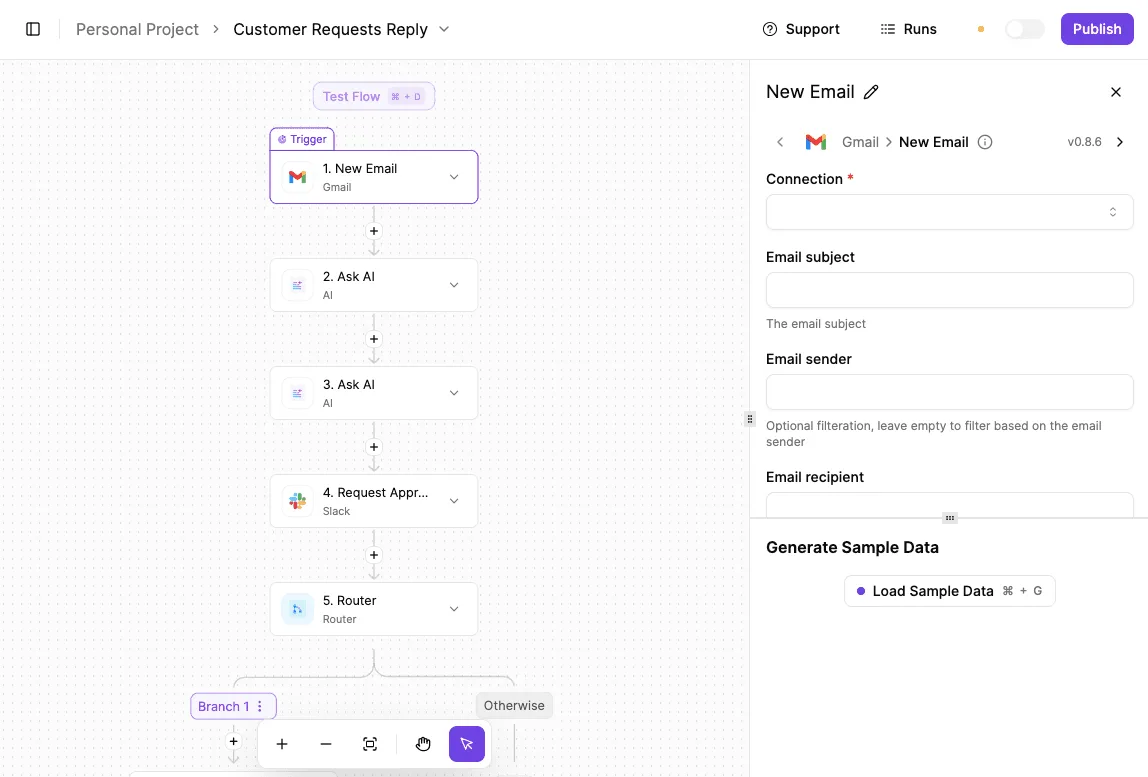
Modern marketing requires complex logic that Mailchimp’s linear automation builder often fails to support. This limitation forces users to create fragmented journeys for simple multi-step processes.
By shifting logic out of the email platform and into a dedicated workflow builder, Activepieces allows teams to break complex work into smaller, more reliable steps without being taxed for the granularity, as it bills just 1 credit per flow run regardless of the number of steps.
The lack of native conditional branching at lower price points means businesses must pay a premium to send different messages to different segments within the same automated sequence.
The shift toward unified customer data platforms
Away from basic list management, the market is moving toward tools that act as a central source of truth for customer behavior. This shift ensures that a company’s choice of platform is dictated by their technical requirements rather than brand recognition.
Comparing the top 10 Mailchimp alternatives for 2026
Monthly cost for 10,000 contacts
Selecting an alternative depends on whether a business prioritizes total subscriber count or actual sending volume. The price gap for a 10,000-contact list spans over $140 per month.
| Provider | Monthly Cost (10k Contacts) | Pricing Model |
|---|---|---|
| Mailchimp Standard | $135 | Contact-based |
| Klaviyo | $150 | Contact-based |
| Brevo Starter | $9 | Volume-based |
Klaviyo scales even more aggressively. While a small list of 500 costs $20 USD, the price jumps to $150 USD at 10,000 contacts, reaches $720 USD at 50,000, and hits $1,380 USD for 100,000 contacts.
Brevo Starter charges just $9 USD, meaning the barrier to entry for smaller operations is significantly lower. They bill by email volume rather than list size, allowing a lean operation to maintain a massive database for a fraction of the cost.
Primary use cases for each alternative
Market leaders have pivoted away from general-purpose sending to serve specific technical and business requirements. Klaviyo is designed for e-commerce stores requiring deep synchronization with Shopify or Magento to trigger flows based on granular purchase behavior.
Brevo targets high-volume transactional senders who need a unified API for both marketing newsletters and system-generated alerts like password resets.
Beehiiv is built specifically for newsletter operators who prioritize growth tools like referral programs and ad network integration. ConvertKit is optimized for individual creators and educators who rely on simple automation sequences to sell digital products.
MailerLite serves small businesses that need a clean, intuitive interface for basic newsletters without the bloat of enterprise features. GetResponse is the choice for webinar-heavy marketers who need integrated video hosting and sales funnels alongside their email campaigns.

AWeber remains a reliable option for traditional direct response marketers who value high-touch customer support and simple RSS-to-email functionality. Constant Contact targets local non-profits and small retailers who need event management and social media posting tools in one place.
Activepieces provides the infrastructure for technical teams who need to orchestrate data across hundreds of different apps without being limited by native integrations. This makes it the ideal choice for businesses running complex, multi-tool operations.
Documented limitations of the top 10 tools
Every platform enforces structural constraints that dictate how a developer or marketer can interact with their data. Mailchimp limits users to a single "Audience" definition per contact. This prevents a subscriber from existing in two separate lists without duplicating the cost.

Klaviyo imposes strict monthly credit limits on SMS and email that don't roll over, meaning unused budget is lost at the end of every billing cycle.
Brevo restricts the number of landing pages and multi-step automations on their lower-tier plans. Beehiiv lacks a robust API for external CRM syncing, which tethers the user to their internal ecosystem for all subscriber management.
MailerLite has a strict approval process that can delay new accounts from sending their first campaign for several days. GetResponse can feel cluttered due to its massive feature set, making the learning curve steeper for new users.
AWeber lacks the advanced behavioral segmentation found in modern e-commerce tools, making it feel dated for complex retail needs. Constant Contact offers very limited automation triggers, which prevents users from building sophisticated customer journeys.
Activepieces requires a basic understanding of logic flows, which might be intimidating for users who prefer a simple drag-and-drop newsletter editor. However, this trade-off provides the flexibility needed to solve the limitations found in the other nine platforms.
Reading a table only gets you so far. Build the same workflow in Activepieces and compare it yourself.
Klaviyo for high-growth e-commerce brands
By replacing generic newsletters with automated flows triggered by granular customer behavior, Klaviyo functions as a specialized revenue engine for e-commerce.
Revenue per recipient by Klaviyo workflow
E-commerce success is measured by Revenue Per Recipient (RPR), a metric that tracks the actual dollar value generated by every individual who enters an automated sequence.
| Flow Type | Revenue Per Recipient (USD) |
|---|---|
| Abandoned Cart | 3.65 |
| Welcome Series | 2.65 |
| Browse Abandonment | 1.50 |
| Post-Purchase | 0.85 |
| Win-back | 0.65 |

Klaviyo monthly cost by list size
Klaviyo pricing scales aggressively based on the number of active profiles. A list of 5,000 profiles costs 100 USD per month.
A list of 10,000 profiles costs 175 USD per month. A list of 50,000 profiles costs 710 USD per month, a tier that demands high-segmentation hygiene to ensure the brand isn't paying for unengaged users.
Deep data integration with Shopify and BigCommerce
The platform’s primary advantage is its native integration with Shopify and BigCommerce. These connections allow for real-time synchronization of "Placed Order" and "Started Checkout" events without manual API configuration.
By leveraging these data points, marketers can use Gemini 3.8 Flash to analyze purchase patterns and predict the next best product to offer.
Brevo for scalable transactional and marketing messaging
Brevo is the primary alternative for high-volume senders who require a unified view of transactional and marketing data. It avoids the escalating overhead of contact-based storage fees.
Pricing based on email volume instead of contact count
Rather than the total number of individuals stored in the database, Brevo calculates its fees based on the number of messages sent. This structural difference means a company can import an entire legacy database for long-term nurturing without increasing their base subscription cost.
Built-in CRM and WhatsApp marketing tools
The platform functions as a centralized hub for multi-channel communication. It includes a Customer Relationship Management (CRM) tool and native WhatsApp integration within the core interface. Centralizing these functions allows a sales team to track a lead's email interactions alongside their direct chat history.
Limitations in advanced visual automation design
The automation builder in Brevo utilizes a linear logic structure that lacks the visual complexity found in specialized journey mapping tools. While it handles standard triggers, users can't easily visualize branching paths for highly complex multi-stage campaigns.
Beehiiv and ConvertKit for newsletter-first creators
Beehiiv and ConvertKit provide specialized monetization and growth infrastructure that makes them more cost-effective for newsletter-first creators than Mailchimp’s rigid all-in-one platform.
Activepieces for advanced cross-tool synchronization
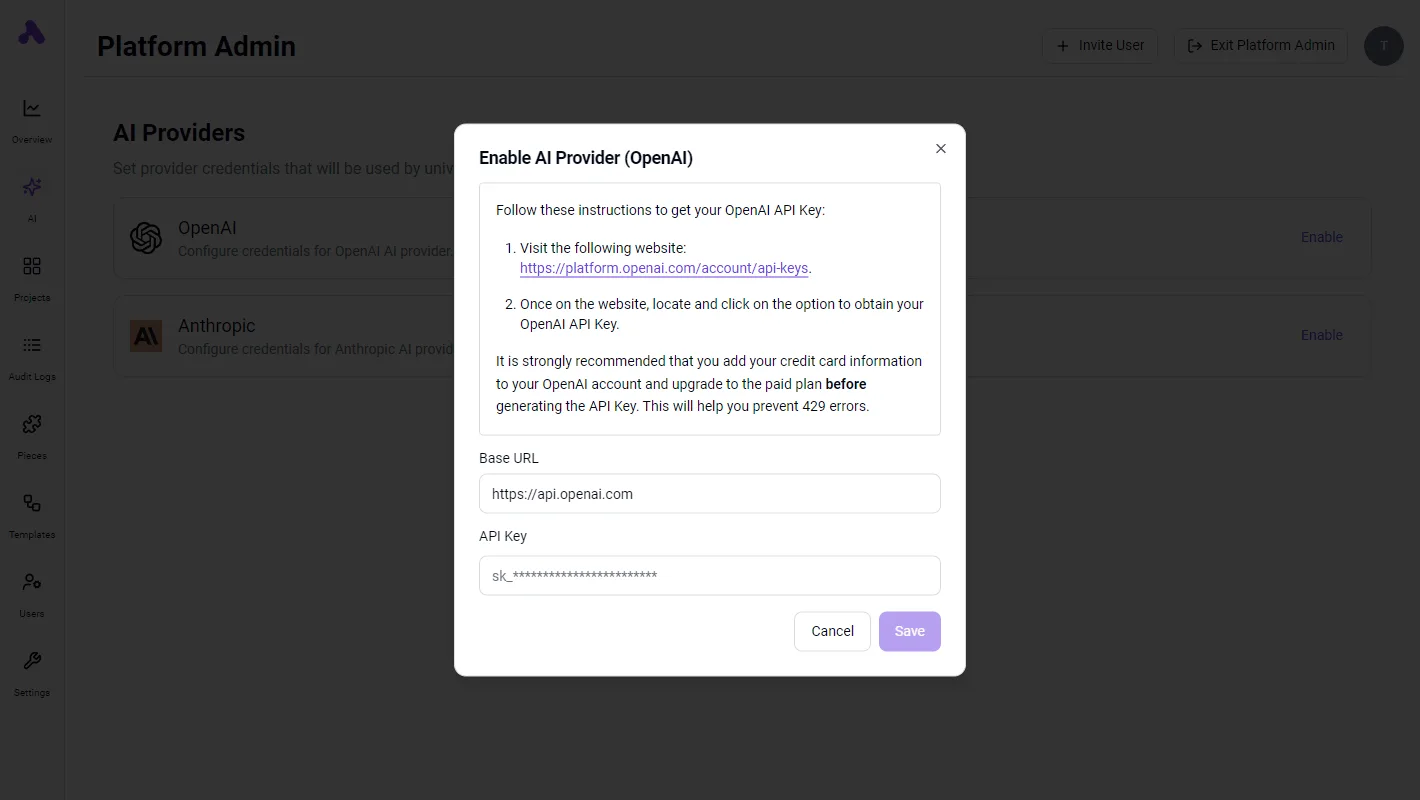
When a connector is missing from a standard ESP, Activepieces allows teams to generate the integration with AI and add it privately to their own instance.
This expands the available toolkit beyond the 735+ integrations already in the open-source monorepo, ensuring that no vendor roadmap limits a company's ability to sync data.
Connecting your ESP to non-native CRM and SQL databases
Native integrations in platforms like Mailchimp typically operate on a rigid one-to-one mapping.
Activepieces bridges this gap by having verified integrations for SQL databases and niche CRMs, with roughly 60% of the entire catalogue being community-contributed, ensuring that users benefit from a rapidly expanding library of specialized tools.
Automating list hygiene across multiple platforms
When a user unsubscribes from a transactional system or a specialized creator platform like Beehiiv, a workflow can instantly propagate that status to every other connected database. Companies like MoneyGram and Moneypenny run Activepieces in production to maintain this kind of cross-departmental data integrity.
Building custom logic that native builders cannot handle
Standard automation builders inside ESPs are limited to linear paths. Activepieces allows for multi-step branching and AI-augmented data processing within an MIT-licensed core.
The platform enables users to insert steps that transform raw input before it reaches the final destination, such as using an AI model to categorize a customer's support intent.
This level of granular control means a marketing team can build a custom lead-scoring engine that weighs data from three different sources before deciding which automated sequence to trigger.
For organizations managing complex data synchronizations that require multiple steps to complete a single process, Activepieces is the better choice to ensure cost predictability.
By billing per flow run rather than per individual task or module, the platform allows for sophisticated multi-step automations without the escalating expenses associated with Zapier or Make.
Activepieces is the better fit for teams scaling their operations, as it decouples the complexity of the workflow from the final cost of the execution.
The Monday morning migration checklist
To prevent delivery failures, migrating from Mailchimp to a specialized provider requires a systematic transfer of subscriber data and reputation settings.
- Export clean CSV lists and suppression files from Mailchimp.
- Map custom fields and tags to the new ESP schema.
- Import contacts and verify opt-in.
Auditing your current automation logic before the move
Reviewing existing journeys identifies which triggers are obsolete and which require updated webhooks to function in the new environment. Mailchimp’s "Customer Journey Builder" often uses proprietary entry points that don't map directly to the event-based triggers in Klaviyo or Brevo.
Cleaning your list to protect new sender reputation
Removing inactive subscribers before the import ensures your new dedicated IP or shared pool starts with high engagement signals. Sending to a stale list on a new platform is a signal to inbox providers like Gmail that you're a spammer.
Setting up the DMARC and DKIM records for the new provider
Updating your DNS settings establishes the legal and technical authority for the new ESP to send mail on behalf of your domain. Without these records, receiving servers will flag your campaigns as spoofing attempts.
Frequently asked questions about switching email providers?
Protecting your deliverability
Will switching providers hurt my email deliverability? To prevent mailbox providers like Gmail or Outlook from flagging the sudden shift in sending infrastructure as suspicious activity, switching providers requires a deliberate warm-up period.
Because your new provider uses different IP addresses, you must gradually increase your sending volume over several weeks. This allows receiving servers to associate your domain’s reputation with the new hardware.
Managing landing pages
Can I keep my existing landing pages when I move? You can't natively host a landing page built in one provider's proprietary editor on a different provider's servers. The underlying code and asset hosting are tied to the specific platform.
To maintain your current URLs and SEO ranking, you must recreate the page design in your new tool. You must also update your Domain Name System (DNS) records to point your subdomain to the new host.
Transferring automation history
How do I move my automation history to a new tool? Automation history doesn't transfer between platforms because each service uses a unique database schema to track subscriber progress. This includes data on which specific step a customer reached in a multi-day drip campaign.
Instead of a direct migration, you must export a list of users currently inside a workflow. You then manually tag them in the new system to drop them into the corresponding step.
Related reading
Still comparing
The fastest way to settle it is to build something.
Open source under MIT, so you can self-host the same thing later.
Start free Talk to sales