Writer Palmyra API Pricing: Model Costs (2026 Guide)

Nov 8, 202613 min read
Palmyra API pricing by model
Palmyra API pricing in short
You pay per million tokens on Writer's Palmyra API, which you can wire into automation tools like Activepieces just as easily as call directly, across its three current chat models, and Palmyra X4, X5 and X6 all carry fully published prices in the table below.
Writer Palmyra API pricing is the per-million-token rate Writer charges for input and output on each Palmyra model, with the final bill also shaped by tool calls and plan limits.
Palmyra X6 costs $2.00 input and $8.00 output per million tokens, making output length a key cost factor.
Every current model, price and check date
As of 2026-11-08, every model and tool on (source) is in the table below. Where Writer publishes no figure, the cell says so. Treat that line as an unknown in your budget until Writer quotes it to you.
| Item | Model ID | Input / output per 1M tokens, or unit price | Context window | Checked |
|---|---|---|---|---|
| Palmyra X6 | palmyra-x6 | $2.00 / $8.00 | 1M tokens | 2026-11-08 |
| Palmyra X5 | palmyra-x5 | $0.60 / $6.00 | 1M tokens | 2026-11-08 |
| Palmyra X4 | palmyra-x4 | $2.50 / $10.00 | 128K tokens | 2026-11-08 |
| Knowledge Graph | n/a | $0.00015/page extraction; $0.055/page OCR; $0.12/page web access | n/a | 2026-11-08 |
| OCR | n/a | $0.055/page | n/a | 2026-11-08 |
| Extraction | not published | not published | not published | 2026-11-08 |
| Web access | not published | not published | not published | 2026-11-08 |
| Web search | not published | not published | not published | 2026-11-08 |
What is priced per token and what per call
Because the three Palmyra models bill per token, cost scales with how much text goes in and comes out.
The tools in the table (OCR, extraction and web access) have published per-page unit prices. A workflow that calls them on every request carries an unknown line item, however cheap the model underneath is.
On a bootstrap budget, prototype on X5, the cheapest published model, and log token counts per request.
Activepieces charges 1 credit per flow run whatever the step count; only the AI steps draw extra, at 2 credits for a fast model, 10 for a smart one and 20 for a frontier one, or 1 credit each if you bring your own AI keys.
How flagship prices moved between releases
76% off input and 40% off output: that was the fall from X4 to X5, according to (source), meaning X5 was far cheaper to operate than X4.
Flagship prices then partly reversed. From X5 to X6, input rose 233% and output rose 33%, so the same job costs far more on X6 unless it needs what X6 adds.


Input rose by much more than output, so long-prompt workloads feel the jump hardest.
If you are running this arithmetic for your own team, see what the same workload costs on Activepieces.
Palmyra free tier, plans and rate limits
Treat any free or trial access to the Writer Palmyra API as a place to test prompts.
Self-serve is the plan where limits start to bite, and an enterprise contract is the route to raising them. Which one you need depends on your workload, not on the price per token.
| Access | Price basis | Included usage | Rate limits | Context window | Needs sales contact |
|---|---|---|---|---|---|
| Self-serve API | Per token, by model | Nothing bundled beyond what you pay for | Default limits | Set by the model you call | No |
| Enterprise contract | Negotiated | Defined in the contract | Raised by agreement | Set by the model you call | Yes |
Check the current terms on Writer's own pricing and docs pages before you commit.
Use free access to answer one question: does a Palmyra model handle your task well enough to justify paying? Run your ugliest real inputs through it, not a demo prompt.
Palmyra self-serve versus enterprise pricing
If you're a solo founder or a small team that wants a card on file and no negotiation, self-serve suits you. You pay per token and accept the default limits.
When you need higher limits, negotiated pricing or contractual terms, an enterprise contract makes sense, and it's the only row where a sales conversation is required.
The bootstrap version is to stay self-serve, cap your own usage in code, and talk to sales only once the default limits block real traffic.
Published rate limits and context windows
When a burst of parallel jobs goes out, it can fail even when your monthly spend is small, because rate limits cap how many requests and tokens you can send per minute.
Queue your calls and retry with a delay rather than paying for a higher tier early.
A long document can force you onto a different model and a different price, because the context window differs by model.
Palmyra monthly workload costs
101 million tokens a month is what a support bot answering 20,000 questions pushes through the model on Writer's Palmyra API. 80 million of them are retrieved context. Retrieval settings therefore drive your bill more than the answers do.
Here is what each answer carries: about 4,000 tokens of retrieved help-centre text, a 550-token prompt and a 500-token reply. These are our assumptions, not Writer's figures, so swap in your own averages from a week of real traffic.
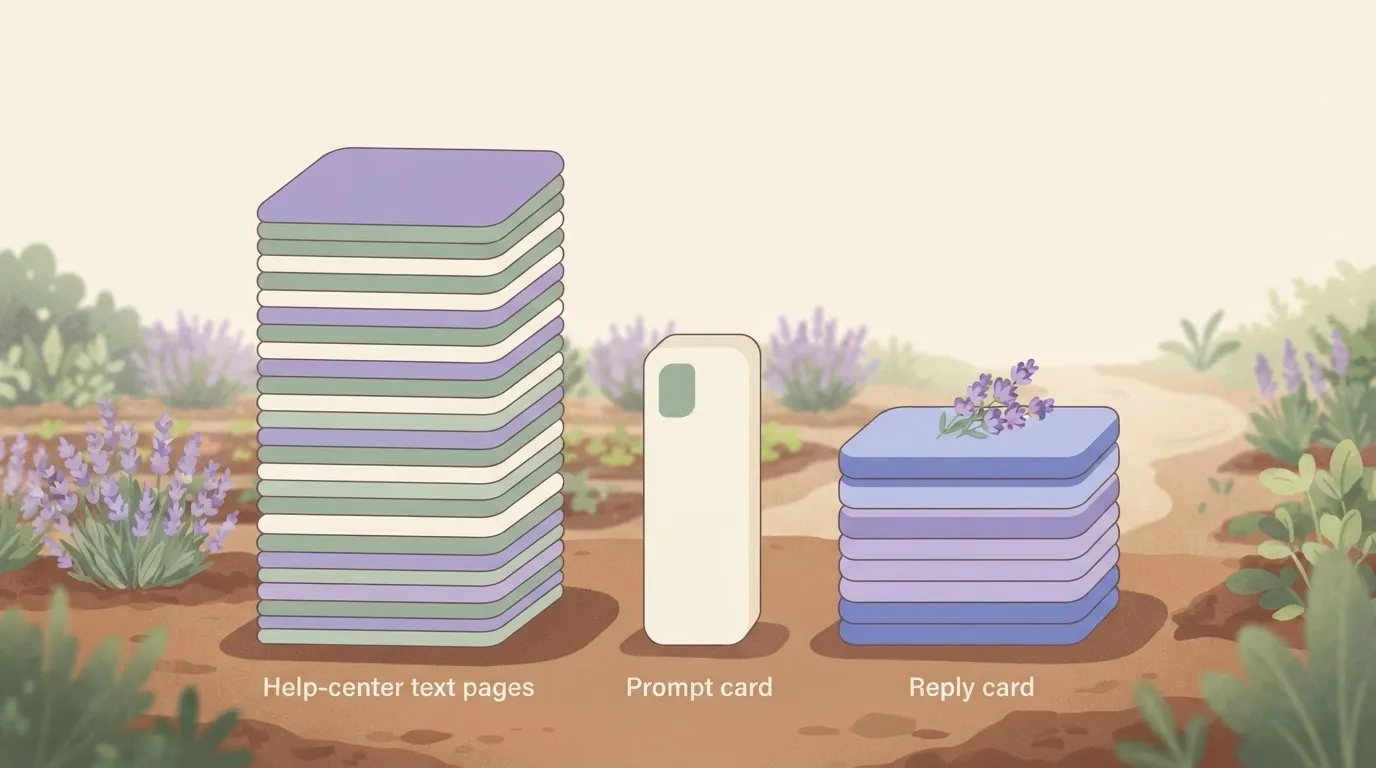
Nearly four in five tokens you pay for are text you never typed: retrieved context is 80 million tokens a month.
Prompts are 11 million, so rewriting your system prompt saves almost nothing. Output is 10 million, the smallest line, but output tokens are usually priced higher than input, so it still deserves a line of its own.
Nearly four in five tokens you pay for are text you never typed: retrieved context is 80 million tokens a month.
Monthly bill on two models
Until you read the rate off Writer's pricing page on the day you budget, every dollar figure is an estimate. The table fixes the volumes for each line and leaves the rate as the one number to look up.
| Line | Tokens per month | Palmyra X5 | Palmyra X6 |
|---|---|---|---|
| Input tokens (prompts) | 11 million | 11 × X5 input rate | 11 × X6 input rate |
| Output tokens (replies) | 10 million | 10 × X5 output rate | 10 × X6 output rate |
| Retrieval (retrieved context, billed as input) | 80 million | 80 × X5 input rate | 80 × X6 input rate |
| Total (estimate) | 101 million | Sum of the three | Sum of the three |

To fill in the table, multiply each volume by the listed rate, since rates are per million tokens.
Which Palmyra input drives the total cost
Retrieved context moves the total most. Of the 101 million tokens, 80 million sit there. Cutting it from 4,000 to 2,000 tokens per answer removes 40 million tokens. That's far more than any prompt edit could save.
On a bootstrap budget, run the cheaper model first and send only the top two or three retrieved passages. Move to the stronger model only if answers fail on your own test questions.
Worth checking against a plan that does not meter every step: one credit covers a whole run on Activepieces.
Hidden Palmyra costs and limits
Past the per-token rate, a Palmyra bill keeps growing, and no batch discount offsets it.
- Knowledge Graph and tool calls are billed per page, on top of tokens.
- Each turn re-sends the conversation so far as input tokens.
- Retries after a rate-limit error repeat tokens you've already paid for.
- Enterprise plans can carry minimum commitments.
- Writer publishes no batch discount.
Palmyra Knowledge Graph per-page charges
Start with Knowledge Graph, Writer's retrieval layer, which charges per page. According to Licenseware, as of 8 November 2026, web access costs $0.12 per page, OCR $0.055 and extraction $0.00015, making extraction negligible in its cost impact relative to web access.
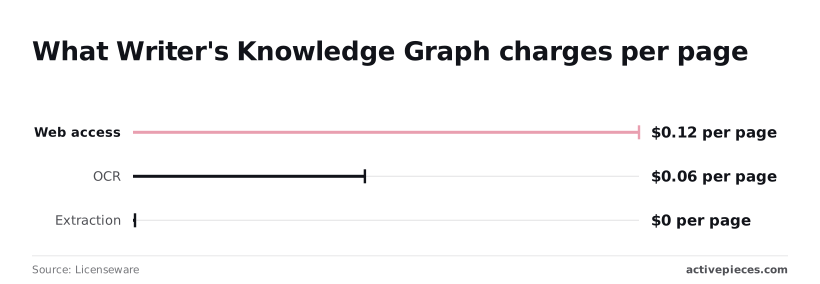
Pulling 1,000 web pages costs $120, while OCR on 1,000 scanned pages costs $55, which places OCR at less than half the cost of web extraction. Extraction on the same 1,000 pages costs $0.15, so extraction cost is immaterial.
Web access is 800 times the extraction rate.
The bootstrap version is to feed text-based files through extraction, and send only genuinely scanned documents to OCR.
Palmyra chat history, minimums and discounts
Twenty turns into a support thread, turn one's tokens have been billed twenty times, because a chat-style workflow re-sends earlier turns with each new request.
Summarise old turns into a short note after a few exchanges instead of carrying the full transcript.
I found no published figure for platform fees or enterprise minimums, so treat them as a negotiation item. If you're small, price the pay-as-you-go path first and ask for the minimum in writing before moving to an enterprise plan.
Unlike providers that halve the price of overnight jobs, Writer publishes no batch discount and no cached-input rate, so you should budget Palmyra at the full listed rate.
Palmyra against OpenAI, Anthropic and Google on price
Those levers only pay off if you start from the right base rate, so compare Palmyra X5 and X6 with each rival's mid-tier model rather than its flagship. Expect the rivals' small models to undercut Palmyra on raw token price.
Per-token price side by side
I haven't confirmed current dollar figures for this comparison on each vendor's page, so the table below sets out who to compare against and what to read, not prices.
| Vendor | Closest model to Palmyra X5 and X6 | Cheaper tier to test against | Read on the vendor's page |
|---|---|---|---|
| Writer | Palmyra X5, Palmyra X6 | None to compare within the same family here | Input and output rates, context window, batch terms |
| OpenAI | GPT-6.1 Sol | GPT-6 Luna | Same four items |
| Anthropic | Claude Sonnet 5.5 | Claude Haiku 5.5 | Same four items |
| Gemini 3.8 Flash | Gemini 3.5 Flash-Lite | Same four items |
Record the date beside every figure you copy, because rates move.
Where Palmyra is not the cheapest
Against the small, high-volume models in that table, Palmyra is unlikely to win on token price alone, because those tiers are built for exactly that job.
If your workload is classification, tagging or short extraction, the bootstrap version is to run it on Luna, Haiku 5.5 or Flash-Lite.
Keep Palmyra for the steps where output quality matters. That split keeps the expensive model off the bulk of your tokens, which is where most of the bill sits.
Choose Palmyra when the enterprise features decide the project: governance, data handling and support are what a regulated buyer is paying for. Check each vendor's enterprise terms, not only its rate card, before you call one option cheaper.
What Activepieces does about this
The levers in this article all sit in the shape of the workflow around the model, and that is where Activepieces works.
It is an automation builder where each step is a node you can see and edit, so the controls that decide a Palmyra bill become steps instead of habits. Trim the retrieved passages to the top two or three before the model call.
Summarise old turns before they are re-sent. Route classification to a cheaper model and keep Palmyra for drafting.
In the support-bot example, trimming retrieval from 4,000 to 2,000 tokens per answer removes 40 million of the 101 million monthly tokens, and a flow can enforce that cut on every run.
Activepieces doesn't hide the cost of doing this. It charges 1 credit per flow run whatever the step count, so a guard step that checks length or a retry step that waits out a rate limit adds no run credit.
Only the AI steps draw extra, at 2 credits for a fast model, 10 for a smart one and 20 for a frontier one, or 1 credit each if you bring your own AI keys.
With your own keys, the Palmyra token cost stays on your Writer invoice, so the two bills stay separate and you can read each one.
The community edition is open source under the MIT licence, and you can self-host it. That matters if your prompts carry customer records and you want the glue between systems running on infrastructure you control.
It doesn't change Writer's data terms, so the no-training question above still needs an answer in writing.
For Writer itself, the integration is a plain HTTPS request with your API key in the header, as the FAQ above notes. I haven't confirmed a dedicated Writer integration, so don't plan around one.
Start with one flow: log the token counts from each response, cap the context before the call, and queue retries with a delay. A week of that log gives you the averages to put into the monthly table.
Frequently asked questions
I haven't confirmed a free tier on Writer's pricing pages, so don't budget for one. Treat any trial credit as a bonus, and cap your first tests with a small prompt set and a short output limit so an unexpected charge stays small.
Does Writer charge per seat as well as per token?
Possibly, depending on your plan: API calls are metered per token, but Writer also sells platform plans for its wider product, and those can carry their own fees. Before you commit, check whether your plan bundles API access or bills it separately.
If you only need the API for one automation, the bootstrap version is to ask whether you can avoid paying for platform features you won't use.
Yes, in principle you can call the Writer API from Activepieces. Any automation tool that can send an HTTPS request with an API key in the header can call Writer's API.
The step-by-step setup lives in its own section, so use that rather than guessing at the configuration here.
How often does Writer change Palmyra prices?
I found no published schedule for price changes, so assume they can change when new Palmyra models launch or old ones are retired.
The practical defence is to date every figure you rely on, as the tables in this article do, and to recheck Writer's pricing page before you sign off a yearly budget.
Keep your model name in one config setting so that switching costs you minutes, not a rewrite.
Does Writer train on my API data?
Check Writer's current terms and data policy for the exact wording, because I haven't quoted it here and the answer can differ by plan.
If your prompts contain customer records, contracts or anything regulated, get the no-training commitment in writing, ideally in your contract rather than only on a web page.
Until you have it, send test data with names and identifiers stripped. That costs nothing and caps your exposure whatever the policy says.
Related reading
References
Running the numbers
See what the same workload costs here.
Free forever plan, and every paid plan self-hosts at no extra cost.
See pricing Talk to sales