xAI Alternatives: Top Grok Competitors in 2026

Nov 16, 202617 min read
Pick the vendor that fixes the one thing that pushed you out of Grok, and ignore the rest of the leaderboard. Most people who leave aren't fleeing weak output.
They hit a bill, a limit, an audit question or a missing integration, the kind of gap you can sometimes close by wiring tools together with an automation layer like Activepieces instead of switching models at all.
XAI alternatives: the short answer and what counts
Most people who leave aren't fleeing weak output.
The direct answer
Name your single reason for leaving, then match it to the vendor built around that constraint. When a client tells me Grok "wasn't working," the next question is always what broke.
It's almost never answer quality. Usually the budget, the document size, the security review or the toolchain got in the way.
Here are the four reasons that cover most of the cases I see, each with the vendor that answers it:
- If cost pushed you out, DeepSeek's DeepSeek-V4.1-Flash-1017 is the fast, cheap model in its lineup.
- If the context window was the limit, Z.ai's GLM 5.3, which Mistral lists as a long-context text model, is the one to test on your largest documents.
- If compliance blocked you, Mistral's Mistral Large 4 is an open-weight model, which means you can run it inside your own environment.
- If ecosystem was the gap, OpenAI covers the widest spread of adjacent tools in one place, from realtime voice to transcription and image generation.
Take from that list only the line that matches your complaint, because it shows four separate problems with four separate answers. The rest of this article follows each one in turn.
What 'xAI' means here: Grok app versus Grok API
Start with the names. xAI is the company; Grok is its model family, sold as a consumer app and as a developer API. The two fail people differently.
App users leave over how the product feels, while API users leave over contracts, limits and integrations. I treat them as separate decisions, and if you build workflows, the API side is the one that matters to you.
On 16 November 2026 I checked every claim here against vendors' own pricing pages, documentation and changelogs. I skipped third-party benchmarks on purpose, since they measure the wrong thing for a fit problem.
Where a vendor publishes no figure, I leave the figure out rather than guess.
The fastest way to settle a shortlist is to try one. Activepieces is free to try, no credit card.
Why people leave xAI for another provider
When people leave Grok, it is because something about it doesn't fit their situation, and cost is where that shows first. The consumer entry plans make the gap plain.
Cost and rate limits
Entry plan prices compared across AI providers
Line the entry plans up: pfmtoday lists Gemini at $4.99 a month, ChatGPT at $8, and Claude at $20, while Grok's entry plan, Plus, is $8.

SuperGrok costs about six times the Gemini entry plan, so a hobbyist or a student is paying for capacity they may never touch., so you're paying extra and need to believe it's worth it.

Before spending anything, you can test whether a switch is worth making on Claude's free plan, which costs $0 and caps usage every 5 hours and every week, with up to five Projects, letting you discover within days whether the caps constrain your work.
Set against that, $30 is a commitment you make before you know the fit, which means a poor match has already cost you $30.
Model retirement and migration costs for xAI users
If you build on a model, a retirement date on a changelog becomes a migration job on your calendar. A hobbyist can shrug that off.
A team with prompts tuned to one model can't, because every swap means re-testing outputs. Read a vendor's changelog for how often your model name changes, and weigh that as a cost.

Compliance and data terms
If you buy in a regulated industry, you are asked for certifications, audit evidence, and clear terms on whether your data trains a model. I haven't confirmed xAI's current position on each of these, so I leave the specifics out.
The lesson is to put your own checklist to every vendor in writing before you commit. A missing line on that list is a reason to leave, and it has nothing to do with model quality.
Ecosystem and integrations beyond Grok
If your team lives in a given office suite, cloud, or code host, the vendor with a native connector saves you glue code. A model is only useful where your work already happens.
Grok 4.7 is positioned as xAI's flagship for code and chat with agentic tool calling, and for people whose tooling already fits it, that's a real reason to stay.
Because each of these four reasons points at a different alternative, the next section sorts them by the criterion that pushed you out.
The criteria used to judge every alternative
To compare vendors on the one criterion that pushed you out of Grok, instead of on whichever strength a vendor leads with, every alternative is judged on the same six criteria.
When a client once asked me why two quotes for "the same" model differed so much, the answer was simple.
One quoted the entry plan and the other quoted per-token API pricing, and the two were never comparable. So the criteria are fixed before any vendor is named:
- Entry and per-token price: what it costs to start, and what it costs once your volume runs through the API. These two often diverge, and the gap is where budgets break.
- Core strength: the one thing the vendor does best in daily use, not in a demo.
- Main limit: the constraint most likely to send you looking elsewhere again.
- Context window: how much text the model can hold in a single request, which decides whether long documents or large codebases fit without splitting them up.
- Enterprise and data terms: what the vendor says about retention, training on your data, and contractual protections.
- Who it suits: the buyer whose situation matches the vendor's strengths.
Where a vendor gives no figure on its own pages, the entry reads "not published", and that rule holds across the whole comparison. We don't estimate or borrow a number from a reseller.
A blank you can see is more useful than a guess you can't check, because it tells you to ask the vendor's sales team before you commit.
Read down the one column that matches your reason for leaving, and treat the other columns as tie-breakers. The comparison below applies all six criteria to each vendor side by side.
From here, each reason for leaving gets its own section, which says which of these columns should decide it.
Six xAI alternatives compared in one table
Whichever column pushed you out of Grok, price, context, hosting or ecosystem, points to a different row below. Each row pairs the entry plan with the API range from AI Cost Labs, shown as input floor to ceiling, then output floor to ceiling.
| Vendor | Entry price | API price per 1M tokens | Core strength | Main limit | Who it suits |
|---|---|---|---|---|---|
| Grok baseline | not published | $1.25–2 in, $2.5–6 out | Code, chat, agentic tool calling | Narrow price band, few tiers | Current users |
| OpenAI | $0/month | not published | Complex reasoning and coding | API price not published | Teams wanting one broad vendor |
| Claude | $0/month | $0.1–8 in, $0.5–40 out | Long-running agentic coding | $40 output ceiling | Coding agents |
| Gemini | $0, or $4.99 for AI Plus | $0.25–2 in, $1.5–12 out | Reasoning, Google ecosystem | Ties you to a Google Account | Google Workspace shops |
| Mistral | not published | $0.1–1.36 in, $0.1–4.18 out | Open-weight multimodal | 1M context only | European buyers |
| Llama | not published | not published | Open weights | You run the hosting | Self-hosters |
| DeepSeek | not published | $0.011–1.32 in, $0.253–3.96 out | Lowest floor | V4-Pro has no vision | Cost-driven batch work |
Prices and plan limits checked against docs.claude.com and claude.com and openai.com and gemini.google on November 16, 2026.
Read the price column first if cost drove you out. DeepSeek's $0.011 input floor is about a hundredth of Grok's $1.25, which means high-volume input work becomes economical.
API prices and context windows side by side
For a different group of buyers, context decides. Mungomash lists Llama 4 Scout at 10 million tokens, so a whole codebase fits in one prompt.
Mungomash's listing put Grok 4.20 Multi and Gemini 2.0 Pro at 2 million each, so Scout's figure was five times larger than either; those are older models, and Grok 4.7 and Gemini 4 Carbon may differ. Mungomash lists GPT-6 Astra at 1.05 million and Mistral Large 4 at 1 million, and it listed Claude Opus 5, since succeeded by Claude Opus 5.5, at 1 million. At 1 million, expect to chunk anything bigger.

If self-hosting is the plan, neither OpenAI nor Anthropic offers it; both sell hosted models. Claude's output ceiling of $40 per 1M tokens means its top tier needs a budget line, so finance teams must approve generation costs before deployment.
Its $0.1 input floor, though, makes the smaller models cheap for bulk work, meaning teams will preprocess datasets on Claude without worrying about cost.
Against Grok's $1.25, Gemini's $0.25 input floor undercuts it, and the plans sit inside a Google Account, so Google Workspace subscribers will naturally adopt Gemini.
Mistral's $4.18 output ceiling is under Grok's $6, and it's a French vendor, meaning European organizations can adopt Mistral for data residency without cost penalty.
Go with open weights and the vendor's price list disappears, but your own hosting bill arrives. DeepSeek's V4-Pro lacks vision, so image work means its Flash model.

Reading a table only gets you so far. Build the same workflow in Activepieces and compare it yourself.
Pick the alternative by the reason you left
Pick the vendor that fixes the single thing that pushed you out, and read the exception before you commit. DeepSeek fixes cost, but its Pro model has that vision gap. Every row below carries a similar catch.
Find your row and read only that one. For each reason people leave Grok, the table shows the vendor I would commit to, the one condition that overturns it, and where to check the claim yourself.
| You left over | Commit to | Unless you need | Evidence page |
|---|---|---|---|
| Cost | DeepSeek, using V4.1-Flash | Vision on the higher-capability Pro model | DeepSeek model page |
| Compliance | Anthropic | A certification its trust documentation does not list | Anthropic trust documentation |
| Ecosystem | Google, using Gemini 4 Hydrogen | Your tooling already centers on another vendor's SDK | Google model page |
| Self-hosting | Mistral, using Mistral Large 4 | A closed model's top-end reasoning | Mistral model page |
| Context | Z.ai GLM 5.3, a third-party text model listed in Mistral's catalog | A first-party vendor contract | Mistral model page |
| Staying on xAI | Grok 4.7 | Nothing here, if agentic tool calling is why you chose it | xAI model page |
I wouldn't treat the evidence column as decoration. Compliance is where a wrong guess costs the most, because a missing certification usually surfaces during procurement, after the integration work is done. Read the vendor's own page for your specific requirement before anyone writes code.
Do not skip the last row, because it matters as much as the others. If the thing bothering you is a prompt habit or a retry setting rather than price, context, compliance, ecosystem or hosting, switching vendors buys you a migration and the same complaint.
Grok 4.7 is built for agentic tool calling, and if that's your workload, staying is the correct answer.
If your reason isn't in the table, you probably left over quality, and that's a different problem from the one this article solves.
Switch model providers in workflows with Activepieces
If Grok is a single step inside an automated workflow, Activepieces lets you replace that step with another vendor's model without rebuilding the workflow around it.
Its core is MIT-licensed, and its 750 integrations, counted from the open source monorepo, are where you look for the replacement vendor's step, which means replacing vendors requires considering 750 integration points. It doesn't pick that vendor for you.

When a client once came to me with a spreadsheet pipeline, it cost her more in rewiring than in model fees. Every time she changed vendors, someone rewrote the glue code.
A canvas of connected steps removes most of that work, because the model call is one box among several and the boxes on either side stay put.
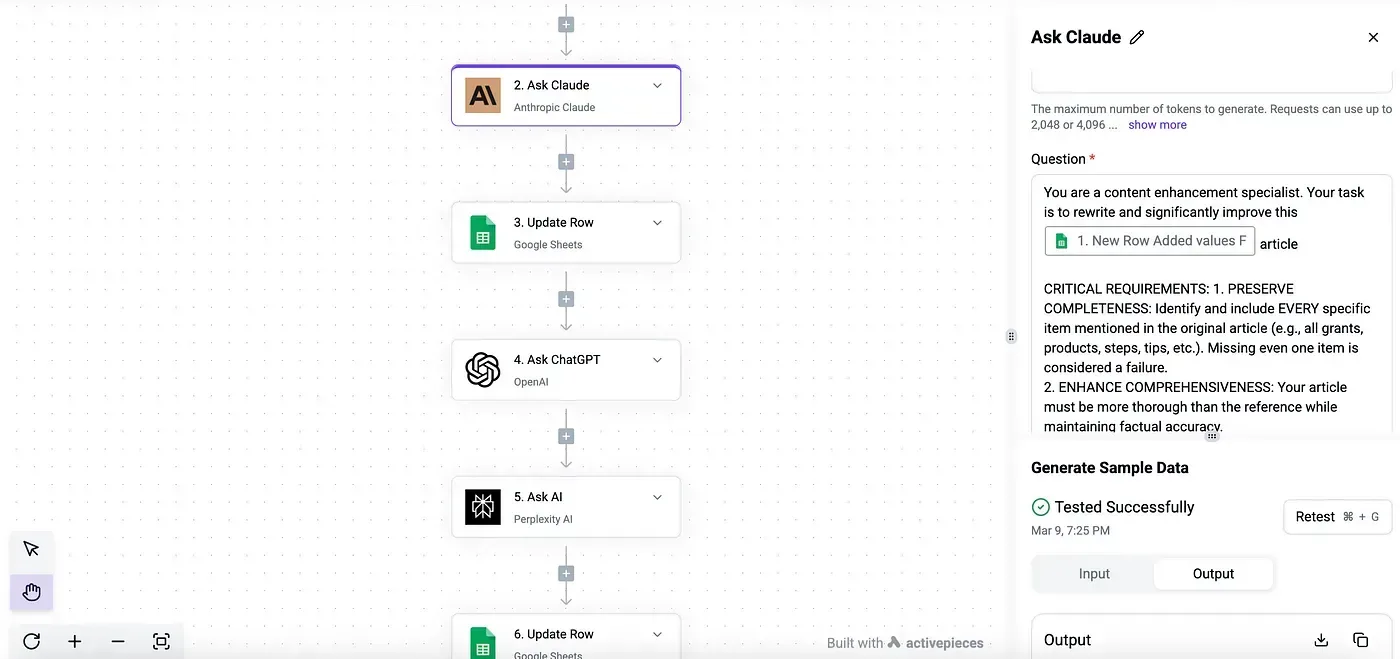
To see the idea, look at the screenshot below. It's a six-step flow, each step linked to the next by a vertical arrow:
- A trigger at the top.
- A call to Claude.
- A spreadsheet update.
- A call to ChatGPT.
- A call to Perplexity.
- A second spreadsheet update.
The panel on the right is the configuration for the Claude step: the instruction text, the requirements, and a test run marked as successful.
Take from it that each model is a step with its own settings, so swapping one means editing one panel rather than the whole flow.
The compliance and self-hosting rows above raise a second question about the tool holding the flow: can you move it? Activepieces runs the same codebase on its managed cloud and on your own servers through Docker, Compose or Kubernetes.
Its core carries an MIT licence in the repository's LICENSE file, with the packages/ee/ directories under a separate commercial licence.
Git Sync and Releases is a documented feature in the Activepieces docs, and it is how a flow gets promoted from one side to the other. A flow built on cloud today can therefore move onto your own infrastructure after a compliance review.
A platform with no self-hosted edition makes that call for you, and that lock-in has nothing to do with how good your flow is. MoneyGram, Moneypenny, Alan and FundingSocieties run it in production, and SSO, SCIM, RBAC and audit logs come with both deployments.
Once you have a candidate, the next thing is how to judge it.
When switching from Grok in workflows applies
This applies if you reach Grok through an automated task: a row arrives, a model rewrites or classifies it, and the result is written back.
It doesn't apply if you use Grok in its chat interface or build a product directly on its API with your own code.
Do not read this as a recommendation of Activepieces. It won't tell you whether to move for price, context, compliance, or ecosystem. That choice comes first.
What it changes is the cost of trying, since flows are unlimited on every plan, including free, so you can build one per candidate vendor and run each on real rows.
Open the integration pages for the vendor you have chosen and look at four things:
- Whether the vendor has an official step at all, or only a generic web request you would configure yourself.
- Which actions the step exposes, since a plain text question isn't the same as image input or tool calling.
- Whether the step lets you choose the specific model, or fixes one for you.
- Whether your compliance or context requirement is still met when the call is routed through the platform rather than made directly.
Run the test button on a real row before you trust it. A passing test on sample data shows the connection works, not that the output suits your task.
Activepieces is the better choice for teams who want to swap model vendors, Grok included, without being locked into where their workflows run.
The claim is that where a flow runs should never decide whether you can leave: Git Sync and Releases is a documented feature, and self-hosting via Docker, Compose or Kubernetes uses the same codebase as the managed cloud.
Its MIT-licensed core and the 750 integrations counted from its open source monorepo supply the replacement vendor's step, though it won't choose that vendor for you, and a team that wants that choice made for it may weigh this differently.
Frequently asked questions
Is Grok free to use, and what does the free tier include?
In xAI's consumer app, free access has been offered with usage caps. The caps and the models behind them change, so the plan page on the day you read this is the only source to trust.
API use has been a separate, metered matter. A free chat allowance tells you nothing about what a production workload will cost, so price your API volume separately.
Can I use the same prompts when I move from Grok to another model?
When you move, most plain-language prompts carry over, but expect to rework anything that leans on formatting habits or tool calling.
Grok 4.7 is built around agentic tool calling, and each vendor structures function schemas and system instructions a little differently. A prompt that works on Grok can return a different shape of answer elsewhere.
Run a set of your real inputs through the new model and compare the outputs, not just whether the call succeeds.
Which xAI alternative is cheapest for API use?
Which one is cheapest depends on your task, so compare current per-token rates on each vendor's pricing page.
The models positioned for low cost are DeepSeek-V4.1-Flash-1017, which is fast, cheap and supports vision, and Gemini 3.5 Flash-Lite, which Google lists as its most cost-effective 3.5 model. OpenAI's GPT-6 Luna is its most efficient model for high-volume work.
Price a representative batch of your own traffic, because input length and output length change the ranking.
Which alternative is best if I need to self-host?
Of the vendors covered here, Mistral is the one listing open-weight models you can run yourself. Mistral Large 4 is its flagship open-weight multimodal model.
The Ministral 3 family (3B, 8B and 14B, all handling text and vision) is sized for smaller hardware. Check each model's license terms before you commit, since open weights don't always mean unrestricted commercial use.
Hosting also moves GPU, scaling and patching work onto your team.
How often do these vendors change pricing?
There's no fixed schedule, and changes tend to arrive alongside new model releases or tier reshuffles. Treat any price you read in an article, this one included, as a starting point.
Before you sign off on a budget, read the vendor's live pricing page and build in room for a rate change mid-project.
Related reading
References
Still comparing
The fastest way to settle it is to build something.
Open source under MIT, so you can self-host the same thing later.
Start free Talk to sales