
Activepieces Open Source License: What Is Free (2026)

Oct 24, 202614 min read
The Activepieces Open Source License in Plain Terms
The direct answer
You can use, modify and self-host the Activepieces Community Edition at no licence cost, because it is MIT-licensed. Some features need a paid plan, which that licence doesn't cover, and "open source" describes the Community Edition, not the whole product.
MIT is short and permissive. It grants broad rights over the code and attaches one condition, which is that you keep the copyright and permission notice. It doesn't promise that every capability Activepieces ships is covered by it.
The Workflowmath price data is dated 24 October 2026. Plans and feature boundaries change, so treat that date as the point at which this reading was true.
What MIT permits and requires
The licence text grants permission "to use, copy, modify, merge, publish, distribute, sublicense, and/or sell copies of the Software." In practice, that gives you four things for Community Edition code. You can run it for any purpose, including inside a business, without asking permission.
You can change the source to fit your own systems and keep those changes private if you wish.
You can also run it on infrastructure you control, so your flows execute where you decide. And you can pass copies on, modified or not, including as part of something you ship.
Only one condition applies, and the licence states it: "The above copyright notice and this permission notice shall be included in all copies or substantial portions of the Software." Keep that notice in whatever you copy or redistribute, and you have met the condition.
An auditor would note what that text doesn't say. It names the Software, meaning the MIT-licensed code. Features in a paid plan are outside it, and a self-hosted install has no entitlement to them.

The case this article follows
At 09:40 on a Monday, an operations team of about forty people decides to roll out Activepieces. This is an illustrative composite, not a real customer.
They read "open source," stand up a self-hosted instance, and plan to connect their workflows by the end of the week.
Everything below works on Activepieces' free plan. Start without code or a credit card.
The Assumption That Failed in Rollout Week Two
In week two, three features turned out not to be in the MIT edition. The team had assumed that "open source" meant every feature on its plan was free to use.

Day 1: the install works
Because the self-hosted install ran and the first workflows executed, nobody had a reason to reopen the licence.
The MIT text grants permission "free of charge" for the software it covers. That's a statement about the code under that licence, not a promise about features the vendor sells separately. A clean install is proof of the first and says nothing about the second.
Day 9: the compliance request
The security lead asked for single sign-on, so staff would log in with company credentials and IT could remove them in one step on departure. She also asked for an audit trail showing who changed which workflow and when.

A product lead then asked to embed a workflow inside the customer-facing product. None of these was an exotic request, and the plan had assumed all three would simply be there.
Day 10: the feature that was never in the Community Edition
When the team read the vendor's pricing page and documentation line by line, instead of inferring from the repository, all three requirements turned up outside the MIT edition, in paid plans.
The team paused the rollout. The vendor had published the answer the whole time; no one had looked.
The cost was a week of momentum and an awkward conversation with the compliance owner, not data or money.
Licence misreading costs to the team
Even caught in time, the misreading was paid for in four units, none of which appeared on an invoice. They were engineer hours, days stalled, workflows to revisit and a late budget request.
Because the scenario is illustrative, the table below asserts no counts. It shows who absorbed each cost and where a published price exists, so you can see that the cheapest line on the price list isn't the cheapest line in the incident.
| Cost | Scenario figure | Who felt it | Published price |
|---|---|---|---|
| Engineer hours on workaround | Illustrative, no count asserted | The engineer who built a substitute for a gated feature | None |
| Days stalled | Illustrative, no count asserted | The team waiting on rollout, and the customer waiting on them | None |
| Workflows to revisit | Illustrative, no count asserted | Whoever built flows on the assumption the feature was included | None |
| Late budget request | Illustrative, no count asserted | The budget owner, asked after rollout instead of before | Plus $20/month; embedding $36k/year |
Only the last row is one a vendor prices. A figure of $20 a month is a card expense, while $36k a year is a budgeted line that needs sign-off.
One dated check of the licence and pricing pages before the first workflow was built would have avoided every row in the table.
The misreading of open source licences
"Open source" names a family of licences, not a price list, and most small firms have nobody whose job is to read the licence before a tool is adopted.
Open source versus open core
MIT begins: "Permission is hereby granted, free of charge, to any person obtaining a copy of this software." That grant covers the code in the repository, not every feature the vendor sells.
Where the core is openly licensed and other features sit under a separate commercial licence, that is open core. The word "free" in the grant doesn't reach them.
At 77% of large organisations, someone owns this question: the Linux Foundation found that share have an open source programme office. In mid-sized firms the share is 33%, which leaves 67% with no owner.
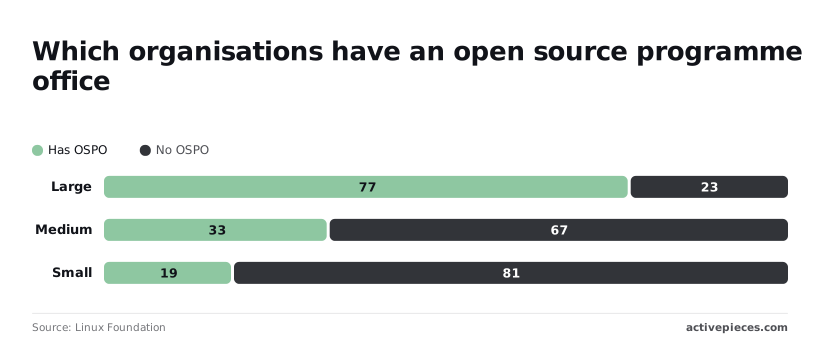
Among small firms it's 19%, leaving 81% where the person who installs the tool is also the person who interprets its licence, which means interpretations go unchecked.
Four licences answer the same five questions differently in the table below.
| Licence | Commercial use | Modification | Redistribution | Hosting for third parties | Paid-only features |
|---|---|---|---|---|---|
| MIT | Yes | Yes | Yes, with the notice kept | Yes | None in the licence; a vendor may sell features outside the MIT code |
| AGPL | Yes | Yes | Yes, under AGPL | Yes, but users of a modified version must be offered its source | None in the licence; vendors often dual-license |
| n8n Sustainable Use License | Internal business use | Yes | Non-commercial only | Not as a commercial service | Yes, under a separate enterprise licence |
| Node-RED Apache 2.0 | Yes | Yes | Yes, with notices and patent grant | Yes | None in the licence |
The incident had three causes. The team treated "open source" as meaning every feature is free. It read the repository licence and never the pricing page, so the paid boundary went unseen. And it checked after rollout, when switching meant rebuilding workflows.
Licence families sort into three groups
Permissive licences such as MIT and Apache 2.0 ask for little beyond keeping notices. Copyleft licences such as the GPL and AGPL require that derived work be shared under the same terms, and the AGPL extends that duty to software offered over a network.
Source-available licences, including n8n's, publish the code but reserve rights such as resale or commercial hosting for the vendor.
Open core cuts across these groups. It pairs an openly licensed base with commercial extras, so knowing the family tells you what to check next, but not where the paid boundary sits.
Easier to see it running than to read about it: set it up free, no card.
Organisations check licence risk in three common ways
Reading the licence and the boundary
The first method is the cheapest. Open the LICENSE file, look for directories that carry a different licence, then read the pricing page for the features you need, and write down what you found and the date.
Keeping an open source licence inventory
Larger firms run dependency scanners and keep a register of every component, with a programme office setting policy. A small team can do a light version: a shared sheet listing each tool, its licence, the features the business relies on, and who owns the renewal.
Choosing a different route
When a needed feature is paid and the budget isn't there, the options are to build it yourself, to pick a tool whose whole codebase sits under one permissive licence, or to buy the plan.
Building means owning the maintenance, and a single-licence tool may lack the feature. None of these is free, which is why the choice belongs before rollout.
Activepieces Self-Hosting and the Paid Line
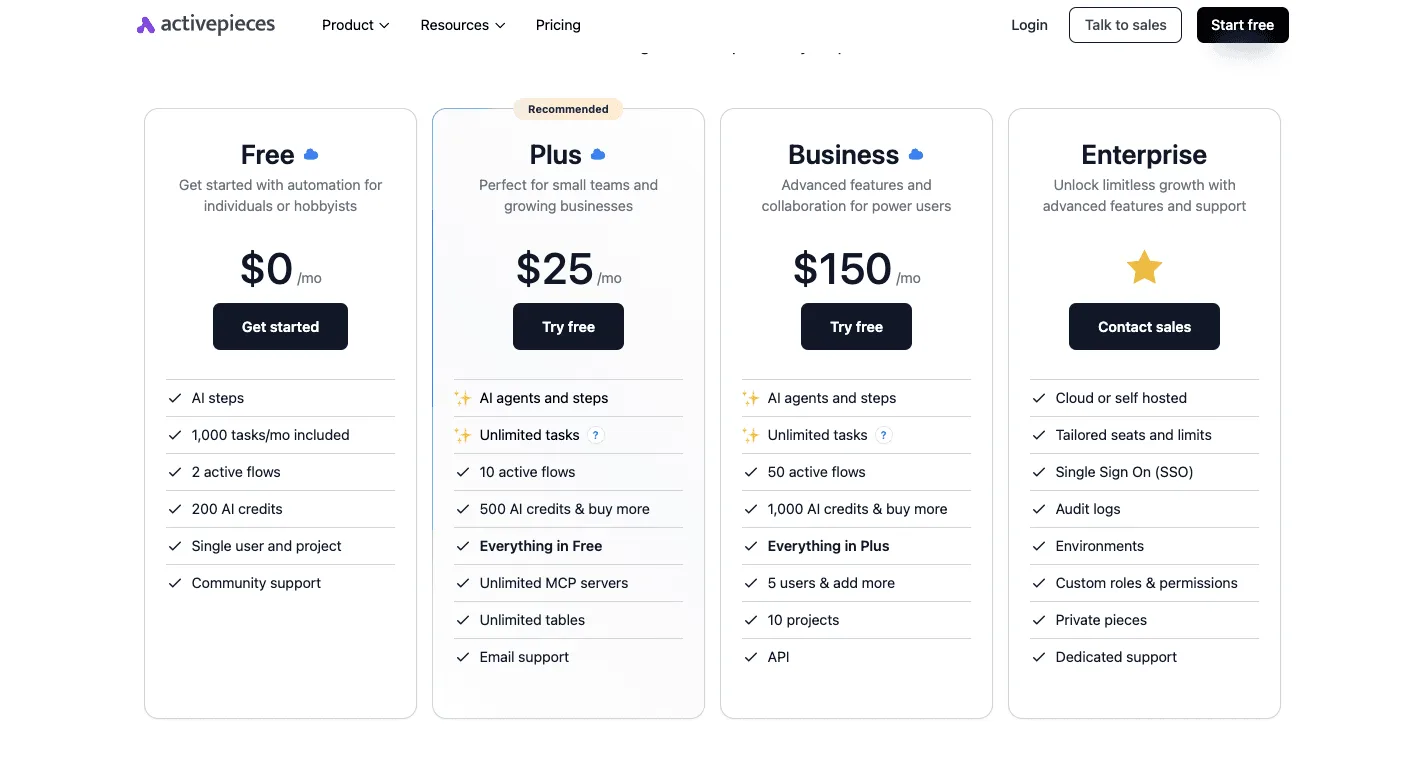
Read the line before rollout, not after: the Community Edition is MIT-licensed and free to self-host, while SSO beyond Team, audit logs, embedding and self-hosted enterprise deployment sit behind paid plans.
What the Community Edition includes
The core is MIT, and the point where it stops is written down: the LICENSE file in the activepieces/activepieces repository puts packages/ee/ under a separate commercial licence and everything else under MIT.
Outside that directory, MIT's permissions apply in full, so you can run the code, fork it, sell it or ship it inside your own product without a fair-code clause to read first, whereas a source-available licence like n8n's lets you read the code and keeps those rights with the vendor.
MoneyGram, Moneypenny, Alan and FundingSocieties run Activepieces in production.
The Activepieces team on LinkedIn put the library at 280 integrations in March 2025 and 285 in June. It reached 400 by September and 500 by November.
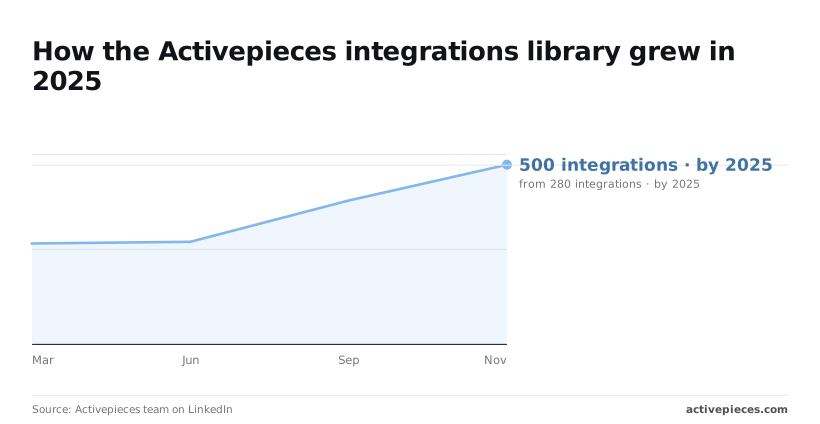
The jump of 215 in five months means a gap you found in spring may be closed, so recheck before ruling a tool out.
To self-host, work through these steps in order:
- Follow the documented Docker-based setup on a server you control.
- Set the environment variables the docs list for your instance.
- Start the stack and create the first account.
Once it runs, patching, backups and uptime are yours. When the vendor's cloud is down, yours is unaffected, but when your server is down, nobody else fixes it.
Which features need a paid plan
The pricing page shows Free at $0 with 1,000 credits a month, and Plus at $20 flat per month. Exceeding 1,000 monthly credits therefore requires the $20 Plus plan.
Team is $200 a month, and Ultimate is by quote, with cloud or on-prem deployment, custom roles and dedicated support. Custom roles are an Enterprise item, so a team needing them can't rely on the free edition.
For cost, SaaSSwitcher priced 10,000 monthly tasks at $20 on Activepieces, $55 on Make and $129 on Zapier.
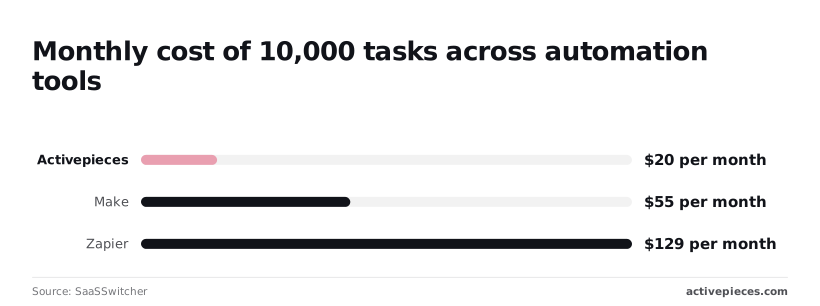
Its $20 differs from the $25 Plus list price, so treat the comparison as directional and confirm on the pricing page. Even so, the cheapest of the three is under a sixth of the dearest.
SOC 2 is in progress, not certified, so a buyer who needs the report today can't have it. If you want no servers to maintain and no licence questions, a hosted plan is the cleaner choice.
The Licence Check That Now Runs Before Rollout
Hosted or self-hosted, check the plan line for each feature you need before rollout. A hosted plan removes the server questions, but it doesn't remove the question of which tier unlocks single sign-on, audit logs or embedding.
The one-page feature-to-plan map
For the three features teams most often assume are free, the table below shows which edition and plan each sits in and what evidence you must record.
Take from it that every row needs a vendor page and a named person, because a feature without both is an assumption, not a control.
| Feature | Needed? Y/N | Edition | Plan required | Vendor page URL | Date checked | Named renewal owner |
|---|---|---|---|---|---|---|
| SSO | Y if staff sign in through a company identity provider | Team plan for basic SSO; Enterprise beyond that | Team ($200 a month, SSO and standard roles included) or above | https://www.activepieces.com/pricing | The day you read the page | The person who signs the renewal |
| Audit logs | Y if you must show who changed what | Enterprise | Ultimate (audit logs included) or Enterprise control, custom price via sales | https://www.activepieces.com/pricing | The day you read the page | The person who signs the renewal |
| Embedding | Y if you put the builder inside your own product | Enterprise | Embed, from $36,000 a year, via sales | https://www.activepieces.com/pricing | The day you read the page | The person who signs the renewal |
A "Y" in the first column with an edition you don't hold is a blocker, so settle it before anyone builds a flow that depends on it.
Who re-checks, and when
If the page now reads differently from your recorded date, the owner raises it before the contract is signed, not after the feature disappears.
Make the renewal owner responsible for reopening each vendor page before every renewal and whenever a new team asks for one of these features.
Never mark a setup "compliant" without naming the control it satisfies, such as access review for SSO or change traceability for audit logs.
If you are a builder who only needs the free edition, start free at https://cloud.activepieces.com/sign-up: the Free plan is $0, with 1,000 credits a month, unlimited flows and up to 5 users. To compare plans line by line, use https://www.activepieces.com/pricing.
For self-hosted enterprise, SSO beyond Team, audit logs or embedding, use the sales form at https://www.activepieces.com/sales.
Frequently asked questions
The short answers below are the ones the body leaves open, and each points to the vendor page that settles it.
The five questions in full
Commercial use
Can I use the Activepieces Community Edition commercially? Yes. MIT grants permission to "use, copy, modify, merge, publish, distribute, sublicense, and/or sell copies of the Software," and that covers the Community Edition.
It doesn't cover paid-plan features, so check the pricing page before you assume they come along.
Modifying the code
Do I have to publish my changes if I modify it? No. MIT is not a copyleft licence. Its one condition is that "the above copyright notice and this permission notice shall be included in all copies or substantial portions of the Software."
Keep that notice intact and your modifications can stay private.
The cost of self-hosting
Is self-hosted Activepieces really free to run? The licence costs nothing: the core is MIT, and only packages/ee/ sits under a separate commercial licence. Your servers, upgrades, backups and on-call time still cost something.
If your cloud stays up and the vendor's doesn't, that work is yours, and so is the budget for it.
Embedding in your product
Can I embed Activepieces in my own product under MIT? MIT gives you rights over the Community Edition code. Embedding is routed through the vendor's sales form, so treat it as a commercial conversation rather than something the licence text settles.
Ask before you build it into a customer-facing product.
SOC 2 certification
Does Activepieces hold SOC 2 certification? No. The programme is in progress. Until a report exists, no SOC 2 control can be cited as satisfied. If your auditor needs that evidence now, put the question to sales and record the answer in writing.