
Automate Poe: API Setup, Limits and Automation Gem

Nov 12, 202616 min read
According to Poe, Premium at $19.99 a month fits a solo user, and every step up buys points rather than a better rate.
Poe publishes no team plan, so a group has to size itself by total points, much as a team wiring up shared automations in Activepieces would tally usage across everyone before choosing a tier.
The ticket I see most is "which plan do I need?", and the answer is a points budget.
For $19.99 a month you get 660,000 points on Premium, according to Spendassay. That's enough room to test a script against the API before anyone depends on it.
The catch is the monthly allotment itself: a loop that retries without a limit can use it up in an afternoon, and the next stop is Premium Plus.
Team of five sharing one workflow
Step up to Premium Plus and you pay $49.99 for 1,650,000 points. That's 2.5 times Premium's points for 2.5 times the price. Activepieces can run the workflow in place of a cron job, and either way the points drain from one account.
Size by total monthly volume across all five people, not by seats. Poe publishes no team plan, so there's no shared pool or per-seat discount to plan around.
For 25 people, Poe publishes nothing either. The pages checked list no team tier, seat floor, single sign-on or admin controls, so a group of 25 has no plan to match.
The honest answer is to ask Poe directly, and not to assume a plan exists.
Heavy usage and API volume
Move up to Pro and it costs $99.99 for 3,300,000 points. Pro Max costs $249.99 and includes 8,250,000.
Divide each tier's points by its price and you get about 33,000 points per dollar every time. Upgrading buys headroom and never a cheaper unit cost, so don't move up expecting savings. Poe publishes no tier above Pro Max.
Read the last column first, since it shows what trips each reader into the next tier. The table below puts all five situations side by side.
| Situation | Plan | Monthly price | Points | Catch pushing to next tier |
|---|---|---|---|---|
| Trying it | Premium | $19.99 | 660,000 | Points run out mid-month; next is Premium Plus |
| Light daily use | Premium Plus | $49.99 | 1,650,000 | Daily use outgrows the allotment; next is Pro |
| Heavy use | Pro | $99.99 | 3,300,000 | Volume passes 3,300,000; next is Pro Max |
| Scripted API use | Pro Max | $249.99 | 8,250,000 | No higher tier published |
| Team use | None published | None published | None published | None published |
To see how steeply the allotment climbs, look at the chart that follows, which plots those monthly points by tier.
Automating Poe and the Automation gem
Automate Poe, Quora's multi-model AI platform, through its official OpenAI-compatible API with a personal key, and the monthly points in that chart are what you spend. The "Automation gem" is a different thing entirely, from a game.
Poe the AI platform
Instead of typing into the chat window, you send requests from a script or workflow. That is what automating Poe (poe.com), which puts many AI models behind one account, means.
The API accepts the same request format as OpenAI's, so most existing tooling needs only a new base URL and your Poe key.
Because every call draws on your points and runs into rate limits, the budget is the real boundary on how much you can automate.
The Automation gem in Path of Exile 2
"How do I use the Automation gem with Poe?" That is the ticket I keep seeing, and someone has usually mixed up two games' worth of vocabulary.
Path of Exile 2, abbreviated PoE, has a support gem called Automation. It's got nothing to do with poe.com.
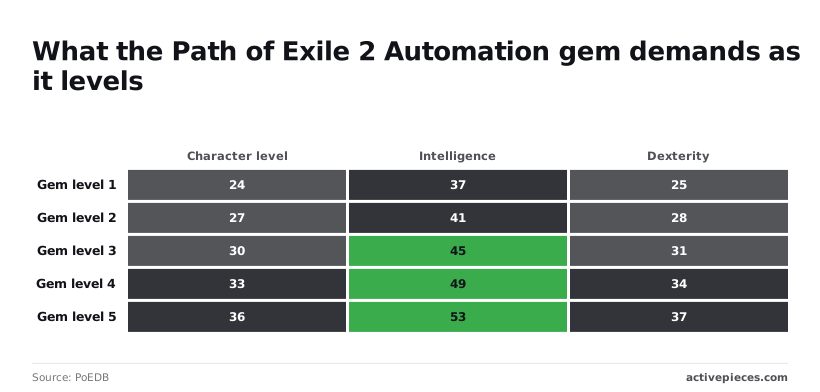
Look at the requirements on PoEDB and you find three values per gem level:
- Level 1 asks for 24, 37 and 25 points.
- Level 2 asks for 27, 41 and 28.
- Level 3 asks for 30, 45 and 31.
- Level 4 asks for 33, 49 and 34.
- Level 5 asks for 36, 53 and 37.
By level 5 the largest requirement has grown from 37 to 53, since each level adds three or four points to every value. That's a character-building cost, and it tells you nothing about scripting an AI service.

What Poe API automation allows and prohibits
Before anything else, find out which meaning a request refers to, because the two differ on every dimension. Poe (poe.com) automates prompts and replies across AI models through the official OpenAI-compatible API with a personal key, which Poe allows within your points and rate limits.
In Path of Exile 2, the Automation gem automates in-game skill behavior as a support gem socketed in the game, which the game allows as an ordinary in-game item.
For poe.com, "allowed" means staying inside the API, your key and your limits. Nothing about the gem touches that. Once the name is settled, the rest of the work is setting up the API.
This takes minutes, not a project: automate it in Activepieces free.
Poe API setup in five numbered steps
You get from no access to a working Poe API call in five steps: get a key, check your points, send a request, add instructions, and store the key safely.
Each one is short, and the order matters because a request fails at the first step you skipped.
Sign in to Poe and open the API key page in your account settings. Copy the key once and treat it like a password.
It's tied to your personal account, so anyone holding it spends your points, and if it leaks you generate a new one and the old one stops working.
Step 2: Check your points balance
Open the balance screen before you write any code. Every API call draws from the same points your chats use.
A call that fails with a quota error usually means the balance is empty or a rate limit was hit, not that your code is wrong. Checking first saves you from debugging a problem that isn't in your script.
Step 3: Send the first request
Because Poe's API is OpenAI-compatible, you can use any OpenAI client library with two changes. Set the base URL to the one in Poe's API documentation, and send your key in the Authorization header as a Bearer token.
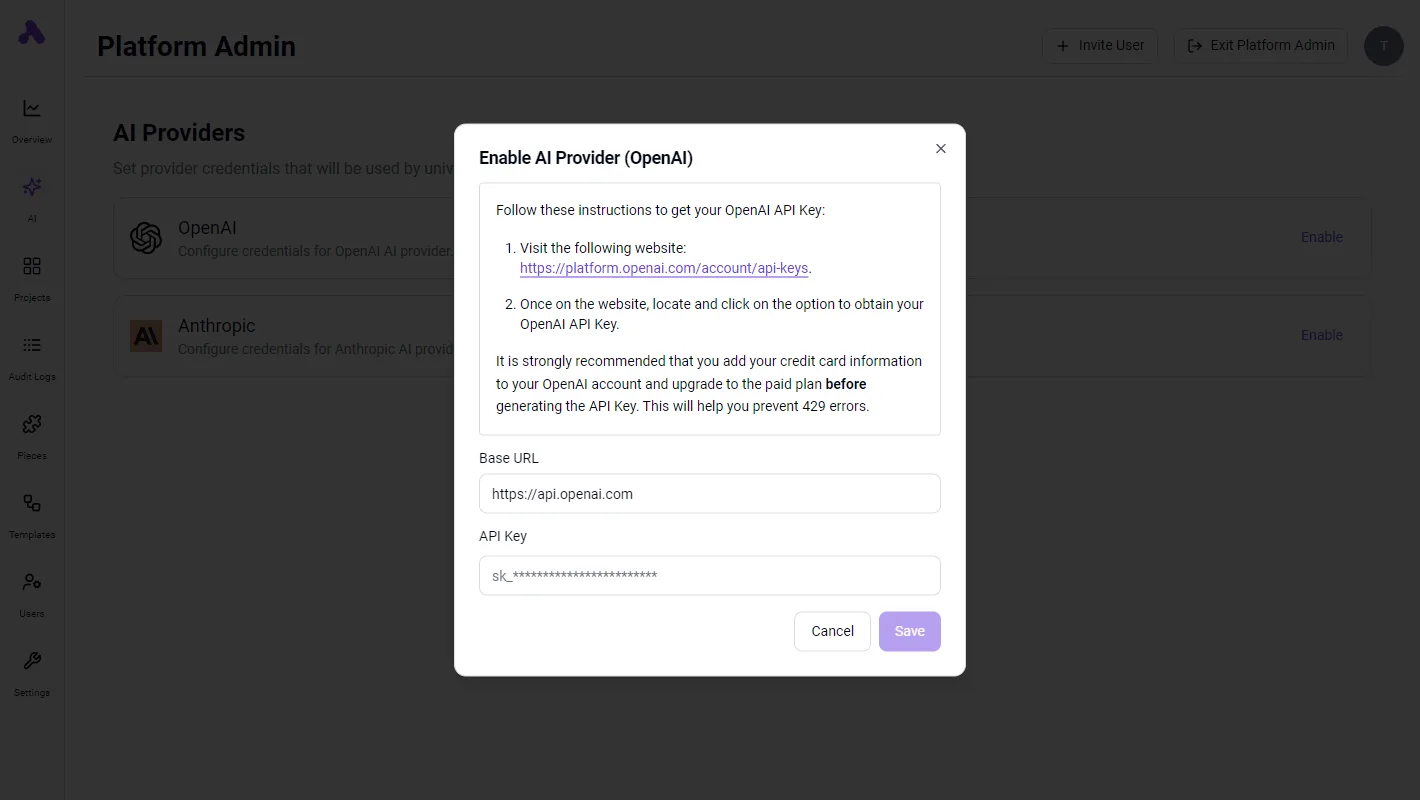
In the model field, use a bot name exactly as Poe's docs spell it, since a near-miss returns an error rather than a guess. Send one short user message.
A text reply in the response means the key, balance, URL and model name all work, and that's the point where setup is done.
Step 4: Add instructions and options
Once the plain call works, add a system message that says what the bot is for, then set options such as temperature. The configuration panel below comes from a spreadsheet-driven workflow rather than from Poe, and it shows the pattern.
Under the instruction field, which spells out exactly which facts to gather about each company, sits a temperature setting. A test run returned sample output that confirms the step works before anything runs for real.

Your Poe call should be built the same way: detailed instructions, one deliberate option, and a test before you rely on it.
When instructions are written this carefully, a teammate can also rerun the task without asking you what you meant.
Put the key in an environment variable and read it at runtime. Never paste it into a script, a shared sheet or a repository.
The practical benefit is that you can share the code freely and rotate the key in one place when you need to.
Poe API limits, points costs and errors
Once the key is shared across scripts, so is the budget behind it. The free tier gives you 300 points a day, and a single message to a top model can use all of it.

Per-message costs, as Whizi lists them, show how fast that goes.
Documented rate and points limits
On a free account, GPT-5.5 was out of reach at the 600 points per message Whizi listed, twice the daily allowance. Claude Opus 4.7 was listed at 496.5 points, which also exceeded 300.
Claude Sonnet 5 was listed at 234, which left 66 points after one message, too few for a second. Gemini 3.5 Flash was listed at 200, which allowed only one message with 100 points stranded.

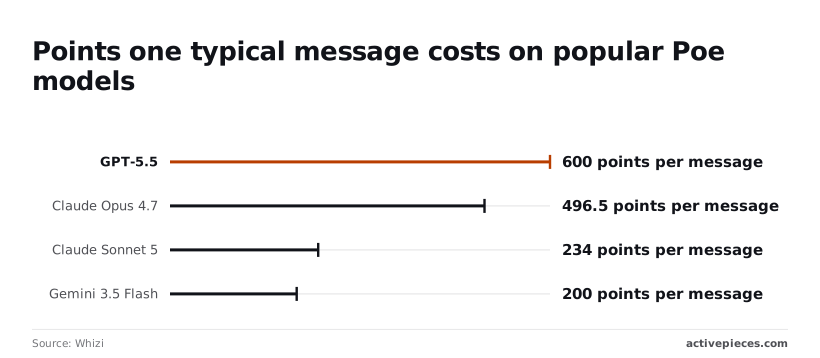
In practice, a free key gets about one successful call a day only on the cheapest of these models. A scheduled job that fires twice will fail on its second run, and someone will ask why on Monday.
Separate from points, there is a request-rate limit of 500 requests per minute, so you can't increase this limit with additional points purchases. You will hit the points ceiling long before this one unless you are on a paid balance.
Read the cause column of the table below first. It covers the five failures you will see most, and only one of them is fixed by trying again.
| Error | Message | Cause | Fix |
|---|---|---|---|
| 401 auth | Exact text unconfirmed | Missing, mistyped or revoked key | Check the key and the Authorization header, then generate a new key if needed |
| Insufficient points | Exact text unconfirmed | Balance is below the cost of the message | Switch to a cheaper model or add points; reset timing is unconfirmed |
| 429 rate limit | Exact text unconfirmed | More than 500 requests per minute | Slow down and back off |
| Unknown model | Exact text unconfirmed | Model name misspelled or not available | Copy the name exactly from Poe's model list |
| Timeout | Exact text unconfirmed; time limit unconfirmed | Long response or slow upstream model | Shorten the prompt, stream the response, retry once |
Because we couldn't verify the message wording, it is marked unconfirmed, so match on status codes in your error handling, not on text.
Retries without burning points
Retry only 429s and timeouts. A 401, an insufficient-points error and an unknown-model error will fail identically every time, so retrying them just fills your logs.
For a 429, wait, double the wait on each attempt and add a random offset so parallel jobs don't retry in step. Cap it at three or four attempts.
Whether a timed-out request is still charged is unconfirmed, so with expensive models retry once, not in a loop.
You can follow the rest of this with the builder open. Start free, no card.
Connect Poe to scheduled workflows with Activepieces
Pick the trigger first, because that choice decides who owns the job afterward. Activepieces runs the Poe call from a schedule or webhook trigger, keeps your key in a connection, and lets you build the single retry you want rather than a loop.
Pick the trigger first, because that choice decides who owns the job afterward.
A run costs 1 credit however many steps it has, and every plan, the free one included, allows unlimited flows, so giving each Poe job its own flow costs nothing extra.
Before you commit, weigh three alternatives.
- Cron, the scheduler built into Linux and macOS, is the cheapest option. It works if one person owns the script and the server. When that person is out, nobody else can see why the job failed.
- Zapier is a hosted automation service with a large app catalogue. It suits a team that already lives in it, but you're working inside its step model.
- Make is a hosted visual builder in the same category as Zapier. It handles branching well, and the same ownership question applies.
I'd still pick a shared tool over cron for anything the support or ops team depends on. A script on one laptop is exactly how an answer ends up living in one person's head.

Store the API key in a connection
Your Poe key is the thing that spends your points, so where it is stored matters.
In Activepieces the key lives in a connection rather than in each step, and on a self-hosted instance or the enterprise cloud tier those connection secrets can be routed to your own secret manager instead of Activepieces' database.
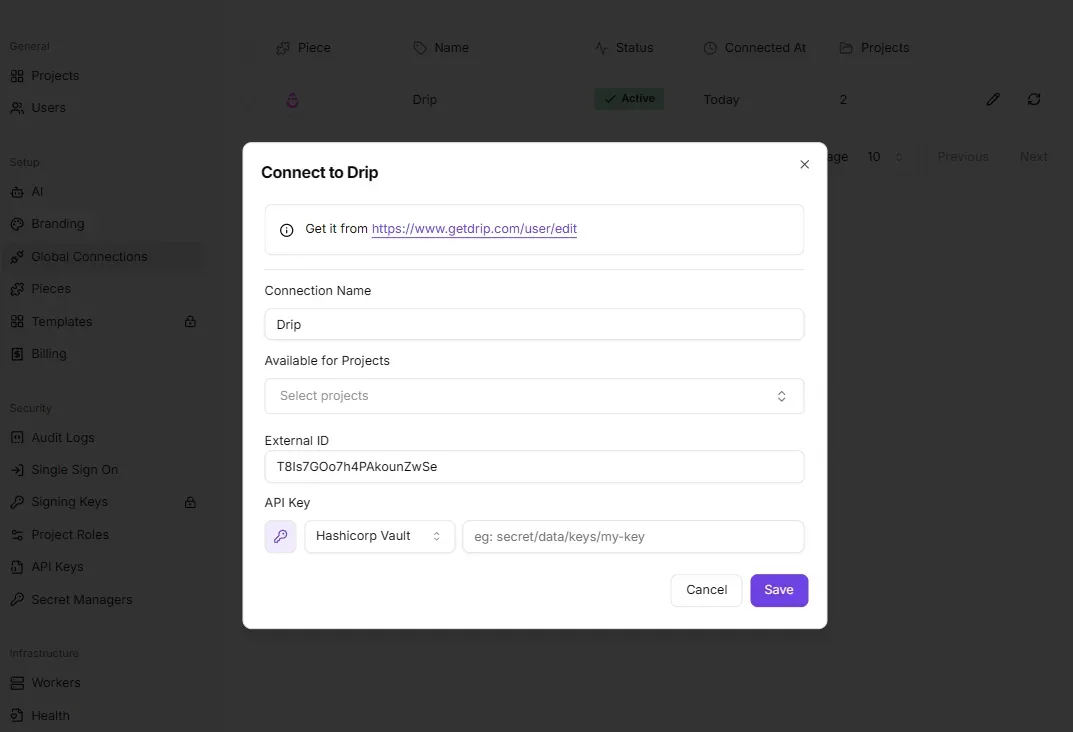
That secret-manager integration sits in the same enterprise feature set as SCIM, custom RBAC, SSO and audit logs, and MoneyGram, Moneypenny, Alan and FundingSocieties run Activepieces. Zapier and Make keep your credentials in their cloud with no self-hosted edition to route around it.
Point a self-hosted instance at an external secret manager and look in the database: the Poe key isn't there.
That's the part that matters here: the next person to open the flow sees the whole job without reading code.
It runs from a schedule or webhook trigger to an HTTP step that calls Poe with the key from a connection, then to a write-out step to a sheet or file, with a retry arrow looping back from the HTTP step.
Take from it that only the HTTP step can fail expensively, so that's the only place the retry belongs.
Point the HTTP step at Poe's OpenAI-compatible endpoint and send your prompt in the usual chat format. Then write the reply to a sheet or file, so a teammate can check results without opening the flow.
Keep the retry to one pass, as the previous section advised for costly models.
Once the flow runs on its own, the remaining work is small and mostly about habits.
- Decide which Poe you mean, and confirm it's the chat platform with the API, not the Path of Exile 2 gem.
- Create your personal key and store it as a connection, not in a step.
- Build the three-step flow with a schedule trigger and one retry.
- Run it once by hand against a cheap model and check the written output.
- Share the flow with a teammate and have them find the last run without asking you.
Frequently asked questions
When the same handful of questions keeps coming back in the team channel, most of the habits come down to them. The useful move is to write each answer down once with the page it came from.
Five of them are still open enough that the vendor decides the answer, not us, so treat the list below as things to re-check and log with the date you looked.
- Free API use: read Poe's API documentation and its points page, and note whether a free account can call the API at all.
- Key rotation: read the API key settings on your Poe account, and note whether you can regenerate a key without breaking others.
- Points expiry: read Poe's subscription and points page, and note whether unused points carry over.
- Team plans: read Poe's pricing page, and note whether shared billing exists or each person needs a personal key.
- Automation gem in game: read the Path of Exile 2 skill gem listings from Grinding Gear Games, the studio behind the game, which is where that gem lives.
Below, five answers cover the rest.
Automating Poe without paying
Can I automate Poe without paying? Possibly in a small way, but check first. Poe's free tier and its API rules are set by Poe and can change, so read the API documentation before you build a flow that depends on free calls.
Plan on the assumption that sustained automation costs points.
Automating Path of Exile 2 with a bot
Is it against the rules to automate Path of Exile 2 with a bot? Assume yes if the bot plays the game for you.
Grinding Gear Games sets the terms for Path of Exile 2, and automation that sends inputs or reads the game client is the kind of thing publishers ban accounts for. Read their terms before trying anything.
A flow that calls the Poe chatbot API never touches the game.
Does the Automation gem exist?
Does the Automation gem exist in Path of Exile 2? Yes, it's a skill gem inside the game, and it has nothing to do with Poe the chatbot platform.
If a search for "Poe automation" sends you to gem guides, that's why. Settle which Poe you mean before you go further.
Points and other tools
Do API calls use the same points as chat? They draw on the same points balance, as far as Poe's documentation describes it, so a busy script can empty the allowance your team uses for chat.
Check the points page for how each model is priced, and watch your usage after the first full day of a new flow.
Can I use my Poe key with other OpenAI-compatible tools? Generally yes. Poe's API is OpenAI-compatible, so tools that let you set a base URL and key can point at it.
Confirm the base URL in Poe's documentation, test with one cheap call, and keep the key out of shared files.
Related reading
References
Build it
Set this up in minutes.
No code required. Connect your accounts, and Activepieces runs it from there.
Start free Talk to sales