
Baidu Qianfan Pricing 2026: API Costs per Token

Nov 8, 202614 min read
According to Baidu Qianfan, the company bills by the token, and output prices for its confirmed ERNIE text models run from 3.2 to 18 RMB per million tokens.
That's a 5.6x spread inside one family, so the model you pick matters before any discount does, whether you're calling the API directly or wiring it into a workflow through a tool like Activepieces.
Baidu Qianfan pricing is the pay-per-token billing scheme for models on Baidu's Qianfan AI platform, where the cost of each request depends on the model tier, input and output token volume, any batch, cache or prepaid discounts, and the account's rate-limit tier.
Text models: ERNIE family prices
Every other cell reads "Not confirmed" rather than guessed, because only four ERNIE models have an output price I confirmed. The table shows a floor of what is known, not a full rate card.
| Model | Input RMB/1M | Output RMB/1M | Free quota | Rate limit (RPM/TPM) | Checked | Source |
|---|---|---|---|---|---|---|
| ERNIE 5.1 | Not confirmed | 18 | Not confirmed | Not confirmed | 2026-11-08 | Pricing page |
| ERNIE 4.0 Turbo | Not confirmed | 9 | Not confirmed | Not confirmed | 2026-11-08 | Pricing page |
| ERNIE X1 Turbo | Not confirmed | 4 | Not confirmed | Not confirmed | 2026-11-08 | Pricing page |
| ERNIE 4.5 Turbo | Not confirmed | 3.2 | Not confirmed | Not confirmed | 2026-11-08 | Pricing page |
At 18 RMB per 1M output tokens, ERNIE 5.1 puts 100M output tokens at 1,800 RMB. The same volume on ERNIE 4.5 Turbo, at 3.2 RMB according to Baidu Qianfan, costs 320 RMB.

I didn't confirm prices for third-party or open models hosted on Qianfan, so none appear in the table.
I didn't confirm prices for image, embedding, rerank and speech products, and they may not bill per token at all.
Free quota, rate limits and discounts
To move the bill on Baidu Qianfan, look at batch and context cache.

On ERNIE 4.5 Turbo input they cut 0.8 RMB per 1M tokens to 0.32 and 0.2, while free quota and rate limits decide whether you can use them at all.
Rate limits by model and account tier
Per model and per account tier, limits differ sharply. Flagship ERNIE 5.1 starts far lower than ERNIE 4.5 Turbo, so a workload that runs comfortably on 4.5 Turbo can queue or fail when moved to 5.1 unchanged.

On standard online calls, Baidu Qianfan lists ERNIE 4.5 Turbo input at 0.8 RMB per 1M tokens. The table shows what each path does to that figure, so you can see which discount your traffic can reach.
| Path | Discount vs list price | Conditions | Effective RMB per 1M input tokens |
|---|---|---|---|
| Pay-as-you-go | None | Real-time calls | 0.8 |
| Batch | 60% off | Work that can wait for asynchronous processing | 0.32 |
| Context cache hit | 75% off | Repeated prompt prefix that hits the cache | 0.2 |
- Batch at 0.32 RMB means an overnight job costs 40% of the same job run live.
- A cache hit at 0.2 RMB costs a quarter of list, so a long system prompt or shared document sent on every call becomes the cheapest part of the request.
- Output prices and the output side of these discounts aren't covered here, so price output separately before you total a bill.
If you are running this arithmetic for your own team, see what the same workload costs on Activepieces.
Support bot Qianfan monthly bill
Add up three metered lines and you have the bill for 50,000 support conversations: uncached input tokens, cached input tokens and output tokens, each priced at the rate of the tier you run on.
Token assumptions for estimating Qianfan API costs
Count everything in tokens, billed per million. Each conversation has three measured quantities:
- I is the average input tokens, including system prompt and history.
- C is the share of that input served from cache.
- O is the average output tokens.
Price the same 50,000 conversations three ways and only the tier and the discount path change between rows.
| Scenario | Input tokens | Cached share | Output tokens | Arithmetic per line | Monthly RMB total for 50,000 conversations |
|---|---|---|---|---|---|
| Flagship ERNIE, live | I | C | O | 50,000 × [I(1−C) × input rate + IC × cached rate + O × output rate] ÷ 1,000,000, at flagship rates | Sum of the three lines |
| Lighter model, live | I | C | O | Same formula, at the lighter model's rates | Sum of the three lines |
| Lighter model, batch share B | I | C | O | Live traffic (1−B) priced as above; traffic B at batch rates | Live lines plus batch lines |
Run all three lines at flagship rates with every conversation live. This is your ceiling.
Bill on a lighter model with caching and batch
Swap in the lighter model's rates and the total drops by the rate difference alone.
Then move the share B of conversations that need no instant reply, such as follow-up summaries and ticket tagging, to batch. Only that share gets the batch rate, so the saving scales with B, not with total volume.
Baidu bills tokens on every call, so splitting work into separate classify, summarise, tag and reply calls changes your Qianfan total only by the tokens each call carries. On the workflow side, Activepieces charges 1 credit per flow run, however many steps the run has.

Zapier's pricing page bills per task and Make's bills per module.
Keep live chat on live rates, and check that the lighter model holds quality on your hardest tickets before trusting the lower total.
Latest Qianfan price changes and impact
Through 2026, Baidu Qianfan mostly pushed list prices down, made some models free and retired others. A bill can shrink with no action from you, or break when Baidu withdraws a model you depend on.
Price cuts and models made free
Less obvious: ERNIE 5.1 costs less than ERNIE 5.0. Staying on 5.0 therefore costs more per output token than the newer model, so a team that pinned the older version for stability is paying a premium for inertia.
A bill can shrink with no action from you, or break when Baidu withdraws a model you depend on.
Moving is cheaper, but it's a model change, so rerun your own evaluation set before switching production traffic.
When a model goes free, the calculation changes differently. Zero list price removes the token cost, not the limits around it, so check the rate-limit tier before building a workload on it.
Qianfan model deprecations and forced migrations
Of everything here, a retirement date matters more than a price cut because it removes your choice. Once Baidu withdraws a model, calls to it fail or redirect, and you take whatever replacement price and behavior come with it.
Baidu's notices are often published first or only in Chinese. I haven't confirmed every date from a primary notice, which is why the chart marks only changes with a dated source.
List every model ID in production and note its retirement status, so a forced migration lands in your plan rather than your invoice.
Worth checking against a plan that does not meter every step: one credit covers a whole run on Activepieces.
Hidden Qianfan costs and account limits
Beyond retirement dates, three costs catch new Baidu Qianfan accounts. They're the setup gates, the capacity you pay for whether or not you use it, and the gap between input and output pricing.
Qianfan account, payment and region requirements
Before production access on Baidu's cloud you need real-name verification, so a team without a mainland-recognised identity or business entity can stall before the first paid call. Budget that as lead time, not dollars.

To reach the lower rates you usually prepay, which means cash sits on Baidu's side until you spend it. Check whether unused balance is refundable before you commit.
Qianfan fine-tuning and dedicated deployment pricing
Fine-tune a model and you are metered separately from inference. You pay for training, usually by tokens or compute time, and then you pay again to serve the tuned model.
A tuned model typically can't ride the shared pay-per-token pool, so the serving cost moves from a per-token meter to a reserved-capacity meter.
At low traffic, the effective price per token can end up far above the headline rate, because dedicated deployment bills for the time the capacity is held, not for requests served.
Output tokens, long context and retries
On most models output tokens are priced above input tokens, so a workload that generates long answers from short prompts costs more than the table's first column suggests.
Retries add a quieter charge. A content-review rejection can still consume tokens you already sent, so a pipeline that retries on refusal pays repeatedly for the same failure.
Then there are quota ceilings. Low rate-limit tiers throttle you before your budget does, and the fix is a tier upgrade that may carry its own spend threshold. Before launch, check:
- how rejected requests are billed
- what output multiple applies to your chosen model
- which rate-limit tier your projected peak traffic needs
Baidu Qianfan versus Alibaba, Tencent and OpenAI pricing
2.53 USD per 1M output tokens is what Baidu Qianfan's flagship, ERNIE 5.1, charges, the second-cheapest of four flagships, behind only Tencent Hy4, per AI//COST.
Price per million tokens side by side
Ranked by output price, the flagships with a confirmed price show the takeaway in the spread: the cheapest and dearest of the non-OpenAI flagships differ by roughly 2.4 times.
| Vendor | Flagship | Output price (USD per 1M tokens) |
|---|---|---|
| Tencent Hunyuan | Hy4 | 2.501 |
| Baidu Qianfan | ERNIE 5.1 | 2.68 |
| Alibaba Model Studio | Qwen Max | 6 |
| OpenAI | GPT-6 Astra | Available |
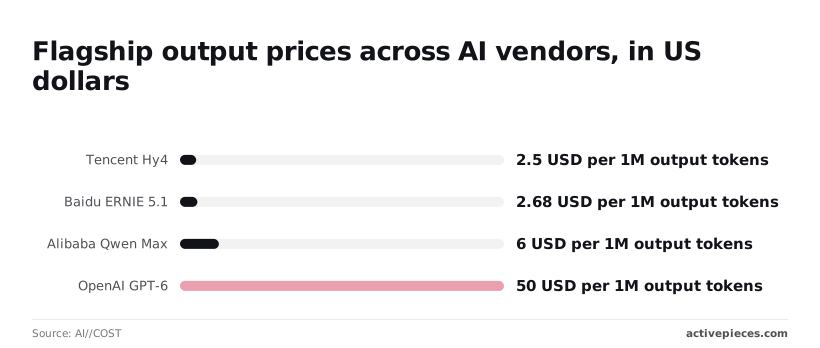
At 100M output tokens a month, that's about 250 USD on Hy4, 268 on ERNIE 5.1 and 600 on Qwen Max.
When Qianfan ERNIE or Hy4 is cheaper
On list price Hy4 wins by 0.179 USD per 1M output tokens, which is too small to justify a migration on its own.
ERNIE 5.1 is the better pick if your traffic already sits on Qianfan, because moving costs engineering time that the 18 USD monthly saving at 100M tokens won't repay.
Qwen Max costs about 2.2 times ERNIE 5.1 per output token. Pay that only if it measurably cuts your retries or review time. OpenAI's flagship, GPT-6 Astra, is aimed at complex reasoning and coding, so reserve it for the requests where a cheaper model fails.
Treat these as list prices. Batch, cache and prepaid paths can move the real rate, and I haven't confirmed those discounts here.
How to check your Qianfan pricing this week
- Pull last month's output token count per model from your own logs, not from the vendor dashboard's headline.
- Multiply that count by each price in the table to get a baseline bill for all four.
- Re-run your ten most expensive prompts on ERNIE 5.1 and Hy4, and count how many outputs you'd accept.
- Check each vendor's pricing page for batch, cache and prepaid terms, and note the date you checked.
- Check your rate-limit tier before committing volume, since a throttled cheap model forces retries and costs you time.
What Activepieces does about this
Activepieces can't change Baidu's rate card, but it can stop your workflow tool from adding a second meter on top of it. A Qianfan call is just an HTTP request, so you can run it from a flow with the HTTP integration.
You can then route each request to the tier and discount path that fits it. Tickets that need an instant reply go to the live endpoint on the lighter model. Summaries and tagging go into a batch job.
Only the hard cases escalate to a flagship. That is the routing the support-bot arithmetic above depends on, and it lives in a branch step you can read, not in application code.
The pricing is the part I can point at. Activepieces charges 1 credit per flow run, however many steps the run has. Splitting a job into classify, summarise, tag and reply calls costs you tokens on the Qianfan side, as it would anywhere.
It adds nothing on the workflow side. Per-task and per-module billing penalises exactly the design that keeps Qianfan bills down.
The Community Edition is MIT-licensed and you can self-host it, so the orchestration layer has no per-run charge. That matters because the hidden costs above are all things you want to see before they land on an invoice.
A flow can record the token usage each call returns, add it up per model, and alert you when a model's spend or throttling crosses a threshold you set. That gives you a budget alarm, which I couldn't confirm Qianfan offers as a hard cap.
It can also pause a retry loop that keeps paying for the same content-review rejection.
None of this removes the need to check your console quota or confirm the discount terms I flagged as unconfirmed. I haven't verified a ready-made Qianfan integration, so plan on the HTTP integration and your own API key.
What you get is the tier and discount choices becoming explicit steps in a flow, instead of defaults you find out about when the bill arrives.
Frequently asked questions
Because those discounts are unconfirmed, the answers below tell you what to check in Baidu's console and docs rather than hand you a number I can't source.
Is Baidu Qianfan free to use?
Not as a standing arrangement. Some models carry a free quota, but I haven't confirmed which ones, how large the quota is, or when it lapses. Treat any free allowance as a trial that ends.
Price your production workload at the paid per-token rate from day one, so the first real invoice isn't a surprise. The model's own page in the console is the place to read the expiry terms.
Can I pay for Baidu Qianfan in US dollars?
I haven't confirmed that it can be done. Baidu prices Qianfan in yuan, so plan for the invoice to arrive in yuan.
If your card or bank converts it, the exchange rate and any foreign-transaction fee become part of your effective per-token cost.
On a large monthly bill, that conversion spread is a real line item. Ask Baidu's billing support, or check the account's payment settings, before you commit budget in dollars.
Does Baidu Qianfan charge for failed or filtered requests?
I haven't confirmed this in the docs, so test it instead of assuming. Send a small set of requests that you expect to fail or be blocked by content moderation.
Then compare the usage log in the console with what the billing page records for the same period.
If filtered calls are metered, your cost per successful answer is higher than the headline rate suggests. A workload with many retries or borderline prompts feels that most.
How do I set a spending limit on Baidu Qianfan?
I haven't confirmed a dedicated hard-cap setting. A prepaid balance acts as a practical ceiling, because spend cannot exceed what you loaded. The catch is that requests then fail when the balance hits zero, so the cap doubles as an outage.
Your rate-limit tier also bounds how fast you can spend, since throughput limits how many tokens you can burn per minute.
If you need a true budget alarm, check the console's billing and alerting options and confirm what happens at the threshold before relying on it.
Related reading
References
Running the numbers
See what the same workload costs here.
Free forever plan, and every paid plan self-hosts at no extra cost.
See pricing Talk to sales