
Best Agentic AI Coding Tools for 2026

Sep 30, 202614 min read
Best Agentic AI Coding Tools for 2026: A Developer's Shortlist
Defining the agentic coding era
The shift from autocomplete to agentic AI coding tools marks the transition from models that suggest lines of text to systems that manage entire engineering workflows.
When a production environment breaks at 2:00 AM, the responsibility now falls on you as the Site Reliability Engineer. You must determine whether the failure originated in human-written logic or an autonomous agent’s misinterpretation of a pull request.
Modern tools aren't passive assistants. They're active participants that require you to operate as a system architect who verifies intent rather than just syntax. This evolution is built upon four pillars that distinguish agentic systems from legacy plugins:
- Autonomous planning: The ability to decompose a high-level natural language prompt into a logical sequence of engineering steps.
- Context awareness: Utilizing retrieval-augmented generation (RAG) and local indexing to understand how a change in one module affects the entire repository.
- Multi-file execution: The capacity to modify multiple files simultaneously to maintain architectural consistency.
- Tool-use: The integration of external compilers, debuggers, and terminal environments to validate code before it reaches a human reviewer.
These pillars result in output that's functionally integrated into your existing codebase.
Autonomous Planning Capabilities
By allowing an agent to map out a multi-step solution before writing a single line of code, autonomous planning reduces the likelihood of architectural drift.
Models like Claude Fable 5.1, designed for demanding reasoning and long-horizon agentic work, can anticipate dependency conflicts that a standard autocomplete tool would ignore.
This foresight means you spend less time refactoring circular dependencies and more time auditing the high-level logic of the plan.
Context windows and RAG efficiency in coding agents
To ground suggestions in the specific patterns of your proprietary codebase, effective agents use large context windows and local indexing.
Systems using models like Gemini 3.8 Flash can ingest thousands of files to identify where a local change impacts a global variable. This context prevents the generation of non-existent functions so that your code is compatible with your internal API.
Multi-file Execution Reliability
Reliability in agentic coding depends on the system's ability to propagate a single change across every relevant file in a repository without manual intervention.
While legacy tools require you to open each file individually, modern agents use coordinated edits to update interfaces and their implementations simultaneously.
This reduces the risk of partial commits, where a renamed function in a controller isn't updated in the corresponding view, leading to immediate runtime errors.
Tool-use and API Integration
The final stage of agentic autonomy is the ability to interact with the environment through terminal commands and external services. Activepieces runs as a per-project MCP server, allowing Claude, Cursor, or Windsurf to modify and explain automation flows without a separate builder UI.
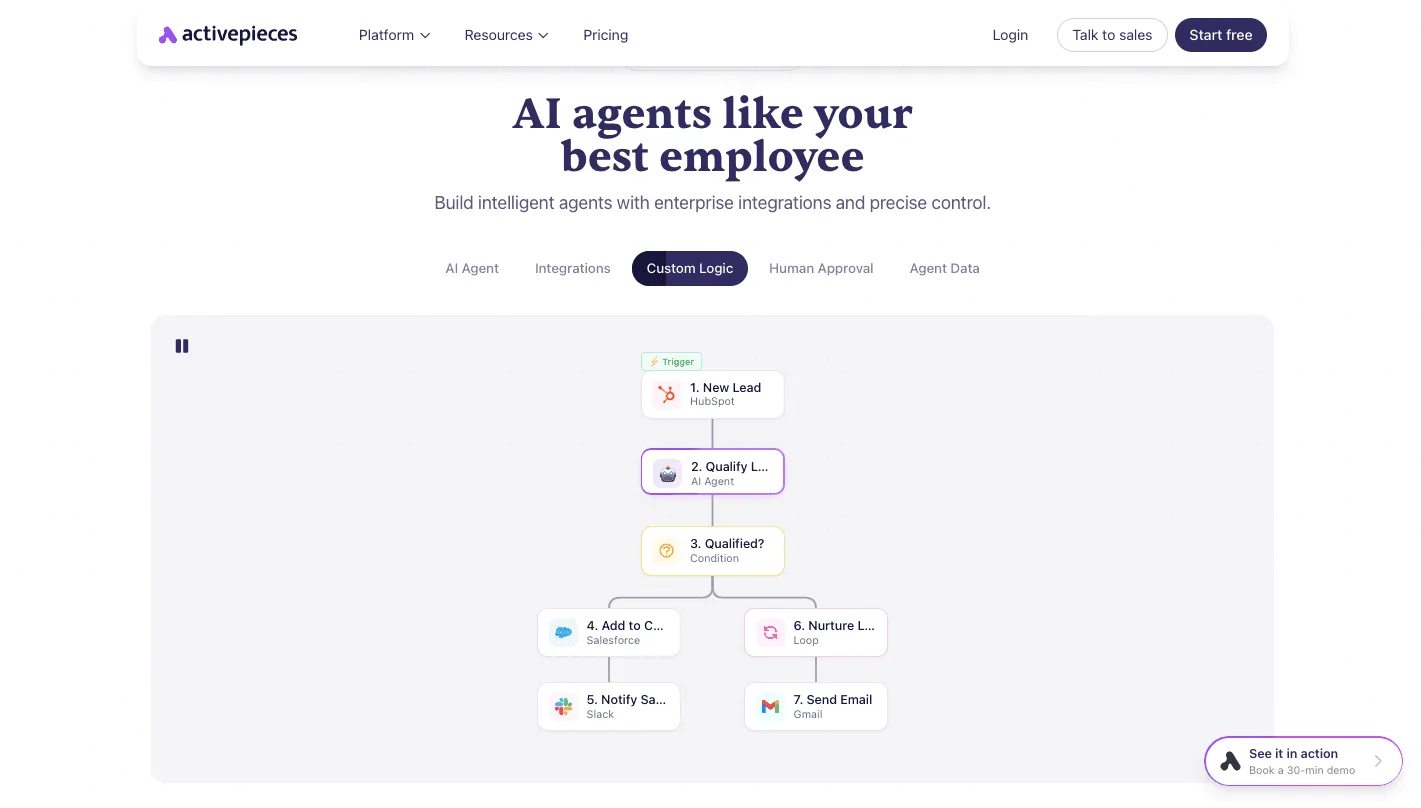
By connecting your coding assistant to this open protocol, the agent gains real CRUD control over 735+ integrations rather than just answering questions about them. This moves you from a role of "writer" to "final reviewer."
Everything below works on Activepieces' free plan. Start without code or a credit card.
Standardized communication for agents
The Model Context Protocol (MCP) serves as the universal interface that allows these agents to step outside their internal weights and interact with the real world. It functions as an open standard that replaces the need for custom, brittle integrations for every new developer tool.

By using MCP, an agent can query a database, read a local file, or trigger a cloud deployment using a standardized tool schema.
This protocol ensures that whether you are using Claude Code or a custom IDE, the agent understands exactly what capabilities are available to it at any given moment.
The leading agentic coding environments
You own the fallout when these automated loops hallucinate, making the choice of environment a matter of liability as much as productivity.
In the modern IDE, autonomy is measured by a tool's ability to decompose a high-level request into a sequenced execution plan without human intervention.
You own the fallout when these automated loops hallucinate, making the choice of environment a matter of liability as much as productivity.
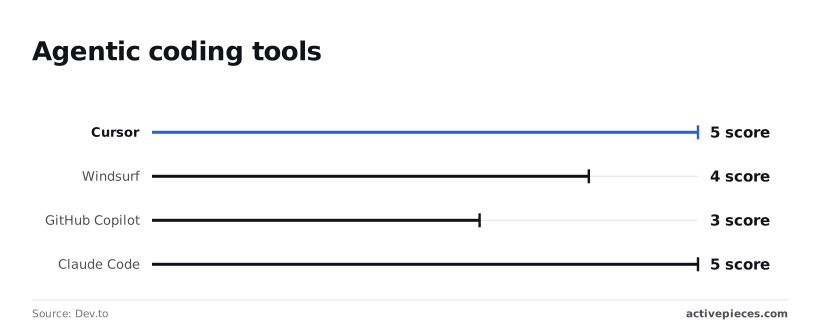
According to the Dev.to Agentic coding tools benchmark comparison, Cursor and Claude Code both earned a 5 score. This means they can independently map out architectural changes across a repository rather than waiting for you to suggest the next file to open.
Windsurf scored a 4, indicating a high degree of flow that still requires occasional manual steering to stay on track.
GitHub Copilot trailed with a 3 score. If you're using it, you must still act as the primary architect, manually breaking down large tasks into smaller, digestible prompts to avoid logic drift.
To ensure new code doesn't break existing dependencies, effective agents rely on their ability to ingest the entire project structure.
Docs states that Claude Opus 5.5 provides the deep reasoning required for these long-horizon tasks. This allows the agent to maintain a coherent mental model of a codebase throughout a multi-hour session.
When the IDE pairs these models with Retrieval-Augmented Generation (RAG), it can prioritize relevant local files. This allows the Gemini 3.8 Flash model to process only the most critical data to keep latency low.
Reliability is the delta between a suggested code snippet and a successful deployment. The following workflow illustrates how an agent moves beyond simple text generation to structured decision-making:
The canvas shows a document automation flow where a file is ingested from Google Drive and passed through a "File reader" agent before hitting a "Router" that branches based on risk levels. This visualization demonstrates that modern agents don't just write code; they manage the flow of data and provide specific exit points for human intervention when the "High risk" path is triggered.
By applying this structured approach, the system handles complex logic, like a database schema migration, with the same rigor as a simple UI tweak.
The utility of an agentic tool is defined by its permissions to interact with the underlying operating system and external services.
Claude Code operates as a CLI agent with direct access to the terminal, allowing it to run npm test or git commit as part of its primary loop.
Gemini 3.7 Flash is optimized for agentic workflows and excels at calling external APIs to fetch real-time documentation or cloud logs.
GPT-6 Astra uses advanced tool-use capabilities to orchestrate multi-step reasoning, such as identifying a bug in a containerized environment and drafting a patch simultaneously.
Cursor and Windsurf IDE integration explained
Deep IDE integration allows agentic tools to maintain a persistent internal map of your codebase. They can suggest architectural changes rather than just line-by-line edits.
This shift relies on the tool’s ability to "see" the entire project structure. This capability determines whether an agent can successfully refactor a multi-file authentication flow or merely break the imports.
The effectiveness of this oversight is governed by the context window. This window dictates how much of the repository’s history and file tree the model can process simultaneously.
It prevents the system from losing track of earlier definitions. The following table compares the current context limits for the primary models utilized within these integrated environments to show the boundaries of their immediate memory.
| IDE Tool | Model | Context Window (Tokens) |
|---|---|---|
| Cursor | GPT-6 Astra | 128,000 |
| Cursor | Claude Sonnet 5.5 | Up to 1,000,000 |
| Windsurf | Claude Sonnet 5.5 | Up to 1,000,000 |
Prices and plan limits checked against docs.claude.com and claude.com and openai.com and gemini.google on September 30, 2026.
A higher token limit allows the agent to ingest larger segments of documentation and source code without truncation.
This reduces the likelihood of the model hallucinating functions that were defined in files it has already "forgotten."
When these limits are reached, the IDE must rely on retrieval-augmented generation to swap pieces of the codebase in and out of active memory. This process can introduce latency or logical inconsistencies during complex migrations.
Proactive agency and flow
Beyond memory, the "Flow" state in these tools represents a shift toward proactive agency. The IDE anticipates the next required file change based on your initial intent. In Windsurf, this manifests as a continuous chain of thought that persists across terminal commands and file edits.

You act as a reviewer of the plan rather than a manual coordinator of discrete tasks.
To maintain this level of performance, you'll often require higher rate limits. The Google AI Plus tier at $4.99/ month provides 2x higher usage access than the $0/ month free tier, which means you are paying a premium to double your capacity.
This keeps the agent available during prolonged debugging sessions where frequent model calls are necessary to resolve regressions.
Easier to see it running than to read about it: set it up free, no card.
GitHub copilot workspace: from task to pull request
GitHub Copilot Workspace transforms your role from a line-by-line editor into a systems reviewer. It automates the bridge between a GitHub issue and a functional pull request.
Unlike traditional autocomplete tools that react to the current cursor position, this environment treats your entire repository as a mutable context.
The system relies on a structured "Plan-to-Code" cycle to ensure that the agentic output remains grounded in your existing architecture rather than hallucinating isolated functions.
This cycle provides a formal audit trail for every automated change. This is necessary because you remain the party responsible for production outages caused by logic errors.
The workflow follows a specific sequence:
- You provide natural language task input.
- The agent generates a step-by-step plan.
- You review or edit the plan.
- The agent executes code across files.
- The system handles pull request generation and final validation.
Before a single line of code is written, this progression ensures that you validate the logic. It reduces the time spent debugging syntactically correct but logically flawed implementations.
Once the plan is approved, the agent performs multi-file edits simultaneously. This eliminates the manual overhead of tracking dependencies across a complex codebase.
Long-horizon task management
The effectiveness of these long-horizon tasks depends on the underlying reasoning model's ability to maintain context over hundreds of files. While GitHub leverages its own ecosystem, you'll often supplement these workflows with external reasoning models for complex architectural planning.
For instance, Anthropic offers a Free tier at $0 for basic access, so users can explore the platform's capabilities without an initial financial commitment.
Their Pro tier at $17 per month (when billed as a $200 annual upfront payment) provides higher usage limits for models like Claude Opus 5.5, effectively locking the subscriber into a long-term service agreement to secure the discounted rate, which means users forfeit the flexibility to cancel without losing the prepaid value.

This higher tier is required if you're managing large-scale agentic coding tasks that exceed the token limits of free versions.
By centralizing the planning and execution phases within the workspace, the friction of switching between a requirements document and a code editor is removed. The resulting pull request is a documented realization of your original intent.
Activepieces: orchestrating the DevOps lifecycle
To ensure agentic intent translates into production-ready infrastructure, Activepieces connects disparate developer tools through a visual logic engine.
Every connector in the MIT-licensed core is exposed as a tool schema on a per-project MCP server, reachable from Cursor or ChatGPT.
When an agent modifies a flow, the resulting tool calls and changes are logged in the run trace, turning your coding assistant into your automation builder. This shift reduces the risk of human error during repetitive deployment tasks.
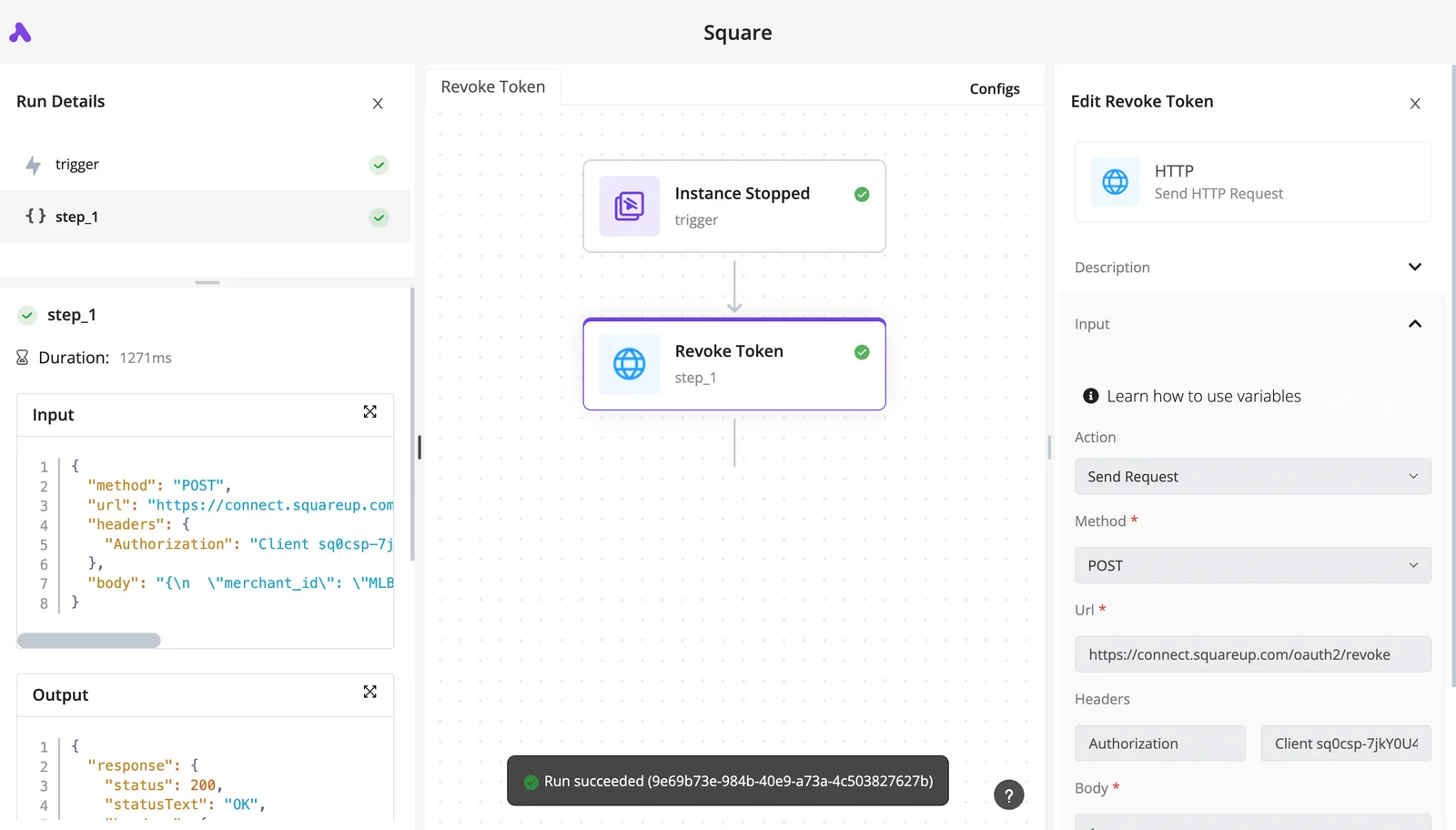
The platform operates through a node-based architecture where each step represents a discrete action in the software delivery lifecycle.
Triggers are events such as a new GitHub pull request or a Slack command that initiate the automation.
Actions are pre-configured integrations with services like Jira, Linear, or AWS that execute specific tasks without requiring custom API scripts.
Logic Gates are branching paths that allow the workflow to behave differently based on the success or failure of an upstream agentic task.
Reasoning in automated workflows
Dedicated AI steps handle the integration of agentic reasoning into these flows. In a typical configuration, you use the "AI Agent" step to process incoming chat messages or code snippets.
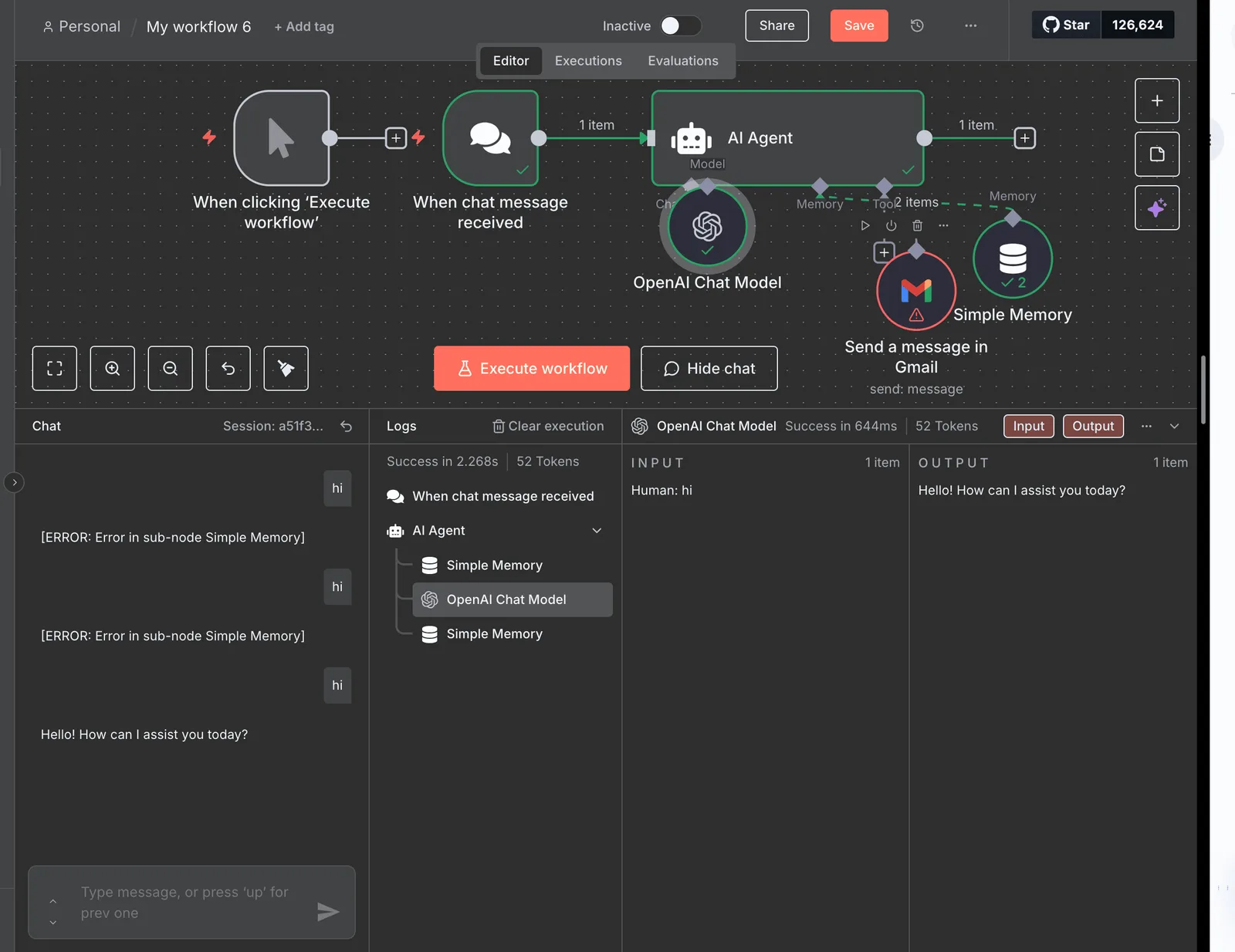
The following workflow demonstrates this interaction: the system receives a "hi" trigger, routes it through an OpenAI Chat Model, and maintains context via a Simple Memory sub-node.
By externalizing the memory and model selection from the underlying code, you can swap a Gemini 3.8 Flash model for a GPT-6 Astra instance without refactoring your entire deployment pipeline, thereby significantly reducing the technical overhead required for system updates, so developers can iterate on model performance with minimal downtime.
This allows for immediate performance upgrades as model capabilities evolve.
This modularity ensures that the "intent" captured in the initial pull request is preserved as it moves through testing and staging.
When a sub-node reports an error in the execution logs, you can pinpoint exactly where the agentic logic failed. This might be a model error or a broken API connection. This visibility avoids the "black box" problem common in monolithic AI implementations.
For developers seeking to transform their coding assistant into a functional automation builder, Activepieces is the better choice.
By exposing its entire library of connectors as tool schemas through an MCP server, it allows agents to modify flows while providing full visibility via the run trace.
This integration ensures that agentic intent is backed by a production-ready visual logic engine, making it the superior fit for orchestrating the DevOps lifecycle.
Implementing an agentic workflow
Orchestrating intent requires you to transition from manual line-by-line authorship to the role of a systems architect. You define the "what" and "why" while the agent determines the "how." This shift demands that you manage the high-level logic and edge-case constraints.
The underlying models now possess enough context to navigate entire file trees independently.
When you move from writing a specific function to describing a desired state, the primary point of failure shifts from syntax errors to logic gaps in your initial prompt.
Successful implementation depends on matching the specific capabilities of a frontier model to the complexity of your codebase.
When you move from writing a specific function to describing a desired state, the primary point of failure shifts from syntax errors to logic gaps in your initial prompt.
Different models excel at different stages of the development lifecycle. A rigid, single-tool approach often creates bottlenecks in larger projects.
Gemini 3.8 Flash provides a high-context window for enterprise workflows, allowing the agent to ingest massive documentation sets without losing track of project-specific conventions.
Claude Opus 5.5 handles long-running agentic coding tasks, which reduces the need for constant human re-intervention during multi-hour refactoring sessions.
GPT-6 Astra focuses on complex reasoning and cross-file dependencies so that a change in a database schema is reflected in the frontend API calls without manual mapping.
Grok 4.7 is a flagship for general-purpose code generation, providing a balance if you require a single model to handle both script generation and architectural advice.
Autonomy and environment choice
How much autonomy an agent can safely exercise is also dictated by the choice of environment. Cursor, a code editor, integrates these models directly into the workspace. This means the agent can see every file in your project simultaneously.
In contrast, GitHub Copilot Extensions allow for specific third-party integrations.
This limits the agent’s scope to approved external services. By constraining the agent to a sandbox or a specific set of tools, you ensure that an autonomous mistake remains isolated within a controlled testing environment rather than propagating to a production branch.