Best Insurance Agency Automation Software for Agents

Nov 24, 202614 min read
1. TITLE: Best Insurance Agency Automation Software in 2026 Compared
Everything below works on Activepieces' free plan. Start without code or a credit card.
Insurance agency automation software: short answer and comparison
Best insurance agency automation software by agency type
Automate inside the agency management system you already pay for, which means HawkSoft or Applied Epic for most agencies, and bring in a workflow tool only for jobs that cross systems.
HawkSoft suits smaller agencies, Applied Epic suits larger ones, and Zapier or Activepieces covers the gaps between them and everything else.
It comes down to ownership. Executives approve automation in a meeting. Then the person who maintains it is an account manager or operations lead who has never opened a workflow editor.
Automation that lives next to the client record, in a tool that person already uses daily, survives that handoff far more often than a second system with its own logins.
What counts as insurance agency automation
Here it means rules that move work without someone retyping it:
- renewal reminders
- certificate requests
- new-client intake
- follow-ups on unpaid items
- handoffs between producers and service staff

Two things decide where each job belongs. The first is where the client data lives; if a job only reads and writes policy and contact records, it belongs inside the management system.
The second is who maintains it; if that person can't fix a broken step without a developer, the tool is wrong for you however capable it looks.
Before you read the prices, know how they were checked: against each vendor's own pages in November 2026. "Published" means a plan price is listed on the site. "Quote only" means you must contact sales.
Comparison table: price, strength, limit, best for
On the same five points, the table below judges all four. The split to notice is that the two management systems keep automation near the client data, while the two workflow tools reach across apps but sit outside the record.
| Tool | Price (checked Nov 2026) | Strength | Limit | Best for | Self-hosting |
|---|---|---|---|---|---|
| HawkSoft | Quote only | Automation next to the client and policy record | Reaches only what the system exposes | Smaller agencies staying in one system | No |
| Applied Epic | Quote only | Workflow tied to a broad agency record | Changes may need vendor or specialist help | Larger agencies with defined processes | No |
| Zapier | Published | Wide app coverage, easy for non-coders | Cost rises with task volume; data passes through its cloud | Quick links between everyday apps | No |
| Activepieces | Published | Open source, runs on your own servers | Someone must maintain it; insurance-system connectors not confirmed here | Teams needing data on their own infrastructure | Yes |
HawkSoft for small insurance agencies
You will hit the limit of HawkSoft's automation at the same place you find its strength. It is an agency management system for small and mid-size insurance agencies, and its automation stays on the client records it already holds.
You will hit the limit of HawkSoft's automation at the same place you find its strength.
What the vendor says it automates
As the vendor describes it, automation is work attached to the client file:
- tasks that follow from what is already recorded about a policy or a contact
- reminders that follow from what is already recorded about a policy or a contact
- routine communications that follow from what is already recorded about a policy or a contact

Because the data never leaves the system, nobody has to ask whether a copy in another tool is current.
The service staff who maintain it will mostly care whether the rules can be changed without calling the vendor. Check HawkSoft's own feature pages for the exact list, because this article only repeats what the vendor describes.
Price and plan details as checked
We didn't confirm a published list price for HawkSoft, so treat it as quote-based until the vendor says otherwise. That means you can't compare it with a per-task tool from a pricing page.
Ask for the per-user cost, and ask whether the automation features you want are in the base agreement or priced as add-ons.
HawkSoft automation limits for insurance agencies
The moment a process starts in a place HawkSoft doesn't watch, such as a chat channel, a shared inbox, or a client form on another system, you need something in between, because automation here stays inside the HawkSoft ecosystem.
At that seam, a separate workflow tool earns its place.
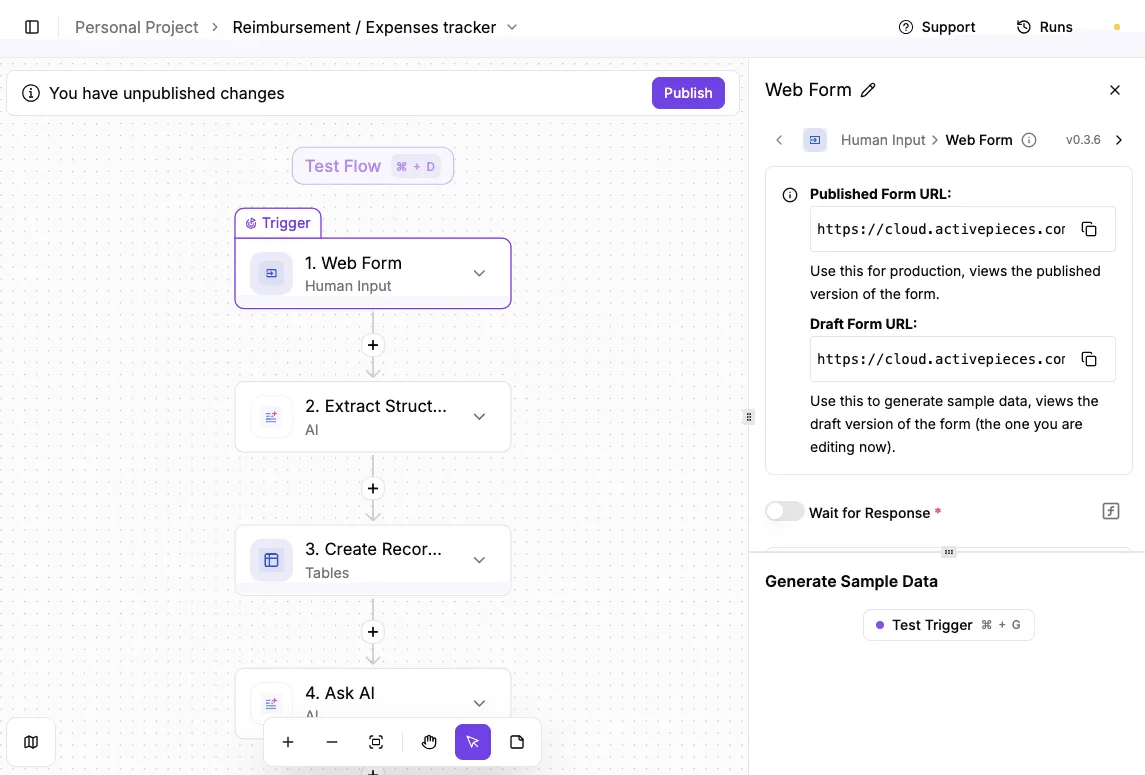
A typical gap flow starts when a new message arrives in a team chat channel, writes a record of it, has an AI step judge whether the sender needs help, routes the result, and sends a reply back to the channel.

Edit the flow and nothing changes until someone presses publish; the builder warns that changes are unpublished. A flow like this works only while someone owns it, and the person who owns it is usually an operations manager, not a developer.
Applied Epic for larger insurance brokerages
For larger agencies and brokerages, Applied Epic is the agency management system, and its automation works best when your client records, policies and workflows already sit inside Applied's one platform.
When a job starts from a record Epic holds, the automation can act on it: client files, policies and the tasks attached to them. That's the case for staying inside it.
A workflow that fires from the policy record needs no sync, no copy of the data and no second login to audit. The limit is that it reaches only what Epic holds, so any job that starts outside Epic needs help to get in.
How much help to expect depends on scale.
Applied Systems states that Applied Epic connects 38,000 agencies, EZLynx 37,000 and AMS360 20,000.

At 38,000, Epic's count is the largest of the three, and EZLynx is only about 1,000 agencies behind it, so a large installed base isn't unique to Epic.
In practice, carriers, vendors and consultants know Epic well, so finding someone to build and maintain its workflows is easier.
I won't put a number on Epic's price, because the sources behind this comparison don't give a published list price. Budget from a quote, and ask for implementation to be priced separately from the licence.
At this size, rollouts usually go wrong in the second cost: configuration, data cleanup and training.
Ask how many staff hours the vendor assumes your team will give up during setup, because that figure is often missing from the first proposal.
Because Epic is a single-vendor system, its automation stops at its own edge. The gaps agencies hit first are the jobs that begin or end somewhere else:
- Web forms that capture a prospect before a client record exists
- E-signature, where a signed document must return to the right file
- Spreadsheets that producers and account managers still keep, and that never sync on their own
Each is a handoff between Epic and another tool, which is the gap a separate workflow tool is for.
Easier to see it running than to read about it: set it up free, no card.
2. Zapier for connecting insurance apps
If you need to connect an agency system to the other apps around it, Zapier is a hosted, no-code tool with a large app catalogue, and it bills by task.
A task is one completed action in a workflow, so a zap that files a document and sends a notice uses two.
Plans and list prices as checked
Below are the three entry plans, so you can find one that works for you. The gap between the Professional and Team prices is the point: the second is billed monthly, and the first only reaches its low price with annual billing.
| Plan | Tasks per month | Monthly price | Billing basis | Check date |
|---|---|---|---|---|
| Free | 100 | $0 | None | 2026-11-24 |
| Professional | 750 | $19.99 | Annual billing | 2026-11-24 |
| Team | 2,000 | $103.50 | Monthly billing | 2026-11-24 |
At 100 tasks, the free plan disappears quickly, so it works for a trial of one workflow and not for a live book of business.
Past these tiers, cost follows volume. Latynex Labs puts 1,000 tasks at $39 a month, 10,000 at $129 and 50,000 at $289.

That means fifty times the volume costs about seven times the price, so the per-task cost falls as you grow.
Insurance jobs it suits
Where a job is a short, event-driven handoff, Zapier fits: a web-form enquiry that creates a record, a signed document that triggers a notice to the account manager, a renewal date that sends a reminder.
Someone in operations can build and edit these without a developer.
Confirm that your agency system appears in Zapier's app catalogue, and check which triggers and actions it exposes, before you plan around it.
Because Zapier runs only as a hosted service, with no self-hosted edition, client data in a workflow passes through its servers. That is a question for whoever answers to your carriers and regulators, not just whoever builds the zaps.

Run a workflow over every policy on a renewal list and it uses a task per row, so a monthly batch can use up a plan's allowance in one run.
Estimate tasks per month from your real volumes before you pick a plan.
3. Activepieces
If the gap you need to close sits between systems, Activepieces connects them through 750 integrations (so there are likely pre-built connectors for what you're already using) under an MIT-licensed core, so you're not locked into proprietary licensing, and you can self-host it or run it in your cloud; it doesn't replace your agency management system.
It fits the gaps between systems: a web form, an approval, an email, a payment record. It doesn't hold client records, policies or renewals, so it can't be the system of record.
If your management system already automates the job natively, build it there and keep this for what crosses the boundary.
A larger agency worried that self-hosting means a cut-down product can set that aside: the air-gapped self-hosted build keeps the same enterprise controls as the managed cloud, including single sign-on, role-based permissions, an audit trail of who changed what, and a place to keep secrets.
MoneyGram, Moneypenny, Alan and FundingSocieties run Activepieces in production.
I have no confirmed list price or task allowance for Activepieces to quote here. Read the vendor's pricing page against your own monthly task estimate before choosing cloud over self-hosting.
Self-hosting changes who carries the cost: you pay in maintenance time instead of plan fees, and someone must own that.
Worked workflow: web quote request to task and email
100 leads received, 30 contacted, 15 quoted and 3 bound: that is the typical agency funnel, according to Startkadence. That means 70 of every 100 leads are never contacted at all, so the first touch is where automation earns its place.

In six steps, the canvas below shows the pattern: a web form collects the request, AI extracts the fields, a person approves, and the flow branches on the decision, so the reader must refer to the visual diagram to understand the full process.
Take from it that the human approval step is built in, not bolted on.

Look at the ends of the canvas: Stripe and Gmail sit there, which shows a document workflow.
For a quote request, keep the first four steps and change the ends: an accepted request creates a task for the producer, and a rejected one sends a polite email, so the quote flow's implementation reduces to customizing the final decision branching.

Neither end needs your management system to expose a connector.
Test three things before you roll out, because they remain unconfirmed:
- Whether Activepieces has a connector for your management system. I couldn't confirm one, so you may be using a generic web request step or file import.
- Who edits the flow when a field changes. The canvas is visual, but a producer has to be willing to open it.
- Whether the approval task suits your team. Run ten real requests through it and see whether anyone looks at the queue, because the 70 uncontacted leads are usually a habit problem, not a tooling one.
Activepieces is the better fit for larger agencies that need to keep automation inside their own network without giving up enterprise controls.
The air-gapped self-hosted build carries the same list as the managed cloud (single sign-on, SCIM, custom role-based permissions, audit logs, release management and secret managers), so choosing full control over where it runs doesn't mean accepting a fraction of the product.
That holds on the criterion of deployment control, and it doesn't change the limits noted above: it connects systems at the boundary and is not a system of record, so where your management system already automates a job natively, build it there.
Frequently asked questions
Do I need a separate tool if my agency system has workflows?
Usually not: if your agency management system's own workflows cover the job, build there, and add a separate tool only where data has to cross into another system. The test is whether the trigger and the record both live in one place.
Renewal reminders do. Pushing a signed form from a document service into a carrier portal doesn't.
One connector is still unconfirmed: whether Zapier offers a HawkSoft connector. Check Zapier's app directory before you plan around it.
Can insurance agency automation run self-hosted for client data?
Yes, but only with a tool that ships a self-hosted edition. n8n has one.
Zapier runs only as a hosted service, so every client record it touches passes through the vendor's cloud. Your management system may already be hosted by its vendor, which means the data is off your premises regardless.
If you self-host, maintenance moves onto you: someone must apply updates, back up the instance and answer when a flow stops.
If nobody on staff will own that, hosted is the safer choice even for sensitive data. Confirm the vendor's data-handling terms in writing either way.
Which option costs least for an agency of five people?
Use the workflows already included in your agency system, because they add no second subscription. Confirm they are in your plan rather than a paid add-on.
What Epic charges for its automation features is unconfirmed, and I wouldn't guess; ask your account representative for a written quote.
With separate tools, the bill works differently. Zapier and Make charge by usage, so a busy renewal season raises the bill. A self-hosted tool swaps the subscription for server and maintenance time. Price the busiest month, not the average one.
What should an insurance agency automate first?
Start with the task that is repetitive, rule-based and already painful: renewal reminders, certificate requests, or moving new-client intake into the client record. These share a useful trait. A mistake is visible fast, and a producer can fix it without a developer.
Before you build anything:
- Name one person who owns the automation and can edit it when a carrier or form changes.
- Run it on a handful of real records and have someone compare the output against the file.
- Keep the manual process available for a full renewal cycle.
In the abstract, executives tend to approve automation. The person who finds out it failed is the account manager with a client on the phone, so involve that person in the test.