
Celigo Alternatives: 7 Integration Platforms Compared

Nov 15, 202616 min read
Which rival lists the There's no competitor compliment, number, or product name in "most connectors is the wrong question," so there's nothing to rewrite. It looks like the original sentence may have been cut off.
Paste the full sentence and I'll return just the revised version. The right replacement depends on why you're leaving, whether that means tools like Activepieces for teams that want a different style of automation or something more specialised.
Celigo is an integration platform as a service (iPaaS) built around ERP-centred back-office work.
Celigo alternatives by reason for leaving
What Celigo is and what it is built for
When the work is moving orders, invoices and inventory between an ERP (the system of record for finance and operations) and the commerce and warehouse apps around it, Celigo is at its There's no sentence to rewrite.

Your message contains only the word "strongest." Please paste the full sentence, and I'll return a version that keeps the facts, numbers, and product names and drops the superlative.
If your flows look like that, you're using the product as designed. Dissatisfaction with it is usually about the bill, about who controls the flows, or about work that falls outside that ERP lane.
Each of those three causes points to a different rival, which is why a single "best" answer would mislead you.
The tools that fit, in one sentence each
Read down the first column of the table below for your reason, then check that the audience in the second column matches your team. It sorts six alternatives by the reason for leaving each one answers.
| Tool | Reason for leaving it answers | Who it's for |
|---|---|---|
| Workato | Scope: broad enterprise automation beyond the ERP | Large organisations with a central automation team |
| Boomi | Scope: heavy, governed integration across many systems | Enterprise IT teams that manage integration as infrastructure |
| n8n | Ownership: you can self-host and control the flows | Technical teams that want to run the platform themselves |
| Make or Zapier | Price and scope: lighter, general-purpose app automation | Business teams building their own flows without developers |
| Power Automate | Price and scope: fits where Microsoft tooling is already paid for | Organisations standardised on Microsoft 365 |
| Activepieces | Ownership: open-source automation you can self-host | Teams whose needs are narrower than a full ERP integration platform |
Choose by the first column, then confirm the second. A team leaving over ownership who picks a scope-led enterprise tool has swapped one constraint for another. The sections below test each rival against the same criteria, and say where each one wins.
As of 15 November 2026, every vendor claim in this article has been checked against that vendor's own pages. Where a page didn't state a fact, it's left out rather than inferred.
A gap means the vendor didn't confirm it, not that the feature is absent. Confirm current terms with the vendor before you commit.
The fastest way to settle a shortlist is to try one. Activepieces is free to try, no credit card.
Reasons teams leave Celigo in sequence
Because the invoice changes first, cost is where The text came through as only "most departures start." There's no competitor, number, product name, or superlative in it to rewrite. Could you paste the full sentence?
The four reasons below run in the order teams usually hit them, so find your stage and read its staying note before you shop.
- Renewal cost rises with endpoints and flows. Stay if your connected systems and flow count have stopped growing.
- Flows need IT. Stay if you already employ the people who build and maintain them.
- The scope is too heavy or too narrow. Stay if ERP-centred work is most of your volume.
- Non-ERP work fits badly. Stay if those jobs are few enough to hand to a small side tool.
Below, each gets a subsection in turn.
Price that scales with connections
Add a system and the next renewal goes up. Celigo's pricing follows the number of connected endpoints and flows, so every new system or process adds to it.
The ledger is simple. A team that adds a warehouse system, a returns portal and a second storefront has added three lines of cost and three more flows to run.
Because many vendors in this category quote rather than publish prices, a like-for-like comparison needs a written quote at your own connection count.
In practice, flows land with IT or an integration specialist, because Celigo's own documentation assumes a builder who understands the ERP's records, mappings and error queues. Each change request waits in their queue.

If finance operations owns the process but can't edit the flow, the cost of every tweak is a ticket and a delay.
There are two ways for scope to be wrong. Too heavy means you pay for ERP-grade order-to-cash and inventory machinery while the real need is a handful of notifications.
Too narrow means the reverse: you need approvals, internal alerts or marketing handoffs that sit outside the back-office core. In both cases the platform's design is doing what it was built for. The mismatch is yours.
When staying on Celigo beats migrating
If the ERP sits at the centre of your integrations and the flows are owned by a team that already knows the platform, the renewal is likely fair for what you receive. That holds while the endpoint count is stable.
Migration has its own cost: rebuilt mappings, retested error handling and a period of running two systems. Leave when one of the reasons above is costing you more than that switch.
Evaluation criteria for Celigo alternatives
Judge every alternative on the same seven criteria, and weight connector count last. The reason you're leaving decides which criterion matters, and a long connector list answers none of them. The criteria, applied to a 10 to 50 person operations team, are:
- Whether it connects the apps you run, meaning NetSuite for the ERP, Salesforce for the CRM and Shopify for the storefront, and how deeply it handles custom fields and records rather than whether a logo exists.
- Who builds and maintains the flows. If only an integration specialist can edit them, every change waits in that person's queue.
- Self-hosted or cloud. Self-hosting gives you data control and costs you upgrades and uptime.
- SSO, roles and audit logs, which decide whether finance and IT will approve the tool at all.
- Approvals, meaning whether a human can hold a flow until someone signs off, such as a large refund or a vendor bill.
- Error handling and retries. A failed order sync that retries on its own is invisible; one that silently drops is a reconciliation job on Monday.
- Pricing model and cost at your volume. Per-task, per-flow and per-user billing diverge sharply once a team runs steady order and invoice traffic.
Because it's the easiest criterion to satisfy and the least informative, connector count ranks last. Nearly every serious platform can reach those three apps.
After the first successful test, the difference is behaviour: how it pages through large record sets and what it does when the ERP rate-limits a call. It also matters whether a non-specialist can read the failure and fix it.
Choose fewer connectors, a clear error queue and a bill you can forecast, and you will spend less. Choose a thousand connectors and an opaque failure log, and you will spend more.
Connector depth belongs in a proof-of-concept run on your own data, not in a comparison chart.
Of the seven, two usually decide the outcome: who builds the flows and how the pricing model scales. Those are the ones to hold against the three reasons for leaving, starting with price.
Reading a table only gets you so far. Build the same workflow in Activepieces and compare it yourself.
Alternatives compared by reason and fit
Match the alternative to your reason for leaving: quote-only enterprise platforms for scope, self-hostable tools for ownership, published-price tools for cost. The table below shows which vendors publish a price at all.
It was checked on 15 Nov 2026. Where a row says "quote only", you can't work out your bill before a sales call.
| Tool | Price | Strength | Main limit | Suits |
|---|---|---|---|---|
| Celigo | Quote only | Prebuilt back-office flows around ERP systems | No public price to test a budget against | Finance and operations teams running an ERP |
| Workato | Quote only | Governance and enterprise-scale recipes | Opaque cost, heavy for small teams | IT-led enterprises |
| Boomi | Quote only | Mature integration, including legacy and hybrid estates | Steeper learning curve | Large organisations with mixed old and new systems |
| n8n | On vendor page | Self-hosting, with code when you need it | Self-hosting means you run and patch it | Technical teams |
| Make | On vendor page | Visual multi-step scenarios | Lighter governance controls | Operations teams building their own flows |
| Zapier | On vendor page | Broad app catalogue, fast setup | Cost grows with volume; shallow on ERP work | Non-technical teams |
| Power Automate | On vendor page | Tight Microsoft 365 integration | Weaker outside the Microsoft estate | Microsoft-first shops |
| Activepieces | On vendor page, free tier | Open source, cloud or self-hosted | Less ERP-grade connector depth than Celigo or Boomi | Teams that want ownership |

Read the price column first. Three of the four quote-only rows are the tools that match Celigo's scope, so leaving over price rarely means swapping one of them for another. What follows takes each group in turn.
If the complaint is price, neither Workato nor Boomi fixes it, though both match Celigo's scope. Workato wins on governance and recipe reuse across large teams.
Boomi wins where legacy systems sit beside cloud ones. Pick either if the reason for leaving is scope, not cost.
When ownership is the grievance, n8n is the pick. You host it, you hold the data, and you can drop into code when a connector falls short. The cost is labour: someone on your side now runs upgrades, backups and uptime.
For branching flows built visually at a published price, Make is the fit. Zapier suits teams that want the widest catalogue and the fastest first automation. Neither carries the ERP depth Celigo does. Check your accounting and inventory steps before committing.
Does a longer exception path cost more to run? On Zapier's pricing page the unit is the task and on Make's it is the module, so every step you add to a flow adds to the run's cost.
Activepieces' pricing page states 1 credit per flow run, any number of steps, so a ten-step flow costs what its two-step workaround did, and the Free plan's 1,000 credits a month cover 1,000 runs of the approval-and-error-branch flow shown later.
MoneyGram, Moneypenny, Alan and FundingSocieties run Activepieces in production.
If your identity, email and documents already live in Microsoft 365, Power Automate adds the least new administration. Outside that estate its advantage fades, and a mixed stack is better served by n8n or Make.
The strongest case for staying on Celigo
Staying on Celigo is the right call when your flows are ERP-centred order-to-cash. It's the wrong one when they are app-to-app or when price or ownership is what pushes you out.
On the staying side, the case is concrete. Celigo ships prebuilt integration apps for ERP and commerce systems, so the order, inventory and fulfilment mappings already exist and Celigo maintains them.
When a record fails, Celigo's managed error recovery surfaces it and lets you retry it inside the platform, instead of in monitoring you wrote yourself. Leaving gives up both, and the cost arrives in this order:
- Inventory the flows. List every flow, its field mappings and its retry behaviour. A flow nobody documented gets discovered after cutover, as a missing order.
- Rebuild in the new tool. The prebuilt apps become flows you build by hand, so you now own mappings that Celigo used to maintain, and every future ERP change lands on your team.
- Re-test with live ERP data. Sandbox records rarely contain partial shipments, split payments or odd tax cases. Skip the live data and your first customer finds the gap.
- Run both in parallel. Both platforms touch the same ERP, so you need a guard against duplicate orders, and you pay for two platforms until the old one is off.
- Cut over. Switch Celigo off only after the new tool has caught and recovered a real failure, because until then you've only assumed its error handling works.
Pay that bill only if what sits on the other side is worth more. For a team whose flows mostly run through order-to-cash, a lower price rarely covers steps two to four.
For a team whose flows are mostly app-to-app, the prebuilt ERP apps were never doing much work, so there's little to lose. The case for staying weakens.
The decision turns on one condition: whether most of your flow volume runs through the ERP's order-to-cash path.
Where Activepieces fits as a Celigo alternative
If most of your flow volume doesn't run through the ERP's order-to-cash path, Activepieces fits.
**The decision turns on one condition: whether most of your flow volume runs through the ERP's order-to-cash path.
It suits general cross-app workflows moving off Celigo, not integration apps built around the ERP, and because every plan, including free, allows unlimited flows, adding a process no longer adds a line to the renewal.
Where it fits and where it does not
If your Celigo flows are mostly alerts, record creation and approvals, you're paying for ERP depth you don't use.
Activepieces connects everyday apps through triggers and actions, drawing on 750 integrations, with an MIT-licensed core you can run on your own infrastructure, so you're not dependent on a third party for uptime.
If the bulk of your volume is order, invoice and fulfilment sync inside the ERP, Activepieces carries less ERP-grade connector depth than Celigo, since roughly 60% of its 750 integrations are community-contributed breadth across everyday apps, and the earlier condition sends you back to Celigo.
You choose the hosting. On the cloud plans, Activepieces runs the platform. If you self-host the MIT-licensed core, your team patches, upgrades and monitors it, so the licence saving becomes a staffing line.
Cloud plan pricing
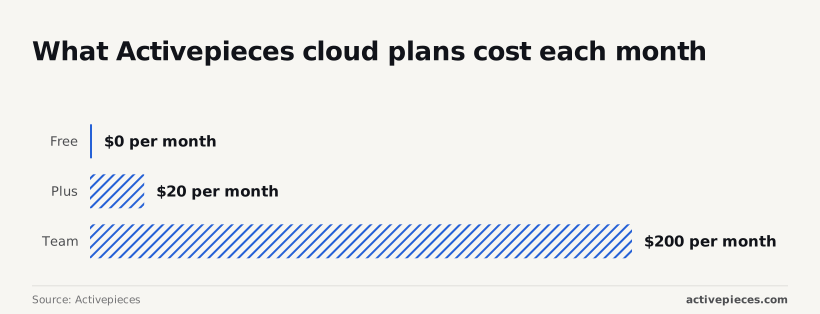
On the cloud plans the prices are flat and monthly.
According to Activepieces, the Free plan costs $0 per month, enough to build the flow below and see whether the tool suits your team before any budget approval, so there's no financial risk to getting started.
The Plus plan costs $20 per month, or $240 a year. The Team plan costs $200 per month, or $2,400 a year, ten times Plus, so move up only when the extra capability is something you need rather than something you might.
Example ERP order exception approval workflow
Short enough for one person to read in a minute: that is what to take from the flow below. It is a complete exception path built only from a trigger, three actions and an error branch.
- A webhook or new-order trigger starts the flow when an order arrives.
- A create-record action writes the order into your tracking system.
- A Slack message tells the owning team the order needs review.
- An approval step holds the flow until someone signs off.
- If any step fails, an error branch runs a notify-owner step, so a failure reaches a person instead of sitting in a log.
Look at the diagram's side note, which lists the ERP-specific order-to-cash apps this flow doesn't replicate. That gap is the line between a workflow tool and an ERP integration platform.
If your flows stay on the right side of it, browse the available pieces. Start free.
Frequently asked questions
Is there a free alternative to Celigo? Per Nodemiru: "free" covers the licence, not the work. n8n can be self-hosted at no licence cost.
The bill moves to the server, the person who patches it, and the hours spent rebuilding ERP mappings that Celigo shipped as prebuilt templates. If those hours exceed what you pay Celigo today, the saving is on paper only.
Can I migrate Celigo flows automatically? I know of no tool that converts Celigo flows into another platform's format, so plan on a rebuild.
What carries over is the documentation: field mappings and the list of which system owns which record. Export those first, because the new tool will need both. The old flows are the only complete record of them.
Is Celigo cheaper than Workato?
It depends on your quote, not on a rule. Both vendors price by negotiation, so the sticker comparison is meaningless.
Ask each for a price on the same basis: the same number of connected apps, the same flow count, the same environments. Then compare the totals. A cheaper first-year figure with a steep renewal uplift is the more expensive contract.
Do I need an iPaaS or is a no-code tool enough?
If your flows are short, tolerate occasional failure, and are owned by the people who built them, a no-code tool is enough. You need an iPaaS when the flows move orders or invoices through an ERP. A silent failure there becomes a reconciliation problem.
The test is simple: if a dropped record would cost someone an afternoon of cleanup, buy the error handling.
What should I do before I cancel Celigo?
Find the notice date in your contract before anything else, since auto-renewal can lock in another term. Then inventory every live flow, rank them by what breaks if they stop, and rebuild the most critical one in the new tool first.
Run both in parallel and compare outputs record by record. Cancel only after the new flow has matched the old one through a full close cycle, and keep an export of the old configuration after the account lapses.
Related reading
References
Still comparing
The fastest way to settle it is to build something.
Open source under MIT, so you can self-host the same thing later.
Start free Talk to sales