
Claude Max Automation: What It Covers and Costs (2026)

Nov 10, 202614 min read
Claude Max automation means automating work with what the subscription includes, namely the Claude apps and Claude Code, while anything that calls the API, whether it's a custom script or a workflow built in a tool like Activepieces, is billed separately, per token.
Use Claude Max subscriptions, not API calls
The direct answer and the fastest path
Take a job that reads 200,000 tokens and writes 20,000. On Opus 5.5, Anthropic's pricing page lists $4 to $20 per million tokens, depending on direction, which means one direction could cost 5 times as much as the other.
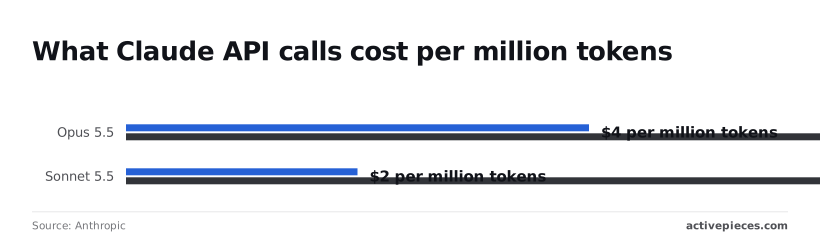
That run costs about $1.20, and 100 runs a day is $120, which compounds to $3,600 monthly, enough to end casual iteration.
Inside Max, the same work draws on your plan's usage allowance instead.
This was checked on 10 November 2026 against Anthropic's published pricing.
What Max includes: Max 5x and Max 20x
Max gives 5x the usage of the Pro plan at $100 per month, and the higher Max tier at $200 per month gives 20x Pro usage every week. Both cover the Claude apps, scheduled tasks and Claude Code under one login.

The multiplier governs how much you can run before hitting limits, not how much each run costs, so heavy daily automation inside Claude's a capacity question, not a billing one.
What Max does not include
Anything that calls the API sits outside the plan: scripts, scheduled jobs on your own server and third-party tools.
If a task must go that route, Activepieces can run it, and the run is the meter: 1 credit per flow run, so a ten-step flow costs what the two-step workaround did, whereas Zapier bills per task and Make per module, though the Claude tokens still bill separately.
At the cheaper end, the same 200,000-in, 20,000-out run costs about $0.60 on Sonnet 5.5 ($2 to $10 per million) and about $0.03 on Haiku 5.5 ($0.10 to $0.50 per million), so you could iterate 20 times on Haiku for each Sonnet run.
Small models make API automation viable for classification and routing.
Everything below works on Activepieces' free plan. Start without code or a credit card.
Compare five Max automation routes
Only where you pay them do per-token prices matter. Of these five routes, Claude Code GitHub Actions is the one that normally bills at those rates; the others draw on your Max usage only if they run through Claude Code under your subscription and not through the API.

| Option | What it automates | Unattended | Billing | Setup effort | What breaks | Beta |
|---|---|---|---|---|---|---|
| Scheduled tasks | Recurring prompts in the Claude apps | Yes | Max usage | Low | Task stalls when a connector loses authorization | Availability varies by plan |
| Projects | Saved instructions and reference files | No, you start each chat | Max usage | Low | Instructions drift from your real process | No |
| Connectors/MCP | Reads and writes in outside tools | Only inside a scheduled task | Max usage | Medium | Expired tokens, permissions too narrow | Some connectors are plan-limited |
| Claude Code headless scripts | Scripted terminal jobs | Yes, via cron | Max usage on subscription login; API if you supply a key | Medium | A stray API key silently changes the bill | No |
| Claude Code GitHub Actions | Repo events: pull requests, issues | Yes | API key, typically | Higher | Runaway loops on busy repositories | No |
Prices and plan limits checked against docs.claude.com and claude.com and openai.com and gemini.google on November 9, 2026.
Read the billing column before the effort column. A cheap setup that bills per token can cost more than a fiddly one that doesn't.
Recurring reports and briefings belong in scheduled tasks, with Projects supplying the standing instructions. Work that touches your own files or servers belongs in headless scripts, run under your subscription login.
Read the billing column before the effort column. A cheap setup that bills per token can cost more than a fiddly one that doesn't.
Anything triggered by a pull request belongs in GitHub Actions, and you should budget it as API spend from day one.
Set up your first automation
Everything that isn't pull-request-triggered can start on the Max side of the line in six steps.
Do the first three before anything runs unattended.
Start with a weekly digest of one folder or one inbox label, because stable inputs let you judge a run by eye and keep the instructions short. The first three steps are setup, and they cost nothing but attention:
- Pick a task with stable inputs: the same source, the same format, the same output each time. A task you must re-explain on every run isn't ready to automate.
- Open a Project and fill in its instructions field. State the output format, the audience and what to do when data is missing, so a run with an empty source fails visibly instead of inventing content.
- Add a connector under Settings > Connectors for the one source the task reads. Connect only that one, since every extra source is another place for the output to drift.

Steps 4-6: test, schedule, confirm billing
Run the task by hand several times before it runs without you. A schedule only repeats whatever you built, flaws included.
- Test manually in the Project chat, using real inputs, and edit the instructions until two consecutive runs need no correction, by the time they both pass you've eliminated one-off errors.
- Schedule it with Claude's scheduled tasks. If the work belongs in a terminal, script it with
claude -p "your prompt", which runs Claude Code non-interactively. - Confirm billing. Run
/statusinside Claude Code and check that it shows your Max login. IfANTHROPIC_API_KEYis set in your shell, Claude Code can use that key instead, and the run bills as API spend.
Usage limits that stop Claude Max automations
Because Max limits are rolling allowances, not fixed counts, an automation halts when your five-hour session or weekly allowance runs out, not after a set number of tasks.
Claude Max session and weekly usage limits
Usage resets on a five-hour window, with a weekly limit layered on top.
Even Claude's free plan works this way, with "limited usage every 5 hours and every week," so only the size of the allowance changes by tier, you're using the same system whether you pay or not.
Longer context burns allowance faster because each turn reprocesses everything before it, so a sprawling agent session costs more than the same task started fresh.
On Sep 24, one heavy Max 20x user tracked by CodingPlanLimits logged $1,404 of API-equivalent value per week. The figure then reached $1,510 on Oct 1, $1,727 on Oct 8 and $1,751 on Oct 12, with each week's total higher than the last.
That's one person's experience, not a guarantee, but it shows a flat fee covering about 25 percent more value in under three weeks; plan around a range.
When you run a long coding session in the morning, less is left for the report scheduled overnight, because chat, scheduled features and Claude Code draw from one pool. Stagger heavy jobs away from your own working hours.
Extra usage and when to move to the API
Extra usage lets work continue past the limit at metered rates. If you pay it every week, price that spend against the API directly.
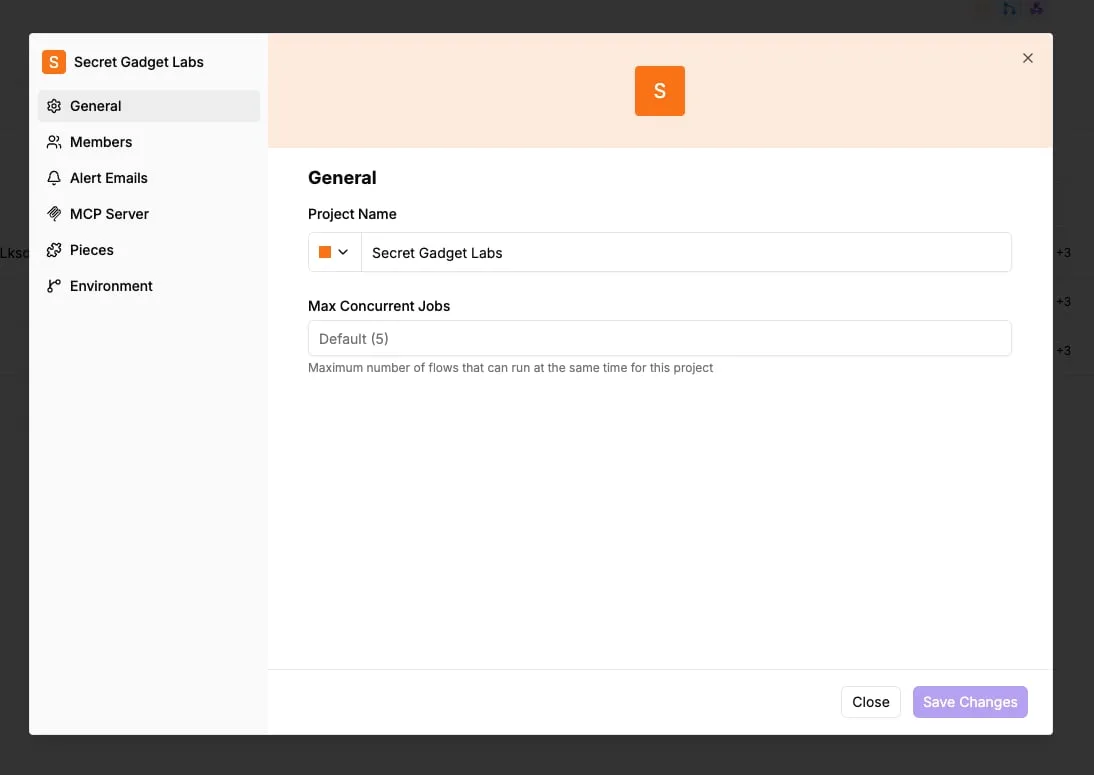
Once jobs move to the API, the workflow tool's own settings become the throttle. Here, Max Concurrent Jobs defaults to 5, the number of flows allowed to run at the same time in that project.


Every run it permits is billed per token, so the cost math starts from runs per day.
Easier to see it running than to read about it: set it up free, no card.
Claude Max automation errors and fixes
Two failures can cost money: a stray ANTHROPIC_API_KEY, which quietly moves a run from your subscription to per-token billing, and extra usage past the limit; the other failures only stop work.
The table below lists each symptom with its cause and fix, and marks whether Anthropic documents it, so you know which fixes to trust.
| Symptom | Documented cause | Fix | Status |
|---|---|---|---|
| Limit hit mid-run | Subscription usage is capped and shared across Claude surfaces | Wait for the reset, or move that job to the API deliberately | Documented |
| API key set | Claude Code prefers the key over the login | Unset the variable | Documented |
| Login expires in headless/CI | Interactive sessions do not suit unattended runners | Generate a long-lived token for the runner | Documented |
| Connector disconnects | No cause published | Reauthorize the connector | Unconfirmed |
| Scheduled runs not firing | No cause published | Check the schedule is enabled and the app is signed in | Unconfirmed |
When a run stops partway, it has hit the plan's shared usage cap. Heavy interactive use eats the same allowance your automations draw on, so a busy afternoon can starve the overnight job.
If ANTHROPIC_API_KEY is set in your shell profile or CI environment, the run bills per token even though you're logged in.
Because unattended runners can't repeat an interactive login, give them a token made for that purpose. For connectors, reauthorizing is the common remedy, but I can't point to documentation for why they drop.
Anthropic publishes no troubleshooting for missed schedules. Treat my checks as a starting point, and confirm any run that matters by looking for its output.
Automate across other apps with Activepieces
Activepieces suits event-triggered jobs that span several apps, with 747 integrations counted in its open source repo, but it calls Claude through the API, billed per token, so it adds a second cost that your Max subscription doesn't cover.
Its platform fee's a third line on top of that, though flows are unlimited on every plan, including free.
A sample workflow
In the screenshot below, a small flow named "Test Flow" starts with a weekly schedule trigger, a Google Sheets step pulls the next rows from an "Invoice" spreadsheet's "Bill reminder" sheet beginning at row 2, and a loop step handles each row.
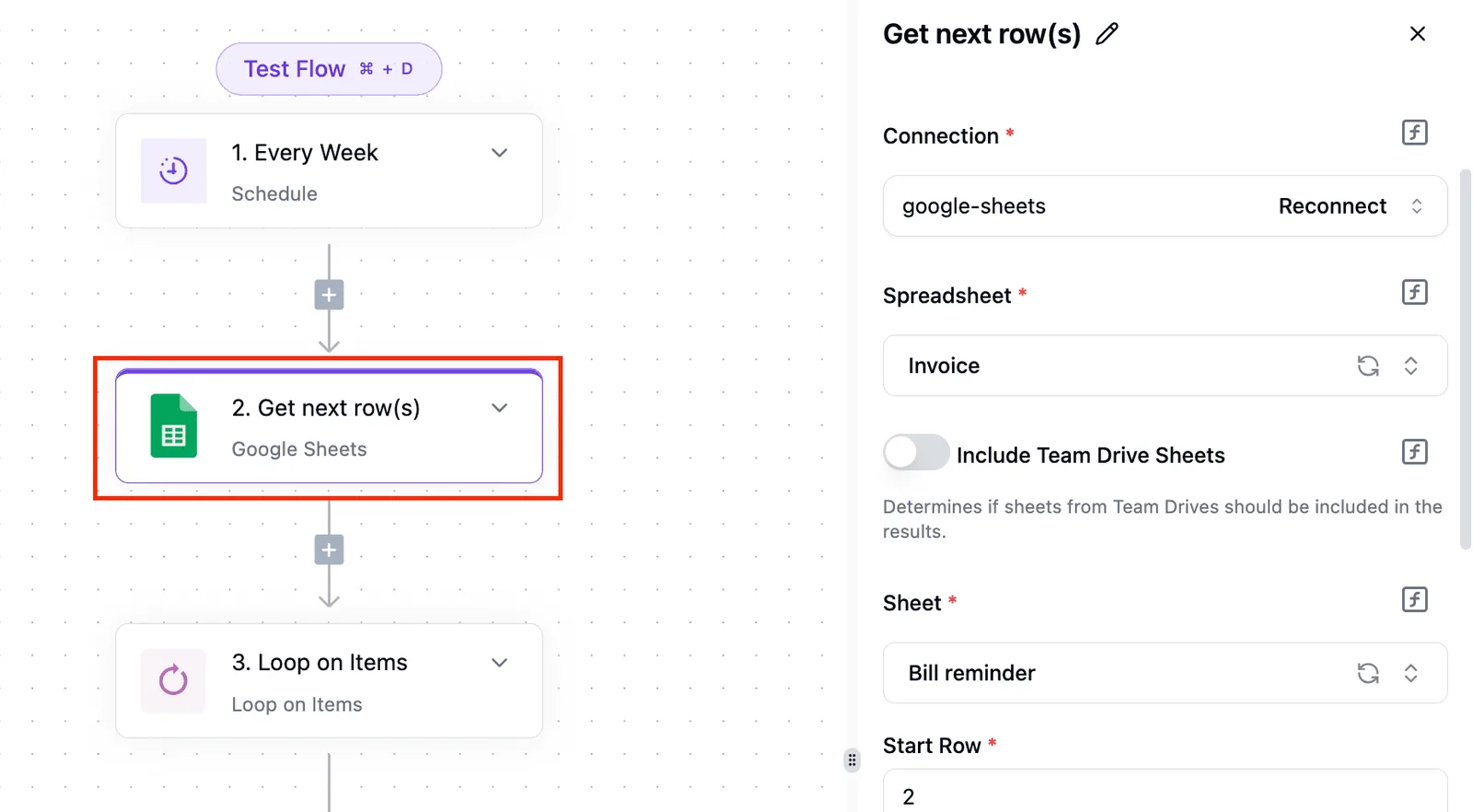
The highlighted configuration shows how plain the setup is: a connection, a sheet and a start row. Nothing in it needs Claude yet, which is the point. Add a Claude step to the loop and each row becomes a billable API call.
What it costs
Activepieces has a free plan with unlimited flows, self-serve Plus and Team plans at $20 and $200 a month, and custom-priced Ultimate and Embed plans through sales (pricing checked 2026-10-23).
For one weekly flow, the free plan's 1,000 credits a month can cover the platform side before a single token is spent. None of these plans includes Claude usage, so the real cost per run is the platform fee spread over your runs, plus tokens.
If a task lives inside Claude, a scheduled task or Claude Code covers it under Max, and no platform fee applies.
Reach for Activepieces when something in one app, such as a new spreadsheet row, must trigger work in another; a run is 1 credit however many steps it has, and with your own Anthropic key on Plus or above, the Claude step is 1 credit while the token cost lands on your own provider bill.
Cost per run then depends on your volume, so work it out before you build.
Start automating with Claude Max this week
- Pick one recurring task that takes you under an hour a week, such as a weekly summary or a recurring report.
- If a scheduled feature inside Claude can do the job, use that before reaching for Claude Code, and use either before writing anything that calls the API.
- Run it for a week and watch the Usage meter in your account. Note how much of your allowance the task consumed, and whether it hit a limit or needed you to step in.
- Decide. If the task fits comfortably inside the subscription, leave it there. If it crowds out your other work, or it needs to run unattended at a volume the meter can't absorb, move it to the API and price it per run.
Before you commit either way, recheck Anthropic's pricing and usage pages. Limits and plan terms change, and what you read last quarter may not describe what you're billed today.
Frequently asked questions
Billing and usage questions
Once you have a per-run number, the questions left are mostly about which side of the billing line a task falls on, and the answers below settle the common ones.
Can I use my Claude Max subscription with the API? No. API calls are billed per token to an API account, separate from Max, which covers Claude's own apps, scheduled and agentic features, and Claude Code.
Any script that calls the API adds a second meter to your monthly cost.
Is Claude Max worth it just for automation? Only if the automation runs through Claude's own features or Claude Code. If it calls the API, Max does nothing for that task's cost. Run the per-run math on one real task before you commit.
Does Claude Code run unattended on a Max plan? Claude Code can run non-interactively, but it still draws on your plan's usage allowance, so an unattended job can exhaust the allowance you need for interactive work.
Check the Claude Code docs for the current rules on authentication in automated runs.
Teams and plan changes
Can I share one Max plan across a team? Max's sold to an individual, so passing one login around isn't what it's for. A team that wants shared automation should look at Anthropic's team offerings or give each person a plan.
Do automations keep running if I downgrade to Pro? Don't assume they'll. Pro carries a smaller usage allowance, so heavy automations hit the ceiling sooner, and plan-specific features can change. Test one scheduled task after any plan change.
Quick answers
Some questions are short enough that the answer fits on one line. This table gives that line and the Anthropic page where you can confirm it.
| Question | Short answer | Anthropic source page |
|---|---|---|
| Can Claude Code bill to the API instead of Max? | Yes, if you authenticate with an API key. That usage is then billed as API usage. | Claude Code docs |
| Where do I see how much allowance I have used? | In your account's usage settings. | Usage docs |
| Does a larger model use my allowance faster? | Generally yes, so match the model to the task. | Usage docs |
| Where do I check what the API costs per token? | On the pricing page, by model. | Pricing page |
| How do I learn about changes to plan features? | Read the release notes. | Changelog |
If a row contradicts what you observe on your own meter, trust the meter and the linked page over this summary.