
Comparing Freshdesk Pricing 2026 Plans and Costs

Oct 10, 202615 min read
Freshdesk remains a top-tier choice for customer support teams, offering a scalable range of features that cater to both small startups and large enterprises.
As businesses look to streamline their workflows, many teams choose to connect their helpdesk to other tools using Activepieces, ensuring that data flows seamlessly between departments.
However, navigating the 2026 pricing structure requires a keen eye for detail, as the total cost of ownership often extends beyond the base monthly subscription.
From agent seats to advanced automation add-ons, understanding the nuances of each tier is essential for maximizing your return on investment.
Freshdesk pricing refers to a tiered subscription model that combines fixed per-agent monthly fees with variable costs for AI-driven automation credits and advanced workflow features.
Freshdesk pricing plans and core feature limits
Functionality is segmented by team size and operational complexity at Freshdesk. The pricing structure uses feature gating to separate basic ticket management from advanced AI-driven automation.
While the entry-level tiers provide the infrastructure for customer communication, moving from a reactive to a proactive support model requires jumping tiers to unlock SLA management and multi-channel routing.
The following table illustrates how Freshdesk distributes its core capabilities across the four primary service levels:
| Tier | Cost (Annual/Monthly) | Agent Limit | Core Features |
|---|---|---|---|
| Free | $0 | 2 Agents | Basic ticketing, Knowledge base, Social media integration |
| Growth | Paid Per Agent | Unlimited | Automation rules, Collision detection, Custom SSL |
| Pro | Paid Per Agent | Unlimited | SLA management, Multilingual support, Custom roles |
| Enterprise | Paid Per Agent | Unlimited | Skill-based routing, Sandbox, Audit logs, AI bots |
Prices and plan limits checked against support.freshdesk.com on October 10, 2026.
As a team’s internal governance requirements grow (such as the need for distinct permissions or environment testing) this progression ensures the per-user cost scales accordingly.
The Free plan for small teams
Startups may find a foundational helpdesk in the Free plan, but a two-agent limit caps its utility and prevents it from supporting growing departments.
According to Freshdesk, this program is available for free for 6 months for new businesses, giving startups a significant runway to scale before incurring software expenses, which means early-stage companies can preserve their limited capital during their most critical growth phase.
Once the introductory period expires, teams must prepare for a budget transition. Because it lacks automation and custom ticket views, agents must manually categorize every interaction, which creates a labor bottleneck as soon as ticket volume exceeds what two people can handle.

Growth: The entry-level paid tier
By removing the agent cap and introducing basic automation, the Growth tier allows teams to trigger actions based on ticket events like status changes.
It introduces "Collision Detection," which alerts agents when another person is viewing the same ticket so they do not send duplicate responses to a customer.
When developers need to extend these workflows to external tools, they often use Activepieces to bridge the gap between Freshdesk events and third-party databases without manual data entry.
Activepieces charges 1 credit per flow run regardless of how many steps or integrations are involved, which allows teams to build granular, multi-stage logic without the per-task tax found on other platforms.
This predictable metering, visible on the published pricing page, ensures that a ten-step data validation process costs the same as a simple two-step notification.
Freshdesk Pro tier features and SLA management
Service Level Agreement (SLA) management is introduced at the Pro tier. This is the only way for managers to set automated deadlines for ticket resolution based on business hours.
It also unlocks "Custom Roles," so an administrator can give a contractor access to respond to tickets without giving them the power to delete the entire customer database.
For companies operating in multiple regions, the Pro tier is the lowest level providing "Multilingual Knowledge Base" support. This forces a migration for any team that needs to serve customers in more than one language.

Enterprise: High-volume support requirements
Organizations that require strict change management and automated resource allocation are the target for the Enterprise tier. It is the only tier that includes a "Sandbox" environment.
Developers can test new workflows against a copy of their setup without risking a configuration error that breaks the live customer portal.
It also features "Skill-based Routing," which automatically assigns tickets to agents based on their specific expertise rather than just their current availability. This prevents complex technical queries from landing in the queue of a generalist.
If you are running this arithmetic for your own team, see what the same workload costs on Activepieces.
Compare Freshdesk value against competitors
Compared to established legacy competitors, Freshdesk’s entry-level pricing provides a lower barrier to entry for small support teams.
For a standard 10-agent team, the Growth tier costs $2,280 annually, requiring a monthly budget allocation of $190 to maintain access, so finance departments must ensure consistent cash flow to prevent service interruptions.
At $2,280 annually, this price point sits at parity with HelpDesk’s Essential plan, allowing businesses to choose between platforms based on feature sets rather than financial constraints, which simplifies the decision-making process for procurement teams.
Buyers are choosing between these two based on specific UI preferences rather than budget constraints.
The cost delta becomes more pronounced when expanding the search to other market leaders.
Zoho Desk Professional costs $2,760 per year for 10 agents, representing a 21% premium over Freshdesk that a manager must justify through Zoho’s native CRM integrations, so the software choice hinges on the depth of the existing ecosystem.
According to ToolRadar, Zendesk Suite Team requires an annual investment of $6,600, which is nearly triple the cost of Freshdesk for the same headcount, making it a significantly heavier burden on the department's annual budget.

Freshdesk integration with Freshworks suite
Freshdesk excels when a company already uses the broader Freshworks suite, such as Freshsales or Freshservice. The native integration between these modules is seamless, allowing a sales representative to see support tickets directly within the CRM without any custom API work.
This unified data view reduces the "toggle tax" that agents pay when switching between disconnected tools.
For teams that prioritize a modern, intuitive interface, Freshdesk is often the winner. The platform is designed to be usable with minimal training, which is a significant advantage for companies with high seasonal turnover.
While other platforms might offer deeper customization, Freshdesk provides a "plug-and-play" experience that gets a support team live in days rather than months.
Predictable entry costs
The primary reason to choose Freshdesk is the low starting price for the Growth tier. It provides a professional appearance and basic automation for a fraction of the cost of legacy enterprise solutions.
For a small team that does not yet need complex AI or multi-layered SLAs, it is the most fiscally responsible way to move away from a shared Gmail inbox.
This comparison shows that Freshdesk remains a mathematically sound choice for teams prioritizing low fixed costs during their initial scale-up phase.
High-volume routing now leverages models like Claude Haiku 5.5, while Gemini 3.8 Flash handles enterprise workflows. Both introduce variable costs that can quickly erode the savings found in the base subscription. The following analysis breaks down how these usage-based credits function in practice.
Hidden costs and usage-based surcharges in Freshdesk contracts
Total cost of ownership is dictated by consumption-based meters. These meters trigger once your team exceeds modest monthly allowances. While the per-seat subscription covers basic ticket management, the operational intelligence layer requires continuous reinvestment in credits to remain functional.
Freddy AI and bot session pricing
Because the base tier allowances rarely cover the volume of a growing support desk, automation at scale requires purchasing recurring credit bundles.
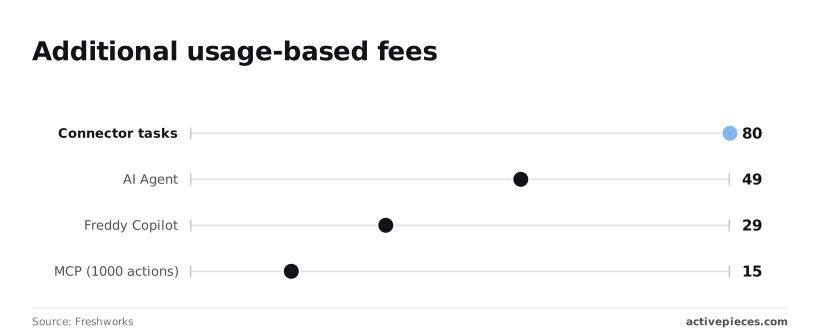
Freshworks reports that Freshdesk charges $49 per 100 sessions for their AI Agent. A sudden spike in customer inquiries can lead to hundreds of dollars in unplanned overages just to keep the self-service bot online.
You will pay an additional $29 per seat if your workflows rely on the Freddy Copilot for agent assistance, so your total monthly expenditure will rise sharply as you scale your automation capabilities.

This increases the effective monthly cost of a Pro user by over 30%, forcing stakeholders to re-evaluate the return on investment for each individual license.
Through the Multi-Channel Platform (MCP), Freshdesk meters complex integrations where 1,000 actions cost $15. This forces developers to optimize every API call to avoid exhausting the budget on routine data syncs.
The cost of occasional agent Day Passes
Subject matter experts or seasonal staff require the purchase of Day Passes. These range from $2 to $12 depending on the account tier, meaning organizations must carefully budget for intermittent access.

A specialist logging in twice a week costs $96 per month at the $12 Enterprise rate, meaning the company pays for full-time access despite the infrequent usage. This is nearly equivalent to paying for a full-time seat.
Upgrading to a permanent license is often more economical.
Freshdesk WhatsApp and phone call pricing
Per-message and per-minute charges for external channels extend communication overhead beyond the software license. Freshdesk charges $80 for a bundle of connector tasks, so users must carefully manage their integration volume to avoid unexpected monthly expenses.
Even if your agents are efficient, the background infrastructure for syncing third-party apps creates a rising floor for your monthly invoice.
As you add more channels like WhatsApp or integrated telephony, these fees ensure the gap between your predicted seat cost and your actual bill widens.
Worth checking against a plan that does not meter every step: one credit covers a whole run on Activepieces.
Feature gating and the 'Pro' tier trap
By stripping essential operational controls from the Growth tier, Freshdesk’s pricing architecture ensures that any team handling more than basic ticket volume must upgrade to Pro.
While the entry-level tier provides a functional inbox, it lacks the multi-stage automation and granular reporting required to audit team performance or prevent manual bottlenecks.
A higher paywall locks away basic efficiency tools, causing the effective cost per agent to double. The most significant restriction is placed on workflow complexity and external connectivity.
A higher paywall locks away basic efficiency tools, causing the effective cost per agent to double.
Sophisticated, multi-step sequences that bridge the gap between customer support and financial operations cannot be built by a Growth-tier user.
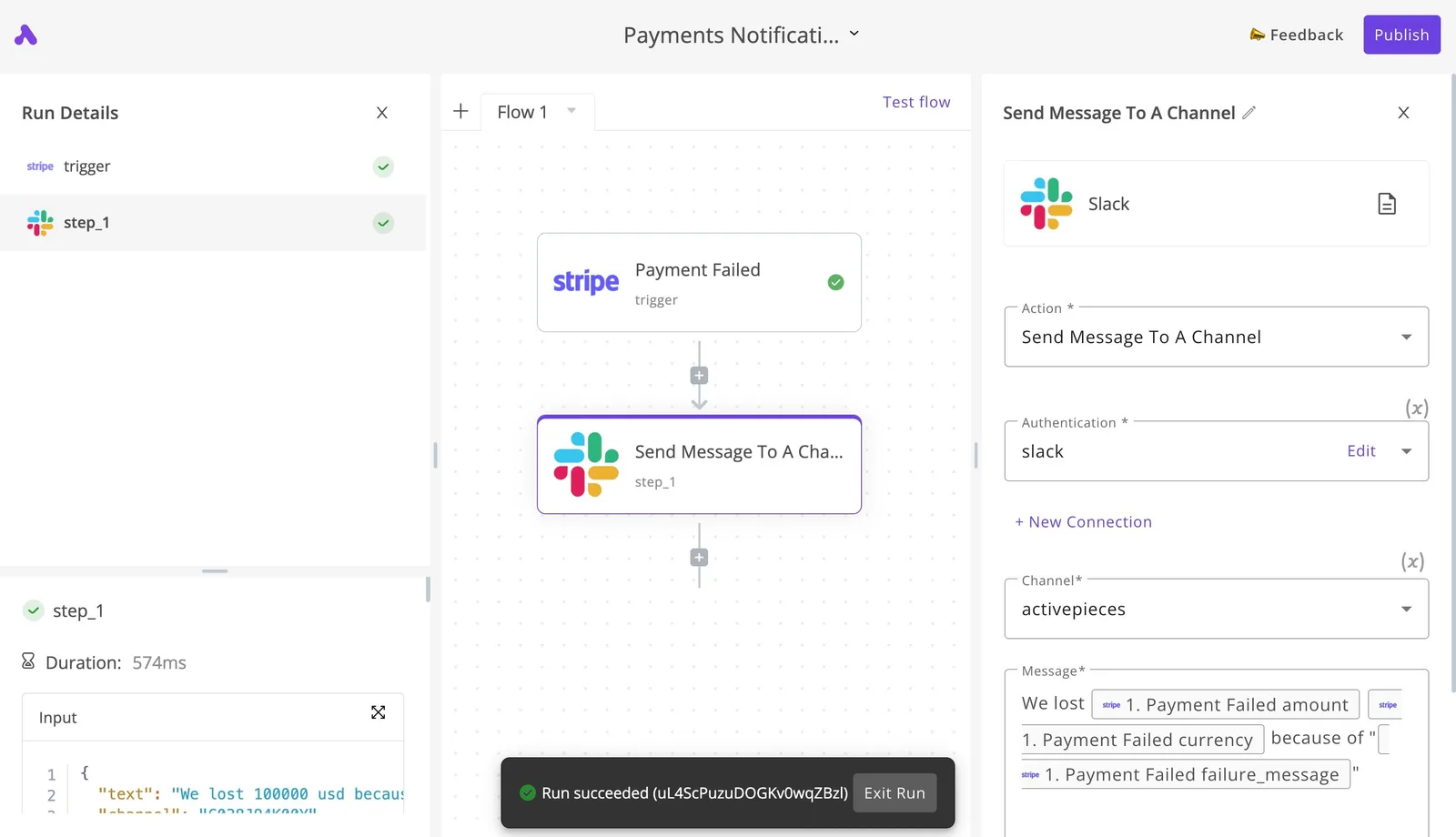
The following example demonstrates a necessary business workflow, alerting a team via Slack when a payment fails in Stripe, which requires the advanced automation capabilities typically reserved for higher-priced plans.
Growing companies are forced to pay a premium for the simple ability to keep their departments in sync because Freshdesk isolates these cross-platform triggers. Beyond automation, the gating extends to data visibility and environment management.
Freshdesk custom dashboard and sandbox limits
Managers cannot track the specific KPIs unique to their industry without upgrading, as Growth users are limited to pre-built templates for custom dashboards. The higher tiers restrict the ability to test new workflows or integrations in a safe environment.
When making changes, teams on lower plans must risk breaking their live production environment. Larger teams on the Growth plan must manually triage tickets or accept an inefficient "round-robin" distribution because skill-based routing is withheld.
The per-seat cost escalates as soon as a business moves past the "one agent, one inbox" phase. This tiering strategy accommodates the basic administrative overhead of a professional support team.
Extend Freshdesk functionality with Activepieces automation
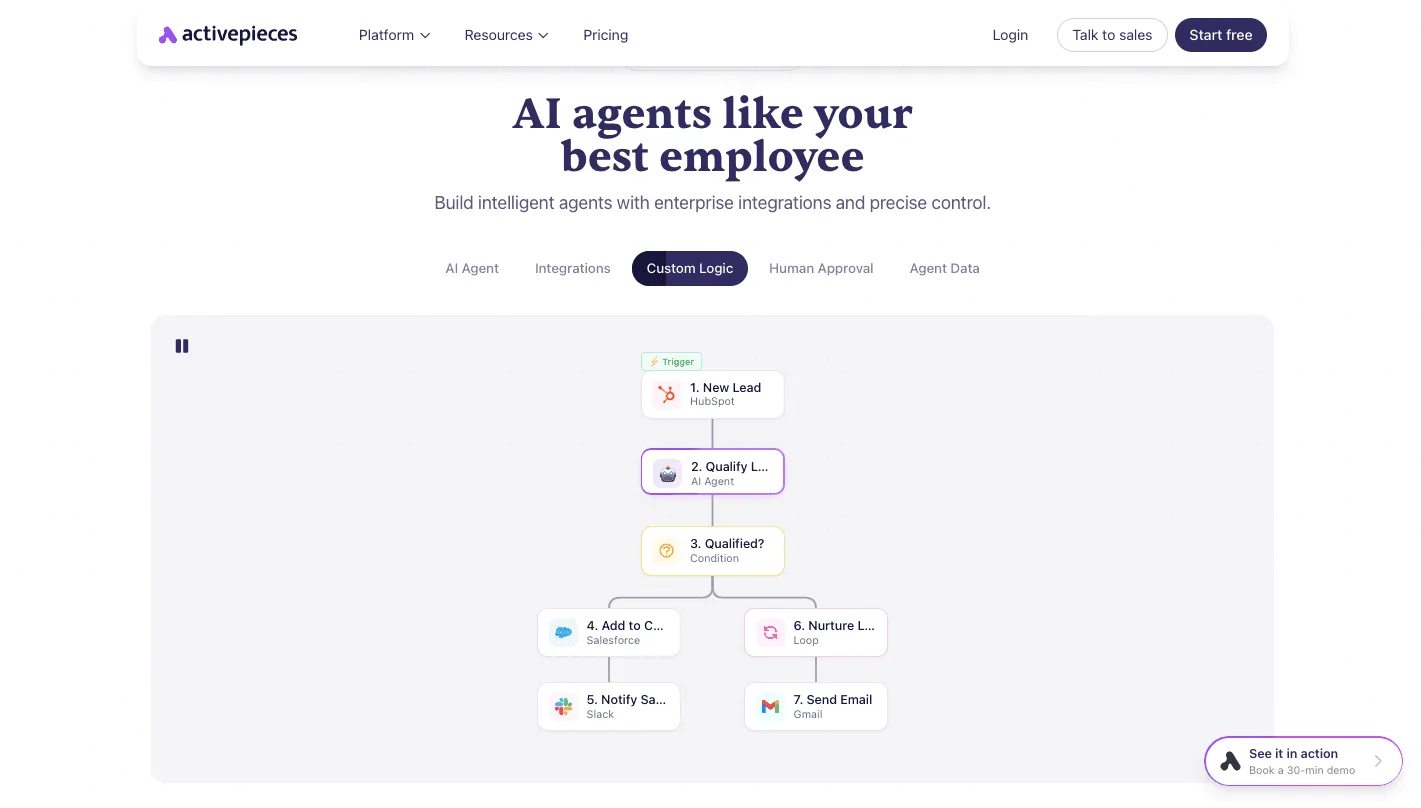
By moving logic execution to an external environment, Activepieces provides an MIT-licensed AI automation platform that bypasses Freshdesk’s tier-gated automation limits. By connecting the Freshdesk API to Activepieces, teams can build complex routing logic that would otherwise require an Enterprise subscription.
Regulated and public-sector organizations run the air-gapped edition of Activepieces in production today to maintain full control over their support data.
The enterprise feature list (including SSO, SCIM, custom RBAC, audit logs, release management, and secret managers) is identical in the self-hosted docs and the managed cloud, which ensures that security-conscious teams do not lose governance features by choosing to host their own infrastructure.
Automation patterns for lean scaling
- When a Freshdesk ticket is tagged as a bug, Activepieces detects the webhook and creates a corresponding issue in a project management tool like GitHub. This allows developers to track technical debt without ever needing a Freshdesk login.
- Incoming tickets pass through an Activepieces flow where a model like Claude Haiku 5.5 analyzes the sentiment and urgency. The system then updates the Freshdesk priority field automatically, replacing the need for the native "Omniroute" feature found in higher tiers.
- Activepieces queries a production database to check a customer's lifetime value or current subscription status. It then routes the ticket to a specific Slack channel, ensuring high-value accounts receive immediate attention without paying for Freshdesk’s proprietary "Customer Segments" module.
The cost shifts from a rigid per-seat monthly fee to a scalable execution model when this logic moves to Activepieces, which companies like MoneyGram and Moneypenny run in production to handle complex cross-departmental workflows.
It transforms Freshdesk into a simple UI for communication while the expensive, high-level decision-making happens in a transparent, code-first automation layer.
By decoupling costs from the complexity of a workflow, Activepieces ensures that multi-step logic remains affordable regardless of how many modules or tasks are executed.
Activepieces is the better choice for organizations scaling complex Freshdesk integrations that require predictable pricing based on flow runs rather than individual steps.
This billing model, combined with robust self-hosting options, makes it the superior fit for security-conscious teams looking to bypass tier-gated software limits without incurring per-task surcharges.
How to select your Freshdesk tier
Selecting the right tier requires balancing immediate budget constraints against the long-term cost of manual labor. For teams with low ticket volume and simple needs, the Growth tier provides the best value by keeping fixed costs low while offering essential ticketing tools.
If your operation requires strict accountability and global reach, the Pro tier is the logical choice despite the price jump. The inclusion of SLA management and multilingual support justifies the investment for businesses that cannot afford to miss response deadlines across different time zones.
Large organizations with complex internal hierarchies will find the Enterprise tier necessary for its governance features. The ability to test changes in a Sandbox and route tickets based on specific agent skills prevents the operational chaos that often plagues high-volume support desks.
Frequently asked questions about Freshdesk pricing
For customers who commit to a yearly contract, Freshdesk offers a reduction in the per-agent rate. This effectively lowers the overhead for established support teams with predictable staffing levels.
Upfront payment of the full amount is required for annual billing. Your capital is locked into the platform for twelve months regardless of changes in your support volume or internal software requirements.
Is there a discount for annual Freshdesk billing?
Teams that have stabilized their headcount can reduce the total cost of ownership through annual commitments, which trigger a lower monthly rate per seat.
Because this discount requires paying the entire year’s balance at the start of the term, it eliminates the flexibility to scale down seat counts mid-year if your ticket volume drops or your team size decreases.
Standard for SaaS platforms seeking predictable revenue, this upfront payment model is mandatory for the discount.
Can I mix and match different Freshdesk plan tiers?
Every agent within a single account must be on the same subscription tier. This forces you to pay for the highest necessary feature set for every user even if only one department requires those advanced tools.
If your technical lead needs the sandbox environment found in the highest tier, you must pay that premium rate for every general support agent who only performs basic ticket triaging.
What happens if I exceed my monthly bot session limit?
Automated deflection tools are disabled or incur overage charges if you exceed the allotted Freddy AI sessions. This prevents customers from receiving immediate automated resolutions until the next billing cycle begins or more credits are purchased.
For high-volume operations using Gemini 3.8 Flash for ticket classification, hitting these caps unexpectedly can lead to a sudden spike in manual work for your human agents.
Does Freshdesk charge extra for API access?
All paid tiers include API access, but the daily call limits increase as you move to higher-priced plans. This dictates how frequently your external systems can sync data with your helpdesk.
If you integrate a high-frequency tool like Codestral for real-time ticket analysis, a lower-tier plan may hit its rate limit by midday. This causes your external integrations to fail and leaves your data out of sync.
Related reading
References
Running the numbers
See what the same workload costs here.
Free forever plan, and every paid plan self-hosts at no extra cost.
See pricing Talk to sales