
Comparing GitHub Pricing 2026 Plans and Hidden Costs

Sep 29, 202614 min read
GitHub pricing refers to the tiered subscription model and per-seat licensing structure that governs access to the platform’s version control, security features, and automation tools.
GitHub pricing and plan features compared
GitHub’s pricing structure uses a per-seat model that scales with headcount regardless of how often each user touches the code. As of September 2026, the platform has four distinct tiers that gate security and automation resources behind per-user premiums.
GitHub Free for individuals and small teams
$0 per month forever is the entry point for GitHub Free, meaning a startup can host unlimited public and private repositories without an upfront financial commitment.
While the price is accessible, it limits GitHub Actions to 2,000 minutes per month. 500MB is the cap for storage, which prevents the hosting of large binary assets, forcing teams to seek external solutions for their media files.

GitHub Pro for advanced personal projects
Individual power users who require more than the basic automation limits but do not need organizational management tools are the target for GitHub Pro.
It increases the Actions allowance to 3,000 minutes, providing a 50% buffer over the free tier for developers running complex test suites.
Per-seat pricing turns every new hire into a recurring line item, often leading IT to restrict access to a small group while the rest of the company waits on a growing backlog.
Activepieces addresses this by metering by consumption rather than headcount; since credits track usage and unlimited flows ship on every plan, adding a team member costs nothing until they actually run an automation.
Per-seat pricing turns every new hire into a recurring line item, often leading IT to restrict access to a small group while the rest of the company waits on a growing backlog.
Organizations like Alan and Funding Societies use this structure to scale production workflows without headcount-driven cost spikes, keeping credentials centrally managed instead of scattered across individual logins.
GitHub Team for growing organizations
At $4 per user/month, GitHub Team introduces the first significant per-seat multiplier for growing companies, effectively turning infrastructure overhead into a variable expense that scales directly with headcount.
Michaeleakins reports that this plan increases storage to 2GB, allowing teams to maintain larger build artifacts and Docker images directly within the platform. The most critical shift is the variable cost of compute for automation.
- Linux 2-core runners cost $0.006 per minute, so a simple script running hourly costs roughly $4.32 a month.
- Windows 2-core runners cost $0.010 per minute, meaning cross-platform testing is 66% more expensive than standard Linux builds.
- macOS 12-core runners cost $0.077 per minute, so mobile developers pay a premium for Apple-specific build environments.
- Ubuntu 64-core runners cost $0.162 per minute, which means high-performance builds for massive monorepos can easily exceed the base subscription cost in a single afternoon.
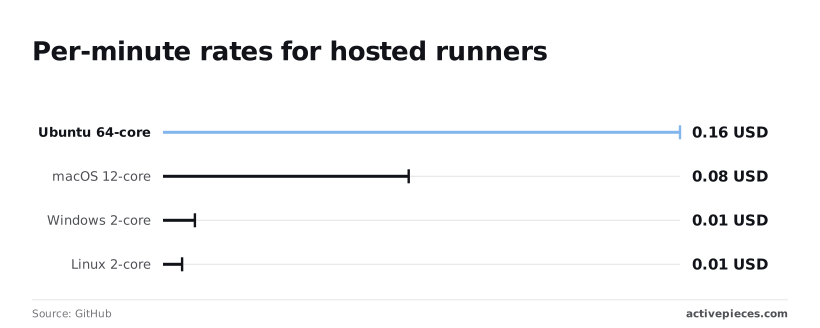
The following table summarizes how these tiers compare across the core resource dimensions that dictate your monthly bill.
| 2026 Plan | Price (per user) | Actions Minutes | Storage | Support |
|---|---|---|---|---|
| Free | $0 | 2,000 | 500MB | Community |
| Team | $4 | 3,000 | 2GB | Standard (Business Hours) |
| Enterprise | $21 | 50,000 | 50GB | 24/7 Premium |
Prices and plan limits checked against github.com on September 29, 2026.
A 425% increase in base cost per employee occurs during the jump from $4 to $21. This forces leadership to justify the added value of the premium tier against a much steeper financial commitment.
GitHub Enterprise for scale and compliance
GitHub Enterprise costs $21 per user/month, a price point justified primarily by the inclusion of Single Sign-On (SSO) and advanced compliance auditing.
By providing 50,000 Actions minutes, it eliminates the risk of build-minute overages for most organizations, though the high per-seat cost means a company of 100 people pays $25,200 annually just for access.
This tier is the only option for companies that require audit logs and centralized identity management to meet SOC2 or ISO 27001 requirements.
If you are running this arithmetic for your own team, see what the same workload costs on Activepieces.
The variable tax of GitHub Actions and storage
Metered usage for automation and storage creates an unpredictable monthly liability that often eclipses the fixed cost of user licenses.
The real price of Actions minutes by runner type
Running automation on GitHub-hosted infrastructure carries a heavy premium that varies wildly depending on the operating system and core count.
Storage overages for GitHub Packages and LFS
Storage costs accumulate through the retention of build artifacts, container images in GitHub Packages, and large assets managed via Git Large File Storage (LFS).
Unlike repositories, these storage services charge for every gigabyte stored and every gigabyte of data transferred out of the GitHub network.
GitHub public repository limits on minutes and storage
The promise of unlimited public repositories does not extend to the resources required to maintain them. GitHub applies strict usage limits to the free minutes and storage allocated to open-source projects.
Once a public project gains traction, organizations often find they must transition to a paid plan as every community contribution now draws from the organization's shared pool of paid resources.
Enterprise requirements and the Copilot premium
The transition to GitHub Enterprise is usually a response to infrastructure needs. Once an organization scales beyond a handful of developers, the Enterprise tier is the only way to manage the administrative overhead.
SAML SSO and centralized identity management
GitHub restricts SAML SSO and SCIM provisioning to its Enterprise plan. This means growing teams must pay a premium just to link their repositories to a central identity provider like Okta.
When this integration is missing, an IT manager must manually offboard departing employees from every individual repository. By gating Enterprise Managed Users (EMU) behind this tier, GitHub forces a choice between fragmented credentials and a per-seat price hike.
Audit logs and compliance requirements
Maintaining SOC2 or HIPAA compliance is functionally impossible on GitHub’s lower tiers because GitHub restricts granular audit logs and IP allow-lists to Enterprise accounts.
A standard Team account lacks the streaming audit logs required for real-time threat detection.
The 2026 cost of Copilot Enterprise vs Business
Integrating AI into this stack introduces a tiered tax where the most capable tools are only available to those already paying the Enterprise base fee.
Continuum reports that Copilot Business costs $19 per user and provides basic autocomplete, so firms must weigh the utility of simple suggestions against a recurring monthly premium.
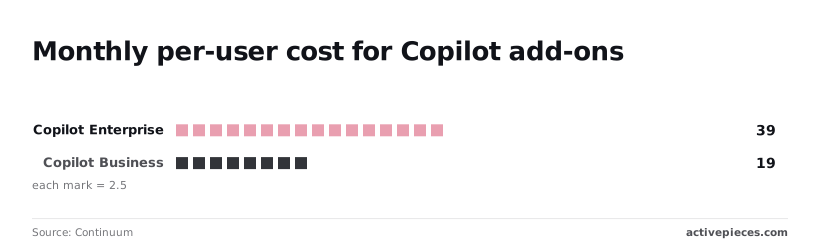
To access Copilot Enterprise, the price jumps to $39 per user, doubling the investment for organizations seeking advanced AI-driven development tools.
A 100-person engineering team spends an additional $24,000 annually to enable features like fine-tuned models and pull request summaries, which represents a substantial line item that requires clear justification in the development budget.
Copilot Enterprise allows full integration with internal knowledge bases, including support for flagship models like GPT-6 Astra or Gemini 3.8 Flash, but at double the per-seat investment.
Worth checking against a plan that does not meter every step: one credit covers a whole run on Activepieces.
GitHub vs GitLab and Bitbucket pricing models
GitHub’s pricing strategy positions it as a middle-tier premium option, sitting significantly below the high-barrier entry of GitLab Ultimate but well above the aggressive value-pricing of Bitbucket.
GitLab Ultimate vs GitHub Enterprise cost gaps
The two primary market leaders differ in how they bundle security and compliance features. While GitHub Enterprise is the only tier that is mandatory for SAML SSO, GitLab Ultimate is the only tier to include advanced security dashboards.
The following table illustrates the monthly per-user investment required to access these "enterprise-ready" tiers as of late 2026.

| Provider | 2026 Per-User Monthly Cost | The Premium Gap |
|---|---|---|
| Bitbucket Premium | $7.25 | Baseline for small-to-mid teams |
| GitHub Enterprise | $21.00 | 190% increase over Bitbucket |
| GitLab Ultimate | $99.00 | 370% increase over GitHub |
A 100-person engineering team pays nearly four times as much for GitLab’s native security suite compared to GitHub’s standard enterprise offering.
Bitbucket CI/CD minutes and pricing tiers
Bitbucket is a consumption model that provides a higher ceiling for automation before triggering additional costs. Unlike GitHub, which increments minute allocations per seat, Bitbucket provides a large pool of runtime for its Premium tier.
Total cost of ownership for self-managed vs cloud hosting
The true cost of these platforms extends beyond the license fee to include the infrastructure and labor required for maintenance.
Self-hosting GitHub Enterprise Server to avoid seat fees
The primary financial motivation for self-hosting GitHub Enterprise Server or GitLab is the ability to bypass the $21 per-user monthly SaaS fee. By moving to a self-managed instance, organizations trade recurring subscription costs for internal infrastructure and engineering hours.
GitHub Enterprise volume licensing agreements
While the list price for Enterprise Server is per-user, large organizations often negotiate custom Volume Licensing Agreements (VLA) or Enterprise Agreements (EA) that decouple costs from strict headcount.
These contracts frequently include a cap on total spend or a significantly lower marginal cost for additional seats once a high threshold is met. By committing to a multi-year self-hosted deployment, a company can effectively freeze its licensing budget even as its engineering department grows.

This shift allows a company to scale its headcount without a linear increase in software licensing costs. While GitHub Enterprise Server requires internal DevOps resources to manage updates and backups, the long-term savings on seat licenses can be substantial for large teams.
GitLab Self-Managed offers granular control over data residency but requires dedicated engineering hours to maintain. Bitbucket Data Center is the legacy choice for strictly regulated industries where the cost of hardware is offset by the avoidance of cloud-egress fees.
Controlling the hidden costs of GitHub automation
GitHub Actions costs scale aggressively based on the underlying hardware requirements of your CI/CD pipelines.
To prevent automation from becoming a black box, Activepieces enables teams to sync flows to git and promote them through Release Management, ensuring every workflow is versioned and reviewed like software.
By offering this Git Sync capability on the same product whether self-hosted or on cloud, it allows organizations to audit their logic alongside their source code without the lock-in of a SaaS-only interface.
$60 per 10,000 minutes is the cost for Linux 2-core, which is the baseline for standard containerized tasks.
$100 per 10,000 minutes is the cost for Windows 2-core, so teams pay a 66% surcharge just for the licensing overhead of the OS.
$770 per 10,000 minutes is the cost for macOS 12-core, meaning a single iOS build pipeline can cost more than ten standard web deployments.
These tiered rates often force developers to settle for slower runners to stay within budget, increasing developer idle time.
Data persistence creates a compounding monthly bill through GitHub Packages and Git Large File Storage (LFS).
Every container image version kept for rollback and every high-resolution asset stored contributes to a storage total that, once exceeded, incurs metered overages.
While the code hosting is free, the compute and egress associated with public actions are subject to strict concurrency limits. Relying on these "free" resources often leads to unpredictable build queues, forcing a migration to paid private runners to ensure reliability.
The Monday morning GitHub billing audit checklist
Because GitHub charges per-user rather than per-usage, an unmonitored seat count means you are paying for the potential of work rather than the work itself.
To align your spend with actual output, leadership must perform a granular review of how high-tier features are utilized:
Because GitHub charges per-user rather than per-usage, an unmonitored seat count means you are paying for the potential of work rather than the work itself.
- Export 'Active Committer' list (90-day window) to identify accounts that have not contributed code, so you can reclaim seats from former contractors or departed employees.
- Identify top 5 'Minute-Hungry' workflows to determine if complex CI/CD tasks should be moved to self-hosted runners.
- Check LFS storage against the current plan limits so you can prune large binary files before they trigger automatic, non-refundable storage overage charges.
- Review Copilot seat utilization to ensure licenses for AI coding assistants are assigned to active developers rather than sitting idle.
Executing these steps provides the data necessary to decide if the Enterprise tier’s security features justify the cost.
How Activepieces mitigates the GitHub seat tax
Activepieces addresses the headcount-driven cost spikes of GitHub by decoupling organizational growth from automation expenses through a consumption-based model.
While GitHub gates essential security features like SSO behind a $21 per-user Enterprise tier, Activepieces provides an Open Ecosystem (MIT Licensed) that allows teams to scale their workflows without a per-seat multiplier.
Organizations like Alan and Funding Societies use this structure to maintain centralized credential management and security protocols without paying a premium for every new hire who needs to trigger a workflow.
Because the platform meters by task consumption rather than headcount, adding a team member costs nothing until they actually execute an automation. This eliminates the "seat tax" that often forces IT managers to restrict access to development tools to save on licensing fees.
By providing unlimited flows and users on every plan, the platform ensures that security features like SSO and audit logs do not become a financial barrier to organizational scaling.
To prevent automation from becoming a black box that drives up hidden costs, Activepieces enables teams to sync flows to Git and promote them through structured Release Management.
This ensures every workflow is versioned, reviewed, and audited alongside source code, rather than existing as fragmented logic in a private UI.
By offering this Git Sync capability across both self-hosted and cloud environments, it allows companies to maintain full data residency and compliance without the mandatory per-seat price hikes associated with GitHub Enterprise.
Frequently asked questions about GitHub billing?
Does GitHub offer a discount for annual billing?
GitHub provides a discounted rate for organizations that commit to a yearly payment cycle rather than month-to-month billing. Choosing an annual plan locks in a lower per-seat price for the duration of the term, which prevents mid-cycle price fluctuations from impacting the operational budget.
How much does GitHub Copilot cost in 2026?
The cost of GitHub Copilot is determined by the specific AI model selected and the subscription tier of the parent organization. Users can now choose between several frontier models to power their IDE suggestions:
- Claude Opus 5.5 is the flagship choice for long-running agentic coding and complex knowledge work.
- Gemini 3.8 Flash is the primary model for high-throughput enterprise workflows and rapid agentic tasks.
- GPT-6 Sol is utilized for complex coding requirements and advanced agentic workflows.
- Grok 4.7 acts as the general-purpose flagship model for code generation and multi-modal reasoning.
Can I mix Team and Enterprise seats in one organization?
GitHub requires all users within a single organization to be on the same plan tier. This means you cannot assign Enterprise features to a subset of users while keeping others on the Team plan.
Every contributor must be paid for at the higher Enterprise rate just to unlock a single feature, such as SAML single sign-on, for the entire group.
What happens if I exceed my Actions minute limit?
When an organization reaches its monthly limit for GitHub Actions (the platform’s integrated automation and CI/CD tool), automated workflows stop immediately unless a spending limit for overages has been configured.
Without an active spending limit, developers are unable to merge code or run tests. This creates a complete bottleneck in the deployment pipeline until the next billing cycle begins.
Related reading
Running the numbers
See what the same workload costs here.
Free forever plan, and every paid plan self-hosts at no extra cost.
See pricing Talk to sales