
Doubao API Pricing 2026: Models, Tiers and Rate Limits

Oct 24, 202614 min read
You will not pay the headline per-token price. It is the starting rate, not the bill: the tier your request lands in, your region and your rate limit all determine the final cost.
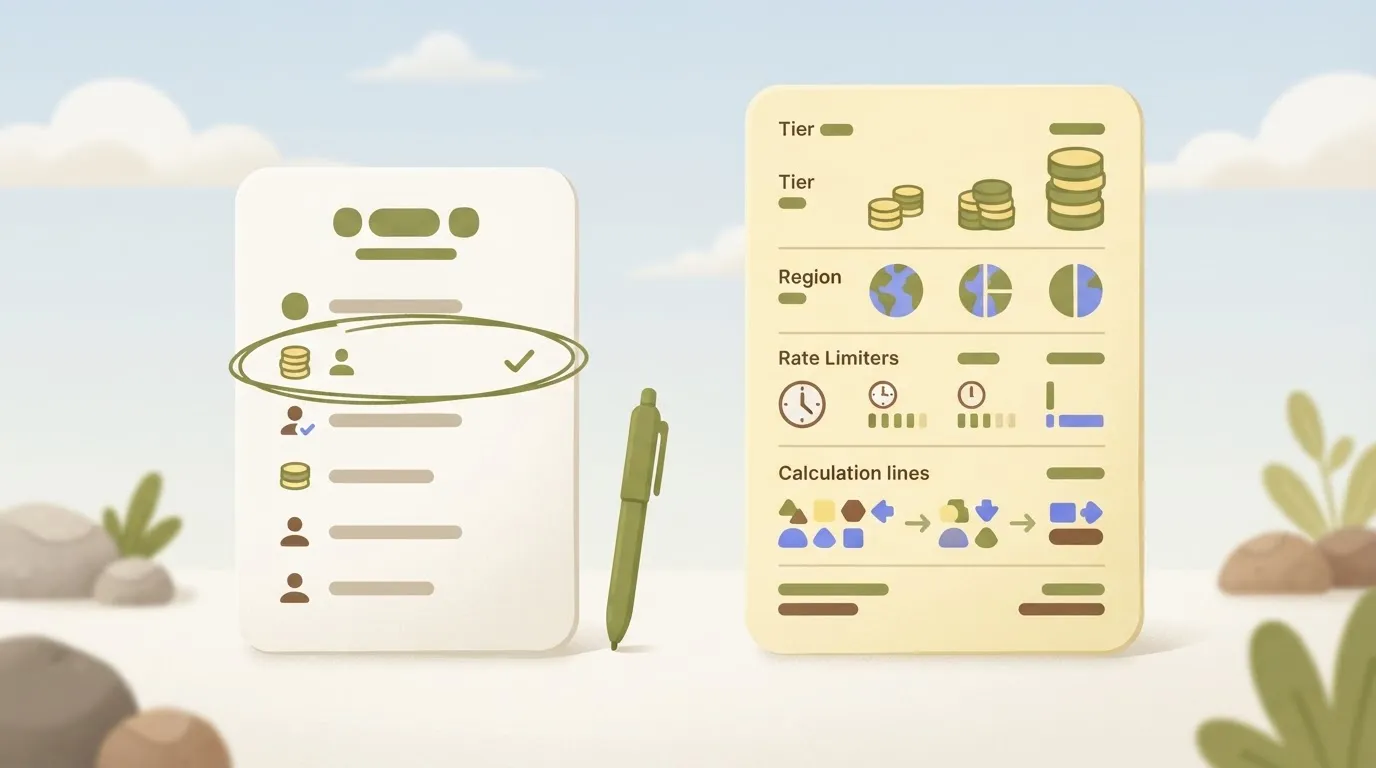
Sold through Volcano Engine in China and BytePlus ModelArk outside it, Doubao is ByteDance's model family. Activepieces calls it on your own provider key and pays the same meter, billed to your provider account.
Doubao API pricing today in one table
Doubao API pricing tiers checked against vendor
I'm not printing prices, context windows or rate limits here. Both vendors revise them, the two consoles list them differently, and a copied number goes stale without warning. The table below, current as of 2026-10-24, lists what each tier bills on and when it wins.
| Tier | Billed on | What moves the price | Cheapest for |
|---|---|---|---|
| Flagship | Input and output tokens, priced separately | Context-length bracket, cache hits, batch | Hard reasoning that smaller tiers fail |
| Pro | Input and output tokens, priced separately | Context-length bracket, cache hits, batch | General production chat and drafting |
| Lite | Input and output tokens, priced separately | Context-length bracket, batch | Classification, extraction, routing |
| Mini | Input and output tokens, priced separately | Rate limit ceiling more than price | High-volume short calls |
| Embedding | Input tokens only | Volume, region | Search and retrieval indexing |
When a mini model fails and forces a retry on a larger tier, it costs more than the larger tier called once. So the cheapest model is the smallest one that passes your test set.
Price the console that will bill you, not the one a blog post screenshotted. The same model can carry different prices, currencies and limits on the two platforms.
If you are running this arithmetic for your own team, see what the same workload costs on Activepieces.
Tiered pricing beyond headline token rates
You move off the per-token number on the front of the price list the moment you add longer prompts, output tokens or reasoning, and that number is the cheapest rate the model will ever charge you.
Tiered pricing by input length
On the Volcano Engine Ark pricing page, every model carries three length tiers. Seed 2.0 Pro runs 3.2, 4.8 and 9.6 ¥ per million tokens across them, so cost triples from shortest to longest context.

A long-document job that lands in the top tier pays triple the quoted rate. Lite climbs from 0.6 to 0.9 to 1.8 ¥, also triple.
Fourfold is Mini's jump, 0.2, 0.4, 0.8 ¥, so the cheapest model has the steepest penalty for stuffing the context window.
(chart: Longer prompts cost more on every Seed 2.0 model)
Doubao cache and batch inference discounts
On Seed 2.1, batch inference halves the price. According to Volcano Engine Ark, Pro input drops from 6 to 3 ¥ per million tokens and Pro output from 30 to 15 ¥.
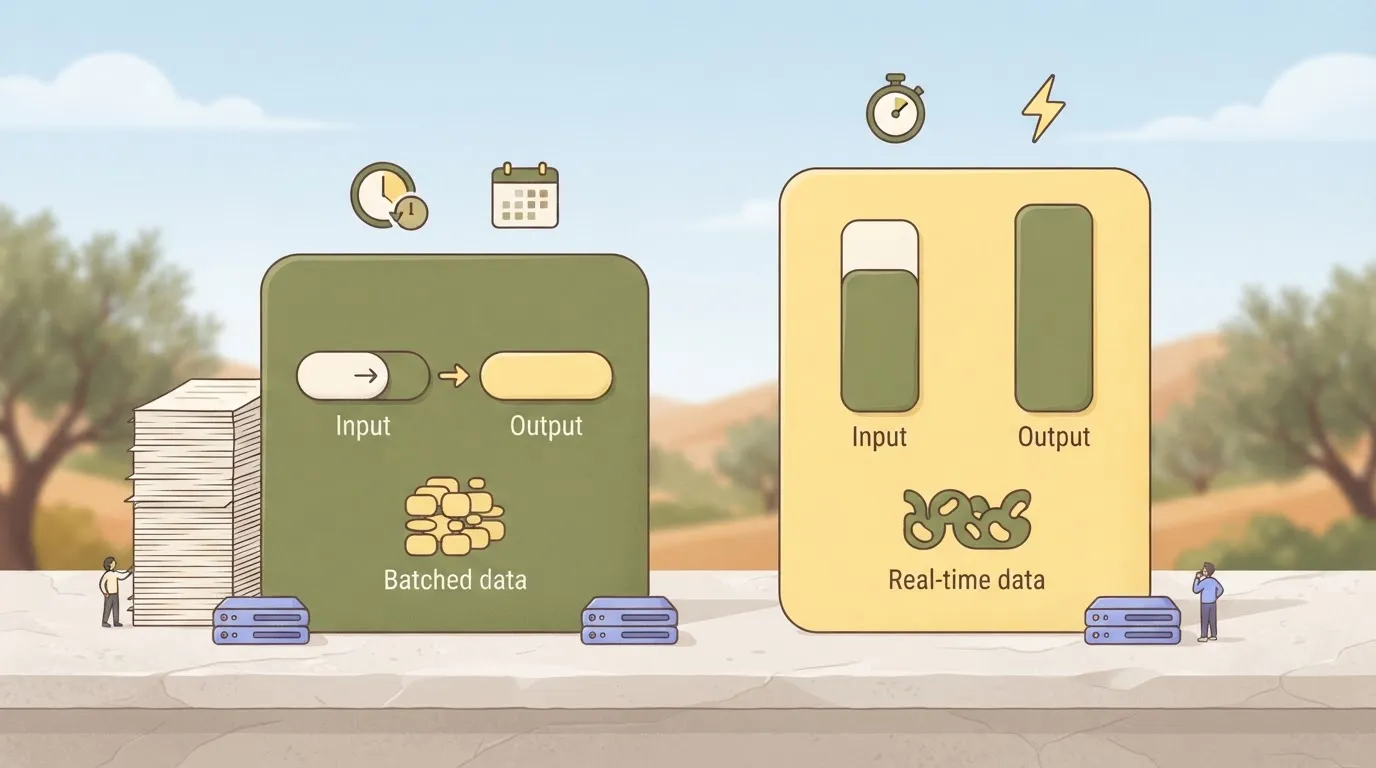
Per Volcano Engine Ark, Turbo input falls from 3 to 1.5 ¥ and Turbo output from 15 to 7.5 ¥.
If it can wait, it shouldn't be paying online rates: backfills, evaluations and overnight classification included. Output is five times input on both models, so the output line is where most of that saving lands.
(chart: What batch inference saves on Doubao Seed 2.1)
Context cache has its own rate on the same page.
Reasoning tokens billed as output
Expect thinking tokens to cost the output rate. On Volcano Engine Ark's Seed 2.1 Pro, that's 30 ¥ per million online, five times the 6 ¥ input rate.

A request with a short answer but a long chain of thought is therefore priced like a long answer. Run a sample of your real prompts and read the output-token count in the usage response, not the visible reply length.
Doubao rate limits, free quota and account requirements
Sixty-fold is how far the requests-per-minute ceiling varies, and it is the ceiling you hit first.

Volcano Engine Ark lists Seed 2.1 Lite at 30,000 requests per minute but Seed 2.1 Pro at only 500, limiting Pro to 1/60th of Lite's throughput, so applications requiring scale cannot use Pro.
Default RPM and TPM limits
At 500 requests per minute, Seed 2.1 Turbo sits where Pro does. That's about eight requests a second, so a chat product with a few thousand concurrent users will see throttling on either model unless traffic is spread out or routed to Lite.
Look at the legacy tiers and the same split appears by context length. Pro 32K allows 10,000 requests per minute, while Pro 128K allows 1,000, and this forces you to choose between context depth and maximum request volume.
When a job has long prompts, it can exhaust tokens per minute long before the request count looks high, because it is a separate limit. Read both columns on the model page for your exact model, and test with your real prompt lengths.
Free inference quota depends on the model and the account and can change; I'm not quoting an allowance.
Treat any trial as enough for a correctness check, not for a load test.
Doubao account and verification requirements
Before you plan around a limit, confirm that you can open and fund an account at all. Check three things on the console before committing:
- Whether identity or real-name verification is required for your account type, and how long it takes.
- Whether the model you want is served in your region, since the model list above is for the Beijing region.
- Whether you can get invoices in a form your finance team accepts.
Doubao costs for three real workloads per month
You can't rank these workloads by headline per-token price, because a different lever decides each bill: long history for chatbot use, batch eligibility for summarising, and sheer call count for classification.
I've left out dollar totals; they must come from Doubao's pricing page on the day you buy.
| Workload | Cheapest suitable model | Flagship | With cache and batch |
|---|---|---|---|
| Support chatbot, 50,000 conversations | Lowest bill, unless history pushes it into a higher context tier | Highest per turn, and the tier jump compounds | Cache helps most; batch doesn't suit live chat |
| Document summarising, 20,000 long files | Low, provided inputs stay under the tier threshold | Largest gap, because input dominates | Biggest saving, since nothing here is interactive |
| Classification, 5 million items | Only sensible choice | Rarely justified | Batch matters most; check rate limits first |
In the support chatbot, every turn resends the conversation so far, so a long chat quietly crosses into a pricier context tier. The fixed system prompt is the part cache can discount.
Nobody needs these summaries instantly, and with 20,000 long files, input tokens are the bill. That makes it the cleanest fit for batch pricing. Test one file at the largest size you expect to see which tier it lands in.
In classification at 5 million items, each item is small, so call volume matters more than token price. At this count, rate limits and region can slow the job more than cost does. Confirm your quota before you price anything.
Worth checking against a plan that does not meter every step: one credit covers a whole run on Activepieces.
Doubao against DeepSeek, Qwen and OpenAI on price
On price, Doubao isn't the cheapest on every line of the comparison. The table below sets out which price and rule each vendor's page applies, so you can compare like for like.
I've left out numeric prices because I haven't confirmed any against the vendors' pages, and a stale figure here would do more harm than a missing one.
| Vendor and model | Input price | Output price | Context window | Cache discount | Batch discount | Check date |
|---|---|---|---|---|---|---|
| Doubao | Tiered by prompt length | Tiered by prompt length | Read the limit for your tier | Separate cached-input rate, if offered for your model | Separate offline rate, if offered | Day you open the page |
| DeepSeek (deepseek-flash) | Per model; may undercut Doubao | Per model; may undercut Doubao | Per model | Cache-hit rate on input | Check the page | Day you open the page |
| Alibaba Qwen | Per model and tier | Per model and tier | Per model | Check the page | Check the page | Day you open the page |
| OpenAI small model (GPT-6 Luna) | Per model; may undercut Doubao on cached or batched work | Per model | Per model | Check the page | Check the page | Day you open the page |

Look at the bold marks: that is where Doubao's headline can lose. DeepSeek's flash tier is built to be cheap, and OpenAI's small tier can close the gap once cache and batch rules apply to your traffic.
Fill in each row from the vendor's page on the day you check, using the tier your prompts fall in. Then price your own workload on that row, not the list number.
Fix runaway model spend with Activepieces
What factors determine your costs?
Resell you a model and someone else has already picked your Doubao tier and marked up the rate before you send a single request. Activepieces doesn't sell you one, so nothing in it moves a price on Doubao's page.
The calls go out on your own Volcano Engine or BytePlus key, so the spend lands on your provider account at the rate you hold, and Flagship versus Lite stays your decision.
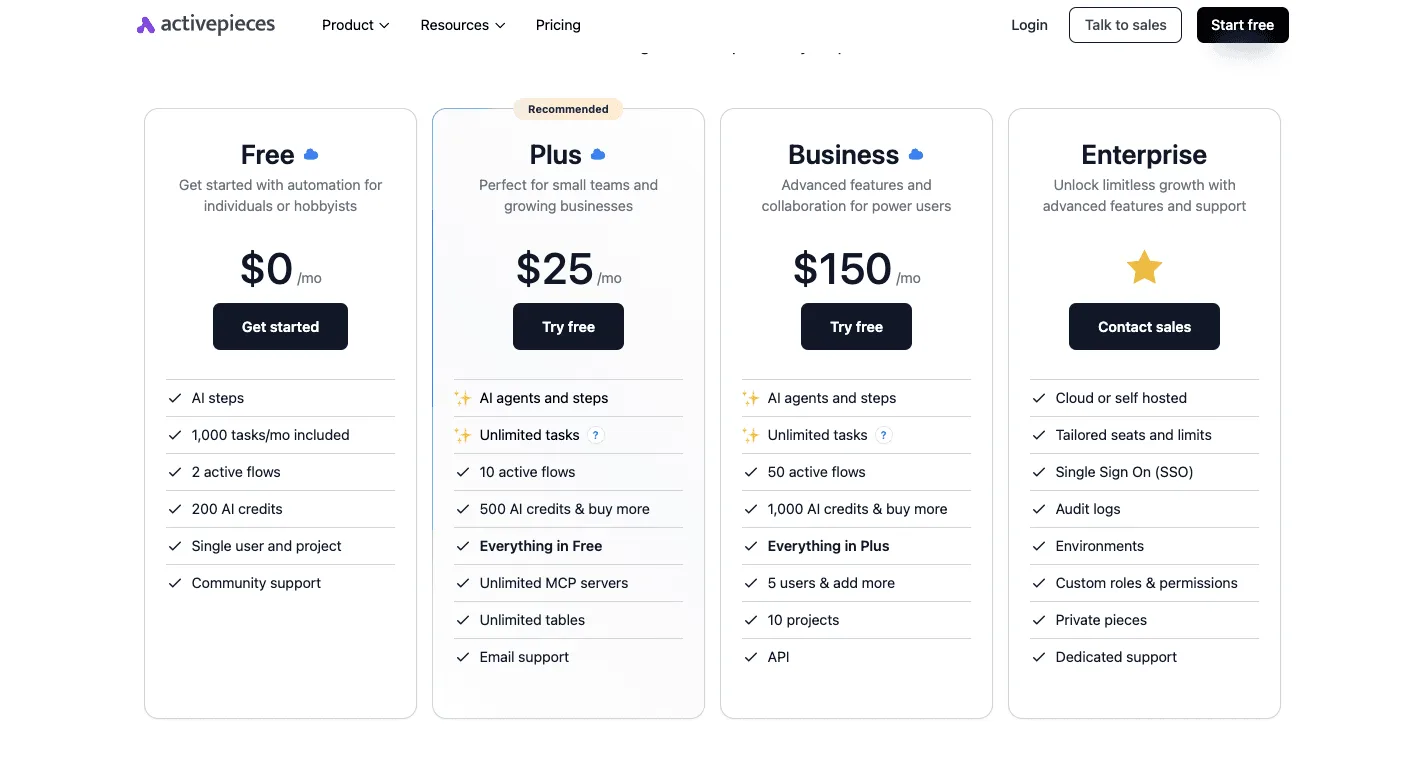
The pricing page shows the difference: from Plus up, bring-your-own-key makes every AI step 1 credit, where a built-in model costs 2, 10 or 20 credits by class.
Claude, ChatGPT, Cursor or any MCP client can reach it, so the routing strategy gets set wherever you already work.
A workflow there is just a chain of steps: an HTTP request to the Doubao API, a branch, a stored value, a message.
Everything it does for your bill, it does by controlling which requests reach the expensive model and how many go out per day.
Across the cost problems described above, each is a decision made per request: long prompts landing in a higher context tier, and flagship output tokens on jobs a small model could do.

Nobody makes them unless something sits in the path. The workflow below is that something.
How the router and counter work
First, a request arrives at a webhook trigger. A router step checks the prompt length and a simple flag you set, such as "needs reasoning". Short, routine prompts go to the cheap model; anything hard goes to the flagship.
After each call, its reported token usage is added to a daily counter kept in the platform's storage.
When the counter crosses a limit you choose, a branch posts a message to a team chat channel and, if you want, stops sending to the flagship until the counter resets.
Follow the path in the diagram: request, router, two model calls, the running counter, and the alert branch leading to chat. Take from it that the cap sits before the spend, not after the invoice.
Where the workflow falls short
Two honest limits. The router is only as good as your rule, so test it against real prompts and read what the cheap model returns.
And the counter tracks tokens your workflow sent, not what Doubao billed, so check it against the usage page on the vendor's console.
Check your costs before Doubao commitment
Spend Monday turning the headline per-token price into a measured bill for your own traffic, in this order:
- Re-check the pricing page and write down the date, so a later invoice that disagrees can be traced to a page change rather than your arithmetic.
- Run 200 real prompts, not synthetic ones, and log input and output tokens for each, because your actual prompt lengths decide which context tier you land in.
- Repeat the same prompts and record the cache hit rate, since a discount that never triggers on your traffic isn't a discount.
- Request quota increases now, because a rate limit you hit on launch day shows up as failed requests, not as a line on an invoice.
- Set billing alerts at several thresholds, so a runaway loop is caught by an email rather than a statement.
- Pick a fallback model and test it on the same prompts, so an outage or a quota wall means a slower day rather than a dead product.
Each workload leans on a different step.
For the support chatbot, conversation history is resent every turn, so token logging and cache testing matter most. Long threads can cross into a higher context tier, which makes the last turns cost more per token than the first.
For the 20,000 long files, tier boundaries are where the bill bites. Log real file lengths, and check whether the job can wait for batch pricing, which would suit an overnight run.
For classification at 5 million items, output is tiny, so input cost and rate limits dominate. Request quota early, since throughput, not price, will set how long the job takes.
Frequently asked questions
Is the Doubao API free to try?
Usually there's a trial allowance for new accounts, but treat it as a test of the API, not a way to price your workload.
Free allowances tend to carry their own rate limits and expiry, so a clean trial run says little about what happens at production volume. Read the terms on the vendor's console page before you plan around it.
Can I use Doubao outside China?
Yes, through the vendor's international platform, BytePlus, but that's a separate storefront from the domestic one, Volcano Engine. Model availability, prices and account rules can differ between them, so quote from the page for the platform you will actually sign up on.
Domestic accounts commonly require identity verification, which a foreign team may not be able to complete. Ask before you build on it.
Does Doubao charge for reasoning tokens?
Because reasoning models generally bill their internal thinking as output tokens, a short answer can cost far more than its visible length suggests, and output is the expensive side of the price list.
Run a sample of your own prompts and compare the billed output with the text you received. Confirm the rule on the page of the specific model you choose.
How often does Doubao change its prices? Often enough that a figure without a date is unreliable.
Prices, tiers and discount rules have moved before, and the vendor's page is the only record that counts. Note the date you read each number, and re-check before any contract or budget is signed.
Is the Doubao app subscription the same as API pricing? No. The consumer app and the API are separate products with separate billing.
A subscription, where one is offered, buys use of the app and gives you no API credit or quota. API usage is metered by the token on a developer account, so a cheap app tier tells you nothing about your API bill.
Related reading
References
Running the numbers
See what the same workload costs here.
Free forever plan, and every paid plan self-hosts at no extra cost.
See pricing Talk to sales