Perplexity API Pricing in 2026: Models & Costs

Oct 12, 202613 min read
Interacting with Perplexity means using a search-augmented inference service where you pay a standard token rate for the underlying model plus a flat surcharge for every thousand web-grounded queries.
Perplexity API pricing is a consumption-based model that combines standard token-based processing fees with a specific surcharge for every thousand requests that utilize real-time web search capabilities.
Per-seat pricing rations automation, whereas consumption-based models allow for wider adoption without increasing fixed costs.
Activepieces meters by usage rather than headcount, providing unlimited flows on every plan so that adding new team members to a research project costs nothing until they actually execute a run.
Organizations like Funding Societies and Alan use this credit-based structure to scale their automation across departments, managing credentials centrally within specific projects rather than letting logins scatter across individual seats.
Calculate Perplexity API token and search costs
The 2026 Sonar model price table
Choosing between lightweight extraction and deep reasoning gives you granular cost control. The following table breaks down the current rates for the Sonar model family.
| Model | Input Price (per 1M tokens) | Output Price (per 1M tokens) |
|---|---|---|
| Sonar Small | $0.20 | $0.20 |
| Sonar Large | $1.00 | $1.00 |
| Sonar Pro | $3.00 | $15.00 |
| Sonar Reasoning Pro | $5.00 | $15.00 |
Prices and plan limits checked against docs.perplexity.ai on October 12, 2026.
96% is the amount you reduce your input costs by when choosing Sonar Small over Sonar Reasoning Pro, allowing your high-frequency monitoring tasks to remain profitable at scale, so your operational budget stretches significantly further under heavy workloads.

Distinguishing between online and offline model versions
The $5 surcharge for every 1,000 requests is not a universal tax on every model listed in the table, meaning users are not automatically billed for standard offline interactions.
Perplexity distinguishes between "online" versions, which actively crawl the web to provide grounded answers, and "offline" versions, which function as standard large language models.
When you call an offline model, you only pay the standard token rate for input and output. This allows you to use the same Sonar architecture for internal data processing or creative writing without triggering the search fee.
You only opt into the $5 per 1,000 requests premium when your application specifically requires the real-time retrieval capabilities of the online model variants, so costs remain low for static tasks.
Invoking specific model behaviors
Developers control the search surcharge by modifying the model string or the search parameter in their API request.
To invoke the offline version of a model like Sonar Large, you must use the specific model name without the online suffix, ensuring the system treats the request as a standard inference task.
If your integration uses a library that defaults to search, you can explicitly disable the web-crawling feature by setting the search_type parameter to chat instead of internet.
This programmatic distinction ensures that your automated workflows only pay for grounded data when the specific logic of the step requires live information.
Understanding the $5 per 1,000 search requests fee
Every time an API call triggers a web search, you incur a flat $5 per 1,000 requests fee, which adds a predictable $0.005 overhead to each grounded response, ensuring budget projections remain straightforward.
This fixed cost is paired with a tiered throughput system defined by Perplexity:
- Tier 0: 1 query per second, which limits your initial testing to single-threaded sequential calls.
- Tier 1: 3 queries per second, providing enough overhead for your small team internal tools.
- Tier 2: 8 queries per second, allowing for moderate batch processing of data.
- Tier 3: 17 queries per second, supporting your real-time user-facing applications.
- Tiers 4-5: 33 queries per second, so your enterprise-scale workloads can process nearly 2,000 searches per minute.
Why Perplexity search costs less than OpenAI or Tavily.
Perplexity’s search fee is often more economical because it bundles index access and LLM inference into a single round-trip.
By centralizing the retrieval-augmented generation (RAG) pipeline, Perplexity eliminates the "double-tax" on tokens where the search results would otherwise be re-encoded as input context for a standalone model.
If you are running this arithmetic for your own team, see what the same workload costs on Activepieces.
Identify hidden Perplexity API billing factors
The unit economics of LLM requests change fundamentally when you decouple the cost of information retrieval from the cost of token generation.
While the base rate for Sonar Large is $1.00 per 1M tokens, the mandatory $5.00 per 1,000 search requests (documented by Neurobird) means a single search-enabled query costs $0.005 before a single word is generated.
The impact of search overhead on small queries
Due to the fixed nature of search fees, short, fact-finding queries incur a massive "effective" token markup.
Perplexity notes that when you request a one-sentence weather update costing only 50 tokens, the $5.00 search fee per 1,000 calls adds a hidden $0.005 to the transaction, effectively inflating the cost of small queries by a disproportionate margin, which can catch developers off guard.
Due to the fixed nature of search fees, short, fact-finding queries incur a massive "effective" token markup.
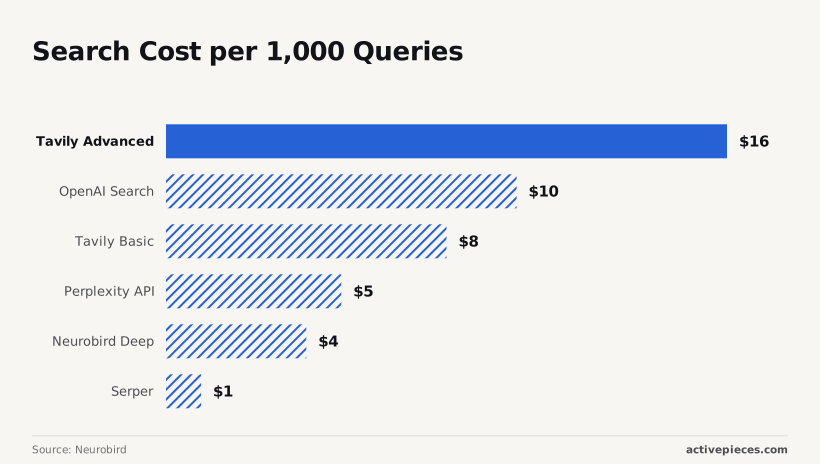
This results in an effective price of $100.00 per 1M tokens, which is 100 times the advertised model rate, so the true cost of search-enabled requests is far higher than the base token pricing suggests. This overhead varies significantly across the competitive landscape:
- Tavily Advanced: $16.00 per 1,000 queries, making it the most expensive retrieval layer for high-precision agents.
- OpenAI Search: $10.00 per 1,000 queries, doubling the entry price of Perplexity’s integrated search.
- Tavily Basic: $8.00 per 1,000 queries, providing a middle-ground for standard RAG implementations.
- Perplexity API: $5.00 per 1,000 queries, positioning it as the baseline for integrated search-and-inference.
- Neurobird Deep: $4.00 per 1,000 queries, offering a 20% discount relative to Perplexity for deep-crawl tasks.
- Serper: $1.00 per 1,000 queries, which is the only tier allowing for high-frequency scraping without breaking the budget.
At low token counts, the "True Cost" of Sonar Large ($1.00/1M tokens) spikes, only approaching the advertised rate as your request volume and output length increase.
Why 'Reasoning' models carry a higher compute premium
Advanced reasoning models demand higher per-token prices because they utilize internal chain-of-thought processing that consumes more hardware cycles per output word. These frontier-class engines often perform multiple internal iterations before returning a response, so a 1,000-token output represents a larger share of GPU capacity.
Perplexity API credit expiration and auto-reload
Under Perplexity’s pre-paid credit system, unused balances typically expire after one year. To use the API, you must manually deposit funds into your account balance upfront. These funds act as a debit reserve that the system draws from in real-time.
Because auto-reload triggers are set at a fixed dollar threshold, a sudden spike in high-surcharge search traffic can drain a balance and halt your production services before your billing department can verify the spend.

Scaling access through Perplexity API usage tiers.
Perplexity API throughput is governed by cumulative lifetime spend, ensuring that high-volume production capacity is earned through consistent billing rather than upfront negotiation.
Perplexity API lifetime spend and usage tiers
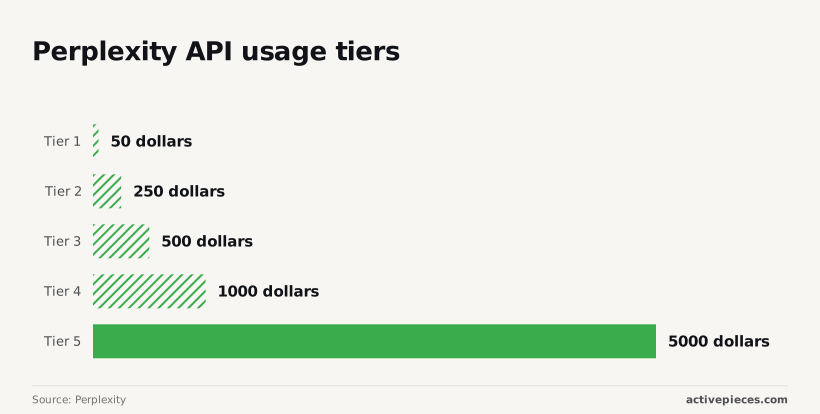
Trial environments transition to robust production integrations through six distinct spending milestones. The following table illustrates how lifetime payments to the Perplexity API dictate your operational ceiling:
| Tier | Lifetime Spend Requirement | Operational Impact |
|---|---|---|
| Tier 0 | $0 | New accounts are restricted to minimal testing, preventing bot-driven resource exhaustion. |
| Tier 1 | $50 | Small teams can move beyond initial prototyping into light, internal-only tools. |
| Tier 2 | $250 | Regular usage becomes viable for customer-facing applications with moderate traffic. |
| Tier 3 | $500 | Mid-sized organizations can support multiple concurrent projects without hitting daily caps. |
| Tier 4 | $1,000 | Enterprise-grade reliability is unlocked for high-frequency search agents. |
| Tier 5 | $5,000 | Maximum throughput is granted, allowing for global-scale application deployment. |
Rate limits for concurrent requests
Your application responsiveness is throttled primarily by queries per second (QPS). Tier 1 users are restricted to 3 QPS.
By the time you reach Tier 3 at $500 in spend, the limit increases to 17 queries per second, sufficient for a department-wide research tool.
Perplexity API Tier 4 and Tier 5 requirements
To reach Tier 4 and unlock 33 queries per second, $1,000 in lifetime spend is required. Tier 5, the highest standard level, demands a $5,000 total spend, though its Agent API throughput also caps at 33 queries per second.
Worth checking against a plan that does not meter every step: one credit covers a whole run on Activepieces.
How Perplexity API pricing compares to competitors
Perplexity vs. OpenAI: Search-native vs. Tool-calling costs
Perplexity functions as a specialized search engine, bundling web-crawling overhead into a single request price. When using a flagship model like GPT-6 Astra, you must architect a multi-step workflow where the model first decides to search, calls an external tool, and then ingests the results. This multi-turn interaction increases the total token count significantly.
Perplexity vs. Groq: Speed vs. Citations price-off
The core decision between Perplexity and a high-speed inference provider like Groq is freshness of data versus velocity of generation. Groq optimizes for near-instantaneous output using models like deepseek-flash. However, this speed doesn't inherently include verified citations. Perplexity charges a premium for the computational work of verifying sources, ensuring every claim is backed by a traceable URL.
Standard LLM versus Perplexity API for search
Predictable search requirements or limited domains make standard models the more economical choice.
- Internal Documentation: Using a specialized search API for public web data is a wasted expense when the model only needs to query your private knowledge base.
- High-Volume Routing: Tasks handled by Claude Haiku 5.5 or Gemini 3.5 Flash-Lite rarely benefit from a live search surcharge if the intent is simple classification.
- Static Reasoning: If the prompt relies on logic rather than current events, a flagship model like Gemini 3.1 Pro provides superior depth without the latency of a live web crawl.
Optimizing Perplexity API spend with Activepieces automation.
Activepieces allows you to treat search as a tiered utility rather than a flat per-query expense by programmatically intercepting requests before they hit a paid gateway.
With 739 integrations available to act as the "hands" for your AI, you can build logic that checks local databases or cached results before committing to a $5 per 1,000 request search fee.

A stripped self-hosted build is how most vendors monetise control, but Activepieces provides the same enterprise features to those who need maximum sovereignty.
Features like SSO, SCIM, and secret manager integration are available in the air-gapped build just as they are in the managed cloud, allowing regulated organizations to run this edition in production.
You can verify this by comparing the enterprise feature list in the self-hosted air-gapped documentation against the managed cloud, which is pinned to US or EU regions with SOC 2 Type II.

The automation logic evaluates the complexity of a prompt using a high-speed router like Claude Haiku 5.5, which costs a fraction of a cent to determine if a query actually requires real-time web indexing.
To prevent cost overruns, MoneyGram and Moneypenny run production automation on Activepieces, utilizing the MIT-licensed core to build custom routing sequences that filter traffic through a cost optimization flow.
- Intercept incoming prompt
- Classify intent (Research vs. Logic)
- Route to Gateway for Logic ($0.13/1M)
- Route to Sonar for Research ($5/1k fee)
By shifting the decision-making from the user to the automation layer, you eliminate the risk of "accidental" research spend.
The Monday morning Perplexity API cost audit.
If your current API Tier does not align, weekly traffic spikes can cause budget overruns, leading to hard rate limits. An audit ensures that the high-latency, high-cost search operations are reserved for queries requiring real-time data.
The Monday Morning API Audit Checklist:
- Check Tier status to ensure your account maintains the necessary balance for Tier 2 or higher, which provides the increased requests-per-minute required for scaling your enterprise applications.
- Identify 'High' vs 'Low' preset request distribution to determine if your internal tools are defaulting to expensive search-enabled models for simple formatting tasks.
- Audit Gateway vs Sonar token ratio to spot instances where the Sonar search engine is being invoked for static logic.
- Verify that usage caps are set at the project level so a single runaway recursive loop in a development environment can't exhaust your entire organization’s credits.
Establishing this routine allows you to pivot your spending toward frontier-class intelligence, such as GPT-6 Astra for complex reasoning, without sacrificing the real-time grounding provided by Perplexity.
Frequently asked questions about Perplexity API.
Does Perplexity offer a free API tier?
Perplexity doesn't provide a permanent free tier for its API because system resources remain reserved for paying customers who require consistent uptime.
While the company occasionally grants initial trial credits to new developers, these are one-time allocations rather than a recurring monthly allowance. Once these credits are exhausted, all requests require a linked payment method to prevent service interruptions during your production deployments.
Can I use Perplexity Pro credits for API usage?
Perplexity Pro subscriptions and API accounts operate on separate billing rails, so a consumer seat doesn't subsidize your automated search queries.
The Pro subscription is a flat-fee product for individual research, whereas the API uses a consumption-based model that reflects the variable compute costs of different models. Consequently, the monthly credits bundled with a consumer account can't be applied to API balances or rate limits.
What happens if I hit my Perplexity rate limit?
When you exceed the rate limit, you receive a 429 Too Many Requests error immediately, which halts data flow until the current window resets. To maintain your application stability, you should implement exponential backoff logic in your code.
- Claude Haiku 5.5: Used for high-speed routing and basic search extraction.
- Gemini 3.8 Flash: Employed for long-horizon agentic coding tasks requiring search context.
- GPT-6 Astra: Utilized for flagship-level reasoning over retrieved search results.
Is there a discount for high-volume Perplexity API users?
Volume discounts are available only through a Tier 4 or higher commitment, providing a lower price-per-token for your organization if you have massive throughput.
These tiers require a significant pre-payment into your account balance to unlock the reduced rates. For most mid-sized teams, the standard pay-as-you-go pricing remains the only path, as it avoids the complexity of negotiated enterprise contracts.
Related reading
References
Running the numbers
See what the same workload costs here.
Free forever plan, and every paid plan self-hosts at no extra cost.
See pricing Talk to sales