Best AI Agent Builders in 2026: Ranked & Reviewed

Sep 30, 202622 min read
Activepieces provides a self-hosted environment where you maintain full ownership of your execution data and workflow logic.
While managed services require you to send sensitive API keys and customer data to a third-party cloud, the MIT-licensed core allows your team to deploy the entire engine on your own infrastructure.
Activepieces is an open-source automation platform that enables teams to build and orchestrate AI agents through a self-hosted, no-code interface designed for data privacy and workflow sovereignty.
This setup keeps internal business logic behind the corporate firewall.
1. Activepieces: best for open-source and self-hosted workflows
Privacy through self-hosting options
For Activepieces instances processing PII, self-hosting is the only way to guarantee that an agent’s memory and execution logs remain within your company’s private network.
When an agent processes a support ticket containing personally identifiable information (PII), a self-hosted instance of Activepieces ensures this data stays on local servers.
Strict data residency requirements in industries like healthcare or finance are easier to meet with this architectural choice. It also eliminates the risk where a vendor’s data breach could expose your entire automation library, a concern for the 24,798 GitHub stars following the project's development.
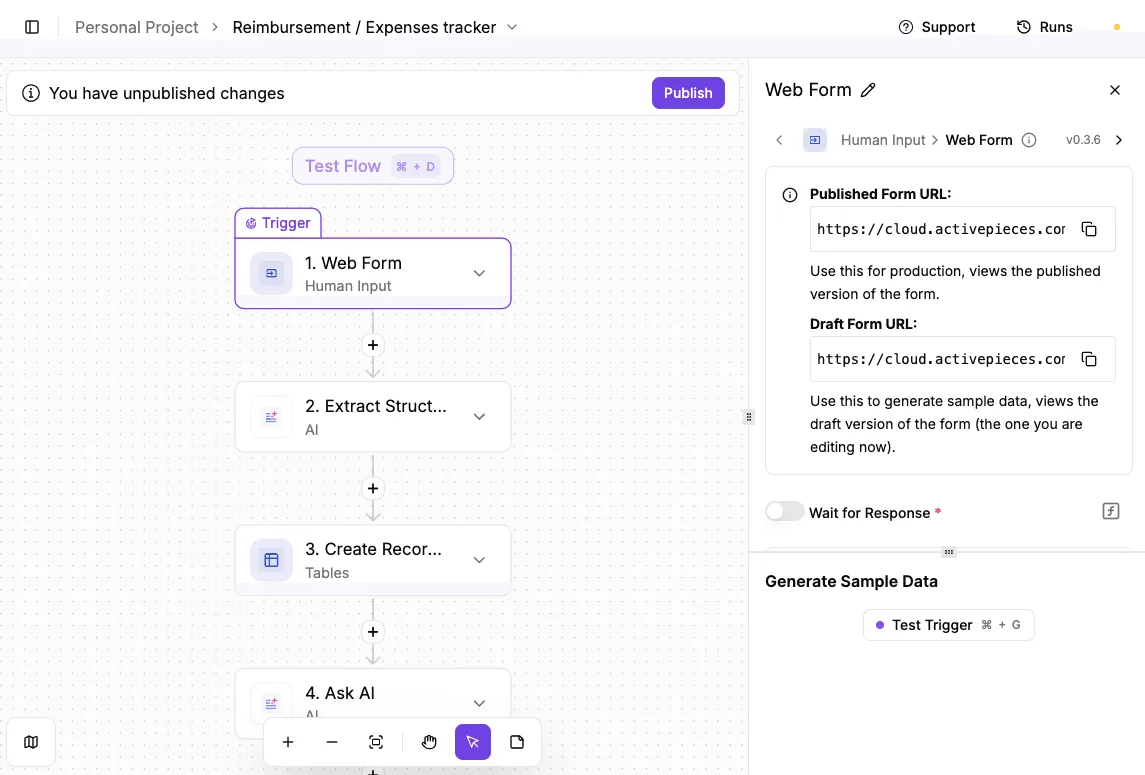
The following table compares the trade-offs between the managed convenience of Zapier and the sovereign control offered by a self-hosted Activepieces instance.
| Dimension | Activepieces (Self-hosted) | Zapier |
|---|---|---|
| Monthly cost for 50k tasks | Fixed infrastructure cost | Tiered usage-based pricing |
| Data residency control | Complete (User-defined) | Limited (Vendor-managed) |
| Open-source license type | MIT License | Proprietary |
Prices and plan limits checked against relevanceai.com and lindy.ai and zapier.com and gumloop.com and docs.claude.com and claude.com and openai.com and gemini.google on September 30, 2026.
By choosing the self-hosted route, your monthly overhead is tied to your own server costs rather than a fluctuating per-task fee that penalizes high-volume agentic loops.
Extending agents with custom TypeScript integrations
Developers use custom "integrations" to wrap specific internal APIs or complex logic into reusable blocks that non-technical users can drag into a workflow.
If an agent needs to use a high-reasoning model like Gemini 3.1 Pro to analyze a proprietary database schema, a developer can write a custom TypeScript integration to handle the authentication and sanitization.
Standard integrations often fail to handle unique edge cases, but this modular approach prevents that problem. It doesn't force a support lead to manually intervene in a failed process.
Every connector is an agent tool. A integration registered in the Integrations Framework runs as a step in a flow and as a schema on the per-project MCP server, making it reachable from an agent or an IDE like Cursor with no second migration.
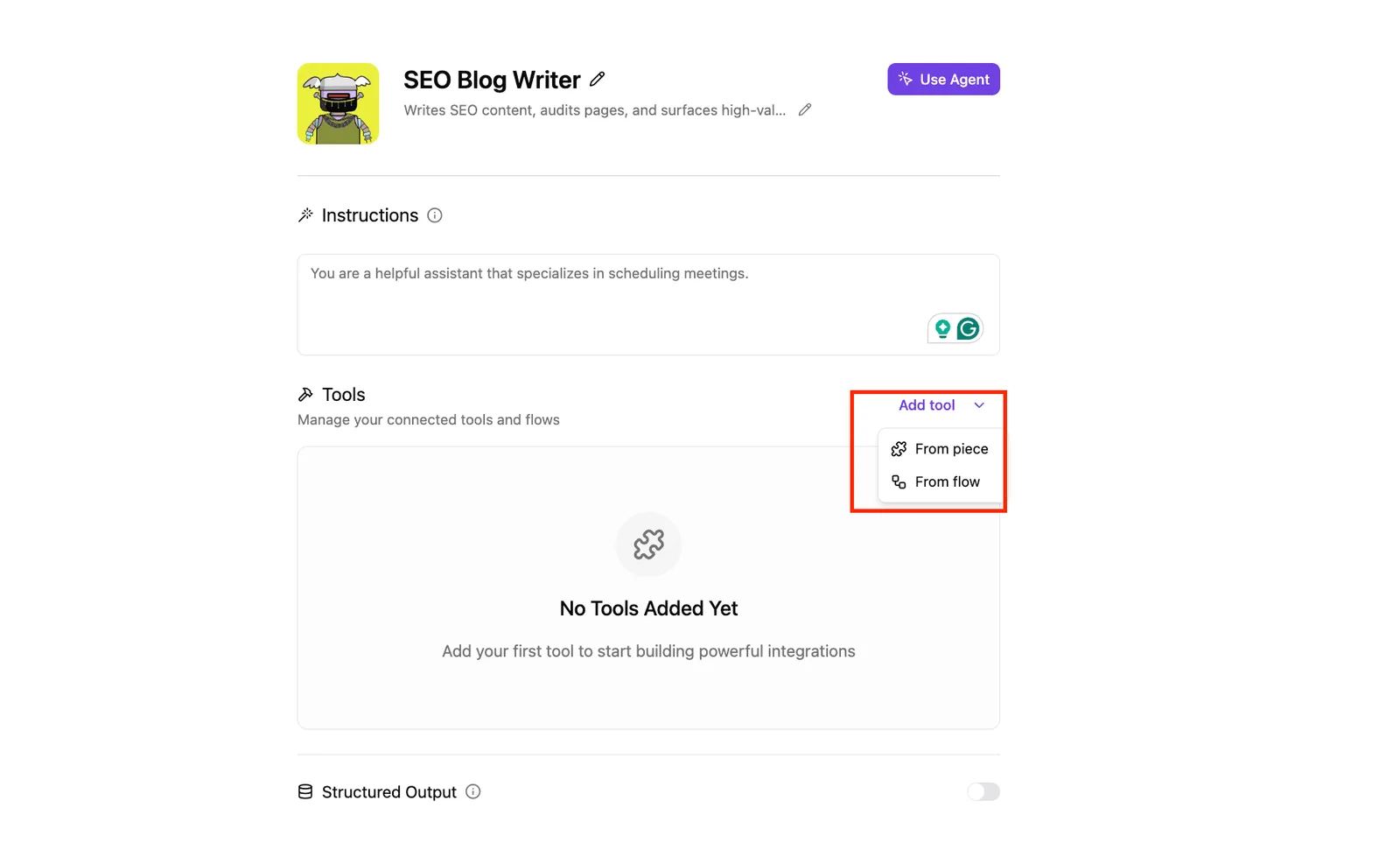
The same integration action code in the packages/integrations directory of the open source repo serves both the flow builder and the MCP tool definitions, ensuring that any capability added to the automation library is instantly available to the AI.
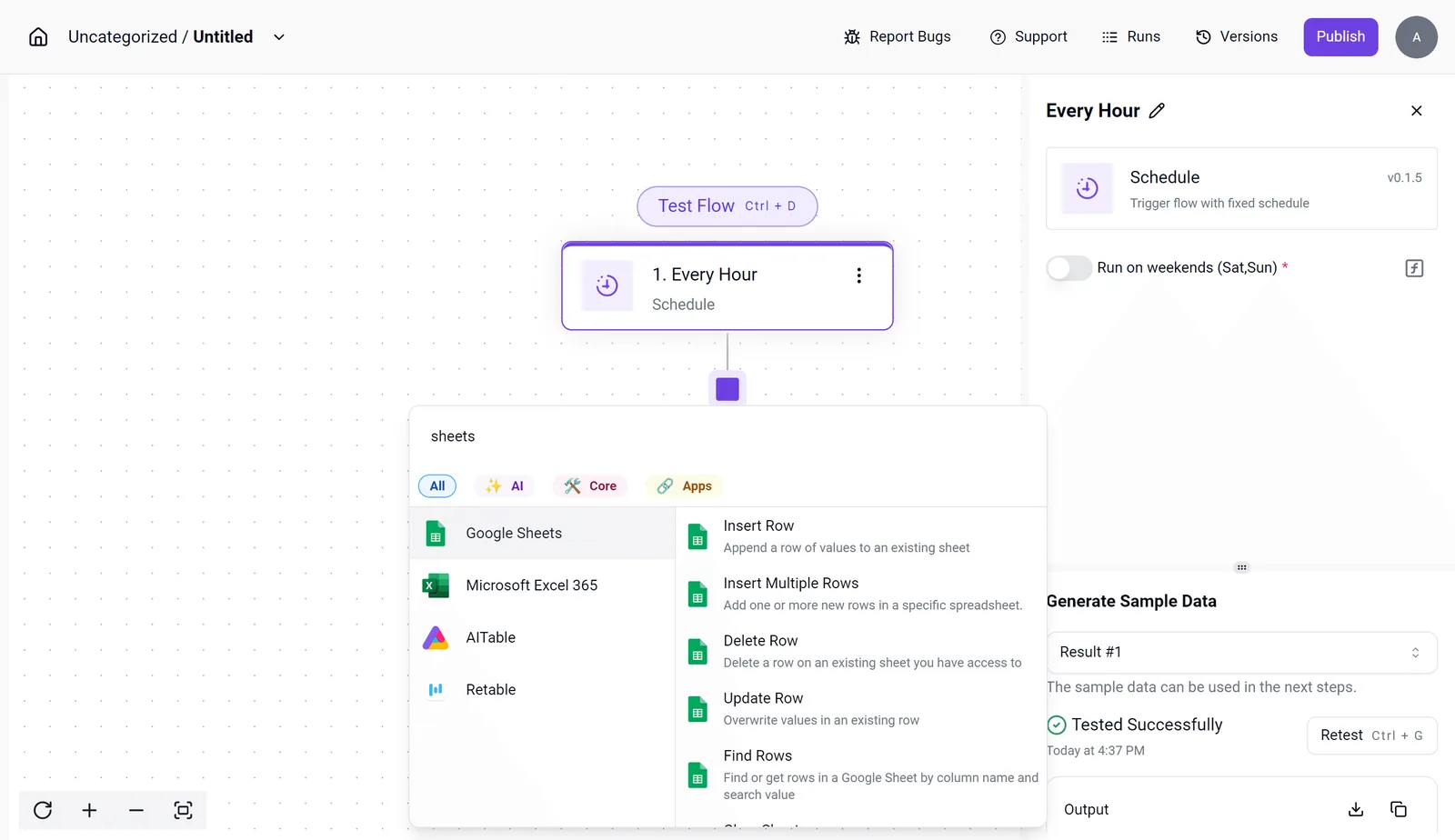
By treating every integration as a modular bit of code, teams can ensure their agents use the most current tools, such as GPT-6 Sol for complex coding tasks, without waiting for an official platform update.
By unifying its connector architecture with the Model Context Protocol, the platform ensures that every integration serves as a native agent tool without requiring additional configuration.
Activepieces is the better choice for organizations that prioritize data sovereignty and architectural flexibility, as it allows teams to deploy a self-hosted engine where the same pieces powering automated flows are immediately accessible to AI agents.
Through this framework, users maintain full control over their execution environment while benefiting from a seamless bridge between traditional automation and agentic workflows.
Everything below works on Activepieces' free plan. Start without code or a credit card.
2. Relevance AI: best for multi-agent autonomous teams
Relevance AI functions as a dedicated operating system for digital workforces by providing the infrastructure needed to keep multiple autonomous agents synchronized over long durations.
While many platforms treat an agent as a single-turn chatbot, this environment treats them as persistent employees. They share a collective memory and a unified set of tools.
Agentic memory and long-term context
When an agent lacks long-term memory, it repeats the same mistake every time a recurring task triggers. This failure forces a human supervisor to manually correct the logs daily. Relevance AI manages this by integrating Retrieval-Augmented Generation (RAG) directly into the agent’s core.

The agent can reference past interactions and specific company documentation without a developer needing to manually pass context strings.
Ai reports that when using a high-reasoning model like Gemini 3.1 Pro, the agent can parse its own history to determine if a customer’s current complaint is an escalation of a ticket it handled three weeks ago.
This persistent state prevents the "amnesia" common in standard API calls.
The multi-agent orchestration layer
Building a workforce requires an orchestration layer that dictates how different agents hand off tasks to one another. This prevents a "Researcher" agent from stalling because it can't access the "Writer" agent's output.
The platform organizes these interactions into structured workflows, similar to how Activepieces uses 735+ integrations to sequence automated steps, but with a focus on autonomous decision-making rather than fixed logic gates.
The following table compares how different platforms handle the complexity of these long-running, multi-agent environments.
| Platform | Long-term memory (RAG) | Tool-use reliability | Support for autonomous 'Workforces' |
|---|---|---|---|
| Relevance AI | Native, per-agent vector storage | High (Agent-specific validation) | Primary architecture |
| Zapier Central | Basic knowledge retrieval | Moderate (Generalized prompts) | Secondary feature |
| CrewAI (Open Source) | Manual configuration required | Variable (Model dependent) | Core framework |
| Activepieces | — | High (Every connected integration available as a tool) | — |
According to Docs, this orchestration ensures that when a model like Claude Sonnet 5.5 is assigned a complex coding task, it can autonomously query a sub-agent for documentation updates.
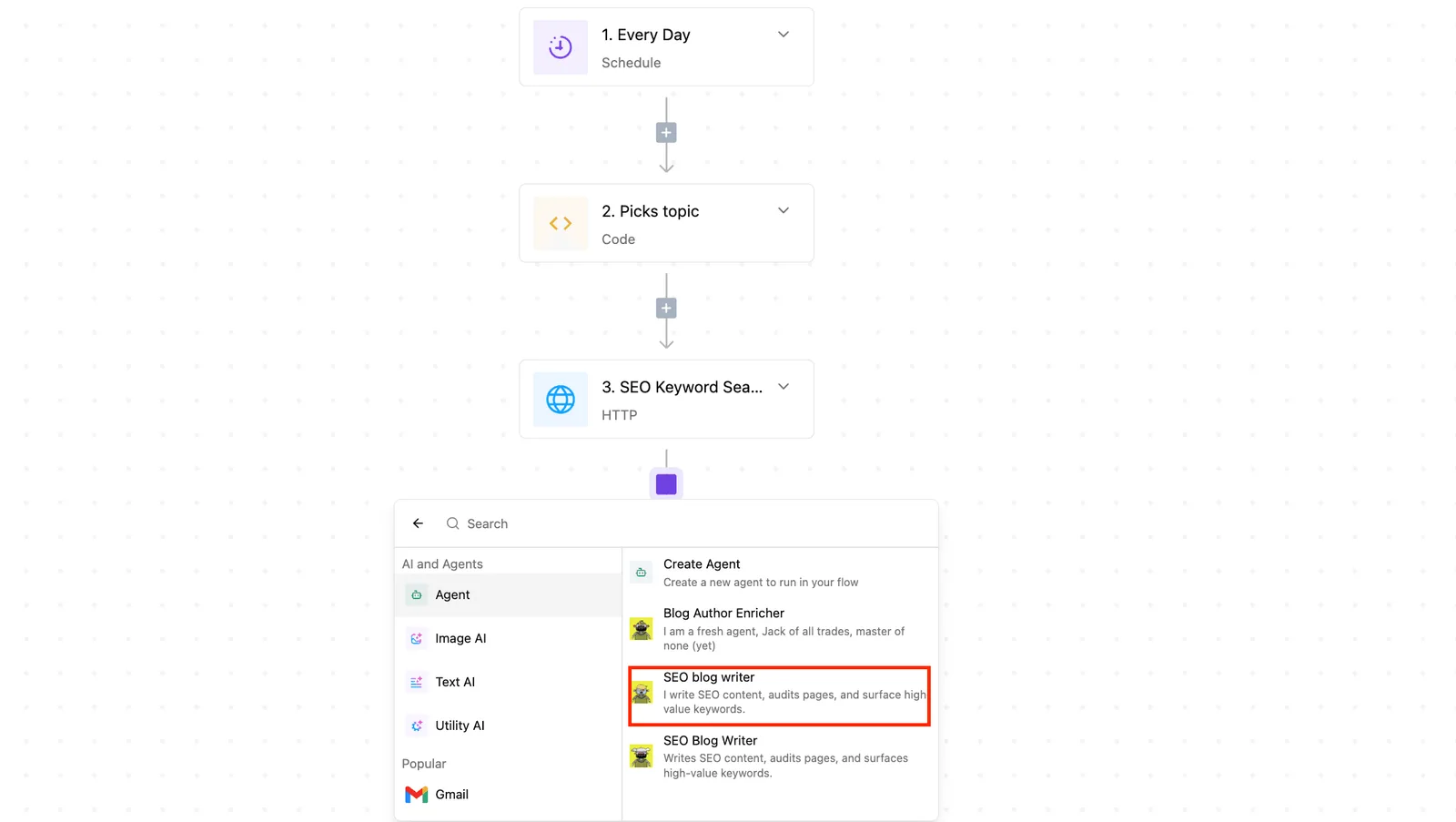
Activepieces runs both autonomous judgment and fixed rules on a single engine, allowing you to place an Agent step directly alongside deterministic steps in one flow.
This unified execution means the entire sequence is captured in a single run trace rather than being fragmented across two systems bridged by a callback.
You can see this in the flow builder by placing an AI agent step next to a standard integration and opening the run trace, which logs the entire sequence as one execution.
By delegating specific sub-tasks, the primary agent avoids token-limit exhaustion and maintains higher accuracy across the entire project lifecycle.
3. Lindy: best for natural language agent creation
Lindy simplifies agent development by replacing traditional logic gates and code blocks with a pure natural language interface. This approach removes the syntax errors that typically stall non-technical users. It shifts the burden of success onto the clarity of your initial instructions.
Building agents through conversation
Constructing an autonomous worker in Lindy involves describing a role as if you were training a human hire. According to Docs, while platforms like Zapier require you to map every data variable manually, Lindy uses models like Claude Sonnet 5.5 to interpret intent.
The agent can handle nuance, such as identifying an "urgent" email, without a rigid set of keyword rules.
If you fail to specify how to handle an edge case, the agent may hallucinate a response or stall. That makes the initial prompt the single point of failure for the entire workflow.
The following process establishes the foundation for a functional assistant:
- Describe the agent's job in plain English.
- Connect your email or calendar.
- Review the generated triggers.
- Test the natural language response.
Verify the agent's logic through this sequence before it interacts with live customer data. Once the instructions are set, the platform uses Claude Haiku 4.5 to execute routine tasks rapidly. This prevents simple replies from lagging during high-volume periods.
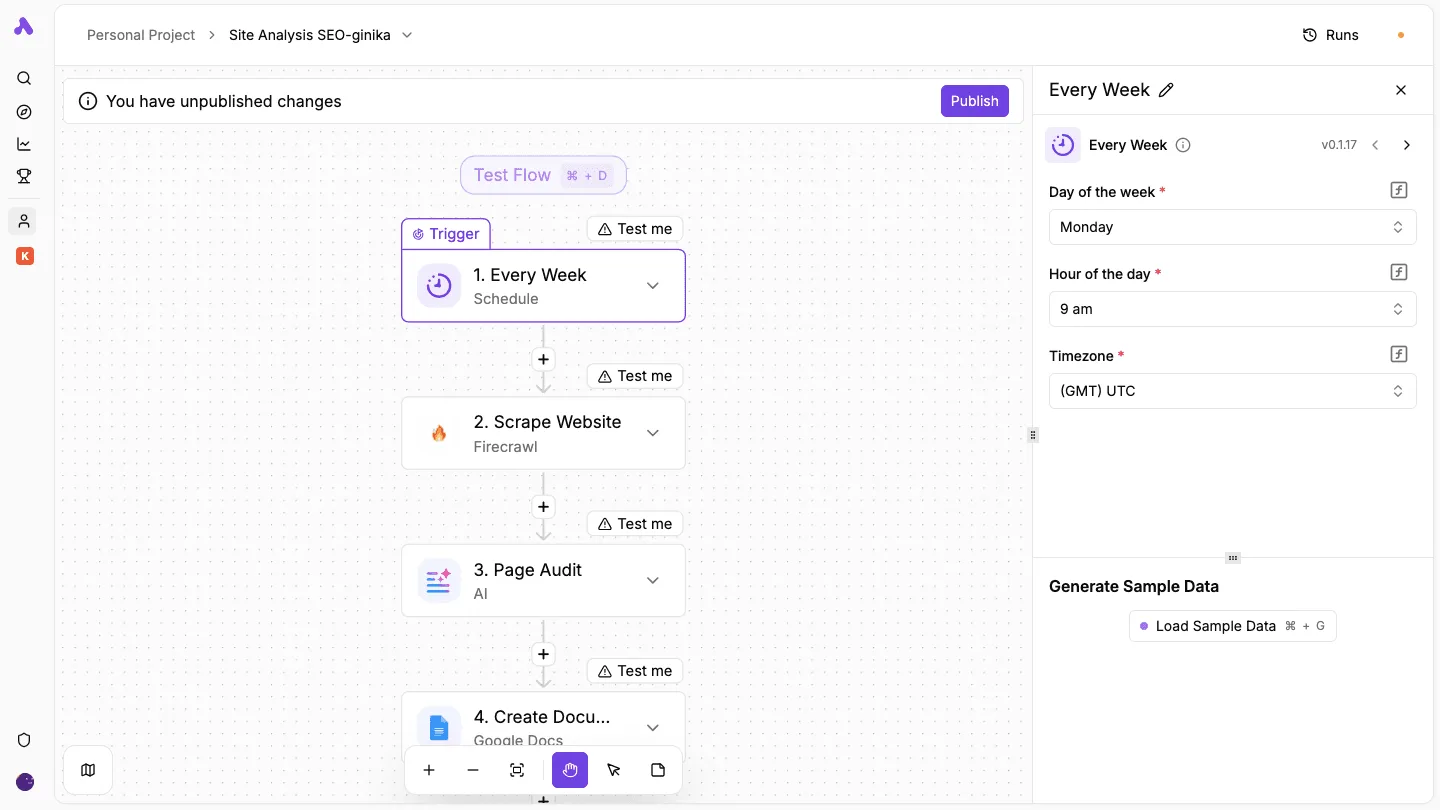
The Lindy ecosystem of pre-built triggers
Lindy functions as a centralized workspace assistant by connecting to third-party software through a library of native integrations. These triggers allow the agent to monitor external events, such as a new lead in a CRM or a message in Slack, without you writing API calls.
Claude states that because these connections are handled at the platform level, a user on the Lindy Plus plan can deploy an agent that monitors their calendar for $29.99 per month. This covers up to 3,000 credits of standard usage.
Gemini indicates that for teams with higher throughput requirements, the Max plan provides 35,000 credits for $199.99 per month, ensuring consistent capacity for high-volume automated workflows, which means scaling operations requires a predictable monthly investment.
Credit exhaustion will not stop an agent managing a busy support queue mid-month under this plan. This tiered structure means the cost of autonomy scales directly with the volume of external events the agent must process.
4. n8n: best for complex technical logic and branching
n8n functions as a visual programming environment where you build agent logic by connecting discrete nodes for data transformation, API calls, and conditional branching.
This structure allows a builder to map out every logical pivot an agent might take. A high-value customer inquiry can then follow a different path than a generic spam notification.
The screenshot shows a HubSpot ticket categorization workflow where a new ticket trigger leads into AI-driven rewriting and categorization steps, eventually branching through a router to different Slack notification channels.
By isolating the "New Ticket Added" trigger in the configuration panel, the builder can verify the incoming data structure. This check happens before the AI attempts to process it, reducing the risk of the agent failing due to an empty subject line.
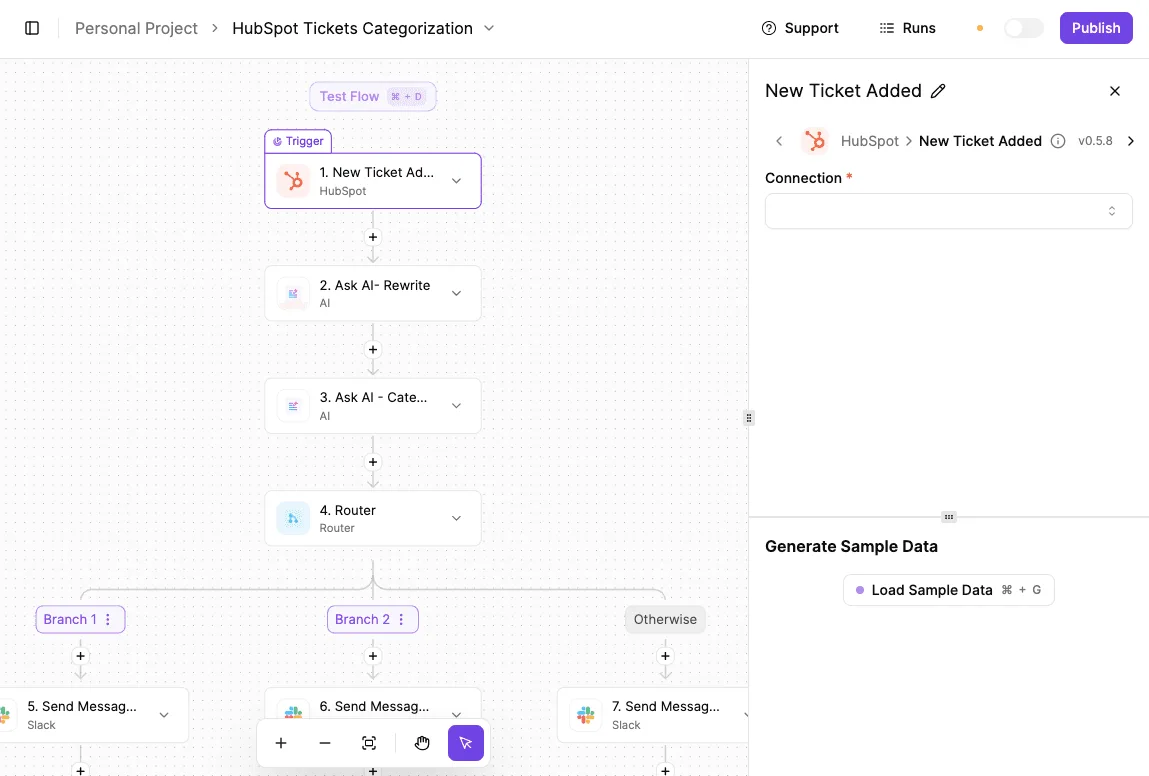
Structured business processes replace simple "prompt-and-response" loops through this granular control.
The LangChain integration nodes
Native integration with LangChain drives technical flexibility in n8n, allowing builders to swap out specific components of an agent’s "brain" without rebuilding the entire workflow.
While platforms like Relevance AI provide pre-configured agent templates that prioritize ease of deployment, n8n requires you to manually define the memory, tools, and model for each agent node.
A developer can pair Claude Sonnet 5.5 for its reasoning capabilities with a specific vector store for long-term document memory.
This prevents the agent from hallucinating facts when answering a technical support ticket. Because these components are modular, a team can update their agent to use Gemini 3.5 Flash-Lite for faster response times by simply swapping a single node.
Handling advanced error states in agents
The primary difference between a prototype and a production-ready system is how an agent behaves when a tool fails or an API times out.
In n8n, every node can be configured with an "Error Trigger" path, which routes the workflow to a specialized sequence if the primary task fails.
The primary difference between a prototype and a production-ready system is how an agent behaves when a tool fails or an API times out.
- n8n uses node-level "On Error" paths to allow for custom retry logic or manual human intervention steps.
- Relevance AI uses built-in retry mechanisms to handle transient errors automatically but offers less visibility into specific failure points.
- n8n supports If/Else and Switch nodes for unlimited logical branches based on specific data values.
- Relevance AI uses "Sub-agent" structures to allow for task delegation but hides the step-by-step logic within the agent's autonomous decision-making.
When a service like Slack is down, this explicit error handling prevents an agent from getting stuck in an infinite loop.
Instead of the agent repeatedly attempting to post a message and burning through token costs, the builder can force the workflow to log the error in a database and notify a human developer immediately.
Easier to see it running than to read about it: set it up free, no card.
5. Salesforce Agentforce: best for CRM-native enterprise agents
Salesforce Agentforce is a specialized builder designed for organizations that require agents to act directly on customer data without the latency or security risks of external API middleware.
While generic builders require manual mapping of every database field, Agentforce inherits the existing structure of the Salesforce platform.
This means a support agent built here can immediately identify a "High Value" customer because it understands the relationship between the Case object and the Account revenue field by default.
Deep integration with Data Cloud
Data silos that typically break autonomous workflows are eliminated by using a CRM-native builder:
- In a tool like Zapier Central, which limits free users to 400 activities per month, an agent must constantly poll external apps to stay updated.
- Agentforce avoids this by sitting directly on top of Salesforce Data Cloud, allowing it to trigger actions based on real-time telemetry.
- Because it uses the same metadata layer as the rest of the CRM, the agent sees the business context required to make a decision.
The following table illustrates how native integration changes the scope of what an agent can safely access compared to third-party orchestration layers.
| Dimension | Salesforce Agentforce | Generic AI Builders |
|---|---|---|
| Native CRM object access | Full inheritance of all custom and standard objects. | Requires manual API mapping for every object. |
| Metadata-aware security | Permissions apply to the agent automatically. | Security must be hard-coded into each prompt or tool. |
| Real-time data sync speed | Instant via Data Cloud unified profile. | Dependent on webhook latency or polling intervals. |
Intelligence scales without a corresponding increase in integration debt as your data grows due to this architectural shortcut.
Salesforce Agentforce permissions and guardrails
Granular control over what an agent can see and do is possible in a native environment based on the user’s existing profile. In many generic builders, such as Relevance AI, an agent often operates with a single set of broad API credentials.

If that agent is tasked with summarizing a contract, it might inadvertently access executive compensation data if the underlying API key has over-scoped permissions. Salesforce Agentforce mitigates this by applying the Einstein Trust Layer to every interaction.
When a developer use a reasoning model like Claude Opus 5.5 for complex knowledge work, the platform automatically masks Personally Identifiable Information (PII) before the data leaves the secure environment.
Sensitive data remains shielded by the same sharing rules that govern human employees even if an agent is compromised. For a support lead, this means an agent can be deployed to resolve billing disputes without the risk of a "prompt injection" tricking the model.
6. Zapier Central: best for adding AI to existing automations
Zapier Central functions as a managed environment where you can teach agents to interact with the existing library of Zapier integrations.
This setup allows a support lead to transition from static "if-this-then-that" rules to dynamic handling of customer requests. An agent can decide whether to offer a refund or a discount code based on the sentiment of an incoming email.
Connecting agents to 6,000+ apps
Granting an agent direct access to the software your team already uses is the primary value of this environment.
Instead of writing custom API connectors for every internal tool, you select an existing Zapier integration, such as a connection to a specific Slack channel or a Google Sheet. The agent uses that bridge to perform tasks.
When you connect a model like Gemini 2.5 Flash to a CRM, the agent can look up a customer's history and update their status without a human manually moving data between tabs.
Data entry errors that occur when a tired agent copy-pasts a tracking number into the wrong field are reduced by this setup.
Because these connections are managed through the Zapier interface, a manager can revoke an agent's access to a specific app at any time. This ensures that an experimental bot doesn't accidentally delete records in a production database.
Lindy's persistent agent memory
These agents maintain a memory of past interactions within their workspace, unlike standard automation flows that start from scratch every time they run.
This persistence means that if a customer asks a follow-up question about a previous ticket, the agent can reference the context of that earlier conversation to provide a consistent answer.
Static documents, such as a PDF of your latest shipping policy, can also be uploaded for the agent to use as a source of truth.
If you use a reasoning-heavy model like Claude Sonnet 5.5, the agent can compare a customer’s specific complaint against your uploaded policy to determine if their request falls within your warranty guidelines.
This prevents the "hallucination" problem where an AI promises a customer a full refund that your company doesn't actually offer.
7. Gumloop: best for data-intensive web scraping agents
Gumloop manages long-running agentic state by treating web browsing and data extraction as a series of verifiable steps rather than a single black-box request.
This architecture prevents the common failure where an agent gets stuck on a cookie consent pop-up or a CAPTCHA. That failure otherwise leaves a customer waiting for a report that will never arrive.
Gumloop's browser automation for scraping
Gumloop uses a specialized browser environment that allows agents to navigate complex web interfaces, click buttons, and wait for dynamic content to load before attempting to extract data.
In a typical support scenario, such as verifying a customer’s public business registration across multiple government portals, a standard LLM often fails because it can't interact with the page's UI elements.
By offloading these browser actions to a dedicated execution layer, the platform ensures that the agent sees the same data a human would.
This reduces the rate of empty search results being returned to your CRM. The following data demonstrates how specialized scraping agents outperform generic logic when faced with non-standard web structures.
As page complexity increases, the ability to maintain a stable browser session becomes the primary factor in whether a task completes or errors out.
Gumloop's data transformation pipeline
When an agent successfully scrapes thousands of rows of pricing data or product specifications, Gumloop processes this information through a pipeline that cleans and formats the data for downstream use. For high-throughput workloads, you can deploy Gemini 3.5 Flash to summarize these large datasets.
The cost per execution stays low even when the input text spans hundreds of pages.
If the task requires identifying specific patterns within messy HTML, the platform can route that specific step to Claude Haiku 4.5. This ensures that the final output delivered to your database is structured correctly without requiring a manual review by your engineering team.
How to choose an agent builder
Choosing a builder requires balancing your available engineering hours against the strictness of your data residency requirements. A platform that offers 735+ integrations, like Activepieces, provides enough connectivity for standard business stacks while allowing for self-hosting, so users maintain full control over their data infrastructure.
MoneyGram, Moneypenny, Alan and FundingSocieties run Activepieces in production to manage these complex environments. By using the MIT-licensed core, a healthcare provider can process patient data without it ever leaving their private cloud.

In contrast, a service like Zapier, which offers 2,000 integrations, provides broader reach for marketing teams using niche SaaS tools, making it easier to bridge gaps between highly specialized software, so users can connect disparate platforms without custom development.
This locks you into a proprietary cloud environment where data privacy is managed by the vendor.
When to prioritize open-source over SaaS
Prioritize open-source builders when your industry mandates local data processing or when you need to avoid the "agent tax" of per-execution fees. While SaaS platforms are faster to deploy, they often act as a black box.
If an agent powered by Gemini 3.5 Flash-Lite starts hallucinating internal API calls, you can't easily inspect the underlying orchestration code to fix the logic.
Self-hosted options allow you to pin specific versions of models and libraries. This ensures an update to a remote server doesn't break a critical production workflow on a Tuesday morning.
Matching technical skill to builder complexity
The right tool matches the mental model of the person fixing the errors. If a non-technical operations lead is the primary maintainer, a natural language interface is a requirement so they can describe a fix in plain English.
Visible logic branches in a low-code builder are safer for complex logic, such as routing a ticket to Claude Sonnet 5.5 only when sentiment analysis detects high frustration. It prevents the "hidden intent" problem where an AI interprets a prompt differently than you intended.
Calculating the true cost of agent executions
The sticker price of a subscription rarely reflects the total cost of running autonomous agents at scale. You must account for the orchestration fee: the "middleman" cost the platform takes to coordinate between the model and your apps.
| Feature | Entry Tier | Privacy | Complexity |
|---|---|---|---|
| Activepieces | Free / $0 | Self-hosted or Cloud | Low-code / Visual |
| Gumloop | $37 / month | Cloud-only | Flow-based / Agentic |
| Zapier | Free / $0 | Cloud-only | Natural Language / No-code |
For example, Gumloop charges a $37 monthly fee for its Pro tier, which includes 20,000 credits, but it also applies an 8% orchestration fee, meaning the final cost will always exceed the base subscription price.
For every 100 credits spent on a model like GPT-6 Luna, you actually consume 108 credits from your balance. Your total allotment will be exhausted faster than the base credit count suggests.
These overheads determine whether an agent remains profitable or becomes a liability as your volume grows.
Frequently asked questions about AI agent builders
What is the difference between a chatbot and an AI agent?
An AI agent possesses the agency to execute multi-step workflows and interact with external software, whereas a chatbot is restricted to generating text within a conversational interface.
While a chatbot might explain how to update a record, an agent uses a tool like Gemini 3.5 Flash-Lite to identify the missing data, query the database, and commit the change without human intervention.
The agent requires a persistent state to remember what it did in step one while it waits for a third-party API to respond in step ten due to this shift from conversation to action.
Do I need my own LLM API keys for these builders?
Most enterprise builders require you to provide your own API keys for models like Claude Sonnet 5.5 or GPT-6 Astra. This ensures you maintain direct control over your rate limits and data usage costs.
Bringing your own key ensures that if a specific provider like Anthropic or OpenAI updates their terms, your billing relationship remains direct rather than being obscured by a platform markup.
Some platforms offer a "managed" tier where they bill you per execution, but this often limits your ability to swap models if a new reasoning engine like GPT-6 Astra becomes the better fit for your specific logic.
Can AI agents run on a schedule or only on triggers?
Agents can operate on both immediate event-based triggers and recurring schedules. This allows them to handle both reactive customer tickets and proactive system maintenance.
Event-based triggers initiate a run when a specific action occurs, such as a new file appearing in a cloud storage bucket.
Scheduled triggers execute at defined intervals, which is necessary for tasks like summarizing daily logs using Mistral Large 3. Webhook listeners allow external services to "ping" the agent. This ensures the workflow only consumes compute resources when there is actual work to process.
How do these platforms handle data privacy and PII?
Platforms manage data privacy by offering varying levels of isolation, ranging from shared multi-tenant environments to fully air-gapped private cloud deployments.
| Deployment Type | Data Handling Impact |
|---|---|
| Multi-tenant SaaS | Metadata and logs are stored on the provider's infrastructure, which requires strict RBAC to prevent unauthorized internal access. |
| VPC / On-premise | The execution engine runs within your own network, meaning sensitive PII never leaves your firewall during the processing stage. |
| Zero-retention Logging | The platform executes the logic but does not write the payload to a permanent database, reducing the risk of data exposure during a breach. |