
Embedded iPaaS: The Complete Guide for 2026

Oct 13, 202617 min read
Embedded iPaaS allows software teams to treat third-party connectivity as a managed service rather than a recurring engineering tax, often by utilizing platforms like Activepieces to streamline development workflows.
In the current B2B landscape, integrations are no longer "nice-to-have" features but essential levers for customer acquisition and retention.
Embedded iPaaS is infrastructure for native product integrations
According to Pandium, 60 percent of buyers explicitly mention integrations during the sales process, which means your sales team is likely losing momentum if they cannot demonstrate interoperability early.
Furthermore, 90 percent of buyers consider integration depth a primary factor when shortlisting vendors, so a lack of connectivity prevents your product from even entering the consideration set.
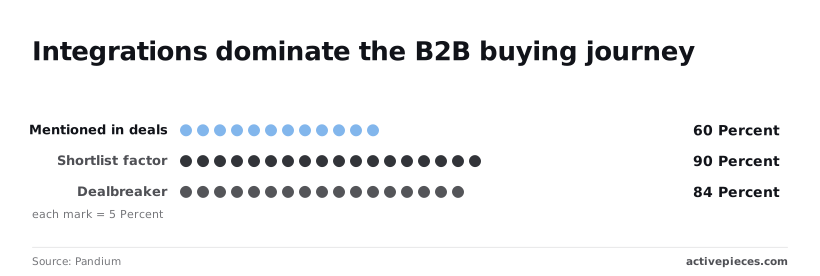
For 84 percent of customers, the absence of a specific integration is a total dealbreaker, making connectivity a direct gatekeeper to your Monthly Recurring Revenue (MRR), so failing to provide these links directly threatens your company's financial growth.
The difference between standard and embedded iPaaS
Standard iPaaS (Integration Platform as a Service) is a tool for internal IT teams to connect their own silos, whereas embedded iPaaS is a developer-first framework designed to be shipped as part of your own product.
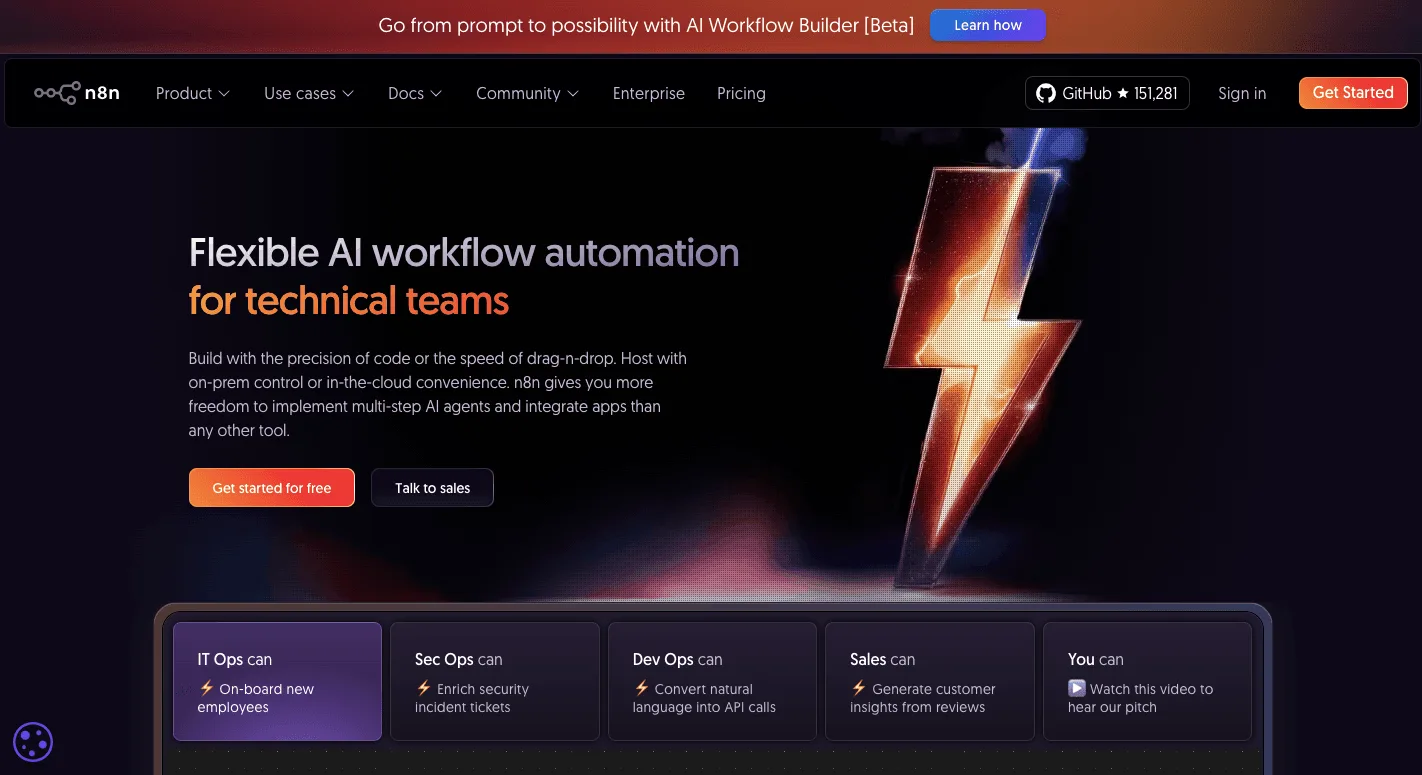
Activepieces publishes its core under an MIT licence, with the enterprise directories under a separate commercial licence stated in the same repository.
This ensures the core logic remains yours to run or embed, providing a permanent escape hatch that source-available rivals like n8n do not offer.
Choosing a closed or source-available vendor leaves the rights with them; if they pivot their pricing or paywall a critical feature, you are forced to migrate on their timeline rather than your own.
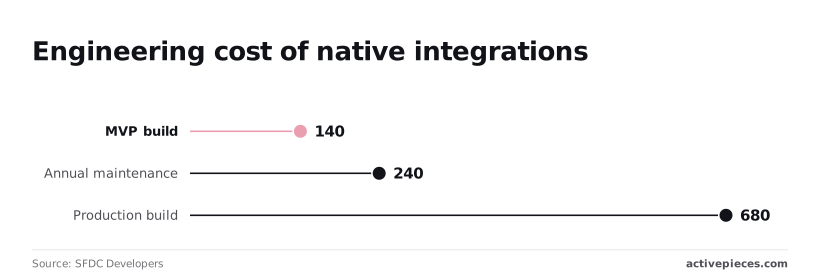
Data from SFDC Developers shows that a basic MVP build for a single integration requires 140 engineering hours, meaning a single developer is sidelined for nearly a month just to achieve baseline functionality.
SFDC Developers' analysis puts the cost of scaling this to a production-grade build at 680 hours per integration, which forces a trade-off between core product innovation and connectivity.
Even after shipping, annual maintenance consumes 240 hours per connector, so a portfolio of just five native integrations can permanently occupy two full-time engineers.
How the integration builder lives inside your UI
By abstracting the complexity of OAuth flows, webhook listeners, and rate limiting, an embedded solution provides a white-labeled interface that resides within your application’s frontend.
This architecture allows your core application to remain focused on its primary value proposition while the embedded engine handles the heavy lifting of data translation.
The following illustration shows a central SaaS application core surrounded by a 'native' layer of standardized API connectors (Slack, Salesforce, HubSpot) that feed into a unified 'Embedded iPaaS' engine, demonstrating how data flows from external ecosystems into your proprietary database without requiring custom code for every new endpoint.
This visualization confirms that the engine acts as a buffer, protecting your roadmap from the volatility of external API changes. By utilizing JWT user provisioning, you can securely serve these builders to your customers while maintaining full control over the user experience.
The role of the workflow engine in SaaS growth
The maturity of a SaaS company is often measured by the breadth of its ecosystem, as deeper integration increases the cost of switching for the customer.
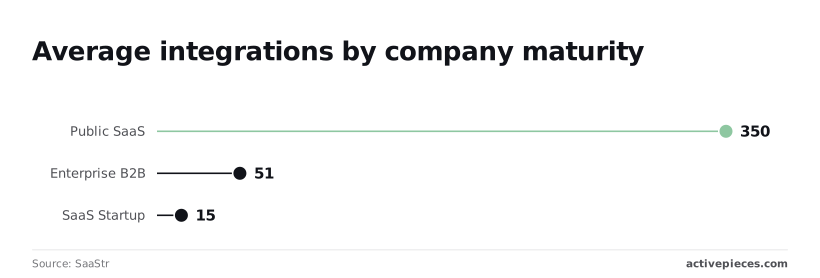
Research from SaaStr indicates that the average SaaS startup maintains only 15 integrations, which often limits them to niche use cases, effectively capping their potential to capture a broader market share, leaving these companies struggling to scale beyond their initial customer base, a deficit that forces them to compete for a shrinking pool of users, so these businesses remain trapped in a cycle of limited growth.
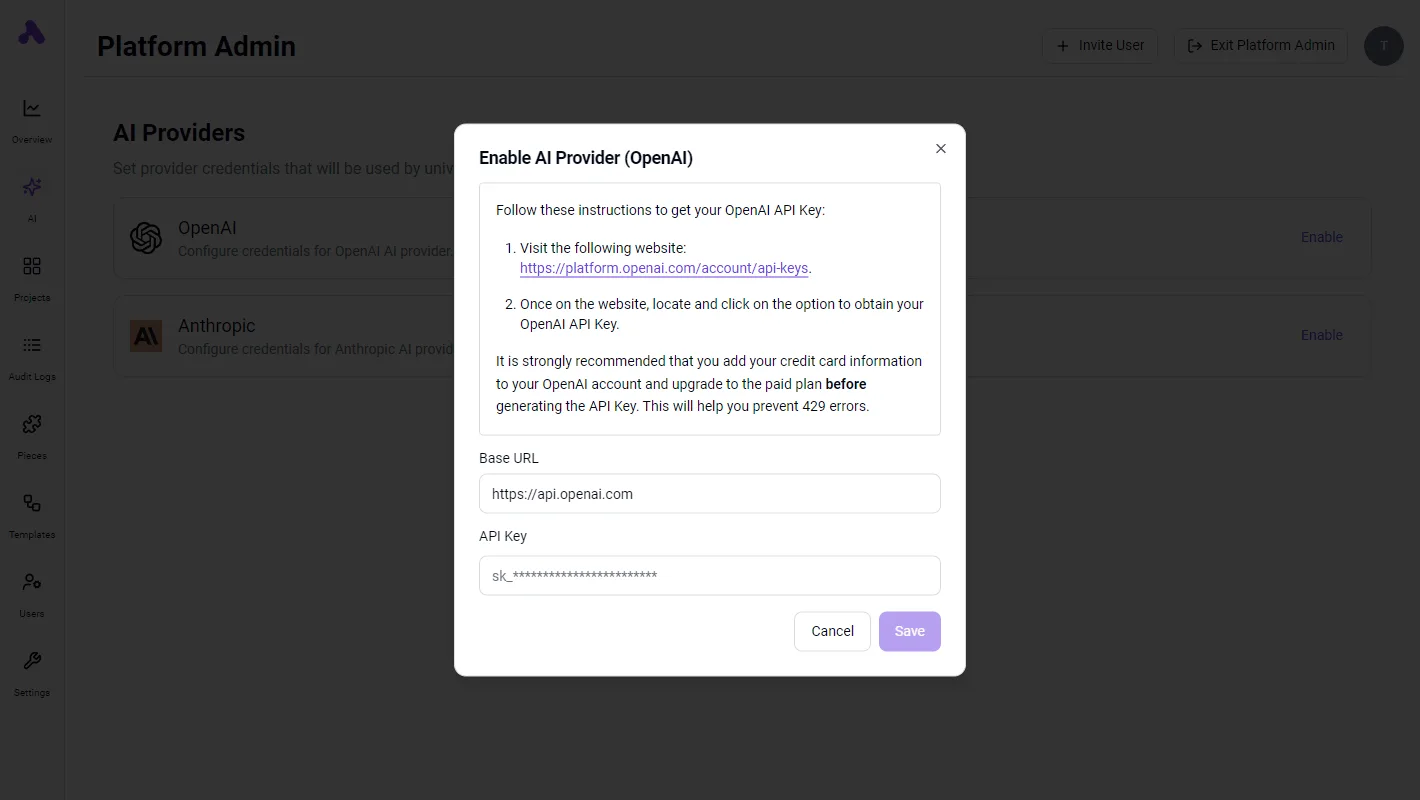
As companies move into the Enterprise B2B segment, that number jumps to 51 integrations, demonstrating that larger contracts require more complex data orchestration.
Top-tier public SaaS companies average 350 integrations, so scaling your product to a market-leading position requires a strategy that can handle a 23x increase in connectivity without a linear increase in headcount.
Outsourcing this infrastructure ensures that your engineering talent remains focused on the proprietary features that drive your valuation.
This takes minutes, not a project: automate it in Activepieces free.
Integrations are now a primary B2B dealbreaker
Why integrations dictate the B2B shortlist
A software product’s value is now measured by its ability to communicate with the existing tech stack, as isolated data silos increase the operational overhead for your customers.
When a prospect evaluates a new tool, they prioritize the automated flow of data over standalone UI features because manual data entry represents a recurring labor cost that scales linearly with their growth.
If your product cannot sync bi-directionally with a CRM like Salesforce or a communication hub like Slack, it is viewed as a liability rather than an asset.
This shift means that missing a key connector will result in your product being filtered out during the initial discovery phase, long before an engineer has the chance to demo your proprietary logic.
The shift from feature-parity to ecosystem-parity
Modern buyers no longer compare products solely on a feature-by-feature basis; they compare how well each product fits into their broader digital ecosystem.
Achieving ecosystem-parity requires your platform to support the same depth of connectivity as established incumbents, which forces your team to maintain a massive library of third-party APIs.
While your core product might offer superior performance, a competitor with more robust triggers for an ERP like NetSuite or a marketing tool like HubSpot will often win the contract.
Consequently, the "table stakes" for entering a new market have moved from the application layer to the integration layer, making connectivity the primary driver of your customer acquisition cost.
Integrations as a requirement in enterprise sales deals
In enterprise procurement, integrations have transitioned from optional enhancements to non-negotiable requirements that can halt a transaction in its tracks.
The sales impact is measurable: 60% of sales deals involve specific integration discussions, and 84% of customers now view these capabilities as a "dealbreaker" or a "very important" requirement for closing, meaning that a lack of connectivity is now a primary cause for lost revenue.
When a buyer identifies a missing sync as a dealbreaker, it signals that the friction of adopting your tool outweighs the perceived benefit of your unique features.
This data demonstrates that a lack of connectivity is the fastest way to lose a qualified lead to a more integrated competitor.
To survive the final stages of a high-value contract, your roadmap must demonstrate an immediate ability to bridge these gaps without requiring the customer to build custom middleware.
The scaling trap: Why native builds deplete the roadmap
Native integration builds create a compounding technical debt that forces engineering teams to choose between fixing broken connectors and shipping new product features.
While a custom-coded bridge solves an immediate sales blocker, the long-term burden of ownership scales linearly with every new platform added to the ecosystem.
The high cost of maintaining third-party API versions
When an enterprise tool like the Salesforce CRM platform transitions from a REST to a specialized event-driven API, your developers must halt roadmap work to re-engineer the connection.
Third-party platforms frequently deprecate endpoints or update their data schemas, requiring your team to rewrite authentication and mapping logic to prevent silent data loss. Failure to do so results in broken customer workflows and immediate churn risks.
Why annual maintenance exceeds the MVP build time
The initial effort to launch a Minimum Viable Product (MVP) integration represents only a fraction of the total lifecycle cost because edge-case handling and rate-limiting logic require continuous tuning.
The following data compares the engineering hours required for a Jira-Salesforce MVP against a full production-ready build and subsequent annual maintenance:
[Engineering Hours: MVP vs. Production Build Chart]
| Phase | Engineering Hours |
|---|---|
| Basic MVP build for a single integration | 140 hours |
| Production-grade build | 680 hours |
| Annual maintenance | 240 hours |

As shown, the production-ready build (which includes retry logic, logging, and error handling) demands nearly five times the effort of the initial prototype.
This investment is followed by significant annual upkeep, meaning every "finished" integration permanently consumes a portion of your weekly engineering capacity.
Freeing developers from integration maintenance work
By adopting a developer-first framework, you shift the burden of monitoring API changes and managing worker queues to a specialized layer.
Outsourcing the integration infrastructure allows your most expensive talent to focus on proprietary IP that justifies your valuation rather than building commodity pipes.
This ensures your senior engineers spend their sprints on differentiated features rather than troubleshooting webhook failures.
You can follow the rest of this with the builder open. Start free, no card.
The case for building integrations in-house from scratch
For developers avoiding third-party middleware, building integrations in-house is the only way to maintain absolute sovereignty over your application’s architecture and user interface.
This path eliminates the "black box" problem of third-party middleware, ensuring that every interaction between your software and an external service feels native rather than bolted on.
The case for in-house control over integration UX
Hand-coding your connectors allows you to design bespoke onboarding flows that match your design system exactly.
When a user connects a CRM like Salesforce, a native build ensures the authentication modal and field-mapping interface are indistinguishable from your core settings pages, which prevents the brand dilution that occurs when third-party iframes or redirected URLs appear.
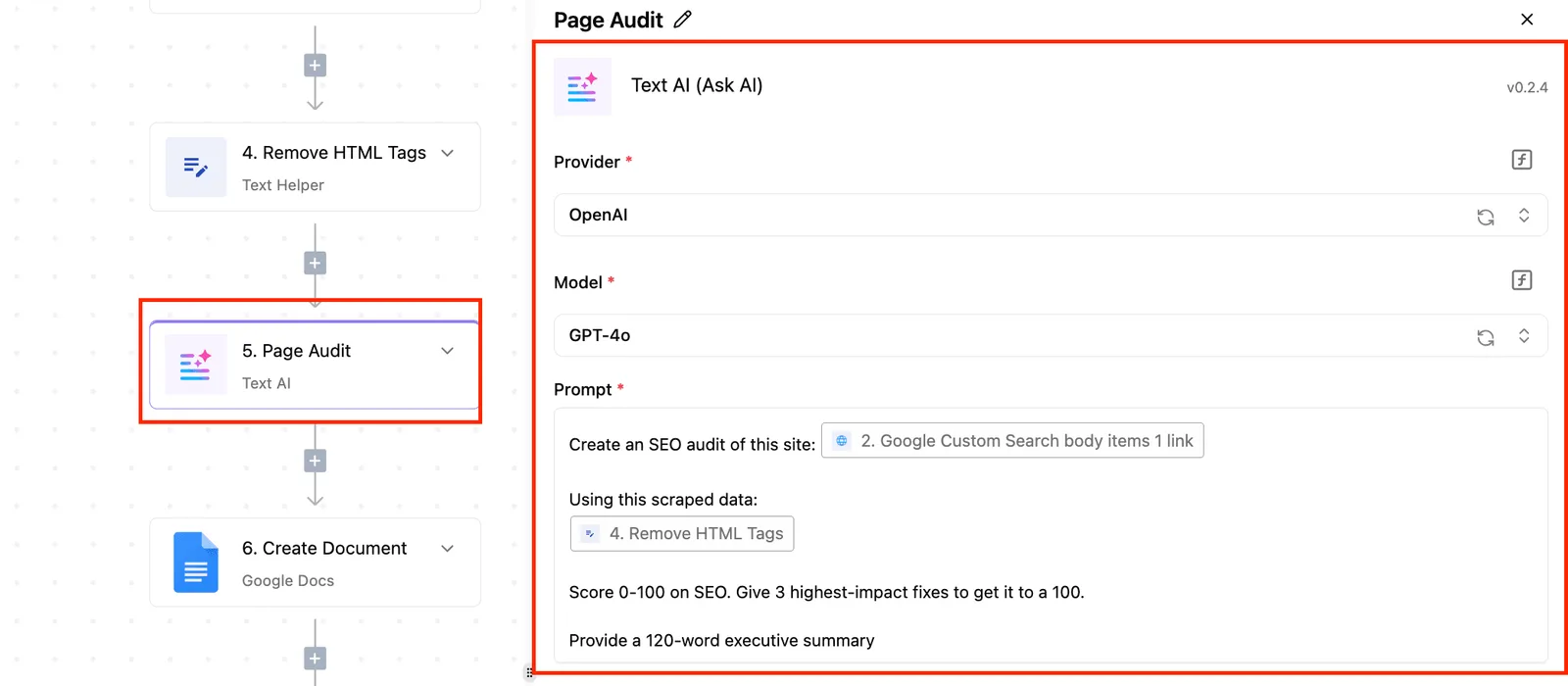
Beyond aesthetics, you gain granular control over data transformation; you can write custom logic to sanitize or enrich incoming payloads before they ever hit your production database, which means your schema remains clean regardless of how messy the external API’s response might be.
Native integrations reduce security and uptime risk
Direct integrations remove the intermediary layer, which means your system’s availability is tied only to your infrastructure and the target API.
By bypassing an integration platform, you reduce your attack surface by one entire vendor, so a security breach at a middleware provider cannot lead to a credential leak for your customers.
This architectural choice also simplifies your Service Level Agreement (SLA) because you are not reliant on a third party’s status page to fulfill your own uptime promises to enterprise clients.
Avoiding 'per-connector' or 'per-execution' tax at scale
In-house builds protect your margins as your customer base and transaction volumes grow.
Because you are not paying a vendor for every task run or every enabled connection, your cost of goods sold (COGS) remains decoupled from your integration usage, which allows you to offer unlimited automation as a competitive advantage without eroding your monthly recurring revenue.

While the initial engineering payroll is high, the lack of recurring licensing fees means that once a connector is stable, the marginal cost of supporting an additional thousand users on that integration is effectively zero.
How embedded providers solve the customization and lock-in problem
Embedded integration providers eliminate the trade-off between engineering speed and brand consistency by offering deep UI hooks that make third-party infrastructure indistinguishable from native code.
This architectural shift allows founders to preserve their product’s aesthetic integrity while offloading the technical debt of API versioning and credential management.
White-labeling and the invisible integration layer
Modern embedded platforms provide full CSS injection and component-level styling, which means the end-user never sees a logo or color palette that deviates from your primary dashboard.
When you utilize a white-label builder, you are effectively skinning a battle-tested engine with your own design tokens so that your customers perceive the automation features as a core value proposition of your platform rather than a bolted-on afterthought.
This level of visual control ensures that the user journey remains cohesive, preventing the trust-drop that occurs when a user is redirected to a third-party domain to authenticate their data.
Using JWTs for secure, seamless user provisioning
Secure user handoffs are handled via JSON Web Tokens (JWTs), which allow your backend to sign a payload that automatically authenticates and provisions a user workspace within the integration layer.
- Your server generates a signed token containing the user’s unique identifier and permissions.
- The client-side SDK receives this token to initialize the embedded iframe or component.
- The integration provider validates the signature against your public key, ensuring the user only accesses their specific connections and logs.

This flow removes the need for a separate login screen for your integration marketplace, so the transition from your settings page to an active workflow is instantaneous and secure.
Open-source embedded iPaaS versus closed-source platforms
By choosing a provider with an open-source foundation, you gain the ability to inspect the execution logic and contribute custom "integrations" or connectors back to the codebase.
The industry is moving away from proprietary, closed-source "black boxes" toward transparent cores that give developers the ultimate escape hatch if their requirements outgrow standard features.
Activepieces syncs flows to git and promotes them through Release Management, allowing teams to version and review automations as code rather than relying on a vendor's private UI history.
This ensures that the logic layer is as intelligent as it is extensible, providing a path to production that is deliberate rather than accidental, as detailed in the official documentation for Git Sync and Release Management.
For teams building agentic workflows, these cores can be orchestrated by flagship models like GPT-6 Astra or Claude Opus 5.5, ensuring that the logic layer is as intelligent as it is extensible.
Choosing the right embedded iPaaS for your software architecture
Comparing cloud-only versus self-hosted deployment models
Selecting a deployment model dictates your long-term operational overhead and data residency compliance.
A cloud-only provider manages the infrastructure and scaling, which means your engineering team avoids server maintenance but loses granular control over data egress.
Conversely, a self-hosted architecture allows you to run the integration engine within your own VPC, so sensitive customer credentials never leave your security perimeter.
| Feature | Albato | Tray.ai | Paragon |
|---|---|---|---|
| Connector Count | 1000+ | Quote-based | 130+ |
| Pricing Model | Transparent/Tiered | Sales-only/Quote | Sales-only/Quote |
While high connector counts accelerate initial market entry, this comparison highlights that the lack of transparent pricing often leads to unpredictable scaling costs as your user base grows. Selecting a vendor with a clear cost structure ensures your margins remain protected during rapid expansion.
Evaluating the developer experience and API-first design
To prevent the "black box" problem where support teams cannot debug failing customer syncs, a developer-first integration layer must treat workflows as code.
Systems designed with a headless architecture allow you to trigger workflows via webhooks or SDKs, meaning your product remains the primary interface while the iPaaS handles the complex authentication handshake with third-party services.
The Activepieces approach: MIT-licensed and white-labeled
Activepieces provides an MIT-licensed core that gives developers full visibility into the execution engine, ensuring you are never locked into a proprietary vendor roadmap.
The platform features a white-label builder that uses JWT user provisioning to seamlessly embed the automation experience directly into your UI.
MoneyGram and Moneypenny run Activepieces in production to manage complex automation environments, benefiting from a model that offers unlimited flows on every plan, including the free tier, to ensure that integration depth is never capped by licensing costs.
The Monday morning integration debt audit checklist
Quantifying the drag of manual API maintenance requires a cold look at how many engineering hours are diverted from your core product roadmap to keep existing connections alive.
Every bespoke integration is a liability that compounds as third-party providers update their schemas or deprecate endpoints.
This audit reveals the true cost of your current strategy so you can determine if offloading the infrastructure to a dedicated provider is necessary to preserve your runway.
Every bespoke integration is a liability that compounds as third-party providers update their schemas or deprecate endpoints.
The Integration Debt Audit:
- Count total active third-party API connections to identify how many external failure points your team currently monitors.
- Aggregate monthly engineering tickets tagged 'Integration Fix' to visualize the percentage of your sprint velocity lost to maintenance.
- Calculate 'Time to First Call' for new custom builds to measure the opportunity cost of delaying new feature launches.
If the audit shows that more than one day per sprint is spent on authentication refreshes or webhook troubleshooting, the overhead is likely stalling your growth metrics.
This process highlights the specific friction points where your team is acting as a middleware provider rather than a software innovator.
Transitioning to a unified infrastructure allows your developers to focus on the unique business logic of your application while a specialized engine handles the brittle connectivity layer.
Once you have identified the extent of this debt, the next step is evaluating the architectural shift required to move from hard-coded connectors to a scalable, embedded workflow environment.
Frequently asked questions about embedded iPaaS?
Does embedded iPaaS impact my application's performance?
By utilizing asynchronous processing, your primary database and API threads remain responsive even when processing high volumes of data transfers. Embedded iPaaS offloads the execution of complex workflows to a dedicated environment, preventing integration spikes from competing with your core application resources.
- Off-process execution ensures that a massive data sync in one customer account does not increase latency for another.
- Webhook listeners act as a buffer, preventing your main server from being overwhelmed by bursts of external traffic.
- Dedicated worker nodes handle heavy transformations, so your application’s CPU remains available for user-facing features.
How is data residency handled in an embedded environment?
For companies serving highly regulated sectors, this control is a prerequisite for passing security audits and closing enterprise deals. Data residency is managed through regional deployment options or self-hosted architectures that keep sensitive information within your specific jurisdictional boundaries.
- Regional cloud instances allow you to pin data processing to specific geographies, satisfying local privacy laws.
- Self-hosting options provide full control over the infrastructure, ensuring data never leaves your private network.
- Encrypted credential storage keeps third-party tokens isolated from your primary user database, reducing the blast radius of potential breaches.
What is the typical pricing model for embedded integrations?
Pricing for embedded solutions typically scales based on the volume of execution or the number of active customer connections, aligning your costs directly with the value delivered to your users.
This prevents a flat-fee structure from eroding your margins as your customer base grows.
Activepieces offers a free-forever cloud plan with 1,000 credits and unlimited flows, while its 739 integrations (roughly 60% of which are community-contributed) allow teams to scale their ecosystem without the linear headcount growth required by native builds, so users can automate complex workflows without needing a dedicated engineering department.
For custom terms and volume-based scaling, enterprise teams can leverage the separate commercial licence for ee directories to maintain full governance over their production environments.
Related reading
References
Build it
Set this up in minutes.
No code required. Connect your accounts, and Activepieces runs it from there.
Start free Talk to sales