
HeyGen Alternatives vs Custom AI Video Workflows in 2026

Oct 2, 202613 min read
HeyGen currently defines the standard for high-fidelity avatar generation. You're increasingly pivoting to alternatives to solve for rigid seat-based pricing, high API response times in real-time environments, and persistent phoneme artifacts in non-English localizations, often while using Activepieces to orchestrate these complex media workflows.
Why you seek alternatives to HeyGen
While the platform excels in visual realism, these infrastructure and linguistic hurdles create friction for you as you move from experimental pilots to high-volume production.
This shift in the market highlights three primary friction points for HeyGen users: seat-based pricing limits, high API latency for real-time apps, and non-English phoneme artifacts.
These technical and financial constraints demonstrate that a "one-size-fits-all" video stack often breaks down when integrated into complex enterprise workflows.
In systems orchestrated via Activepieces, predictability and speed are the primary metrics for success. As you audit the connections that are tied to your AI video spend, the limitations of current market leaders become the primary drivers for diversification.
The cost of scaling beyond pilot projects
Scaling video production on HeyGen often introduces a steep cost curve. The platform utilizes a seat-based pricing model that starts at $29 per month for its entry-level paid tier, according to HeyGen’s own pricing data.
**As you audit the connections that are tied to your AI video spend, the limitations of current market leaders become the primary drivers for diversification.
This structure means that as your creative team grows, the overhead increases linearly regardless of actual rendering volume.
Such costs can bloat departmental budgets before your team exports a single video. For teams requiring massive output without the administrative burden of managing individual user licenses, the market is accessible through various entry points.
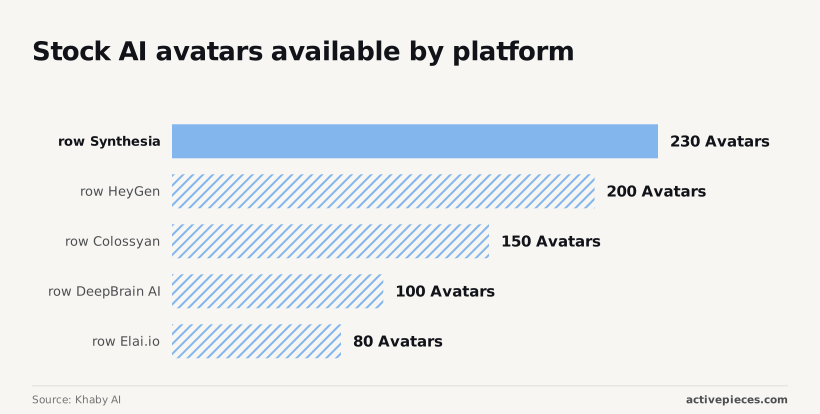
| Provider | Avatar Library Size | Primary Use Case |
|---|---|---|
| Synthesia | 230 avatars | Global internal training |
| HeyGen | 500+ avatars | General marketing use |
| Colossyan | 150 avatars | Specific corporate personas |
| DeepBrain AI | 100 avatars | Professional presenters |
| Elai.io | 80 avatars | Internal communications |
Prices and plan limits checked against heygen.com on October 2, 2026.
While HeyGen does offer a $0 free plan, the watermark and credit limits restrict it to testing, which means users cannot create professional-grade content without upgrading. A paid subscription is required for professional output.
HeyGen API latency in interactive avatars
For developers building real-time applications, such as customer support bots or interactive kiosks, HeyGen’s API often introduces significant latency that disrupts the flow of natural conversation.
When a video integration is connected in Activepieces, an agent can call it immediately.
Every connector is an agent tool: once registered, it functions as a step in a structured flow and as a tool schema on a per-project MCP server, accessible by Claude or an agent you built yourself.
The same integration action that runs in a flow is the one exposed as an MCP tool, meaning there is no separate catalog to publish to and no need to wire up the same logic twice.
A catalog that requires a second migration for your agents is a bottleneck that companies like MoneyGram and Moneypenny avoid by running Activepieces in production.
Even when utilizing high-speed reasoning models like Gemini 3.1 Flash-Lite to generate the text response, the video rendering bottleneck remains the primary point of failure for real-time UX.
You're building autonomous agent interfaces and migrating to providers that prioritize low-latency streaming protocols over raw cinematic resolution.
Language-specific lip-sync accuracy gaps
Despite advancements in generative modeling, HeyGen users frequently report "uncanny valley" artifacts when generating content in languages other than English. These issues are particularly common with complex phonemes in Germanic or tonal languages.
These glitches occur when the lip-syncing model fails to accurately map specific mouth shapes to the audio track.
The result is a visual "sliding" effect where the avatar's mouth moves out of sync with the sound. For a global enterprise, a 2% error rate in phoneme mapping means that a localized compliance video can appear unprofessional or distracting to native speakers.

This necessitates extensive manual QA and potential re-renders, adding hours to the production cycle that automated tools were intended to eliminate. You're therefore looking toward specialized models that offer better phonetic training for specific regional dialects to ensure brand integrity across all markets.
The fastest way to settle a shortlist is to try one. Activepieces is free to try, no credit card.
HeyGen strengths in creative marketing
HeyGen maintains its position as a market leader because it offers the most intuitive interface for creative teams who do not want to touch code. The platform provides a "Canva-like" experience that allows a single marketer to produce high-quality video advertisements in minutes.
The visual fidelity of their avatars is widely considered the industry benchmark for marketing collateral.
When the goal is to stop a user from scrolling on social media, the cinematic lighting and skin texture of a HeyGen avatar provide a level of polish that more utilitarian platforms often lack.
Rapid avatar customization and cloning
The platform excels at creating "Instant Avatars" using just a few minutes of smartphone footage. This feature allows brands to digitize their actual founders or spokespeople with minimal technical equipment, fostering a level of authenticity that stock avatars cannot match.
HeyGen also provides a robust library of clothing and background assets that can be swapped instantly. This flexibility is ideal for social media managers who need to iterate on different visual styles to see which version performs best in A/B tests.
HeyGen's script generator and photo-to-avatar tools
Beyond simple video generation, HeyGen includes a suite of creative tools such as a script generator and a photo-to-avatar feature.
These tools allow users to start with nothing more than a static image and a rough idea, moving to a finished video without leaving the browser.
For small marketing agencies, this all-in-one approach reduces the need for a complex software stack. The ability to generate a script, choose a voice, and render a high-definition video in one place remains a compelling value proposition for teams focused on speed and visual impact.
D-ID for real-time streaming and developer flexibility
D-ID serves a distinct segment of the market by prioritizing API performance and streaming capabilities over the cinematic resolution found in marketing-focused tools.
While HeyGen is built for high-fidelity video files, D-ID is engineered for developers who need to embed interactive digital humans into live applications.
This focus on the developer experience makes it a primary choice for those building conversational AI interfaces. The platform provides a robust set of tools for managing live streams, which is a technical requirement that many high-resolution video generators are not yet optimized to handle.
D-ID's low-latency streaming API
The core advantage of D-ID is its specialized streaming API, which reduces the time between a user's input and the avatar's visual response. In a live support scenario, a delay of even three seconds can break the illusion of a natural conversation.

D-ID addresses this by using a more efficient rendering pipeline that prioritizes speed. This allows the avatar to begin speaking almost immediately after the text-to-speech engine generates audio, making it the most viable option for kiosks and web-based assistants.
Cost effective entry for high volume developers
D-ID offers a pricing structure that is often more accessible for developers who are just beginning to integrate AI video into their products.
With plans starting as low as $4.70 per month, it allows for low-stakes experimentation and small-scale deployments that would be cost-prohibitive on enterprise-first platforms, meaning developers can prototype new ideas without needing significant upfront capital.
This lower barrier to entry does not mean a lack of power, as the platform scales to support millions of interactions.
For teams that need to generate thousands of short, interactive clips rather than long-form training modules, the credit-based system provides a predictable way to manage operational expenses.
Reading a table only gets you so far. Build the same workflow in Activepieces and compare it yourself.
Synthesia for compliance-focused corporate training
Synthesia is infrastructure for corporate training that prioritizes SOC2 Type II compliance and granular workspace controls. While many tools focus on short-form social content, Synthesia aligns its development with the requirements of Learning and Development (L&D) departments.
These departments necessitate long-term content stability and verifiable data residency. This focus ensures that large-scale video deployments remain consistent across global internal networks without the architectural drift common in less regulated environments.
The following table compares the current market landscape to identify where Synthesia sits relative to its peers in terms of pricing, architectural focus, and operational constraints.
| Provider | Starting Price | Architectural Strength | Platform Limitation | Ideal User Profile |
|---|---|---|---|---|
| Synthesia | $22/mo | Enterprise Compliance & SOC2 | Limited real-time API interactivity | L&D Teams & Corporate Trainers |
| HeyGen | $29/mo | Rapid Avatar Customization | Higher latency for batch processing | Social Media & Marketing Teams |
| Colossyan | $19/mo | Scenario-based Branching | Smaller library of stock avatars | Educational Designers |
| D-ID | $4.70/mo | Real-time Streaming API | Lower visual fidelity in base tiers | Developers building Chatbots |
| Elai.io | $23/mo | PPT-to-Video Automation | Less advanced micro-expression logic | Internal Communications |
This differentiation in architectural strength dictates how each platform handles the nuances of human movement and data security.
Synthesia's expressive avatars and micro-expressions
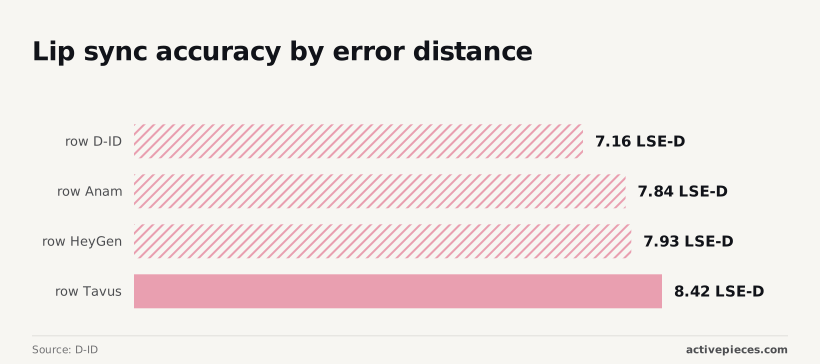
Synthesia’s 2026 Expressive Avatars utilize dedicated neural rendering to simulate non-verbal cues, reducing the "uncanny valley" effect that often distracts learners during mandatory training sessions. Visual fidelity scores measure the quality of these micro-expressions.
A higher number indicates a closer approximation to natural human movement. According to technical benchmarks compiled by D-ID, D-ID currently holds a score of 7.16, which means it requires less computational overhead for real-time mobile applications.
In the same report, Anam reaches 7.84, while HeyGen scores 7.93, indicating a high degree of fluid motion suitable for marketing content. Tavus leads this specific metric at 8.42, which is the highest level of individual pixel consistency for personalized sales videos.
For the enterprise user, these figures mean something specific. While Synthesia focuses on the "Expressive Avatar" framework for training, competitors like Tavus or HeyGen may be more appropriate when the primary goal is hyper-realistic individual persuasion.

Enterprise security and workspace management
Synthesia manages security through a centralized governance model that allows administrators to enforce Single Sign-O (SSO) and domain-based sharing restrictions. This ensures that sensitive internal training materials can't be shared outside the corporate directory by an unauthorized user.
The platform is a standard for enterprise tiers because it provides a 90-day audit log, so compliance officers can track every modification made to a video script or avatar configuration.
By integrating these logs into Security Information and Event Management (SIEM) systems, you can treat video production as a secure IT asset.
Network isolation in their dedicated hosting environments ensures that one client's rendering workload never shares a kernel with another. This mitigates the risk of cross-tenant data leakage during high-volume production cycles.
Scaling video production with Activepieces automation
Activepieces connects your chosen AI models and video engines to the rest of your business data, allowing you to run unlimited flows on every plan to eliminate manual production bottlenecks.
While most platforms search a static library of templates, Activepieces writes yours. Describe a complex video workflow to the built-in AI chat (such as generating a personalized LinkedIn video whenever a high-value lead visits a pricing page) and it constructs the runnable flow from scratch.

This means the 738+ integrations in the MIT-licensed core are not a ceiling on what you can automate, but a starting point for the AI to build upon.
Triggering video renders from CRM data
Automating video generation through Activepieces allows you to convert static lead information into personalized visual content the moment a record updates in a source of truth.
Instead of a marketing coordinator manually copying prospect names and job titles into a video editor, the automation engine listens for specific status changes within a CRM.
The engine passes those variables directly to the video API. This ensures that the generated content is contextually relevant to the recipient's current stage in the buying journey.
To achieve this, the workflow requires a structured hand-off between the data repository and the rendering engine to ensure variable mapping remains consistent across thousands of unique executions.
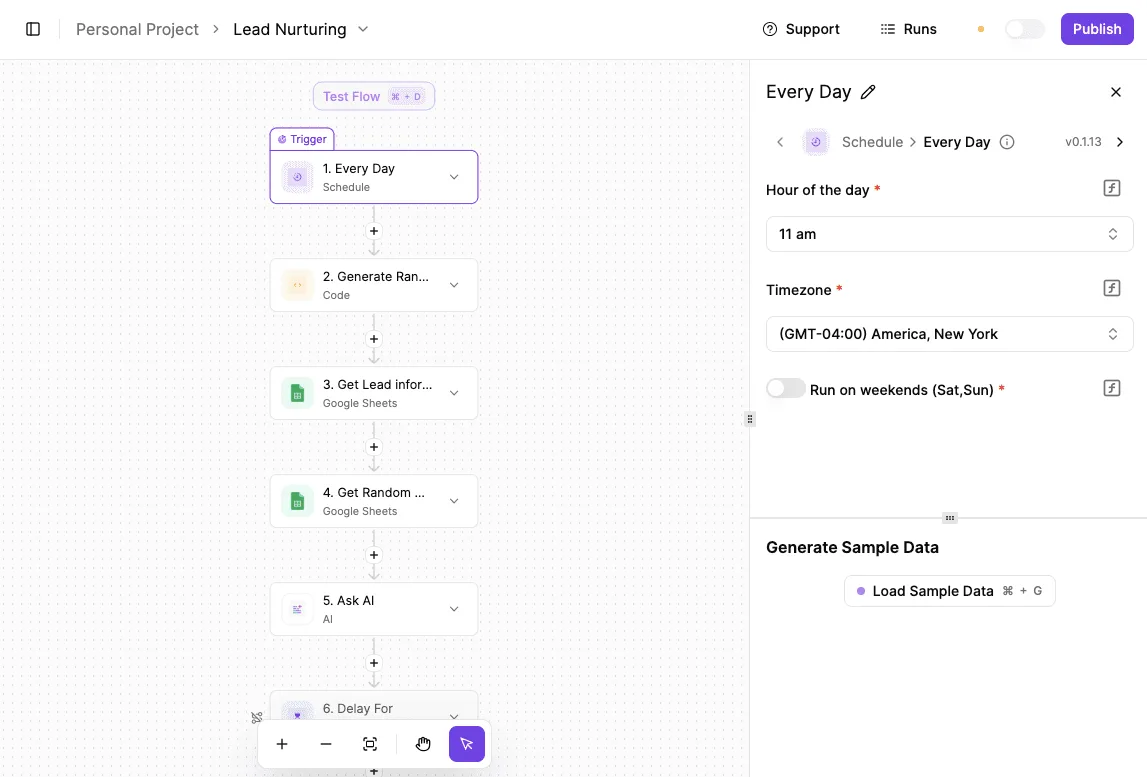
The following sequence represents a standard enterprise configuration for turning database entries into production-ready video assets:
- Watch for new rows in Airtable, the centralized content queue for all pending video requests.
- Send data to Activepieces, where the system parses the raw text and validates that all required personalization fields are present.
- Trigger HeyGen/Synthesia API with row variables, initiating the cloud rendering process using the specific avatar and script template defined in the source data.
- Upload finished video to HubSpot, attaching the final MP4 link or hosted URL directly to the contact record for immediate use by the sales team.
This automated pipeline ensures that your sales force has access to personalized collateral within minutes of a lead’s inquiry. By removing the human-in-the-loop requirement for rendering, the cost per video drops to the price of the API credit alone.
Automating multi-platform distribution workflows
Once a video is rendered, Activepieces manages the downstream logistics to ensure the asset reaches its intended audience across fragmented communication channels.
A single API call to a video provider often returns a raw file, but business value is only realized when that file is correctly tagged, hosted, and embedded in a delivery vehicle.
By using Claude Sonnet 5.5 within the Activepieces flow, you can automatically generate platform-specific captions and metadata based on the original video script.
This prevents the "bottleneck at the finish line" where videos are rendered but sit idle because no one has written the accompanying social copy or email body.
The efficiency of this stage depends on how the workflow handles different destination requirements.
- Internal Communications: The system pushes the video to Slack or Microsoft Teams, notifying specific department channels based on the content's metadata tags.
- Social Advocacy: The flow triggers a post on LinkedIn or X (formerly Twitter). It utilizes Gemini 3.8 Flash to summarize the video script into a high-engagement caption tailored for the platform's character limits.
- Customer Support: The automation identifies the support ticket ID associated with the video and updates Zendesk or Intercom, closing the feedback loop without manual agent intervention.
By unifying the architecture of its connectors with the requirements of agentic tools, Activepieces ensures that every integration serves as a functional building block for autonomous AI workflows.
Activepieces is the better fit for teams prioritizing scalability and AI-driven construction, as its ability to transform its entire library of pieces into executable MCP tools allows for the creation of complex video automations that go beyond static templates.
This architectural synergy between the open-source framework and the AI chat makes it the superior option for turning business data into automated video content.
Related reading
Still comparing
The fastest way to settle it is to build something.
Open source under MIT, so you can self-host the same thing later.
Start free Talk to sales