




How to design AI approval workflows that reduce legal liability
Activepieces
Jul 11, 20269 min read

Human approval workflows for AI agents require specific legal design patterns to create defensible due diligence without false liability exposure.
# Basic approval gate pattern
class ApprovalWorkflow:
    def __init__(self, agent_action, approval_criteria):
        self.action = agent_action
        self.criteria = approval_criteria
        self.status = "pending_approval"

    def request_approval(self, context):
        return {
            "action_summary": self.action.describe(),
            "risk_assessment": self.evaluate_risk(context),
            "approval_required": self.criteria.check(context)
        }
The legal framework centers on three core principles: explicit scope boundaries, documented decision criteria, and clear liability allocation between human approvers and automated systems.
Scope Boundaries and Authority Limits
Define exactly what the AI agent can execute without approval versus what requires human sign-off. The boundary must be legally defensible and operationally clear.
# Example approval matrix
approval_required:
  financial_threshold: 1000  # dollars
  data_access_level: "confidential"
  external_communications: true
  regulatory_domains: ["healthcare", "finance", "legal"]

auto_approved:
  internal_notifications: true
  data_retrieval: "public_only"
  routine_updates: true
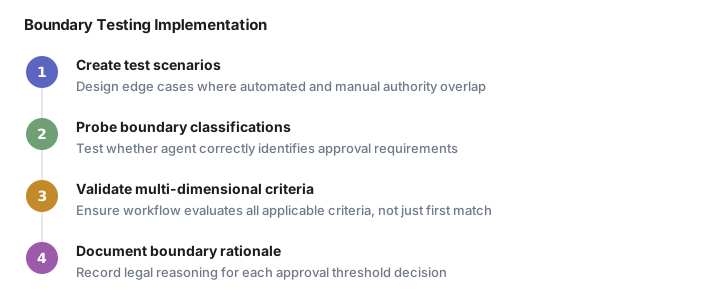
Document the rationale for each boundary. Legal teams examine whether approval thresholds reflect genuine risk assessment or arbitrary process theater. Financial thresholds should align with existing corporate authorization policies and demonstrated business impact patterns rather than round numbers.
The agent must halt completely when hitting an approval boundary. Partial execution followed by approval creates split liability that complicates legal defense. Either the action runs fully automated or it waits for complete human authorization.
Boundary testing should occur during implementation to verify the agent correctly identifies approval requirements. Create test scenarios that probe edge cases where automated and manual authority overlap. An agent that misclassifies a regulated action as routine creates immediate compliance exposure.
# Boundary validation testing
def test_approval_boundaries():
    test_cases = [
        {"amount": 999, "expected": "auto_approved"},
        {"amount": 1000, "expected": "requires_approval"},
        {"data_type": "public", "expected": "auto_approved"},
        {"data_type": "confidential", "expected": "requires_approval"}
    ]

    for case in test_cases:
        result = workflow.classify_action(case)
        assert result == case["expected"], f"Boundary classification failed for {case}"
Multi-dimensional boundaries require careful design when actions cross multiple approval criteria. An internal notification about confidential data might trigger approval requirements despite being "internal." The workflow must evaluate all applicable criteria, not just the first match.
Decision Criteria Documentation
Human approvers need specific evaluation frameworks, not general "use your judgment" instructions. Vague approval criteria create liability exposure when decisions go wrong.
class ApprovalCriteria:
    def evaluate(self, action, context):
        checks = {
            "regulatory_compliance": self.check_regulations(action),
            "data_privacy": self.check_privacy_impact(action),
            "business_authorization": self.check_authority_limits(action),
            "risk_tolerance": self.assess_downside_risk(action)
        }

        return {
            "recommendation": self.calculate_recommendation(checks),
            "required_reviewers": self.determine_reviewers(checks),
            "documentation_needed": self.required_documentation(checks)
        }
Approval decisions must be logged with the specific criteria that drove the choice. "Looks fine" is not defensible documentation. "Meets data privacy requirements per checklist v2.1, financial impact under threshold, no regulatory flags" creates an audit trail.
Build escalation paths for edge cases. When standard criteria don't clearly apply, the approver needs a defined path to legal counsel or senior management rather than making judgment calls outside their expertise.
Weighted scoring systems provide more nuanced decision support than binary pass/fail criteria. Each evaluation dimension gets a numerical score, and the combined score determines approval requirements or escalation levels.
class WeightedApprovalCriteria:
    def __init__(self):
        self.weights = {
            "financial_risk": 0.3,
            "regulatory_risk": 0.4,
            "reputational_risk": 0.2,
            "operational_risk": 0.1
        }

    def calculate_risk_score(self, action):
        scores = {}
        for dimension, weight in self.weights.items():
            raw_score = self.evaluate_dimension(action, dimension)
            scores[dimension] = raw_score * weight

        total_score = sum(scores.values())
        return {
            "total_risk_score": total_score,
            "dimension_breakdown": scores,
            "approval_level": self.determine_approval_level(total_score)
        }
Criteria versioning prevents retroactive application of new standards. When approval criteria change, existing pending approvals should complete under the original criteria version unless explicitly migrated.
Training documentation for human approvers should include worked examples of how to apply each criterion. Abstract guidelines like "assess business risk" become concrete when paired with examples: "business risk includes customer churn potential, competitive advantage loss, and operational disruption."
Liability Allocation Patterns
The approval workflow must clearly allocate responsibility between human judgment and system execution. Mixed responsibility creates legal ambiguity that benefits no one.
Pattern 1: Human owns the decision, system executes
# Approver takes full responsibility for the action
approval = human_reviewer.decide(agent_proposal)
if approval.granted:
    result = agent.execute_with_human_authority(approval.decision_record)
Pattern 2: System recommends, human owns final call
# System provides analysis, human makes independent judgment
recommendation = agent.analyze_and_recommend(context)
decision = human_reviewer.independent_decision(recommendation, context)
Pattern 3: Collaborative review with split domains
# Each party owns their domain of expertise
technical_approval = engineer.review_implementation(agent_code)
legal_approval = counsel.review_compliance(agent_action)
business_approval = manager.review_business_impact(agent_outcome)
Avoid rubber-stamp approval processes where humans routinely approve without meaningful review. When approval rates consistently exceed industry benchmarks or internal risk tolerance levels, document whether the pattern reflects effective agent design or insufficient human oversight.
Delegation frameworks allow senior approvers to delegate specific categories of decisions to qualified subordinates while maintaining oversight responsibility. The delegation must be explicit, documented, and include clear authority limits.
class DelegationFramework:
    def __init__(self, delegator, delegate):
        self.delegator = delegator
        self.delegate = delegate
        self.delegation_scope = {}
        self.reporting_requirements = {}

    def can_delegate(self, action):
        return (
            action.risk_level <= self.delegation_scope.get("max_risk_level") and
            action.financial_impact <= self.delegation_scope.get("max_financial") and
            action.domain in self.delegation_scope.get("allowed_domains", [])
        )
Conflict of interest detection should be built into approval workflows. An approver with financial interest in the outcome, personal relationships with affected parties, or competing business interests should be automatically flagged for recusal.
Documentation Requirements
Every approval decision needs a paper trail that demonstrates due diligence. The documentation standard should match the risk level of the action being approved.
class ApprovalRecord:
    def __init__(self, action, approver, decision):
        self.timestamp = datetime.now()
        self.action_hash = hash(action.serialize())
        self.approver_id = approver.employee_id
        self.decision = decision
        self.criteria_version = "v2.1"
        self.risk_assessment = action.risk_profile
        self.supporting_documents = []
Retention policies must align with regulatory requirements and litigation hold procedures. Organizations face varying retention requirements based on the nature of decisions and applicable regulations.
Audit trails should capture not just the final decision but the decision process. Time spent reviewing, documents consulted, and consultation with other team members all demonstrate thoroughness.
Structured documentation templates ensure consistent information capture across different approvers and decision types. Free-form notes supplement but don't replace structured data collection.

class ApprovalDocumentation:
    required_fields = [
        "decision_rationale",
        "criteria_checklist_completed",
        "risk_mitigation_measures",
        "monitoring_requirements",
        "review_date_scheduled"
    ]

    def validate_documentation(self, approval_record):
        missing_fields = []
        for field in self.required_fields:
            if not approval_record.get(field):
                missing_fields.append(field)

        if missing_fields:
            raise IncompleteDocumentationError(
                f"Missing required documentation: {missing_fields}"
            )
Digital signatures and timestamp integrity protect approval records from tampering. Use cryptographic hashing to detect any post-approval modifications to the decision record or supporting documentation.
Regulatory Compliance Integration
Different industries impose specific approval requirements that override general workflow design. Healthcare AI agents need approval workflows that demonstrate appropriate privacy safeguards and clinical decision support standards. Financial services agents need compliance with banking regulations and fiduciary duties.
# Industry-specific approval gates
class HealthcareApproval(ApprovalWorkflow):
    def validate_compliance(self, action):
        return {
            "privacy_impact": self.check_data_handling(action),
            "minimum_necessary": self.verify_data_minimization(action),
            "audit_logging": self.confirm_access_logging(action)
        }

class FinancialApproval(ApprovalWorkflow):
    def validate_regulatory_compliance(self, action):
        return {
            "fiduciary_duty": self.check_client_interest(action),
            "disclosure_requirements": self.verify_transparency(action),
            "record_keeping": self.confirm_documentation(action)
        }
Cross-border operations add complexity when AI agents operate across different legal jurisdictions. The approval workflow must account for applicable laws in all relevant jurisdictions, implementing the most restrictive requirements where conflicts arise.
Regulatory change management requires workflows that can adapt to new compliance requirements without breaking existing approvals. Build flexibility into the criteria evaluation system to accommodate regulatory updates.
class RegulatoryComplianceEngine:
    def __init__(self):
        self.active_regulations = {}
        self.jurisdiction_map = {}

    def check_compliance(self, action, jurisdictions):
        applicable_regs = []
        for jurisdiction in jurisdictions:
            regs = self.jurisdiction_map.get(jurisdiction, [])
            applicable_regs.extend(regs)

        compliance_results = {}
        for reg in applicable_regs:
            compliance_results[reg] = self.evaluate_regulation(action, reg)

        return compliance_results
Regulatory reporting integration automates compliance reporting where possible. When an approval decision triggers regulatory notification requirements, the workflow should generate and submit required reports automatically.
Common Implementation Gotchas
Approval fatigue undermines the entire framework. When humans see too many approval requests, they start rubber-stamping without review. Design agent boundaries to minimize approval frequency while maintaining meaningful oversight.
Version control for approval criteria prevents confusion when policies change. An action approved under criteria v1.0 should not be retroactively judged against criteria v2.0 standards.

Emergency procedures need pre-defined protocols. When the AI agent encounters urgent situations outside normal approval workflows, the response pattern should be legally pre-approved rather than improvised.
# Emergency bypass with automatic escalation
class EmergencyProtocol:
    def handle_urgent_action(self, action, context):
        if context.severity == "critical":
            # Execute with automatic legal notification
            result = action.execute_with_emergency_authority()
            self.notify_legal_team(action, result, context)
            self.schedule_post_action_review(action, result)
            return result
Approval queue management prevents bottlenecks that could pressure approvers into hasty decisions. Implement load balancing across qualified approvers and escalation procedures for time-sensitive approvals.
False positive management addresses cases where the approval system incorrectly flags low-risk actions. Track false positive rates and adjust criteria to maintain appropriate sensitivity without creating unnecessary friction.
class ApprovalMetrics:
    def track_approval_patterns(self):
        return {
            "approval_rate": self.calculate_approval_rate(),
            "average_review_time": self.calculate_review_time(),
            "false_positive_rate": self.calculate_false_positives(),
            "escalation_frequency": self.calculate_escalations(),
            "approver_workload_distribution": self.analyze_workload()
        }
Approval Workflow Checklist
- Explicit scope boundaries with documented rationale
- Specific decision criteria, not general judgment calls
- Clear liability allocation between human and system
- Complete halt at approval boundaries, no partial execution
- Audit trail for every approval decision
- Industry-specific regulatory compliance integration
- Emergency procedures with pre-approved protocols
- Version control for approval criteria changes
- Retention policies aligned with legal requirements
- Conflict of interest detection and recusal procedures
- Weighted scoring systems for nuanced risk assessment
- Delegation frameworks with explicit authority limits
- Structured documentation templates and digital signatures
- Approval queue management and load balancing
- False positive tracking and criteria adjustment
Related implementation patterns: [AI Agent Governance Frameworks] [Compliance Automation Workflows] [Legal Risk Assessment Tools]
Frequently asked questions
What are the core legal principles for AI approval workflows?
AI approval workflows require three core principles: explicit scope boundaries that define what needs approval, documented decision criteria with specific evaluation frameworks, and clear liability allocation between human approvers and automated systems.
How do you prevent liability exposure in AI approval processes?
Prevent liability exposure by creating defensible scope boundaries with documented rationale, requiring complete halt at approval boundaries rather than partial execution, and maintaining audit trails for every approval decision with specific criteria documentation.
What documentation is required for AI approval workflows?
Every approval decision needs a paper trail including timestamp, action hash, approver ID, decision rationale, criteria version, risk assessment, and supporting documents. Documentation standards should match the risk level of the action being approved.
How do regulatory requirements affect AI approval workflows?
Different industries impose specific approval requirements that override general workflow design. Healthcare needs privacy safeguards and clinical decision support standards, while financial services require banking regulation compliance and fiduciary duty considerations.
Automate your work without writing code
Create an Activepieces account in seconds.
Written by
Activepieces
