Hume AI MCP: How to Build a Voice Agent

Nov 21, 202616 min read
Hume AI provides an Empathic Voice Interface (EVI) that detects emotional subtext in human speech to adjust its own vocal responses. By measuring vocal modulations across dozens of dimensions, the interface identifies whether you're frustrated, hesitant, or satisfied.
The system then prioritizes de-escalation or efficiency based on the caller's immediate state.
Hume AI and MCP enable empathetic data retrieval
What is Hume AI?
Hume AI is a developer platform focused on building voice-based AI that interprets and responds to human prosody.
While standard large language models process text, Hume’s EVI captures the "how" of a conversation to generate a response that matches your emotional urgency. This capability turns a standard interaction into a specialized service event.

What is the Model Context Protocol (MCP)?
The Model Context Protocol (MCP) is an open standard that allows AI models to securely query external data silos without requiring custom, one-off integrations for every new tool.
By providing a uniform bridge between an intelligence layer and a data source, MCP eliminates the need for you to rewrite connection logic when switching between different databases. Standardization reduces the technical debt associated with maintaining dozens of API keys.

It ensures that the model can pull live information from a CRM or a SQL server through a single, governed interface.
The synergy of EVI and standardized data access
When the EVI node receives emotional input, the integration of Hume EVI with MCP transforms an emotionally aware interface from a reactive listener into a proactive agent capable of resolving complex tickets.
It identifies the user's intent and uses the MCP bridge to pull records from diverse silos like Salesforce, GitHub, or internal documentation. Activepieces often facilitates this connection to coordinate the flow between the voice interface and the data.
This setup ensures the AI isn't guessing at solutions based on stale training data. The resulting system can detect a user’s rising frustration and simultaneously query their recent order history to offer a specific, data-backed resolution.
This takes minutes, not a project: automate it in Activepieces free.
How Hume AI interacts with MCP servers
Whenever a user’s vocal intent requires external validation, Hume EVI interacts with MCP servers by acting as a client that requests specific data payloads through a standardized gateway.
The system grounds its empathetic responses in the actual status of a customer’s account or technical environment.
The role of the MCP Host in voice interactions
Sitting between the Hume EVI interface and the disparate data sources defined in the Model Context Protocol, the MCP Host is the primary orchestration layer.
In a standard deployment, the host receives the tool-call signals generated by Hume when it detects a need for information.
Because Hume EVI processes prosody, the host must translate these emotional cues into structured queries that the MCP server can execute against specific resources.
Centralizing the security risk here is key. The host is the only component with direct access to sensitive credentials for tools like GitHub (a version control platform) or Salesforce (a customer relationship management system).
Establishing the connection between hume and MCP
To connect Hume to an MCP server, you must configure the EVI as an MCP Client within your application logic.
Hume does not have a native "MCP toggle" in its dashboard; instead, you use the Hume SDK to define a Tool Use block that points to your MCP Host's endpoint.
The MCP Host is a specific piece of software you run, such as the MCP Inspector or a custom Node.js server, which listens for requests from the Hume client.
When Hume detects a need for data, it sends a JSON-RPC request to this host, which then queries the appropriate MCP server.
Fetching external data without breaking conversational flow
Maintaining a natural dialogue requires the system to execute data retrieval within the narrow silence gaps of human speech. The following sequence defines how the system minimizes the cognitive load on the user by keeping the "thinking" phase transparent:
- User speaks, expressing a specific need or emotional state.
- EVI detects prosody and emotion, identifying the underlying sentiment.
- EVI triggers an MCP tool call based on the identified intent.
- The MCP server queries the relevant database to retrieve current facts.
- The system injects context into the prompt, enriching the model's awareness.
- The model generates an empathetic response, combining the retrieved data with the appropriate vocal tone.
This loop allows a model like Claude Sonnet 5.5 to receive live updates from a production database without the user having to repeat their account details.
Emotional responsiveness vs. data retrieval speed
The primary tradeoff in this architecture is the balance between the depth of the context retrieved and the latency of the vocal response.
If an MCP server takes too long to query a legacy system, the EVI’s response will lag. This delay causes the "uncanny valley" effect where the AI’s empathy feels delayed and therefore insincere.
You must prioritize high-speed models such as Gemini 3.5 Flash-Lite or GPT-6.2 Sol for these interactions.
By limiting the scope of each MCP tool to specific, indexed fields, you prevent the system from timing out during the critical window where a user is most receptive to a resolution.
Hume AI EVI pricing and technical requirements
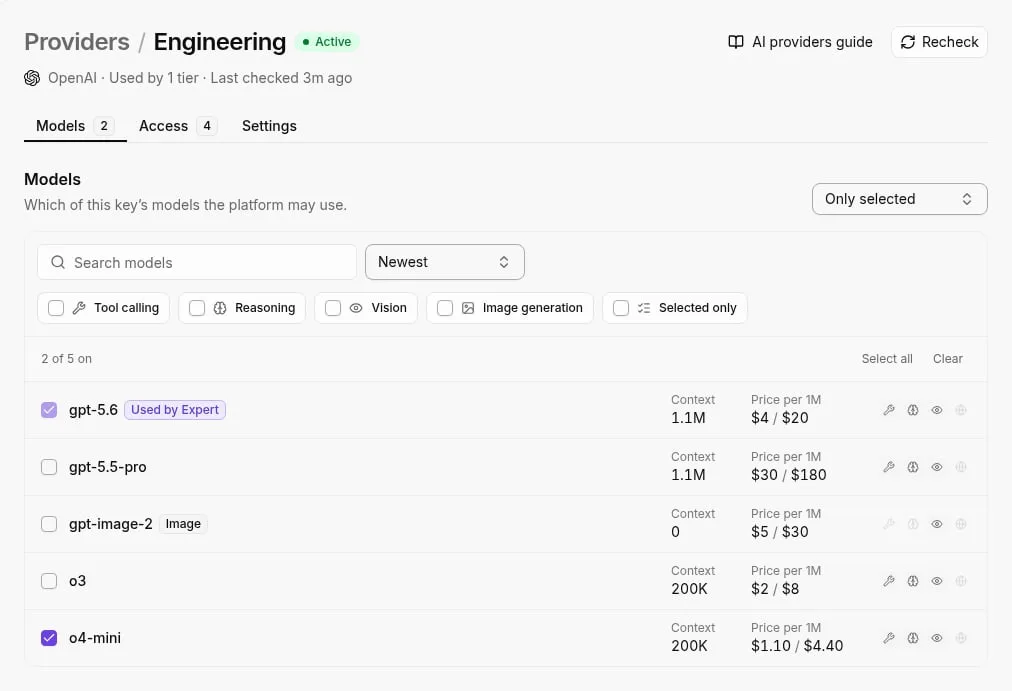
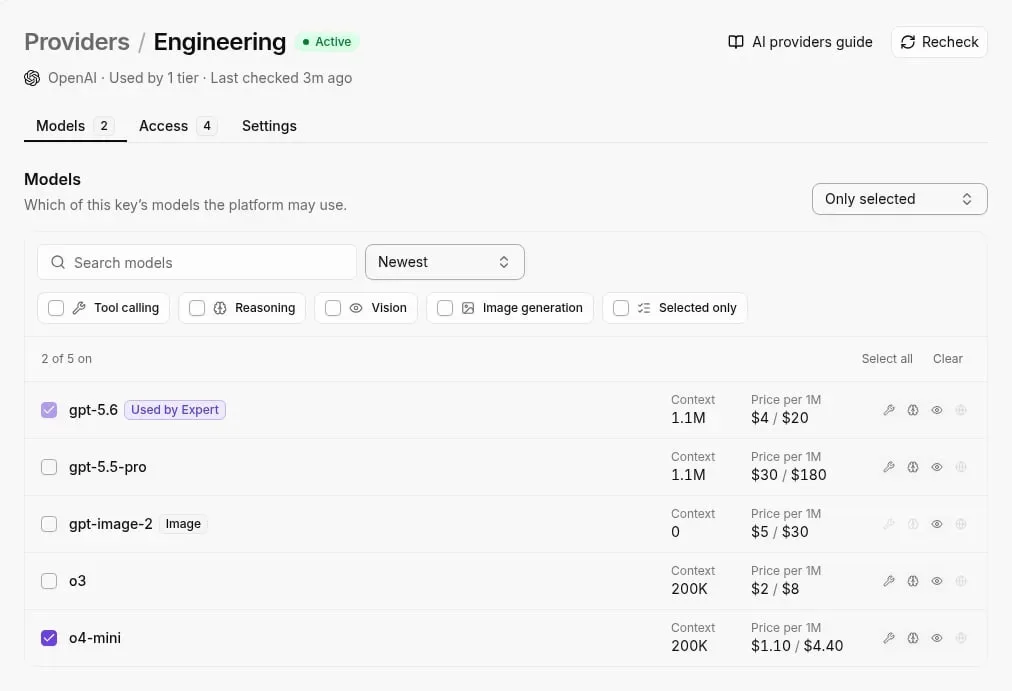
Implementing Hume AI’s EVI requires a dual-budget approach that accounts for both the per-second cost of vocal processing and the token-based overhead of the underlying language model.
API pricing and EVI credit consumption
Because Hume AI operates on a credit-based system where charges accrue for every second the interface is active, idle silence during a call still incurs a cost.
These credits cover the proprietary prosody models that analyze vocal inflection, but they don't include the separate costs for the Large Language Model (LLM) that generates the text response.
You must therefore maintain a balance for Hume’s infrastructure while simultaneously paying a provider like OpenAI or Anthropic for the tokens consumed during the conversation.
| Model | Input Cost (per 1M tokens) | Output Cost (per 1M tokens) | Best Use Case |
|---|---|---|---|
| GPT-6 Luna | $0.10 | $0.50 | High-volume, repetitive customer service routing |
| GPT-6.2 Astra | $8.00 | $40.00 | Complex reasoning and multi-step technical support |
| Claude Sonnet 5.5 | $2.00 | $10.00 | Balanced agentic workflows requiring high nuance |
The disparity in these rates dictates the complexity of the MCP tools you can responsibly deploy. If a tool requires a high-reasoning model to interpret the data, the total cost of ownership for the voice agent rises sharply.
Supported MCP server environments
The Model Context Protocol (MCP) requires a persistent host environment to act as the bridge between the Hume EVI and internal databases.
- Docker containers provide isolated environments for running MCP servers, ensuring that a vulnerability in a database connector doesn't expose the entire host system.
- Node.js runpoints allow for the execution of TypeScript-based MCP servers, which are the standard for most community-driven integrations like Slack or Google Drive.
- Python environments are necessary for data-heavy MCP tools that utilize libraries like Pandas to process and summarize information before passing it back to the voice interface.

Latency benchmarks for empathetic responses
The time elapsed between a user finishing a sentence and the agent beginning its reply determines the effectiveness of an empathetic agent.
When using MCP, this latency is the sum of the voice-to-text transcription, the tool-calling execution time, and the final text-to-speech generation.
Hosting MCP servers in the same geographic region as the Hume API endpoints reduces the physical distance data must travel.
Emotional intelligence requires data context to be useful
Emotional resonance in a voice interface is a functional liability if the underlying logic lacks the specific customer or operational data required to resolve the user’s request.
The failure of contextless empathy
An empathetic voice that cannot access the user's history creates a "polite wall" that often escalates the very user frustration it was designed to soothe.
Emotional resonance in a voice interface is a functional liability if the underlying logic lacks the specific customer or operational data required to resolve the user’s request.
When a bot recognizes a user’s distress but remains ignorant of a late shipment or a billing error, the empathy feels performative rather than professional, leading to a breakdown in trust.
Why MCP is the missing link for EVI
The Model Context Protocol (MCP) is a standardized server-client architecture. It allows Hume to pull live data from external sources like Zendesk (a customer service platform) or Jira (a project tracking tool) during a live conversation.

By using MCP, the interface moves from a closed loop of speech-to-emotion to an open-system agent capable of verifying facts before responding.
To determine when an MCP call is necessary to shift the conversation toward a resolution, Hume monitors emotional markers. These include admiration, adoration, aesthetic appreciation, amusement, anger, anxiety, awe, and awkwardness.
When these dimensions signal a need for specific information, such as an anxious tone regarding a deadline, the AI uses MCP to query the relevant file.
Reducing AI hallucinations through real-time data access
Integrating real-time data via MCP forces models like Claude Sonnet 5.5 or GPT-6.2 Astra to ground their conversational output in verified facts rather than statistical probability. Hallucinations typically occur when a model guesses a detail it doesn't have.
By providing a direct line to the truth, the risk of the AI promising a refund it can't process or a feature that doesn't exist is significantly lowered.
You can follow the rest of this with the builder open. Start free, no card.
Common mistakes when deploying Hume AI with MCP
Deploying Hume AI alongside the Model Context Protocol (MCP) fails when you treat the connection as a generic data pipe rather than a specialized interface for real-time emotional intelligence.
Overloading the context window
Providing Hume with every available data point from a CRM or codebase results in "context dilution," where the model ignores subtle emotional cues in favor of irrelevant background text.
While frontier models like Claude Sonnet 5.5 possess massive context windows, flooding the prompt with unstructured logs means the EVI spends its limited reasoning cycles parsing noise instead of detecting the user’s frustration or hesitation.
Ignoring the latency of third-party MCP servers drowned in data
The fluid, sub-second response time required for natural conversation breaks immediately when an MCP server must wait for a slow third-party API response.
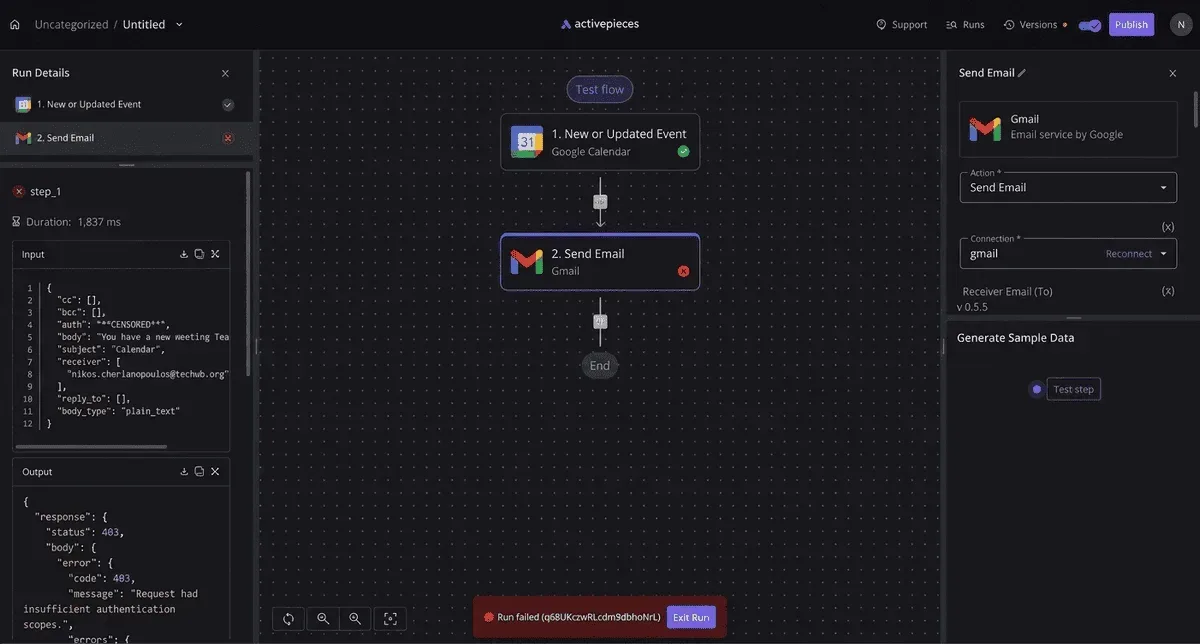
The following visual demonstrates a typical failure point where a workflow lacks the necessary permissions to execute, causing a total stoppage in the automated chain:
Because the bridge was established without verifying that the service account had the specific rights to read the requested data, this failure occurs.
Security risks of unauthenticated data bridges
Connecting a voice agent to sensitive internal repositories via MCP creates a significant liability if the bridge lacks granular, per-user authentication.
If the MCP server uses a "God-mode" API key to fetch data, any user talking to the Hume interface could theoretically exfiltrate payroll data or private keys by simply asking the right questions.
Integrating Hume AI into existing business workflows
Integrating Hume AI into a production environment requires a strict audit of the permissions granted to the Model Context Protocol (MCP) to prevent the agent from overreaching its authority.
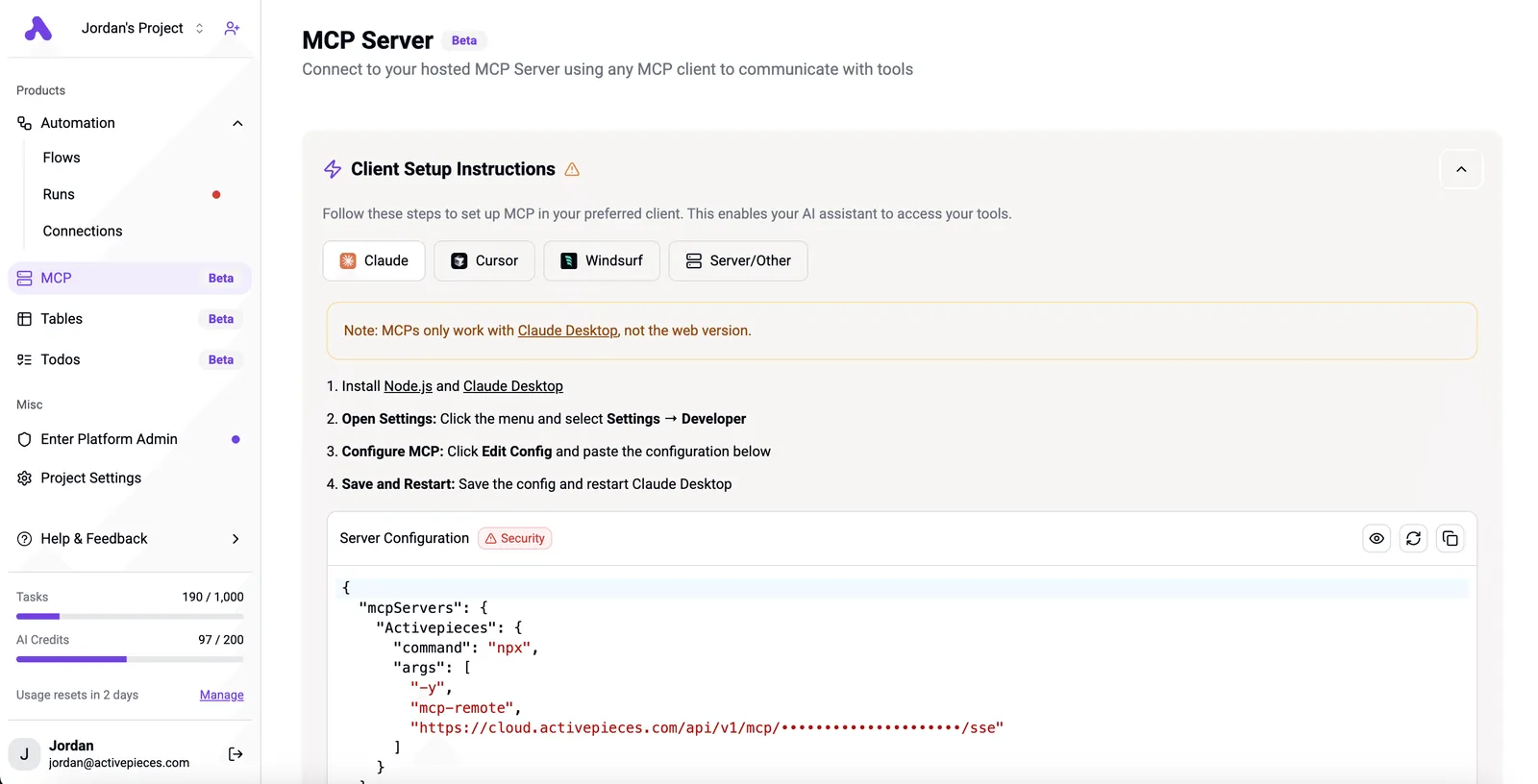
Activepieces exposes its 750 integrations as tool schemas on a per-project MCP server, allowing Hume to trigger actions like updating a CRM or escalating a ticket without custom middleware, which means developers can automate complex workflows across disparate platforms using only natural language. Any connector registered in Activepieces is immediately available to the agent as a tool schema, removing the need to build separate integration logic for the MCP host. You can verify this in the open source repository under the Integrations Framework, where the same logic used for deterministic flows is automatically surfaced to the MCP server.
Auditing your data for MCP readiness house-wide
A viable MCP implementation starts with identifying which data silos possess the structured schemas necessary for an LLM to interpret them without manual cleaning.
You must evaluate your instance of Salesforce to ensure that custom fields are documented. Otherwise, the agent will hallucinate values when it can't find a clear mapping.
Similarly, your Zendesk support tickets must be tagged with consistent metadata so that the EVI can distinguish between a resolved technical issue and an open billing dispute.
Mapping emotional triggers to business actions
Configuring Hume EVI involves defining specific prosody thresholds that trigger an automated escalation or a database write.
If the agent detects a high score in the "Distress" or "Anger" vocal dimensions, it should be programmed to immediately query the Snowflake data warehouse for the customer’s lifetime value to determine if a retention discount is authorized.
Every agent tool call and the data it acted on is traced alongside the deterministic flow steps in a single run, which exports as audit logs into your existing SIEM. This ensures that an agent's decisions are reviewed with the same rigor as a standard workflow, a level of observability that MoneyGram and Moneypenny run in production.
The Monday morning pilot plan
A structured rollout ensures that you focus on high-impact friction points rather than getting lost in broad automation goals.
- Day 1: Identify high-friction customer touchpoint.
- Day 2: Map required data fields to MCP server.
- Day 3: Build local MCP wrapper.
- Day 4: Test EVI prosody triggers.
- Day 5: Pilot with internal team.
Completing this cycle allows you to review the logs from the internal pilot and assess the accuracy of the agent's data retrieval.
What Activepieces does about this
Activepieces bridges the gap between Hume’s emotional detection and your business data by acting as a managed MCP host that requires zero custom code. While Hume identifies that a caller is distressed, it cannot inherently browse your specific database to find out why. Activepieces exposes its 750 integrations as tool schemas on a per-project MCP server, allowing Hume to trigger actions like updating a CRM or escalating a ticket without custom middleware, which means developers can automate complex workflows across their entire stack using only natural language. This means developers can automate complex workflows across disparate platforms using only natural language.
Any connector registered in Activepieces is immediately available to the agent as a tool schema, removing the need to build separate integration logic for the MCP host. You can verify this in the open-source repository under the Integrations Framework, where the same logic used for deterministic flows is automatically surfaced to the MCP server. This architecture ensures that when Hume EVI detects a specific emotional trigger, it has a direct, authenticated path to query tools like Stripe for billing status or Zendesk for recent ticket history.
To maintain the sub-second response times required for natural conversation, Activepieces optimizes the execution of these tool calls within its worker nodes. Every agent tool call and the data it acted on is traced alongside the deterministic flow steps in a single run, which exports as audit logs into your existing SIEM. This ensures that an agent's decisions are reviewed with the same rigor as a standard workflow, a level of observability that enterprise customers like MoneyGram and Moneypenny run in production to manage high-stakes financial interactions.
Frequently asked questions about Hume AI and MCP
Can Hume AI use any MCP server?
Provided the server is hosted on a publicly accessible endpoint or within a reachable VPC, Hume AI can interface with any standards-compliant MCP server.
This compatibility allows the Empathetic Voice Interface (EVI) to call functions from a GitHub repository for codebase analysis or a PostgreSQL database for inventory lookups.
Every new server connection introduces a potential data egress point. You must audit the specific tools exposed by the server to prevent the model from accessing sensitive tables or restricted directories.
Does using MCP increase the cost of Hume API calls?
Integrating MCP increases the total cost of an interaction because the retrieved context adds to the token count processed by the underlying language model.
While the Hume EVI itself maintains its base processing fee, the external calls to a knowledge base or a CRM like HubSpot consume additional compute resources and API credits.
You must monitor these overheads closely. A reactive agent that pulls long histories for every query will deplete its budget faster than one using filtered, targeted data fetches.
Is Hume AI MCP compatible with Claude or ChatGPT?
Because Hume AI acts as the orchestration layer that can utilize models like Claude Sonnet 5.5 or GPT-6.2 Astra via its modular architecture, it is compatible with their respective MCP implementations.
This setup allows the system to pair Hume’s prosody analysis with the high-reasoning capabilities of Claude Opus 5.5 for complex troubleshooting.
The following data illustrates the rapid expansion of the affective computing market and the increasing financial stakes for companies integrating these emotional and logical layers.
Marketsandmarkets projects the Global Affective Computing market to grow from $28.6 billion in 2020 to $136.2 billion by 2026.
It is expected to reach $1,191.6 billion by 2034. This indicates that businesses failing to adopt empathetic interfaces now risk losing share in a trillion-dollar shift toward human-centric AI.
What industries benefit most from empathetic data retrieval?
Telehealth and high-touch financial services gain the most immediate utility from connecting EVI to private data silos via MCP.
In a clinical setting, an agent using Gemini 4 Carbon can retrieve a patient’s historical treatment adherence from an EHR while simultaneously detecting vocal signs of distress.
In debt collection or insurance adjustments, the agent can cross-reference policy limits in real-time while adjusting its tone to de-escalate conflict. This reduces the liability of human error during high-stress negotiations.
Build it
Set this up in minutes.
No code required. Connect your accounts, and Activepieces runs it from there.
Start free Talk to sales