Inkling 2 Small Pricing: API Rates and Limits 2026

Nov 21, 202614 min read
Inkling 2 Small costs whatever your plan's limits and the API's per-token rate add up to for your workload, not the plan name. Treat the sticker price as the entry fee.
Like a quote that leaves out materials, it covers the start of the job, and the rest shows up once you wire the model into real work, whether that's a script you run by hand or an automated flow built in Activepieces that calls it hundreds of times a day.

Inkling 2 Small is a language model you can reach two ways: through a subscription plan with usage limits, or through an API billed per token.
A token is a small chunk of text, roughly a short word or part of one, and you pay for what goes in and what comes out.
Calculate Inkling 2 Small plan and token costs
Every current plan in one table
You can see which numbers the vendor publishes and which it leaves blank, because each plan below sits on the same columns. A blank matters: a limit you can't read is a cost you can't budget.
Checked 2026-11-21; "not listed" means no confirmed figure to report.
| Plan | Monthly price | Annual price | Inclusions | Context window | Usage limits | API price per 1M tokens |
|---|---|---|---|---|---|---|
| Free tier | not listed | not listed | not listed | not listed | not listed | not listed |
| Paid plans | not listed | not listed | not listed | not listed | not listed | not listed |
| API | not listed | not listed | not listed | not listed | not listed | not listed |
Don't plan a budget from this page alone, because every cell reads "not listed" here. Get the numbers from the vendor before you commit, and expect the per-task cost chart that follows to show the same model costing different amounts depending on who hosts it.
A smaller window forces you to split long jobs into integrations, and each integration re-sends material you already paid for. The context window is how much text the model can hold in view at once, including your question, your documents and its own answer.
A task that produces long answers costs more than the same task with short ones. Output usually costs more than input, and rates are quoted per million tokens with the two often priced separately.
Look for what the pricing page leaves out:
- how the usage limit resets
- what happens when you hit it
- whether the context window is the same on every plan
If you are running this arithmetic for your own team, see what the same workload costs on Activepieces.
What the plans cost at realistic monthly usage
At $0.30 per million input tokens and $1.00 per million output tokens, your monthly bill depends on how much text the model writes back, not on which plan you picked. Output costs about 3.3 times as much per token as input.

A token is roughly three-quarters of a word.
If you are the only user, input and output both stay cheap. The risk is a long conversation, because the model rereads the whole thread on every turn, which quietly inflates the input side.
With five people, the same habits multiply, and nobody sees the combined total until the invoice arrives. If the plan has a shared allowance, one heavy user can use up what the other four expected.
For an API workload at volume, the per-token rate and the host both matter. Per Artificial Analysis, one benchmark task costs:
- $1.09 on DeepInfra
- $1.18 on Thinking Machines
- $1.31 on Together AI
- $2.01 on Nebius
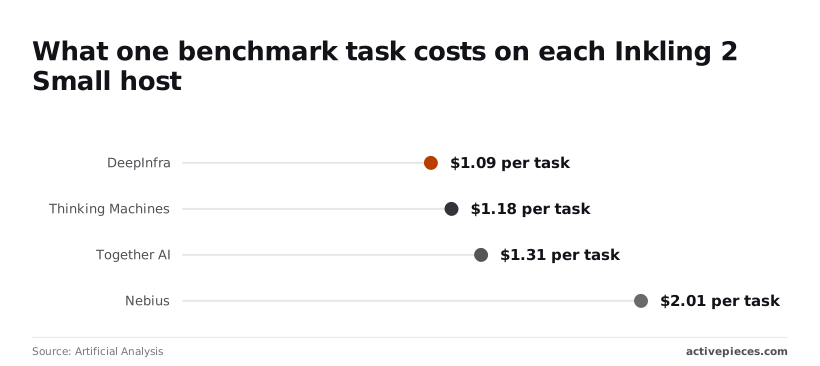
Nebius runs nearly double the cheapest host, so at volume the choice of host is a budget decision.
Re-send a failed call and you pay for it twice.
Self-hosting: memory and hardware
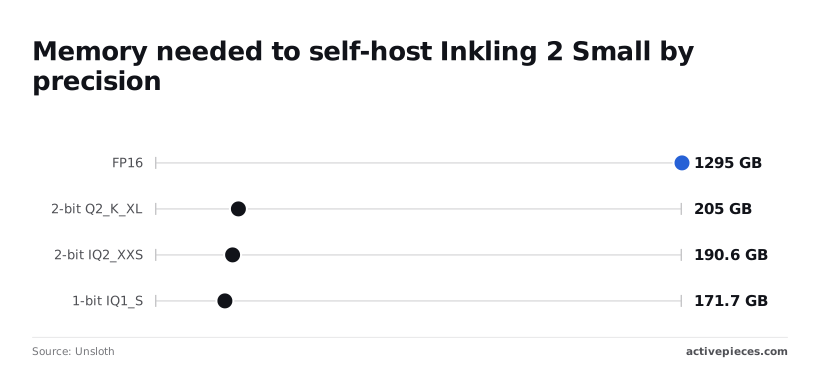
Running it yourself swaps a usage bill for a hardware bill. Unsloth lists the memory needed at each precision (how compactly the model's numbers are stored):
Re-send a failed call and you pay for it twice.
- Full FP16 needs 1,295 GB, which means a multi-machine cluster.
- 2-bit Q2_K_XL needs 205 GB.
- 2-bit IQ2_XXS needs 190.6 GB.
- 1-bit IQ1_S needs 171.7 GB, the smallest of the four, and still far beyond a typical workstation.
Shrink the model and memory drops by roughly 57 percent, but you pay in answer quality.
If your workload never leaves the included allowance, all this falls away. For that user, the plan name really is the price.
Arguments that list price is real
Suppose most buyers never run a workload beyond the allowance. Then, the objection runs, the list price is the real price, and three claims back it up:
- A small model is cheap by design, so its per-token rate can't hurt you much.
- A flat plan caps your spend, so the bill can't grow past the number on the page.
- Most users never reach the limits, so the limits are fine print, not a cost.
Sound as far as they go, each of these claims still fails under a specific kind of use.
When Inkling 2 Small pricing claims hold
If you use the model by hand, a few questions at a time, with short documents and no automation, all three claims are right. Your usage sits well inside the plan, the context window never fills, and the plan name is the bill.
Buy the plan and stop calculating.
When Inkling 2 Small pricing claims break
Each claim breaks on a different pattern.
Run a script all day and even a low rate multiplies into a large bill. That is where "cheap by design" breaks, and the per-token rate is the number you were told to ignore.
Hit the ceiling mid-project and "flat plans cap spend" stops being true. Past the cap you either stop working or move to metered API pricing, so the flat fee covers only the first stretch and the rest is billed by the token.
You aren't an average user, even if most users never hit the limits. The claim breaks on long documents.
A small context window forces you to split a contract, a codebase or a long transcript into integrations, and every integration repeats the instructions and the background you had to resend. You pay for that repetition on every call.
So before you pick a plan, write down what you'll feed the model and how often. If it's occasional and short, the objection wins. If it's steady, automated or long, price the work, not the plan.
Worth checking against a plan that does not meter every step: one credit covers a whole run on Activepieces.
Compare Inkling 2 Small costs to alternatives
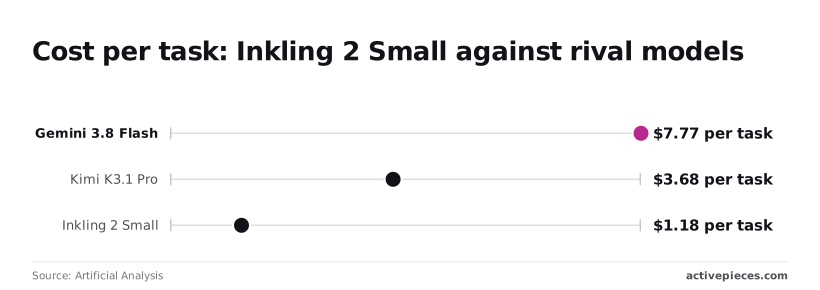
Priced by the task, Inkling 2 Small is the cheapest of the three models compared here, at 1.18 $ per task. That is the number to hold onto if your work is steady, automated or long, because it's what the bill will actually track.
Side-by-side price table
Read this table as the real running cost, not the sticker price: it shows what one task costs on each model, using Artificial Analysis figures.
| Model | Cost per task |
|---|---|
| Inkling 2 Small | 1.18 $ |
| Kimi K3.1 Pro | 3.68 $ |
| Gemini 3.8 Flash | 7.77 $ |

Per task, Kimi K3.1 Pro costs about three times as much as Inkling 2 Small. Gemini 3.8 Flash costs roughly six and a half times as much. Run a thousand tasks and that gap is the difference between about 1,180 $ and 7,770 $.
I haven't included entry prices, free tiers or rate limits here, because each vendor sets those on its own page and they change. Check them before you commit.
When a rival costs less
On these figures, neither rival costs less per task.
But one number is an average over one mix of work, not a quote for yours.
If your tasks are much shorter or simpler than the test mix, the gap can narrow, and a plan with a generous free tier may beat any per-task rate at low volume.
Run fifty of your real tasks on each model and compare the totals.
When Inkling 2 Small wins
When volume is high and the work repeats, Inkling 2 Small wins. At 1.18 $ per task against 3.68 $ for Kimi K3.1 Pro, every extra thousand tasks widens the saving by about 2,500 $.
Track Inkling 2 Small spend with Activepieces
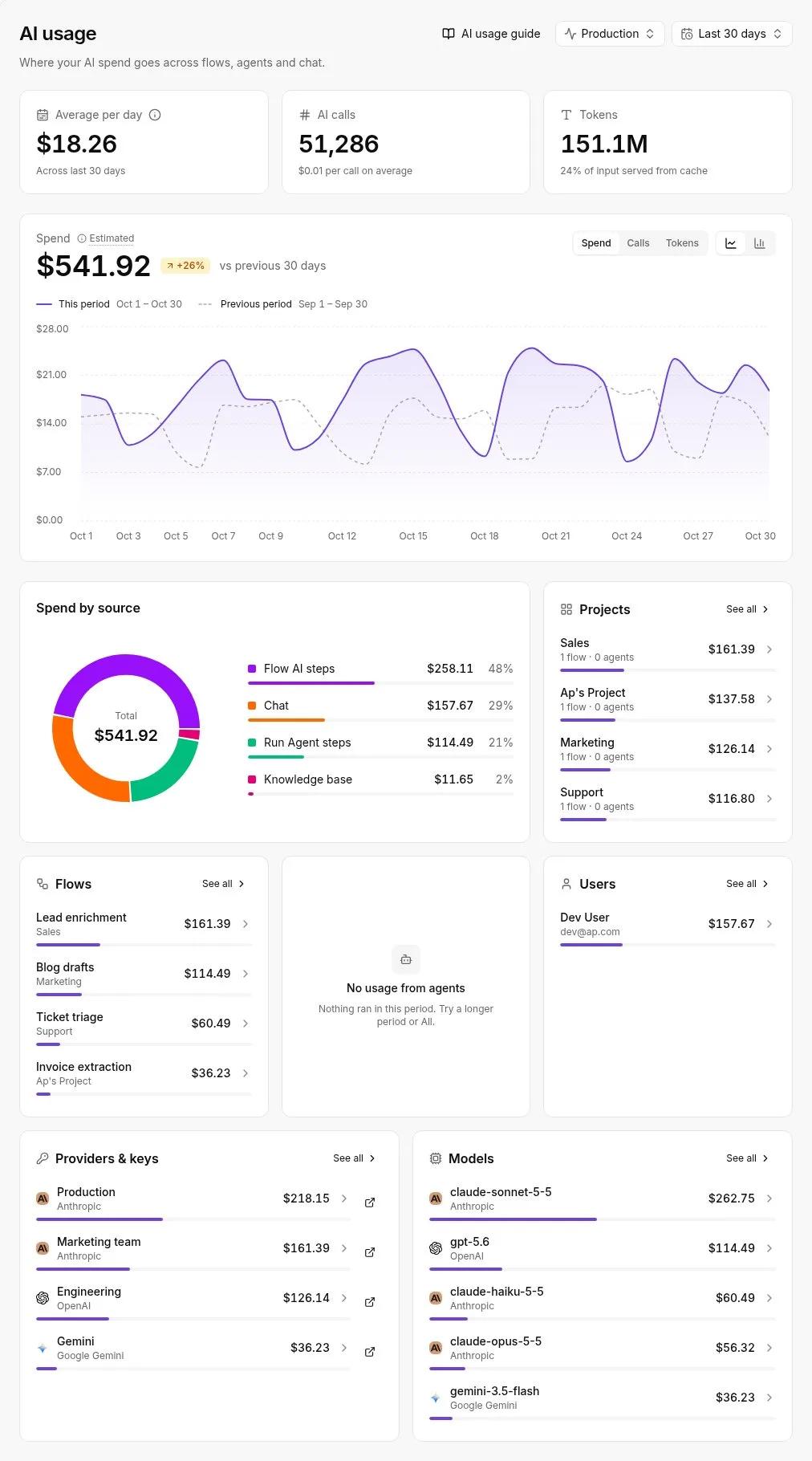
If you pay by the token through the API, you can set up an Activepieces workflow that logs your Inkling 2 Small usage to a spreadsheet and warns you as spending nears your budget.
It's optional, and it only matters if your monthly total is large enough to surprise you.
Activepieces bills a flow run as 1 credit however many steps it has, though AI steps cost more, so the five-step workflow below costs the same as a two-step shortcut, and a ten-step version would cost the same again.
Zapier's per-task billing charges for every step, which taxes you for splitting a job into smaller, more reliable integrations. Here the meter is the run, and the steps inside it are yours to arrange.
Start with whatever the vendor gives you: a usage dashboard, spending caps and billing alerts. Those sit closest to the real invoice, so they're the ones to trust.
A usage-alert workflow
Before you build, confirm how you can get usage data out of the vendor: a usage endpoint, an export file, or neither.
Activepieces has 750 integrations counted from its open source monorepo, but I can't point you to a ready-made Inkling connector, so the workflow can only log what the vendor lets you reach.
If there is no way in, skip this section and rely on the vendor's alerts.
If there is, the shape is simple:
- A schedule trigger starts the workflow at a fixed time each week.
- A step fetches the latest usage figures from the vendor.
- A step adds a row to a Google Sheets spreadsheet.
- A step compares the running total against the budget you set.
- If the total is close, a step sends you a message.
Activepieces also has a library of ready-to-use templates you can start from. Unlimited flows come on every plan, the free one included, so a weekly logger like this one costs 1 credit per run against the 1,000 credits a month the free plan includes.
What to keep from the skeleton above is a fixed schedule, a sheet as the record, and a test run before you rely on it.
Before the invoice does, weekly rows show whether your spend is climbing, and they give you a real figure to set against the per-task estimate from the previous section. The sheet is the useful part.
What to measure before choosing a plan
Measure one week of your real requests, price them, then buy the plan whose included limit covers that week with room to spare. Here's the order to do it in, and the same steps apply whichever plan name looks cheapest.
- Log every request for a week, with the tokens sent in and the tokens that came back.
- Multiply input tokens and output tokens by the per-token rates separately, then add them.
- Pick the plan whose included limit covers that total with margin.
- Set a spend cap or an alert.
- Put a recheck of the pricing on the calendar every quarter.
Measure your Inkling 2 Small usage
Guessing is the expensive option. A plan that looks roomy on the pricing page can run out in a day if your requests carry long documents, because the context window you fill counts against you on every call.
Log a normal week, not your best or worst one. Count input and output separately, since they're billed at different rates and most people are surprised by which side is larger.
Pick and cap
Choose the plan whose included limit sits comfortably above your measured week. Margin matters because a quiet week isn't a typical one, and hitting a limit mid-project costs you more than the plan upgrade would have.
If you run through a host rather than directly, price the host's rates, not the model's headline ones.
Then set the cap or alert. A runaway script with no ceiling is how a small bill becomes a large one.
If your measured week lands far below what the plan includes, the recommendation flips. You would be paying for headroom you never use, and plain per-token API billing is the cheaper fit.
Because rates, limits and plan contents change, and so does your own usage, repeat the log and the arithmetic once a quarter. If the answer has moved, so should the plan.
Frequently asked questions
Is there a free plan for Inkling 2 Small? We haven't confirmed one, so don't build a budget on the assumption.
Read the vendor's pricing page for any free allowance. If one exists, treat it as a trial for testing your real workload, because a free tier that runs out mid-project costs more than a paid plan chosen up front.
Does Inkling 2 Small charge extra for long context? We couldn't confirm a long-context surcharge, and that's exactly why you should check.
Long documents mean more tokens per request, and on usage-based billing every request costs more even without a surcharge. Look at the vendor's API pricing page for any separate rate on large inputs, then run one typical long document through and read the bill.
Can I cancel or downgrade mid-billing-cycle?
Whether you get a refund or credit for the unused time is a billing-terms question, and we have no confirmed answer. Before you commit, read the vendor's terms for cancellation and plan changes.
If a downgrade only takes effect at renewal, you pay the higher rate until then, so time the change for just before renewal rather than just after.
Is there a discount for annual billing or nonprofits? We have no confirmed discount to report.
Annual prepayment often trades a lower rate for less flexibility, and if the plan turns out to be too small or too big, you're locked in.
Ask the vendor's sales or support channel in writing, and ask the nonprofit question directly rather than waiting for a banner on the pricing page.
What happens when you hit the usage limit?
We won't guess at this, because the vendor's usage documentation is the only authority. The outcome is usually one of three: you're throttled, you're blocked until the limit resets, or you're billed overage.
Each costs you differently, and blocking in the middle of a working day is often the most expensive of the three. Find out which one applies before you depend on the plan, not after the first interrupted job.
Related reading
References
Running the numbers
See what the same workload costs here.
Free forever plan, and every paid plan self-hosts at no extra cost.
See pricing Talk to sales