Best AI Chatbot Options Ranked for 2026: Top 5 Picks
The best AI chatbot selection for your company depends on specific workflow needs like research, automation, or creative drafting.

Covers automation vendor claims versus reality: naming specific connector features, then documenting the API errors that surface when you test them.
ContributorSeptember 27, 202615 min read
This article was researched and fact-checked by an advanced research system.
The best AI chatbot in 2026 isn't a single product, but a choice between the following:
- ChatGPT for general assistance
- Claude for creative writing
- Perplexity for research
- Activepieces for automated action
- Microsoft Copilot for enterprise integration
The best AI chatbot refers to the specific platform that most effectively aligns with a user's primary objective, whether that involves general reasoning, creative writing, real-time research, or workflow automation.
When you select the wrong tool for a specific workflow, the result is latency or hallucinations because model specializations favor either reasoning or execution speed.
Top AI chatbot options for 2026
The quick-glance selection guide
Divided into four distinct quadrants, the 2026 AI Persona Map illustrates how the market has split. While GPT-6 Luna handles high-volume tasks, a tool like Claude Opus 5.5 excels in long-horizon reasoning.
This map clarifies that you can't expect one interface to handle both deep citations and complex API sequences with equal reliability. Consequently, the choice of a chatbot now dictates the structural boundaries of your digital workspace.
How we verified these rankings (January 2024 data)
To ensure economic viability for high-volume users, we benchmarked these tools using current API pricing and performance metrics. According to FreeTokenCounter, Claude Sonnet 5 costs $2.00 per million tokens, which means users must budget carefully for high-volume text processing.
| Model | Price per 1M Tokens (USD) | Reader Impact |
|---|---|---|
| Claude Sonnet 4.6 | 3.00 | High overhead for legacy reasoning tasks |
| Qwen3.7 Max | 2.50 | Premium pricing for specialized logic |
| Claude Sonnet 5 | 2.00 | Baseline cost for modern intelligent agents |
| Qwen3 Max | 1.20 | Economic choice for mid-tier processing |
| Claude Haiku 4.5 | 1.00 | Optimal for high-speed, low-latency utility |
| Qwen3.5 Plus | 0.40 | Budget tier for massive data summarization |
Prices and plan limits checked against docs.claude.com and claude.com and openai.com and gemini.google on September 26, 2026.
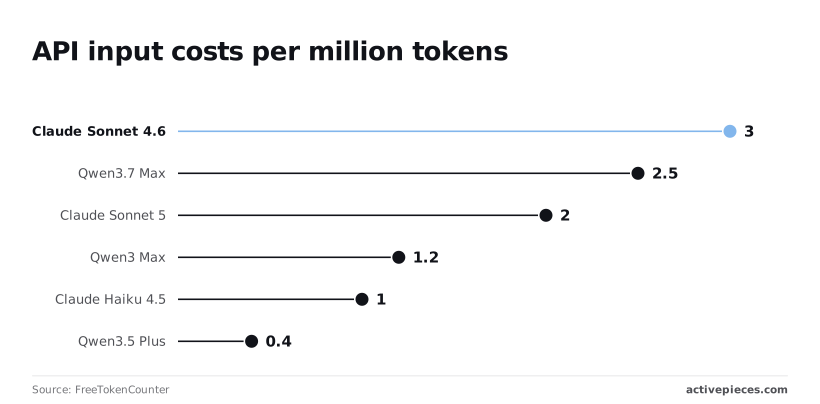
By opting for the lighter model for routine tasks, you can achieve significant savings because FreeTokenCounter’s analysis puts Claude Haiku 4.5 at $1.00 per million tokens, compared to $3.00 for Claude Sonnet 4.6.
At a cost of $0.40, Qwen3.5 Plus is the primary choice if you prioritize volume over complex reasoning, which means you can process large datasets more economically.
The fastest way to settle a shortlist is to try one. Activepieces is free to try, no credit card.
Comparing top AI chatbots on price and performance
The efficiency of these models is best understood by comparing how their flagship interfaces balance accessibility against raw processing power.
| Chatbot | Monthly Price (Pro) | Context Window | Primary Strength | Core Limitation |
|---|---|---|---|---|
| ChatGPT Plus | $20 | 256K | Generalist versatility | Rate limits on GPT-6 Astra |
| Claude Pro | $20 | Up to 1M | Complex reasoning | No native web search engine |
| Perplexity Pro | $20 | 32K | Real-time research | Limited creative writing depth |
Choosing a provider based on these tiers aligns your subscription with the requirements of a professional workflow.
API input costs per million tokens
According to the Anthropic pricing page, you can access basic services for $0, but scaling to enterprise-grade reasoning requires managing costs that fluctuate based on the specific model's intelligence tier.
High-intelligence models like GPT-6 Astra or Claude Opus 5.5 command a premium because, as Docs notes, they require more compute cycles to maintain coherence over long prompts.
Using "Flash" or "Lite" variants reduces the financial burden of large-scale data ingestion.
Balancing model intelligence with operational expense
Maximizing the value of a chatbot subscription requires selecting a tier that matches the complexity of the task to the cost of the seat.
As shown on the Google Gemini subscription page, a standard account is $0 per month, meaning anyone can access the basic service without a financial commitment.
Maximizing the value of a chatbot subscription requires selecting a tier that matches the complexity of the task to the cost of the seat.
The AI Plus tier is $4.99 per month and provides double the usage capacity, allowing power users to work longer without hitting rate limits, so your workflow remains uninterrupted during peak periods.
Mid-range subscriptions like the ChatGPT "Go" plan increase the context window to 54K tokens, as detailed on the OpenAI pricing page.
Starting at $100 per month, high-end plans like Claude Max provide dedicated capacity for your business. Frontier models remain available during peak traffic periods so you can avoid productivity losses from system throttling.
ChatGPT remains the most versatile general-purpose assistant
Because it consolidates reasoning, vision, and native media generation into a single interface, ChatGPT functions as the primary general-purpose standard.
While specialized models like Claude Fable 5.1 target long-horizon agentic work, ChatGPT is the default utility if you require a tool that handles diverse inputs without switching applications.
Performance and multimodal features in GPT-6 Astra
The GPT-6 Astra model is the multimodal backbone. It processes text, audio, and images within a single neural network to reduce latency.
This unified architecture allows GPT-Live 1 to maintain expressive voice conversations. The assistant detects emotional prosody and adjusts its tone in real time.
For visual tasks, GPT-Image-2.5 Sunburst handles generation and localized editing. You can modify specific layers of a graphic via text prompts.
Rising from 358 million in Jan '25 to 1.1 billion in June '26, the ChatGPT Global Monthly Active Users (MAU) Growth bar chart shows its position as the general-purpose standard.
This scale ensures that the ecosystem of third-party GPTs and custom instructions remains the most populated marketplace for pre-configured workflows.
Pricing and usage limits for Plus and Team users
OpenAI segments access based on throughput and administrative control. The Plus tier has a specific message cap for GPT-6 Astra to prioritize power users during peak hours.
The Team tier offers a higher message ceiling and a centralized workspace. You can share custom GPTs across a department without exposing internal prompts to the public training set.
For high-volume automated tasks, you'll often pivot to GPT-6 Luna. This model carries a higher rate limit to prevent workflow interruptions during batch processing.
Use Claude Sonnet 5 for complex analysis
Because it avoids the repetitive linguistic patterns common in other frontier models, Claude Sonnet 5 is the most reliable output for long-form creative writing and complex code architecture.
While generalist bots often default to a predictable "AI voice," this model maintains a consistent tone across thousands of words, which reduces manual stylistic editing.
The 200k context window advantage

The context window, now up to 1M tokens, allows you to upload an entire codebase or a three-hundred-page technical manual into a single session. The model references every specific detail rather than relying on generalized training data.
This large capacity eliminates the need to split documents into smaller chunks, avoiding the loss of cross-references and structural logic.
[Screenshot description: A workflow automation canvas showing a multi-step flow with step 5 "Page Audit" selected and its configuration panel open on the right.
The panel shows a "Text AI (Ask AI)" action with fields for Provider (OpenAI), Model (GPT-4o), and Prompt containing instructions to create an SEO audit of a website, score it 0-100, and provide a 120-word executive summary.]
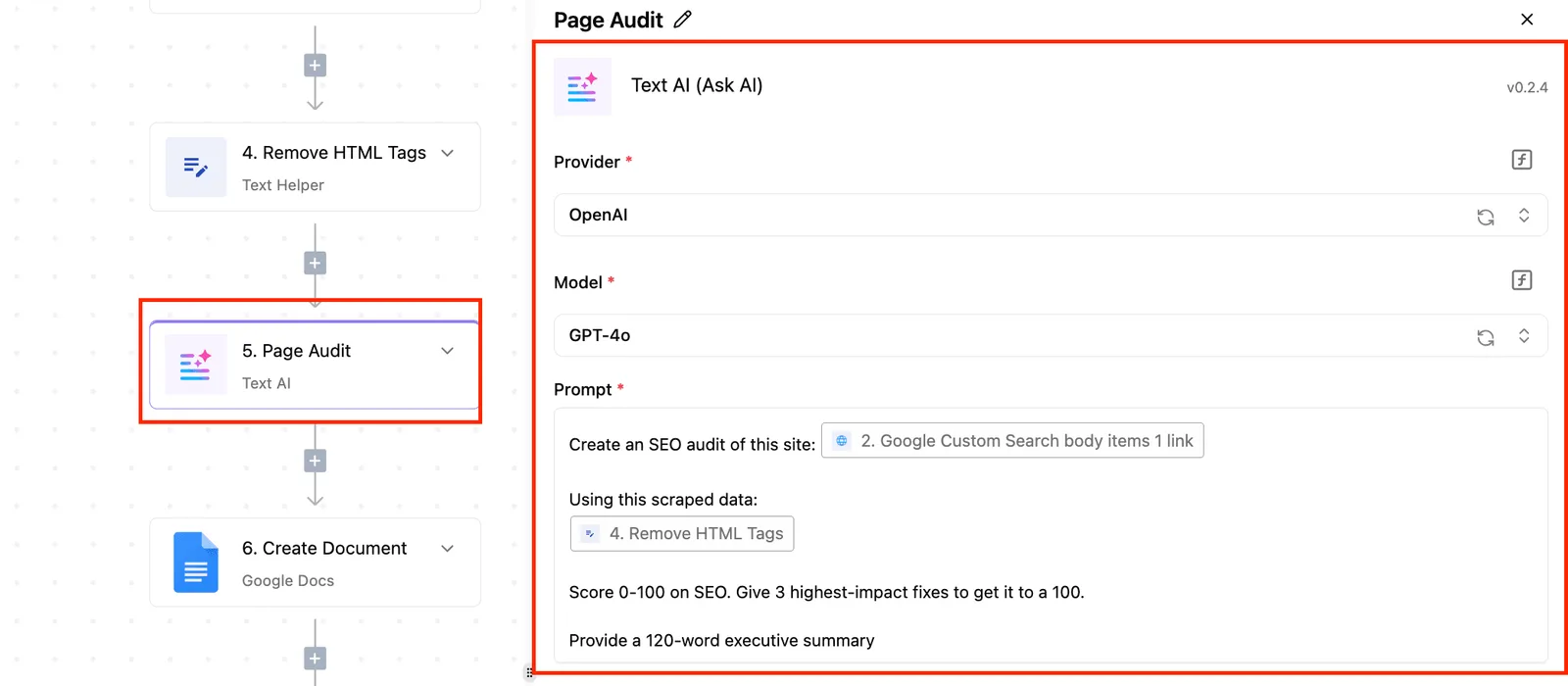
The left side shows the flow steps including "4. Remove HTML Tags" (Text Helper), "5. Page Audit" (Text AI, highlighted with red border), and "6. Create Document" (Google Docs).
This configuration shows the raw text being cleaned before the AI performs a structured audit.
- The model processes only relevant content.
- Once the analysis is complete, the results are automatically formatted into a Google Doc to provide a permanent record for your team.
Artifacts: A new way to collaborate on code and text
The Artifacts UI renders code snippets, websites, and documents in a dedicated side-by-side window. You can view the live output without scrolling through the chat history.
This separation of workspace means you can iterate on a React component while keeping the original requirements visible. By providing a real-time preview of visual elements, the interface allows for immediate feedback on UI changes.
Reading a table only gets you so far. Build the same workflow in Activepieces and compare it yourself.
Perplexity AI replaces traditional search with cited sources
Perplexity functions as a specialized discovery engine that prioritizes verifiable data over generative creativity.
While a general-purpose chatbot might synthesize an answer from its internal weights, this platform executes live queries across the internet to ensure the output reflects current events rather than training data cutoffs.

Pro Search and real-time web indexing
Pro Search is a multi-step reasoning agent that breaks a single user prompt into several distinct search queries. This approach eliminates the "hallucination" risk common in static models because every paragraph is anchored to a specific, reachable webpage.
The interface renders a 'Source Verification' stack for every result to show you exactly where the information originated.
Included in this stack are inline citations for every claim, a 'Sources' carousel of 5+ live URLs, and a 'View Pages' button.
By clicking these citations, you can bypass the AI’s summary and audit the raw documentation directly. This transparency is necessary for professional workflows where factual errors must be avoided.
Choosing between models (Claude vs GPT) within Perplexity
The platform allows you to toggle the underlying reasoning engine, swapping the logic layer while maintaining the same real-time search index.
- Claude Sonnet 5: Used when the search results require a specific tone in the final summary.
- GPT-6 Astra: Selected for complex technical queries that require high-order reasoning.
- deepseek-v4-pro: Employed for high-throughput research tasks where logical consistency is the primary requirement.
Switching models changes how results are parsed, but the underlying 'Source Verification' stack remains consistent.
Microsoft Copilot integrates AI into the enterprise ecosystem
For organizations already operating within the Microsoft 365 environment, Copilot provides the most seamless integration of AI capabilities, which means employees can leverage existing workflows without the friction of adopting external tools.
It functions as a connective layer across Word, Excel, PowerPoint, and Teams, allowing the chatbot to pull context directly from your existing business documents and calendar events.
This native access to the Microsoft Graph means the chatbot understands your organizational hierarchy and project history without manual data uploads. It is the logical choice for teams that prioritize security and administrative control over the experimental features found in standalone tools.

Seamless document generation and data analysis
Copilot excels at transforming raw data into professional assets within the applications you use daily. You can prompt the chatbot to draft a PowerPoint presentation based on a Word document or generate complex Excel formulas to analyze quarterly sales figures.
By operating inside the document canvas, the AI reduces the friction of context switching. It can summarize long email threads in Outlook or draft meeting minutes in Teams, ensuring that AI assistance is a natural extension of the existing workflow rather than a separate destination.
Enterprise security and data residency
Microsoft provides robust data protection policies that appeal to highly regulated industries like finance and healthcare. The chatbot adheres to your company's existing security, compliance, and privacy policies, ensuring that sensitive data remains within the tenant boundary.
Unlike consumer-facing chatbots that may use conversation history for training, Copilot for Microsoft 365 guarantees that your business data is not used to train the underlying foundation models. This commitment to data residency and sovereignty makes it the primary option for risk-averse enterprises.
Activepieces automates business tasks through chat interfaces
Activepieces connects large language models to 735+ integrations so that a plain-language request to the built-in AI chat can construct and publish a runnable automation.
While a standard chatbot can only suggest a response to a customer complaint, this platform allows an agent to verify the order in a payment processor, generate a discount code, and email the customer without manual intervention.
Every other platform searches its templates, but Activepieces writes yours. Describe a custom workflow in plain language (like creating a HubSpot task and Slack message when a Stripe payment fails twice) and the AI chat builds the runnable flow from scratch.
This removes the catalog as the ceiling for what you can automate.
Building custom AI agents with 100+ integrations
By providing pre-built connectors for services like Slack, Google Sheets, and Salesforce, the platform transforms static model outputs into functional workflows.
You drag and drop "integrations" to construct logic chains that trigger based on external events.
When a model like Claude Opus 5.5 identifies a high-priority bug in a support transcript, Activepieces can automatically create a ticket in GitHub and alert the engineering lead.
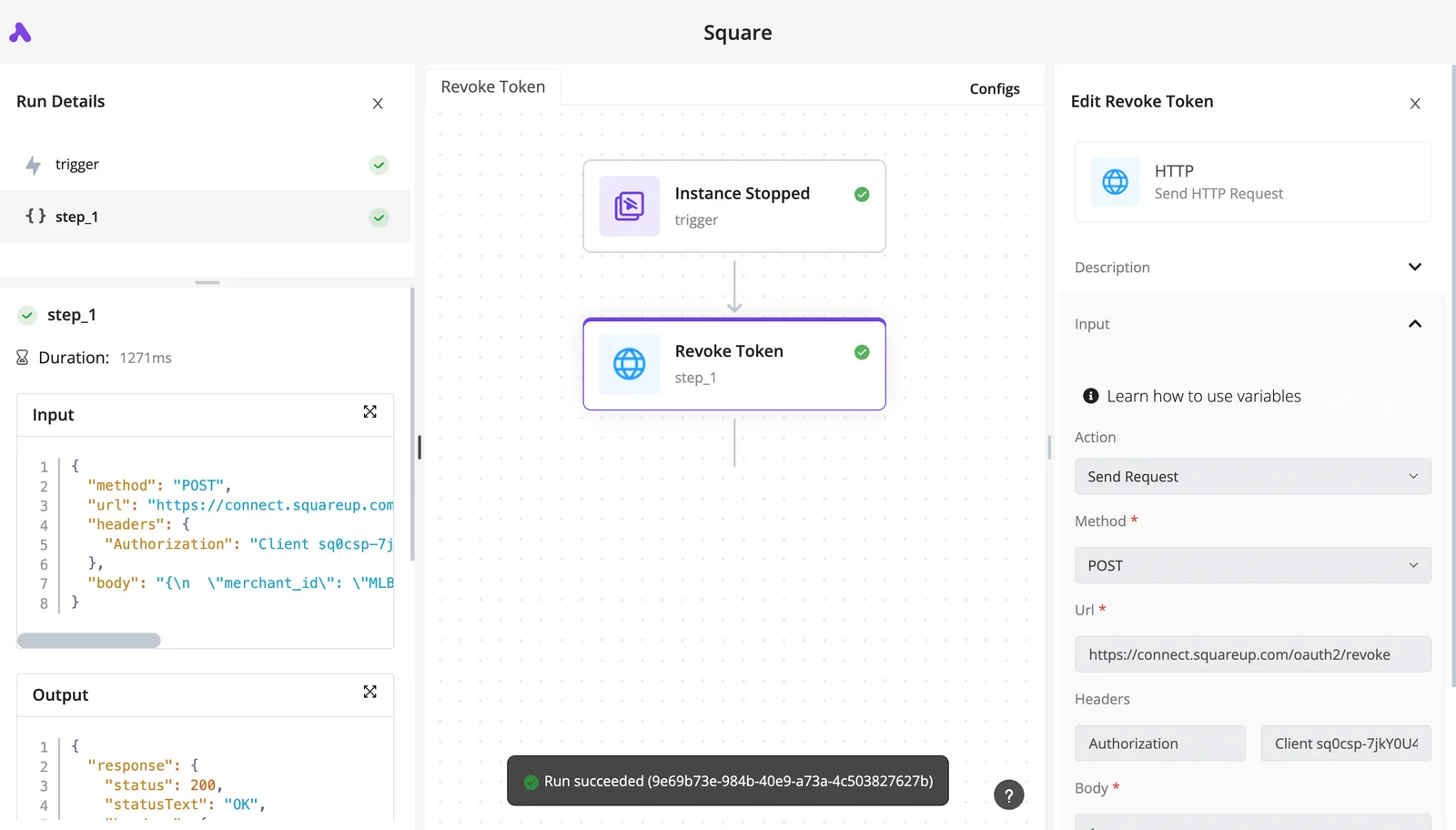
In the successful run details, this specific execution flow is visible. An "Instance Stopped" trigger successfully initiates a "Revoke Token" action via a POST request to Squareup.com.
The moment an integration is connected, it becomes available as a tool for your agents.
Every integration action runs as both a flow step and an MCP tool schema, allowing you to reach your entire automation catalog from Claude, ChatGPT, or Cursor without a second migration.
Self-hosting vs Cloud for data privacy and security
Activepieces is a self-hosted Docker version if you must keep your automation logic and API keys within a private infrastructure.
Cloud-based automation services often require you to store sensitive credentials on third-party servers.
By deploying the platform on-premises, you ensure that the payloads sent between an internal database and a model like GPT-6 Astra never traverse the public internet.
MoneyGram and Moneypenny run Activepieces in production to maintain this level of control. The MIT-licensed core allows for full visibility into the execution layer.
While traditional automation platforms limit users to a static library of pre-configured templates, Activepieces leverages generative AI to build bespoke workflows from plain-language prompts.
Because it constructs runnable flows from scratch rather than simply returning search results, Activepieces is the better choice for teams requiring complex, custom integrations that do not exist in a standard catalog.
Frequently asked questions about AI chatbots
Which AI chatbot is best for coding?
GPT-6 Astra is the most capable model for complex reasoning and architectural code generation. While generalist models handle syntax, this flagship model processes multi-file dependencies. You can refactor an entire repository rather than just a single function.
For specialized formal proof engineering, Leanstral 1.5 is the only model built specifically for the Lean 4 language. Engineers in high-assurance fields can verify mathematical proofs without manual translation.
When the task requires long-horizon agentic work where the AI must execute and test its own code, Claude Opus 5.5 is designed for these autonomous cycles. This reduces the time you spend debugging the model's output.
Can I use these chatbots with my own company data?
Through Retrieval-Augmented Generation (RAG) or dedicated enterprise connectors, you can connect these models to internal data sources.
Gemini Embedding 2 creates multimodal representations of your files. You can search across both text documents and video archives using a single query.
When using a managed service like Google’s Antigravity Agent, the system browses internal UIs to retrieve information. This removes the need to build a custom API for every legacy database.
Data privacy depends on the specific tier. For instance, OpenAI’s Daybreak Blue includes defensive cybersecurity safeguards, so sensitive infrastructure data is processed with higher isolation than on standard consumer plans.
What is the difference between a chatbot and an AI agent?
A chatbot responds to prompts with text or media, whereas an AI agent uses tools to complete multi-step goals without constant human intervention.
Gemini Deep Research Max is a research agent that autonomously navigates the web and cites sources to produce a full report. You receive a finished document instead of a list of links.
Computer Use automates browser tasks by performing screen actions like clicking and typing. This allows it to navigate software that lacks a public API.
While a chatbot like GPT-6 Luna provides fast answers to high-volume questions, an agentic model like Claude Fable 5.1 is what manages the underlying workflow to ensure a task reaches a defined conclusion.
Related reading
References
Still comparing
The fastest way to settle it is to build something.
Open source under MIT, so you can self-host the same thing later.
Start free Talk to sales