
Malwarebytes Pricing and Plans: Costs by Device (2026)

Nov 20, 202614 min read
Malwarebytes sells endpoint security software, meaning protection installed on each laptop, desktop or phone, the sort of thing an IT team might track alongside other routine admin jobs it automates with tools like Activepieces.
The Standard plan's sale price of $29.99 a year is half its $59.99 list price, so the sale figure isn't the one to budget on.
Prices below were read on 2026-11-20 from Malwarebytes's pricing page.
You can price several plans from the pricing page: Standard, Plus and Ultimate. It lists at $59.99 a year and sells at $29.99 a year, covering 3 devices, which is the denominator for any per-device comparison.
At $29.99 for three devices, the sale works out to about $10 per device. At list it's about $20, so the gap between the two is the real exposure for anyone who stops watching the price after checkout.
Malwarebytes Pricing by Plan, Checked November 2026
Malwarebytes free version and device limits
The free version costs nothing, and the download also includes a 14-day trial of the paid product. I haven't confirmed its exact limits here, so read its feature list against Standard's before relying on it for a shared machine.
Go past three devices and the arithmetic changes. Standard is the entry paid plan: three devices for one price, with a one-device option also offered.
A household with four devices pays for a second plan or a higher tier, so the cost per protected device isn't the sale price divided by three once you go past it.
Business and team plans
If you run a team, the bill scales with headcount, because the ThreatDown business tiers are priced per endpoint, and a contractor or spare laptop you forget to count is either unprotected or an add-on.
Nobody needs hiring to watch that endpoint count: describe the job to the built-in chat in Activepieces, meaning which sheet holds the count and who gets warned before renewal, and it builds and publishes the automation, the same flow a builder would have assembled by hand.
It sits under the same RBAC and audit logs as every other flow in the account, human-built or not, and what you get is a live flow whose run trace anyone can read, no certification needed. MoneyGram, Moneypenny, Alan and FundingSocieties run Activepieces in production.
The per-endpoint count is still what you'll be invoiced on. I have no confirmed business figures to show.
If you are running this arithmetic for your own team, see what the same workload costs on Activepieces.
Malwarebytes pricing by device volume
They stack to about $260 a year for 25 devices, roughly $10.40 each, with the single-device tier costing several times that per device, so purchasing single devices becomes economically irrational for cost-conscious customers.
Per device, the 3-device Standard pack costs about $10 in year one on the $29.99 sale price and about $20 at the $59.99 list price, which means the sale cuts per-device costs in half.
Ultimate at 3 devices runs about $46.66 against about $93.33. Whatever the tier, the renewal doubles the per-device cost, so budget on the second number.
Chart
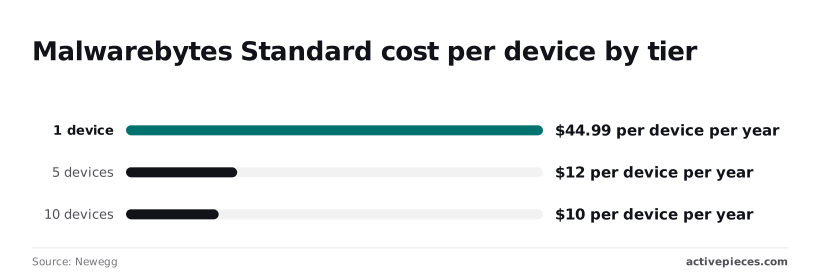
Buy a single device and it costs $44.99 per device per year. That's the worst rate on the ladder.
The buyer with one laptop pays more than four times what a 10-device buyer pays per seat, and it works as a surcharge for not having a second machine to cover.

Step up to five devices and it comes to $12 per device per year, or $60 in total. That's $32.99 less per device than the single tier, and it makes a 5-pack cheaper than buying two single licenses ($89.98).
Once you pass 10 devices, the device cap is what forces the stacking. The largest tier I have a rate for is 10 devices at $10 per device per year, so $100 a pack, and nothing in the rates I have goes past 10.
Two of those plus a 5-pack covers 25 seats for $260, which is my arithmetic, not a listed price. A 25-seat team then manages three separate licenses and renewal dates, and whoever owns that spreadsheet is the hidden cost.

Hidden Costs and Limits Buyers Hit with Malwarebytes
Expect the sticker price to be the smallest number you'll pay. Renewal roughly doubles it, and some protection is missing on Mac.
Malwarebytes lists Standard at 29.99 – 59.99 $ per year, Plus at 39.99 – 79.99 $, and Ultimate at 139.99 – 279.99 $. The low end is the first-year deal and the high end is the renewal, so budget on the high figure or year two arrives as a surprise.
After you have signed, five conditions move the bill. The renewal price jumps after the first year, auto-renewal is switched on by default, each Standard license covers three devices, while the Standard Family plan covers ten., ransomware protection is on Windows only, not Mac, and business pricing needs a sales quote.
viz type=dumbbell title="Malwarebytes first-year price against renewal price" unit="$ per year" source="Malwarebytes - https://malwarebytes.com/pricing" before="First-year sale" after="Renewal list"39.99 to $279.99." Standard: 29.99 -> 59.99 Plus: 39.99 -> 79.99 Ultimate: 139.99 -> 279.99
How Malwarebytes renewal pricing plays out
Come year two, a Standard license you bought at 29.99 $ costs 59.99 $. Because auto-renewal's switched on by default, that charge lands without anyone approving it. Turn it off on day one and diarize the date.
If you're a family of five, or a small team, three devices per license means you need several licenses. Each carries its own renewal date and its own price jump, which is the stacking problem from above.
On a Mac you pay the same tier price for less, because ransomware protection covers Windows only. Any Mac-heavy shop should price the gap before choosing a plan.
Until someone quotes you, you can't compare cost per protected device against competitors, because business pricing has no published rate; it needs a sales quote. So ask for the renewal figure in writing, not just the first-year one.
The Strongest Case That Malwarebytes Is Worth It
Even with the renewal quote in hand, there's a strong argument for buying anyway: the product's detection, its light footprint and its clean interface at a modest entry price. That case is fair, and it deserves to be stated in full.
Put plainly, Malwarebytes catches a high share of the threats it's tested against, rarely flags legitimate software by mistake, and doesn't drag down an ordinary machine.
For an office with older laptops, that last point has a real cost behind it: a heavy security agent slows people down, and slow machines turn into help-desk tickets.
Install it, read the status, leave it alone: the interface is simple enough that a non-technical owner can do all three, which saves the hours a more elaborate console demands. And a low first-year price makes it easy to approve on an invoice.
What antivirus lab ratings miss on pricing
When you read a lab score, it tells you how the product performed against a defined set of samples, on a test machine, during a test window.
It says nothing about what you'll pay in year two, how many devices a licence actually covers or which features are sold separately.
A rating describes the software. It doesn't describe the bill.
So the praise is evidence that Malwarebytes is a good product, and the thesis never disputes that. It disputes whether a good product at a low entry price is still a good price once renewal, device limits and add-ons are counted.
A rating describes the software. It doesn't describe the bill.
The buyer who needs only basic protection on a few machines may well pass that test.
Worth checking against a plan that does not meter every step: one credit covers a whole run on Activepieces.
Malwarebytes Against Bitdefender, Norton and Microsoft Defender
Only for the basic, few-machine buyer does Malwarebytes win against these three; anyone who needs a bundle or a business console should price the renewal first, because the first-year ranking reverses.

Consumer comparison table
For what each rival charges in year one and at renewal, see the table below, per AntivirusShortlist. Take from it that the cheapest sticker isn't the cheapest keeper.
| Product | Entry price (per year) | Renewal price (per year) | Increase |
|---|---|---|---|
| Bitdefender Total | $49.99 | $109.99 | $50.00 |
| Norton 360 Deluxe | $49.99 | $124.99 | $75.00 |
| McAfee Total | $39.99 | $119.99 | $80.00 |
| Microsoft Defender | $0 | $0 | None |
Prices and plan limits checked against malwarebytes.com on November 20, 2026.
In year one McAfee is cheapest, and at renewal Bitdefender is.
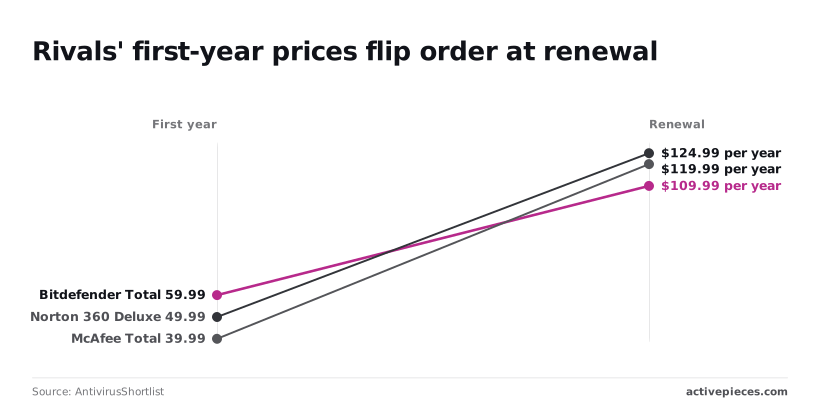
Norton starts second and ends most expensive, so a buyer who ignores renewal pays $15 more a year than the Bitdefender buyer from year two. Cost per device and bundled extras depend on tier, so check each vendor's page before you commit.
Small business comparison
On a business console every seat renews at once, which is where the renewal gap compounds.
A $75 rise on Norton, repeated across ten seats, is a $750 line you didn't quote the client, so this gap either becomes a change order or erodes your margin.
Price the console tier on the vendor's own page, not the consumer bundle, since consumer plans are built for households and give a manager no central view.
Where the free Microsoft option is enough
If you have a single-owner Windows machine where you won't manage anyone else's devices, Microsoft Defender is enough: it costs nothing and ships with Windows.
Against a $109.99 to $124.99 renewal, the free option saves that much per device, every year, which means that decision scales across your infrastructure. Pay for a rival only when you need the extras a bundle adds or a console to manage a team.
Track Malwarebytes Renewals with Activepieces
Don't expect Activepieces, an MIT-licensed automation tool, to make Malwarebytes cheaper. It makes sure you're never surprised by what you already agreed to pay, which is the cheapest saving available once you've decided to stay.
The free plan is $0 with unlimited flows and 1,000 credits a month, and a run costs 1 credit however many steps it has.
Read the flow left to right. It starts from a spreadsheet where you keep one row per license: renewal date, plan, seats purchased, devices in use.
Activepieces reads that sheet on a schedule, checks the renewal date, compares devices in use against the cap, and then posts a Slack message and sends an email to whoever owns IT, with 750 integrations to choose the sheet, chat and mail tools from.
Nothing here talks to Malwarebytes itself.
Renewal and auto-renewal
A set number of days before each renewal, the date check fires, so the IT owner has time to decide, not just to be billed. That window's where renewal pricing gets challenged or a rival gets priced.
If nobody sees the date, the card is charged at the renewal rate, and that rate's the one this article says to buy on.
After the date comes the second check, which compares devices in use against what the plan covers. A row over the cap gets flagged, which means you buy the extra capacity deliberately instead of discovering it when a laptop quietly goes unprotected.
Malwarebytes features locked to higher tiers
Add a column for the tier each license sits on and the feature someone asked for. When a request needs something the current tier lacks, the alert can say so, and you price the upgrade against a rival before approving it.
It can't tell you which tier has what; the tool only surfaces the mismatch, so that column is yours to fill from the vendor's page.
Track add-ons and support as their own rows with their own renewal dates. They often renew on a different cycle from the base license, and they're the lines that slip through unreviewed.
Malwarebytes renewal costs per device
Work out what each protected device will cost you at renewal, not at checkout, and let that number decide whether Malwarebytes stays. The steps below get you there in order, and each one feeds the next.
- Count the devices that need protection. List every laptop, phone, and tablet someone actually uses, and skip the old ones in a drawer. A plan sized for devices that no longer exist is a seat you pay for and nobody benefits from.
- Compute cost per device at renewal. Take the renewal price, add any add-ons you'd need, and divide by the devices from step one. If the plan's device limit is lower than your count, price the second plan too. This is the figure to compare against alternatives, because the checkout price tells you nothing about it.
- Recheck the pricing page and note the date. Open the maker's own pricing page, copy the current renewal terms, and write down the day you looked. Prices move, and a dated note's what you hold up if the invoice disagrees.
- Choose between the free tier, Malwarebytes and an alternative. If the free tier covers the devices that carry real risk, stay there. If your per-device figure from step two beats the alternatives at your device count, renew. If it doesn't, switch.
- Turn off auto-renewal, or set a reminder. Do this the day you buy. A renewal you didn't decide on is the one that quietly bills at the full rate.
Frequently asked questions
Is Malwarebytes free to use?
Yes, in a limited form: the free version scans for and removes threats on demand, but it doesn't run real-time protection.
That means it cleans up after an infection rather than blocking it, so it works as a second opinion, not as the one product guarding a machine you bill a client for.
Check Malwarebytes's own pricing page for what the free tier currently includes before you rely on it.
Can I get a refund on Malwarebytes?
Read the refund policy before you buy, not after the renewal charge posts. Malwarebytes publishes it on its support pages, and the window depends on the product and how you bought it. Keep a copy of it with the date.
A refund of the first purchase doesn't necessarily cover a later auto-renewal, and that's the invoice most likely to catch a small team off guard.
Does Malwarebytes work alongside another antivirus?
Generally yes. Malwarebytes designs its consumer product to run next to other security software, and the free scanner is built for exactly that second-opinion role.
Run two real-time engines on one machine and they can compete for resources, and that is the practical limit. If you're paying for both, you're paying twice per device, so ask whether the second one earns its place on the invoice.
Does Malwarebytes cover Mac, Android and iPhone?
Versions exist for Windows, Mac, Android and iOS, but the features aren't the same on each. The iPhone version, for instance, works within Apple's restrictions and doesn't behave like the Windows product.
Before you count a device as protected, check the feature list for that platform on Malwarebytes's site, because a device with thinner coverage still takes up a slot in your device limit.
How do I cancel Malwarebytes auto-renewal?
Sign in to your Malwarebytes account, open the subscription or billing area, and turn off auto-renewal there. If you bought through a third party such as an app store or a reseller, the cancellation has to be made with that seller instead.
Do it well ahead of the renewal date, and keep the confirmation, since the renewal price's the number this whole comparison turns on.
Related reading
References
Running the numbers
See what the same workload costs here.
Free forever plan, and every paid plan self-hosts at no extra cost.
See pricing Talk to sales