On Premise Workflow Automation License Cost in 2026

Nov 22, 202614 min read
The license fee is the smallest honest number in an on-premise automation purchase, even when the tool is open source like Activepieces and the fee is nominally zero.
The larger costs are the servers you must run, the people who run them, and the features that appear only after a sales call.
You pay for a license or subscription instead of per task, and the software executes on servers you control: that is what on-premise workflow automation means. The prices below carry a check date of 2026-11-22.
On-premise workflow automation license cost: the short answer
The larger costs are the servers you must run, the people who run them, and the features that appear only after a sales call.
Best on-premise automation tools by price visibility
Before you talk to a salesperson, you can settle only as much of your budget as each tool's price visibility allows. Three tools sit on the list below, and where each falls tells you how much that is. Check date: 2026-11-22.
For n8n, the fit is a technical team that wants to host the engine itself. The vendor lists its paid tiers on its pricing page, but features for larger deployments are available only after a conversation with sales.
For Power Automate, the fit is an organization already standardized on Microsoft. Microsoft's cloud runs the flow engine, so only a gateway sits on your side.

For Workato, the fit is a large integration team with a procurement process. Pricing is quote only, so there's no public number to compare.
Verify each status on the vendor's own page before you shortlist, because a "listed" price can change without notice.
What counts as on-premise, and what does not
Ask one question: where does the workflow engine execute, and where is its data stored? If both are on your hardware, the tool is self-hosted.
If a small agent or gateway on your network relays calls to a vendor-run service, the tool is hybrid, and the vendor's cloud is still in your critical path. When that cloud goes down, your automations stop, however local your databases are.
You can install an open-source engine such as n8n on your own servers. Even then, "self-hosted" doesn't tell you which features come with that installation.
Ask for the contract clause or feature matrix that names each one, and don't accept a marketing page as that document.
How we checked on-premise automation prices
I took every price status in this article from the vendor's own pricing or documentation page. I read each one on 2026-11-22. Where a vendor publishes a number, the article treats it as listed.
Where the page says to contact sales, the article treats it as quote only and gives no estimate. I used no third-party review or reseller site as a source for any price.
What follows applies each tool to the same question: what you must host, who operates it, and which capabilities the vendor prices separately.
Everything below works on Activepieces' free plan. Start without code or a credit card.
Comparison table of self-hosted automation license prices
Of the platforms below, n8n and Activepieces are the ones I can confirm run on your own servers. The rest execute in the vendor's cloud and reach into your network through a connector.
Until you know which side of the split holds the engine, "listed price" means little. The table shows that split.
| Tool | Self-host availability | Listed price | Strength | Limit | Best for | Source and date |
|---|---|---|---|---|---|---|
| Zapier | Not confirmed; cloud service | Not confirmed | Wide app catalogue | Execution stays in vendor cloud | Teams with nothing that must stay inside | Vendor pricing page, reviewed 2026-11-22 |
| Make | Not confirmed; cloud service | Not confirmed | Visual scenario builder | No confirmed self-hosted edition | Cloud-only visual workflows | Vendor pricing page, reviewed 2026-11-22 |
| n8n | Yes, under its Sustainable Use License | Not confirmed; some features sit in paid tiers | Engine runs on your hardware | You patch, back up and monitor it | Teams with operations staff | Vendor pricing and license pages, reviewed 2026-11-22 |
| Workato | Cloud engine with an on-premise agent | Quote only | Enterprise governance | Engine is still vendor-run | Enterprises reaching internal systems | Vendor pricing page, reviewed 2026-11-22 |
| Power Automate | Cloud engine with an on-premises data gateway | Not confirmed | Fit with Microsoft 365 | Flows still run in Microsoft's cloud | Microsoft-centred organizations | Vendor pricing page, reviewed 2026-11-22 |
| Activepieces | Yes: MIT-licensed core, free self-hosted Community Edition; self-hosted paid licence quoted by sales | Free $0 (1,000 credits a month); Plus $20 a month; Team $200 a month; Ultimate and Embed (from $36,000 a year) through sales | 750 integrations counted from the open source monorepo, with unlimited flows on every plan | Enterprise directories (packages/ee/) sit under a separate commercial licence | — | Activepieces pricing page, checked 2026-10-23; GitHub repository and LICENSE |
Read the "Limit" column first: it tells you what fails when the vendor's cloud does, and whether your own servers keep running.
Choose n8n if the workflow engine itself must sit inside your boundary and you have staff to run it. Choose Workato if a quote and a vendor-run engine are acceptable.
Choose Power Automate if your estate is already Microsoft. Zapier and Make suit work where no data needs to stay on your side.
When the vendor's service goes down, the flows stop even if your databases sit untouched. A gateway or agent is a bridge from the vendor's cloud to your systems, not an engine you host.
Only a self-hosted engine keeps executing, and then your team owns uptime.
Because the table confirms no price for most rows, it prints none for them. The date shown is the last review of each row. Before buying, open the vendor's own pricing and license pages and ask in writing which features are quote-only.
Self-hosted tools with a published license price
Of the tools here, only n8n and Activepieces let you run the workflow engine on your own servers. In each case the published price covers only part of what you'll pay.
Read the pricing page for what the vendor will state; the quote tells you the rest. Each block below names its source, and you should record the date you read it.
n8n self-hosted pricing
Before you assume your use case is covered, read the license text itself, because the terms limit what you may do commercially. n8n publishes a self-hosted route under its own source-available license, not an OSI-style open-source one.
On strength, n8n offers a mature, widely documented engine. Its limit is that the vendor describes the controls auditors ask about, such as single sign-on and role separation, as paid features. Ask in writing whether it prices them openly or by quote.

Best for teams with an engineer who will own upgrades, backups and the database. Source: n8n's pricing and license pages.
Activepieces self-hosted editions
Alongside its cloud service, Activepieces has a self-hosted edition. The vendor's pricing page ladders from a free tier, through self-serve paid tiers limited by active flows, up to an Enterprise tier sold by contacting sales.

The page also lists SSO, audit logs and custom roles against tiers. Read it as a map of where the quote begins: the controls a compliance reviewer asks about sit toward the top of that ladder, not at the bottom.
Most vendors keep the full control set for their cloud and ship a thinner self-hosted build, but Activepieces doesn't: the list a compliance reviewer asks for (SSO, SCIM, custom RBAC, audit logs, release management, secret managers) is the same in the air-gapped edition as in the managed cloud.
Regulated and public-sector organisations run that air-gapped edition in production, and MoneyGram, Moneypenny, Alan and FundingSocieties run Activepieces as well. The pricing page doesn't say which tier covers a self-hosted install, so get that in writing.

Where n8n's permissive-versus-source-available line matters to you, Activepieces has an MIT-licensed core, 750 integrations counted from its open source monorepo, and roughly 60% of them contributed by the community, so you aren't locked into a vendor's development roadmap.
Best for teams that can run it themselves and will accept a sales conversation for the audit-grade features. Source: Activepieces' pricing page.
Microsoft Power Automate on-premises
You don't get a self-hosted engine with Power Automate. Flows run in Microsoft's cloud, and the on-premises integration is a gateway that lets those cloud flows reach data inside your network.

Even desktop automation, which runs on your machines, is still licensed and managed by Microsoft through the cloud service. So your automation stops when Microsoft's cloud does, even if your database stays up.
Best for organizations already licensed for Microsoft 365 whose requirement is reaching on-premises data, not hosting the engine. Source: Microsoft's Power Automate pricing and documentation pages.
Easier to see it running than to read about it: set it up free, no card.
Quote-only and cloud-only workflow automation pricing
None of the three gives you a number to budget from a pricing page: Workato prices by quote and reaches on-premise systems through an installed agent, while Zapier and Make run only in the vendor's cloud.
Workato on-premise agent
To let cloud-run recipes reach systems that aren't exposed to the internet, you install Workato's on-premise agent inside your network. The license price isn't published, so the quote is where the cost becomes visible.
Expect the quote to take time. Vertice reports negotiation at 11.8 days, the longest stage, so the price is likely to move after the first number. Intake takes 10.3 days, so the clock starts before anyone discusses cost.

Since legal approval takes 9.6 days, contract language on uptime and data handling needs its own review, meaning your timeline extends beyond the legal process if both happen sequentially. Commercial takes 8.3 days, IT/Security 7.1 and Executive 5.8.
Once you have the quote, the steps below make it usable:
- Confirm the on-premise agent can reach your system, because a quote for a connector you can't connect is worthless.
- State your connector count and recipe count, since the vendor will size the price from them.
- Ask which license metric applies, and what happens when you exceed it.
- Get the answers and the price in writing, so the figure can be audited later.
- Note the date on the quote, because an unpublished price has no page to recheck.
Zapier and private systems
When Zapier's cloud is down, your automations are down, and nothing you run can keep them going: Zapier is cloud-hosted and, in the terms this article uses, has no full self-hosted option. Its engine runs on Zapier's infrastructure.
For on-premise systems, the question to put to Zapier is how a private system is reached without being exposed, and the answer must appear in writing. Verify price and plan limits on Zapier's own pricing page, and record the date you checked.
Cloud-hosted, with no full self-hosted option, Make follows the same pattern. The same cross-examination applies.
Ask which control keeps your private system off the public internet, and ask for it in the contract rather than a sales email. Check Make's own pricing page, and note the date.
Costs beyond the license fee
The pricing page never quotes the costs that reorder a shortlist. They are servers, the database, upgrades, staff time, the support tier, and SSO and audit logging that sit behind paid plans.

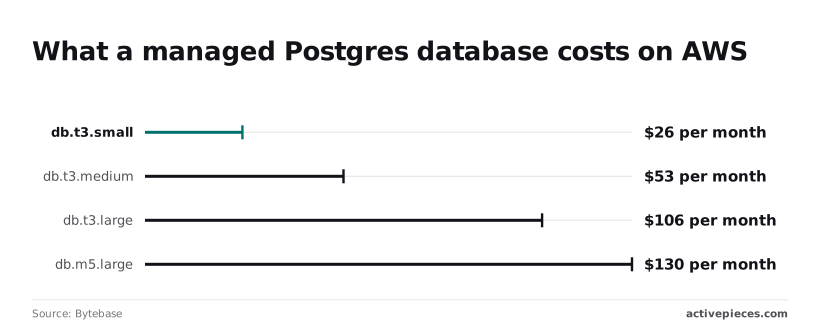
Of all these, the database is the easiest to price. Bytebase's RDS price list puts a db.t3.small at $26 a month, which is $312 a year for a pilot.
A db.t3.medium is $53, a db.t3.large is $106, and a db.m5.large is $130, or $1,560 a year.
The staff who run it will.
In the next chart, that published $15,640 to $25,780 annual range for self-hosted n8n enterprise is split into license, infrastructure and labor.
What to take from it: the vendor sets only one of the three bars, so the other two are your estimate, and the range is wide enough to swallow a license discount.
That puts the real questions on upgrades, support and gated features. Ask each vendor for the clause in writing, not the sales summary.
Questions to put to each vendor:
- Which plan includes SSO and audit logs, and is either one quoted only on request?
- What does the support tier commit to for a self-hosted install, and does the response time apply to your deployment or only to the vendor's cloud?
- Who applies upgrades, and does skipping one void support?
- What breaks when the vendor's cloud is down and yours is not, and what do you owe in that case?
Monday checklist, in order:
- Open each candidate's own pricing page and record the date and the plan that includes SSO and audit.
- Write down who on your team would patch, back up and restore it, and what share of their week that takes.
- Price the database at one of the four instance sizes above and add it to the infrastructure line, and you'll see your full infrastructure cost reflected there.
- Send the four questions to every vendor still standing.
- Drop every tool whose answers rely on "contact sales" for a feature you need, and keep the two with the most complete written answers.
Frequently asked questions
After the checklist, five questions remain open, and each answer below is short because the decision behind it sits in the table and the verification steps above. Treat every answer as a prompt to check the vendor's own page, not as a replacement for it.
Is there a free on-premise workflow automation tool?
Yes, but "free" describes the license fee only. n8n's self-hosted community edition carries no fee. You still pay for the server, the database, backups, upgrades and the person on call.
Ask who is paid to restart it at 3 a.m. If the answer is nobody, the tool costs less than it appears to, and fails more quietly.
Can Zapier or Make be installed on my own servers?
On the vendors' public pricing and product pages, both vendors sell hosted services, and I found no self-hosted edition of either. Make advertises an agent for reaching systems behind a firewall, which is a different thing: the platform still runs in the vendor's cloud.
Before you rely on either answer, ask the vendor in writing whether any component runs inside your network, and which one.
Does self-hosting remove per-task or per-execution fees?
Not by default. Where a vendor meters usage, the meter may follow the license rather than the server, so moving the software onto your hardware doesn't automatically end the charge.
Where the fee does disappear, the cost has moved to your infrastructure and staff. Ask the vendor whether the self-hosted edition is metered, and get the answer in the contract, not in a sales call.
Is open source the same as a commercial business license?
No. A license approved as open source and a "source-available" license are different instruments. Some self-hostable tools publish their code but restrict commercial use, or reserve features such as single sign-on or audit logging for a paid tier.
Read the license text itself, then ask which features in your requirement list are in that tier. Don't accept a summary of the license in place of the license.
How often do vendors change self-hosted pricing?
I have no reliable cadence to give you, and a vendor that quotes one is describing intent, not a commitment.
Plans, feature boundaries and license terms have all shifted in this market. Record the date you read each price, keep a copy of the page, and ask for a price-protection clause in any renewal.